

You can do all the right things — and still feel as though something is slowly coming undone.
I see this pattern repeatedly in clinic.
High-performing clients who, on paper, appear to be doing everything “correctly”: structured routines, thoughtful nutrition, successful careers, full diaries.
They’re not visibly burnt out. They wouldn’t necessarily describe themselves as anxious.
And yet, underneath the surface, there’s a quiet erosion.
Energy dips that don’t fully recover.
Brain fog that creeps in mid-afternoon.
Digestion that becomes unpredictable seemingly overnight.
A gradual unravelling that doesn’t resolve — no matter how disciplined the habits, how clean the diet, or how determined the mindset.
#1. The Hidden Cost of Being ‘Always On’

You wake up already tired, reach for caffeine, and move straight into problem-solving mode. The day is productive, but never restorative.
For many high achievers, slowing down doesn’t feel neutral — it feels like failure. There’s often an unspoken belief that rest must be earned, justified, or postponed.
One client, a project manager and mother of two, put it succinctly:
“I kept thinking I needed to try harder. But the harder I pushed, the worse I felt.”
This isn’t a lack of resilience.
And it certainly isn’t laziness.
It’s physiology.
#2. When High Performers Start to Break Down

It may not register as anxiety in the traditional sense. But you might recognise yourself here:
- Feeling wired yet exhausted most evenings.
- Losing words or forgetting simple things mid-task.
- Becoming irritable without an obvious trigger.
- Experiencing bloating, sluggishness, or a flat mood despite “doing everything right.”
These symptoms are rarely random.
They often reflect a nervous system that’s stuck in high alert — running your body as though it’s under threat, even when life appears objectively stable.
#3. The Nervous System You’ve Been Ignoring
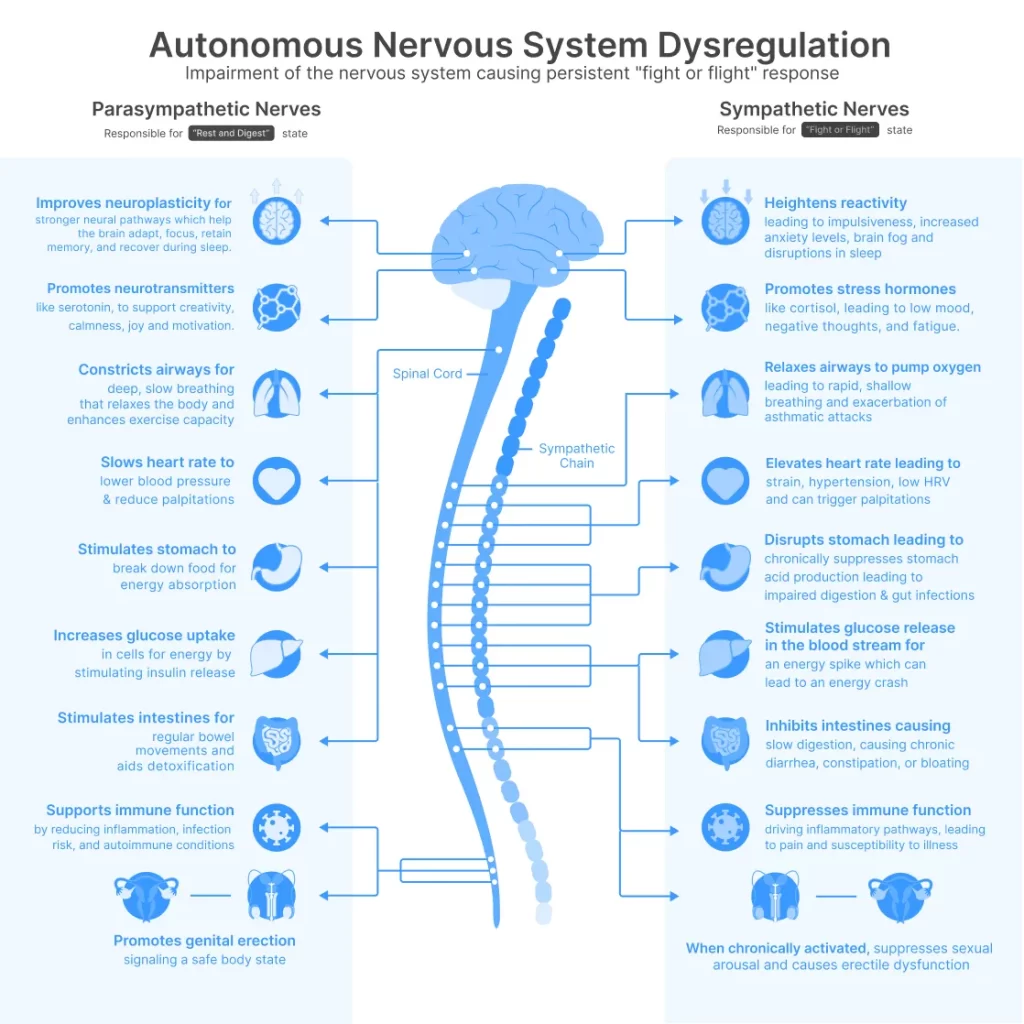
Your autonomic nervous system operates through two primary states:
- Sympathetic — fight, flight, mobilisation
- Parasympathetic — rest, digest, repair
The vagus nerve acts as a kind of biological switchboard between the two. It plays a central role in:
- Heart rate variability (HRV)
- Digestion and gut motility
- Mood regulation
- Inflammation control
- Memory, focus, and emotional resilience
Research consistently shows that vagal tone — essentially how well this nerve functions — is closely tied to recovery capacity.
- Addorisio et al., 2019 demonstrated that targeted vagus nerve stimulation significantly reduced pro-inflammatory cytokines such as IL-6 and TNF-α — two immune messengers that are frequently elevated in autoimmune disease and chronic inflammatory states. When these cytokines remain high, the immune system stays locked in activation mode, driving symptoms like fatigue, pain, gut inflammation, and brain fog.
- Lehrer et al., 2020 showed that HRV is strongly influenced by vagal tone, chronic stress, and inflammatory load.
When vagal tone is low, the body struggles to move out of high-alert mode. Recovery is no longer efficient, and symptoms build gradually — often without an obvious trigger.
#4. What Happens When the System Fails to Reset?

Chronic sympathetic dominance often presents subtly at first:
- Racing thoughts at night.
- Light, restless, or unrefreshing sleep.
- Digestive changes — bloating, constipation, IBS flares.
- Low morning energy and unexplained mood dips.
The research backs this up.
- Camilleri et al., 2022 linked vagal dysfunction directly with IBS and functional gut disorders.
- Sakaki et al., 2016 found higher HRV to be associated with better emotional regulation and lower perceived fatigue.
For many high-functioning individuals, this pattern can persist for years, often masked by productivity and resilience, until the body stops responding to the usual interventions — and symptoms begin to surface more clearly as fatigue, inflammation, or recurring flares.
#5. Why Common Fixes Don’t Work (for Long)

Meditation apps.
Therapy.
Cold exposure.
Adaptogens and carefully curated supplement stacks.
These tools can absolutely help — and I use many of them clinically.
But they are often supportive, not corrective.
If the underlying nervous system pattern doesn’t change, the relief is temporary. Symptoms subside, then resurface.
One woman I worked with described it perfectly:
“I’d feel better for a few weeks, sometimes a month — and then crash again, for no clear reason.”
That cycle isn’t a personal failure. It’s a sign that the underlying regulatory systems — particularly the nervous system — aren’t resetting properly, so symptoms recur even when supportive strategies are in place.
#6. The Breakthrough Researchers Are Exploring Now
Vagus nerve stimulation (VNS) was originally developed for conditions such as epilepsy and treatment-resistant depression, delivered surgically.
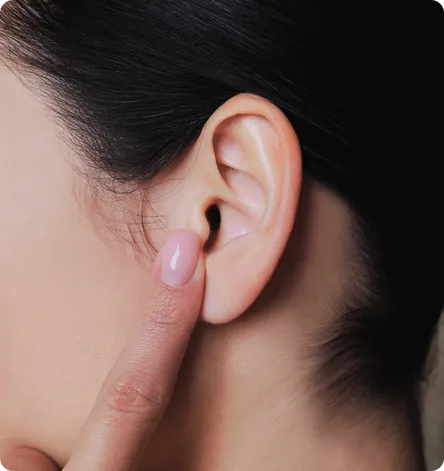
More recently, attention has shifted to a non-invasive approach: transcutaneous auricular vagus nerve stimulation (taVNS), which stimulates the vagus nerve via the ear.
Research from institutions including Harvard, UCLA, and Imperial College London has shown that taVNS:
- Improves HRV, reflecting increased parasympathetic activity
- Enhances memory and cognitive performance in both healthy individuals and clinical populations
- Improves sleep quality and overall wellbeing
A 2024 randomised clinical trial found significant improvements in sleep quality (measured via the Pittsburgh Sleep Quality Index) and quality of life in individuals with insomnia compared to sham stimulation.
Other trials and case studies demonstrate meaningful reductions in anxiety symptoms, including improvements on validated measures such as the GAD-7.
#7. The Skeptic’s Tool That Changed My Perspective

I’m cautious with wellness technology. Novelty alone doesn’t impress me.
But after reviewing the data, I trialled Nurosym, a CE-marked taVNS device, myself.
I initially used it during particularly demanding work periods, when focus and clarity mattered most. The effect wasn’t dramatic or immediate in an obvious way — it was subtler than that. More a sense of mental steadiness, as though the background noise had dialled down.
Over time, what stood out was how much more efficiently I recovered from stress, and how much less reactive I felt under pressure.
That was when I began offering it selectively to clients who were clearly stuck in sympathetic overdrive.
Some reported:
Sleeping through the night for the first time in months
Feeling calmer and more present with family
Reduced bloating and digestive discomfort
According to Nurosym’s data:
- 61% increase in vagal activation within minutes
- 78% reduction in key inflammatory markers
- 45% improvement in mood scores
#8. Who Might Benefit — And Who Shouldn’t Use It

May be helpful for:
- High-stress professionals with “wired-but-tired” energy patterns
- Those whose digestive symptoms flare with stress
- Individuals with disrupted sleep despite strong foundations
Not suitable if you:
- Have a pacemaker or implantable cardiac device
- Are pregnant
- Have had a recent serious cardiac event
- Are under 18
#9. A Safe Way to Explore It

Nurosym currently offers:
- A 30-day money-back guarantee
- Limited study participation slots, with some users eligible for a €70 subsidy in exchange for feedback
If you’re curious, I can guide you on how to integrate this alongside nutrition, breathwork, and somatic practices — rather than viewing it as a standalone fix.
Final Thoughts:
What if brain fog, gut flares, or fading motivation weren’t personal shortcomings, but physiological signals?
Signals that the nervous system needs a different kind of support.
When you stop interpreting these patterns as a willpower issue, it becomes possible to work with your biology rather than against it — and, in many cases, regain a sense of steadiness and clarity.
References:
- Addorisio, M. E., Imperato, G. H., de Vos, A. F., Forti, S., Goldstein, R. S., Pavlov, V. A., van der Poll, T., Yang, H., Diamond, B., Tracey, K. J., & Chavan, S. S. (2019). Investigational treatment of rheumatoid arthritis with a vibrotactile device applied to the external ear. Bioelectronic Medicine, 5, 4. https://doi.org/10.1186/s42234-019-0020-4
- Camilleri, M. (2023). Electrical devices for functional visceral pain. Neurogastroenterology & Motility, 35(3), e14518. https://doi.org/10.1111/nmo.14518
- Kong, J., Fang, J., Park, J., Li, S., & Rong, P. (2018). Treating depression with transcutaneous auricular vagus nerve stimulation: State of the art and future perspectives. Frontiers in Psychiatry, 9, 20. https://doi.org/10.3389/fpsyt.2018.00020
- Lehrer, P., Kaur, K., Sharma, A., Shah, K., Huseby, R., Bhavsar, J., Sgobba, P., & Zhang, Y. (2020). Heart rate variability biofeedback improves emotional and physical health and performance: A systematic review and meta-analysis. Applied Psychophysiology and Biofeedback, 45(3), 109–129. https://doi.org/10.1007/s10484-020-09466-z
- Redgrave, J., Day, D., Leung, H., Laud, P. J., Ali, A., Lindert, R., & Majid, A. (2018). Safety and tolerability of transcutaneous vagus nerve stimulation in humans; A systematic review. Brain Stimulation, 11(6), 1225–1238. https://doi.org/10.1016/j.brs.2018.08.010
- Stavrakis, S., Elkholey, K., Morris, L., Niewiadomska, M., Asad, Z. U. A., Humphrey, M. B., et al. (2022). Neuromodulation of inflammation to treat heart failure with preserved ejection fraction: A pilot randomized clinical trial. Journal of the American Heart Association, 11(3), e023582. https://doi.org/10.1161/JAHA.121.023582
- Parasym Health. (2021). Vagus nerve stimulation devices: Ultimate health guide. Parasym. https://www.parasym.co/parasym-device-transcutaneous-vagus-nerve-stimulation.html
The article does not in any way constitute as medical advice. Please seek consultation with a licensed medical professional before starting any treatment. This website may receive commissions from the links or products mentioned in this article.
Share via:



 French
  English
  German
  Spanish