
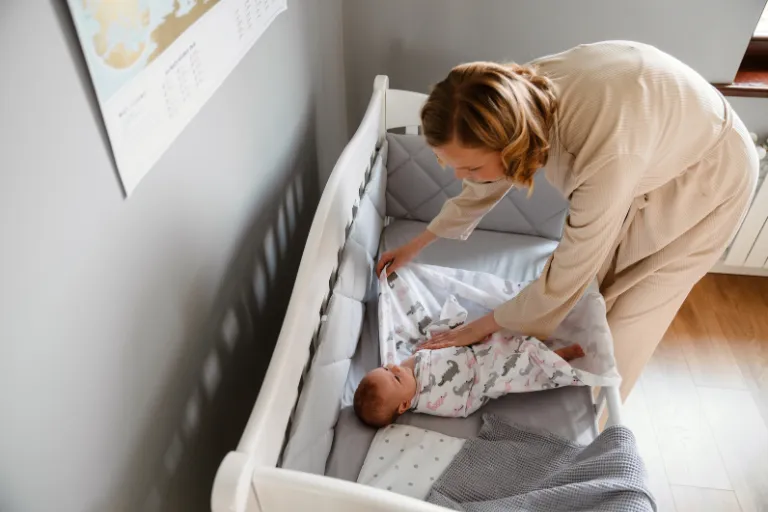
Wichtige Punkte
- Learning how to swaddle a baby can help soothe newborns, improve sleep quality, and reduce startle reflexes—but only if done safely.
- Risks include overheating, hip development concerns, and suffocation if the baby rolls over or the wrap loosens.
- Verwenden Sie sichere Wickeltechniken, die die Arme fest umschließen, während Hüften und Beine sich frei bewegen können.
- Wissen Sie, wann Sie mit dem Wickeln aufhören sollten – in der Regel zwischen 2 und 4 Monaten – und wechseln Sie zu einem Schlafsack.
What Is Swaddling and Why Does It Matters for Newborn Sleep
There’s a certain magic in the moment a newborn stops crying. One second, tiny arms flail like they’re signalling for air traffic control; the next, they’re wrapped in a soft cocoon, eyes heavy, breaths even. That’s the power of swaddling—an age-old baby-calming technique that has survived centuries, countless parenting trends, and many debates in parenting circles.
Knowing how to swaddle a baby safely can transform bedtime into a calmer, more predictable routine. Part security blanket, part sleep strategy, swaddling can turn a midnight meltdown into a peaceful slumber. But doing it correctly is just as important as doing it at all. The perfect swaddle is equal parts comfort and safety—a snug little burrito that soothes without overheating, cradles without constricting, and lulls without risk.
Whether you’re a first-time parent nervously folding your hospital blanket into a triangle or a grandparent brushing up on the “new” rules (yes, they’ve changed since the 80s), mastering safe swaddling techniques is about blending tradition with modern safety science.
Warum das Wickeln für Babys und Eltern wichtig ist
The first few weeks with a newborn can feel like living in a time warp. Days and nights blur together, and you quickly realise that a good stretch of baby sleep is the holy grail of early parenthood. This is where swaddling a newborn at night can make a big difference—not just for your baby’s comfort, but for your sanity.
Swaddling isn’t just about warmth—it mimics the snug, secure feeling of the womb, helping calm newborns who are adjusting to a world that’s much bigger, brighter, and noisier than the one they knew for nine months. By keeping flailing arms from startling them awake (thanks to the Moro reflex), swaddling can help babies drift into deeper, more restful sleep—benefits confirmed in both full-term and preterm infants.
The benefits extend to the entire household. A calmer, well-rested baby means parents can grab a few more precious minutes of sleep. Incorrect swaddling, however, can cause overheating, hip issues, or breathing hazards. That’s why the AAP swaddling guidelines stress pairing swaddling with safe sleep practices—always placing babies on their backs.
Wissenschaftlich belegte Vorteile und Risiken des Wickelns
Multiple studies highlight both the benefits and the risks of swaddling.
Vorteile:
- Reduces spontaneous awakenings.
- Lessens the startle reflex.
- Promotes longer stretches of quiet sleep.
- Helps premature babies maintain motor control and physiological stability, sometimes outperforming massage in soothing effectiveness.
Risks (when done incorrectly):
- Continuing to swaddle when a baby starts rolling increases suffocation risk.
- Tight wrapping around the hips can lead to developmental dysplasia.
- Overheating from heavy fabrics or multiple layers increases unsafe sleep risks.
Sichere Wickelrichtlinien, die alle Eltern befolgen sollten
Die Sicherheit beim Wickeln von Neugeborenen beginnt mit einigen wichtigen Regeln:
- Always place your baby on their back for every sleep, swaddled or not.
- Use hip-healthy swaddling—allow hips and knees to move freely.
- Avoid overheating by using a single lightweight, breathable blanket and ensuring you can fit two to three fingers between the wrap and your baby’s chest.
- Know when to stop swaddling—usually between 2–4 months or at the first sign of rolling.
Wie man ein Baby wickelt: Schritt-für-Schritt-Anleitung
This swaddling step-by-step method follows pediatric and orthopaedic recommendations:
- Breiten Sie eine Decke in Rautenform aus und falten Sie die obere Ecke nach unten.
- Place the baby face-up, with the shoulders just below the folded edge.
- Strecken Sie einen Arm aus und legen Sie ihn über die Brust, wobei Sie die Decke unter der gegenüberliegenden Seite feststecken.
- Falten Sie die Unterkante nach oben und stecken Sie sie vorsichtig unter das Kinn.
- Den anderen Arm umwickeln und fixieren, dabei die Hüften locker halten, um eine gesunde Bewegung zu gewährleisten.
Warum die richtige Wickeltechnik so wichtig ist
A swaddle is more than just a blanket wrap—it’s a newborn care tool that affects sleep quality, comfort, and physical development.
Done right, it offers gentle, womb-like pressure that calms the nervous system and minimises reflex-driven wake-ups.
Incorrect technique:
- Loose swaddles may unravel, creating a suffocation hazard.
- Tight wrapping around the hips increases the risk of hip dysplasia.
- Heavy fabrics can cause dangerous overheating.
The perfect swaddle strikes a balance—snug for security, flexible for movement and breathing.
Praktische nächste Schritte für sicheres Wickeln
The best way to master safe swaddling techniques is to practice while your baby is awake and supervised. This lets you refine your method without the pressure of nighttime fussiness. Watch for signs it’s time to stop—rolling, kicking out of the wrap, or resisting confinement—and switch to a sleep sack for continued comfort and safety. If needed, combine swaddling with other soothing strategies like gentle shushing, rocking, or side-holding.
Fazit: Das Erlernen des sicheren Wickelns eines Babys verbindet altbewährten Komfort mit moderner Sicherheitswissenschaft. Richtig angewendet, ist es eine einfache Gewohnheit, die Ihrem Baby – und Ihnen – einen besseren Schlaf bescheren kann.
Dieser Blogbeitrag soll informativ sein und sollte keine professionelle Gesundheitsberatung ersetzen. Konsultieren Sie immer einen Arzt, um eine individuelle Beratung zu erhalten.
Quellen
- Dixley A, Ball HL. The effect of swaddling on infant sleep and arousal: A systematic review and narrative synthesis. Frontiers in Pediatrics [Internet]. 2022;10(1):1000180. Available from: https://pubmed.ncbi.nlm.nih.gov/36533224/
- Ullah S, Rehman A, Qazi U, Abdullah A, Zahir Shah A, Jalil Khan A, et al. Knowledge of Safe Swaddling Practices among Mothers of Neonates Visiting a Tertiary-Care Hospital in a Developing Country. Journal of Gandhara Medical and Dental Science. 2023 Apr 1;10(2):71–4.
- Sangadji I, Khatibi A, Shari NB, S JT, Windiyaningsih C. Midline Swaddling and Traditional swaddling Position and Their Influence on Physical and Autonomic sign on Newborn Babies. Japanese Journal of Medical Research. 2023 Dec 31;1(2).
- Ghosh S. Effectiveness of Nesting and Swaddling on Sleep and Selected Physiological Parameters among Hospitalized Low Birth Weight Neonates in Selected Hospitals in West Bengal. International Journal of Science and Research (IJSR). 2023 Oct 5;12(10):557–62.
- Obladen M. Swinging and Rocking: Two Millennia of Debating the Cradle. Neonatology. 2021;118(2):198–205.


 German
  English
  French
  Spanish
  Swedish
  Italian
Feels very well-researched but still easy to understand