
The Truth About Managing Irritable Gut & SIBO (And Why Standard Advice Is Falling Short)
Reviewed by Dr. Saloni Kabra, BHMS
If your stomach is constantly bloating, yet eating a simple meal feels like playing Russian roulette with your digestion, you already know how exhausting it is when your gut-brain axis is out of balance.

But if you’re tired of being told to “just avoid trigger foods” or “manage your stress,” this article offers an evidence-informed perspective.
Conventional Gut Strategies - Do They Work?
If you’ve been battling irritable gut and SIBO for years, you’ve probably tried it all. The cycle usually looks like this:
- Elimination Diets: Carefully tracking fermentable carbohydrates (FODMAPs), which can sometimes lead to overly restrictive eating patterns and food-related anxious thoughts.
- Probiotics and Supplements: Investing in herbal antimicrobials and probiotics that may provide temporary symptom relief for some individuals.
- Social Avoidance: Isolating yourself and constantly “bathroom mapping” everywhere you go to manage the unpredictability.
- Pharmacological Options: Using antibiotics, prokinetics, or antispasmodics, which can be effective but may carry adverse events or risk of recurrence in some cases.
- Psychological Therapies: Engaging in cognitive-behavioural therapy or mindfulness-based interventions to help manage stress and improve gut–brain axis regulation.
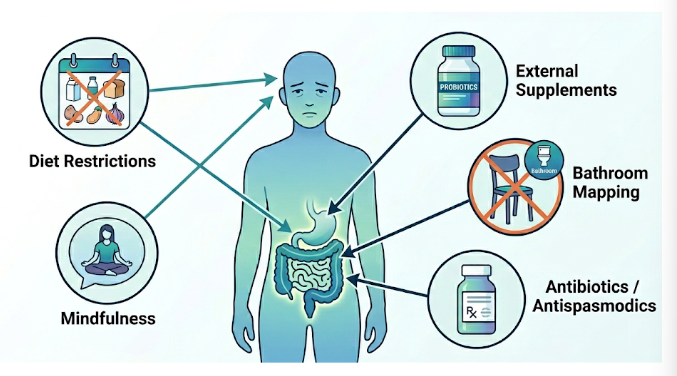
It’s a frustrating loop: you try a new protocol, feel a brief spark of hope, and then crash when another flare-up hits out of nowhere. It’s not your fault. These conventional approaches may fall short because they primarily address symptoms rather than underlying neurogastroenterological and regulatory mechanisms.
Emerging research suggests that autonomic nervous system dysregulation may contribute to digestive dysfunction and symptom severity.
When your nervous system is chronically stuck in an exaggerated “fight-or-flight” mode, your body halts digestion, increases visceral pain sensitivity, and leaves your gut inflamed and sluggish. Relying solely on supplements, strict dietary tracking, or relaxation techniques may not fully address underlying autonomic imbalances. To find real digestive stability, you need an approach that directly supports and regulates your autonomic balance.
That’s where vagus nerve stimulation comes in.
¿Qué es la estimulación del nervio vago (y por qué funciona)?
Your vagus nerve is the main communication highway between your brain and your digestive tract. It plays a crucial role in regulating gut motility, digestive secretions, immune responses, and the body’s ability to shift into “rest-and-digest” mode.
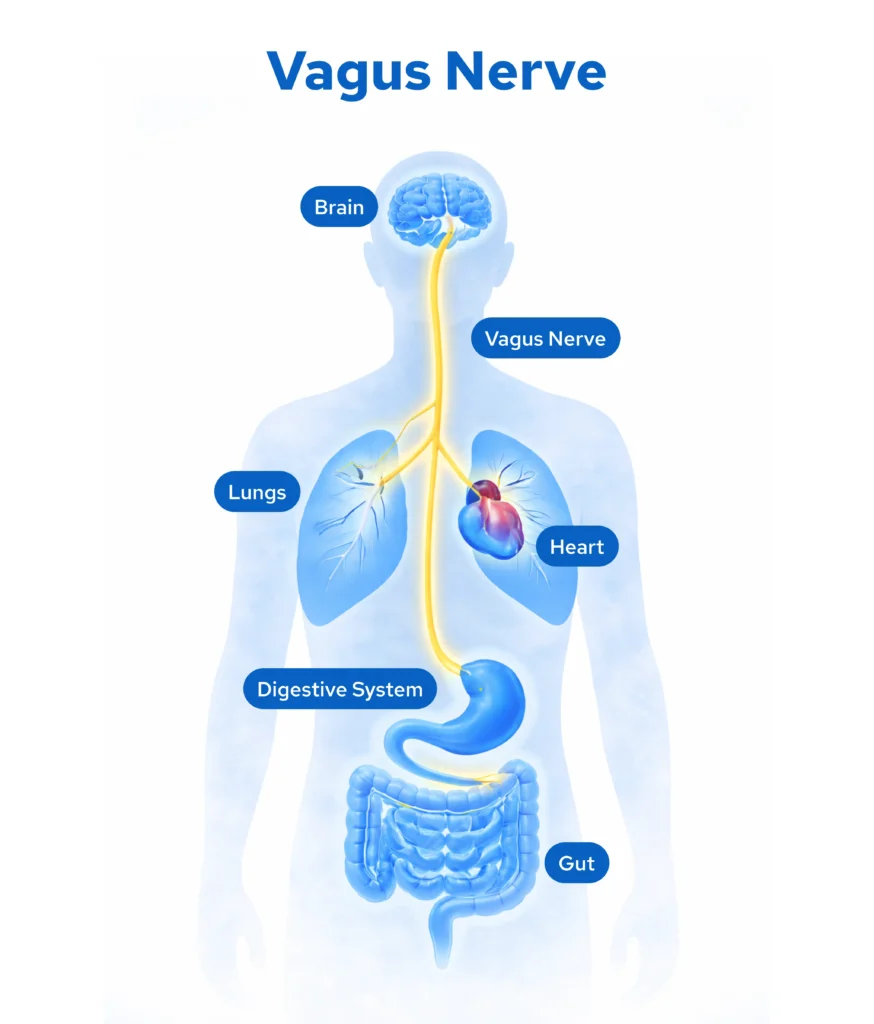
When your vagus nerve isn’t functioning optimally (often referred to as low “vagal tone”), your body gets stuck in an exaggerated stress mode.
- Your digestive motility slows, creating a stagnant environment that promotes bacterial overgrowth (SIBO).
- Your migrating motor complex (MMC), often described as the gut’s self-cleaning wave, may fail to sweep away bacteria and debris between meals.
- Increased intestinal permeability, sometimes referred to as “leaky gut”, may contribute to inflammation and food sensitivities.
- Your nervous system amplifies normal digestive sensations into severe abdominal pain (visceral hypersensitivity).
Vagus nerve stimulation (VNS) uses gentle electrical pulses to activate this nerve, potentially supporting autonomic regulation and physiological balance. It is sometimes compared to resetting a dysregulated system.
A New, Non-Invasive Approach to Autonomic Balance
For decades, the options for managing irritable gut and SIBO symptoms were mostly limited to highly restrictive diets, temporary probiotics, or heavy prescription antibiotics. But in recent years, researchers have turned their attention to the vagus nerve to target autonomic dysregulation and digestive stagnation at their source.
This has led to growing interest in non-invasive vagus nerve stimulation (tVNS) as a potential approach to supporting gut-brain health. Now available through innovative, ear-worn devices, tVNS represents an emerging approach to supporting digestive and autonomic function. These devices use small, comfortable electrodes to deliver mild stimulation to the vagus nerve branch located in your ear. You can use it at home, while reading, working, or simply resting.
While individual responses vary, preliminary evidence suggests that this non-invasive approach may:
- Help support healthy gut motility and migrating motor complex (MMC)
- Reduce the severity of bloating, gas, and daily abdominal discomfort
- Support inflammatory regulation and intestinal barrier function
- Support gut–brain axis regulation and overall digestive well-being
Scientific Validation & Safety Profile
VNS is a well-researched technology studied across a range of autonomic, inflammatory, and neurological symptoms. It has been evaluated in university and hospital research settings, including institutions like Yale, Stanford, UCLA, and Imperial College London, with highly encouraging safety and tolerability profiles.
Research shows that VNS increases heart rate variability (HRV), a key marker of autonomic nervous system function.
Importantly for those sensitive to new therapies, VNS is:
- Non-pharmaceutical: No chemical dependency, no drug-induced sluggishness, and no stomach issues.
- No invasiva: Worn externally on the ear, requiring no surgery or implants.
- Generalmente bien tolerado: Most users report a gentle, calming tingling sensation during a session.
Descubre Nurosym: el camino natural hacia el equilibrio autonómico

Nurosym ofrece un enfoque sin medicamentos y respaldado por investigaciones científicas para ayudar a restaurar la energía y la estabilidad mediante la estimulación auricular del nervio vago.
Por qué funciona Nurosym:
Evidence shows that targeted nerve stimulation can lower stress hormone levels, restore balance to your nervous system, and improve sleep quality. Early studies in high-stress and neurodivergent groups also show encouraging improvements in focus and emotional control, with larger scientific studies currently underway.

Restablecimiento instantáneo del sistema nervioso autónomo
Comienza a recuperar el equilibrio en cuestión de minutos desde el primer uso.

Scientifically studied
Más de 50 estudios investigan el equilibrio autonómico, la VFC, el sueño y la fatiga.

Natural y seguro
No invasivo y sin interacciones medicamentosas.
Nurosym es un dispositivo con marcado CE en la Unión Europea y se utiliza en estudios realizados en Estados Unidos bajo la clasificación de “riesgo no significativo” de la FDA.
Respaldado por destacados especialistas en recuperación y sistema nervioso autónomo

Anthony Kaveh, MD
Anestesiólogo y Director médico en Clarus Health
"Quería saber si podemos ayudar a nuestros pacientes a tener un alivio aún más sostenido de un sistema nervioso simpático fuera de control. Me complace decir que hasta ahora la respuesta ha sido sí."
Dr Myro Figura
Anestesiólogo y Oficial Médico Jefe en HealFast
"(Nurosym) aumenta el lado de reposo y digestión de su sistema nervioso hasta en un 61% en cinco minutos y es un potente alivio para los estados ansiosos."

Dr James Gill
Profesor Asociado en la Escuela de Medicina y Médico General de Warwick
"Encontré (publicaciones) sin conflicto de intereses declarado por la Universidad de Leeds. Demostraron una actividad reducida del nervio simpático. Personalmente, (con Nurosym) mi HRV aumentó de 40 a 69".

Dr Mikolaj Raszek
Investigador en Merogenomics
"Según las evidencias que están saliendo a la luz, parece que estos dispositivos... parecen estar ayudando mucho en términos de fatiga post-viral."

Ashley Ridout
Osteópata y Educador
"Probé esto en dos pacientes: un hombre de 45 años con dolor crónico en el cuello reportó un sueño mejor y más profundo... Una mujer de 30 años con dolores de cabeza notó un mejor sueño y menos dolor."

Bryan Johnson
Fundador de Braintree, Proyecto Blueprint
"HRV es un biomarcador bastante significativo para la salud. Tiene una clara asociación con la edad... el entrenamiento con HRV me mantiene discreto, tranquilo y calmado."
Resultados reales de personas reales
Desde las alteraciones posturales de la frecuencia cardíaca hasta tener menos días difíciles; basta con dejar de usarlo un día para notar la diferencia.
– Usuario de Nurosym
“Después de la disautonomía posviral, por fin encontré una manera de salir del agotamiento.”
– Sarit
“Los altibajos constantes se transformaron en días más estables. La mejoría fue inmediata.”
– Testimonio de una persona con alteraciones posturales de la frecuencia cardíaca
Conozca a los profesionales de la salud
Médico psiquiatra en ejercicio, Elisabetta tiene un MBA de la Escuela de Negocios INSEAD y experiencia en atención directa al paciente, investigación en neurociencia, comunicación y gestión. La Dra. Burchi es una médico-científica, trabajando con Parasym en asuntos clínicos con un historial de publicaciones en las revistas científicas más importantes como The Lancet, escribiendo propuestas de subvención exitosas para el NIH, y liderando la producción de material editorial, clínico, regulatorio y promocional en equipos multidisciplinarios colaborativos. La Dra. Burchi también ha coordinado ensayos clínicos e implementado una práctica de telemedicina que recibió una certificación de excelencia entre más de 100,000 profesionales.

Dr. Elisabetta Burchi, MD, MBA
Líder de investigación traslacional en Parasym
Take Control of Your Digestion Naturally

Únete a miles de personas que están recuperando su estabilidad y energía.
Participate in the Gut-Brain Health research program, and save €70 on your Nurosym device.
*La evaluación para participar en el estudio toma menos de 3 minutos.
50+
Estudios citados
4M+
Sesiones completadas con éxito
30
Días de devolución de dinero

Dispositivo médico certificado
Únete a miles de personas que están recuperando su estabilidad y energía.
Participa en el programa de investigación sobre alteraciones posturales de la frecuencia cardíaca y ahorra 70 € en tu dispositivo Nurosym.
*La evaluación para participar en el estudio toma menos de 3 minutos.
50+
Estudios citados
4M+
Sesiones completadas con éxito
30
Días de devolución de dinero

Dispositivo médico certificado
Garantía de devolución del dinero de 30 días
Cada kit Nurosym está respaldado por una política de 30 días de reembolso completo si los usuarios no están satisfechos con su progreso.
REFERENCIAS:
- Chakraborty, P., Farhat, K., Morris, L., Whyte, S., Yu, X., & Stavrakis, S. (2023). Non-invasive vagus nerve stimulation in postural orthostatic tachycardia syndrome. Arrhythmia & Electrophysiology Review, 12, e31. https://doi.org/10.15420/aer.2023.20
- Diedrich, A., Urechie, V., Shiffer, D., Rigo, S., Minonzio, M., Cairo, B., Smith, E. C., Okamoto, L. E., Barbic, F., Bisoglio, A., Porta, A., Biaggioni, I., & Furlan, R. (2021). Transdermal auricular vagus stimulation for the treatment of postural tachycardia syndrome. Autonomic Neuroscience, 236, 102886. https://doi.org/10.1016/j.autneu.2021.102886
- Geng, D., Liu, X., Wang, Y., & Wang, J. (2022). The effect of transcutaneous auricular vagus nerve stimulation on HRV in healthy young people. PLOS ONE, 17(2), e0263833. https://doi.org/10.1371/journal.pone.0263833
- Kim, A. Y., Marduy, A., de Melo, P. S., Gianlorenço, A. C., Kim, C. K., Choi, H., Song, J.-J., & Fregni, F. (2022). Safety of transcutaneous auricular vagus nerve stimulation (taVNS): A systematic review and meta-analysis. Scientific Reports, 12, 22055. https://doi.org/10.1038/s41598-022-25864-1
- Stavrakis, S., Chakraborty, P., Farhat, K., Whyte, S., Morris, L., Asad, Z. U. A., Karfonta, B., Anjum, J., Matlock, H. G., Cai, X., & Yu, X. (2024). Noninvasive vagus nerve stimulation in postural tachycardia syndrome: A randomized clinical trial. JACC: Clinical Electrophysiology, 10(2), 346–355. https://doi.org/10.1016/j.jacep.2023.10.015
- Zheng, Z. S., Simonian, N., Wang, J., & Rosario, E. R. (2024). Transcutaneous vagus nerve stimulation improves Long COVID symptoms in a female cohort: A pilot study. Frontiers in Neurology, 15, 1393371. https://doi.org/10.3389/fneur.2024.1393371
El artículo no constituye en modo alguno un consejo médico. Consulte con un profesional médico autorizado antes de iniciar cualquier tratamiento. Este sitio web puede recibir comisiones por los enlaces o productos mencionados en este artículo.
Reviewed by Dr. Saloni Kabra, BHMS


 Spanish
 English
 German
 French
 Swedish
 Italian