
The Truth About Managing Irritable Gut & SIBO (And Why Standard Advice Is Falling Short)
Reviewed by Dr. Saloni Kabra, BHMS
If your stomach is constantly bloating, yet eating a simple meal feels like playing Russian roulette with your digestion, you already know how exhausting it is when your gut-brain axis is out of balance.

But if you’re tired of being told to “just avoid trigger foods” or “manage your stress,” this article offers an evidence-informed perspective.
Conventional Gut Strategies - Do They Work?
If you’ve been battling irritable gut and SIBO for years, you’ve probably tried it all. The cycle usually looks like this:
- Elimination Diets: Carefully tracking fermentable carbohydrates (FODMAPs), which can sometimes lead to overly restrictive eating patterns and food-related anxious thoughts.
- Probiotics and Supplements: Investing in herbal antimicrobials and probiotics that may provide temporary symptom relief for some individuals.
- Social Avoidance: Isolating yourself and constantly “bathroom mapping” everywhere you go to manage the unpredictability.
- Pharmacological Options: Using antibiotics, prokinetics, or antispasmodics, which can be effective but may carry adverse events or risk of recurrence in some cases.
- Psychological Therapies: Engaging in cognitive-behavioural therapy or mindfulness-based interventions to help manage stress and improve gut–brain axis regulation.
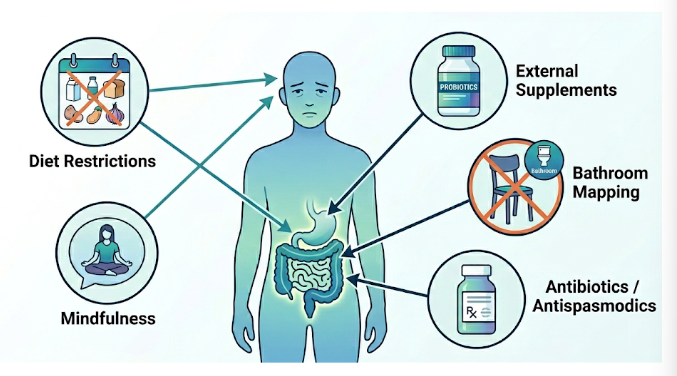
It’s a frustrating loop: you try a new protocol, feel a brief spark of hope, and then crash when another flare-up hits out of nowhere. It’s not your fault. These conventional approaches may fall short because they primarily address symptoms rather than underlying neurogastroenterological and regulatory mechanisms.
Emerging research suggests that autonomic nervous system dysregulation may contribute to digestive dysfunction and symptom severity.
When your nervous system is chronically stuck in an exaggerated “fight-or-flight” mode, your body halts digestion, increases visceral pain sensitivity, and leaves your gut inflamed and sluggish. Relying solely on supplements, strict dietary tracking, or relaxation techniques may not fully address underlying autonomic imbalances. To find real digestive stability, you need an approach that directly supports and regulates your autonomic balance.
That’s where vagus nerve stimulation comes in.
What is Vagus Nerve Stimulation (And Why Does It Work)?
Your vagus nerve is the main communication highway between your brain and your digestive tract. It plays a crucial role in regulating gut motility, digestive secretions, immune responses, and the body’s ability to shift into “rest-and-digest” mode.
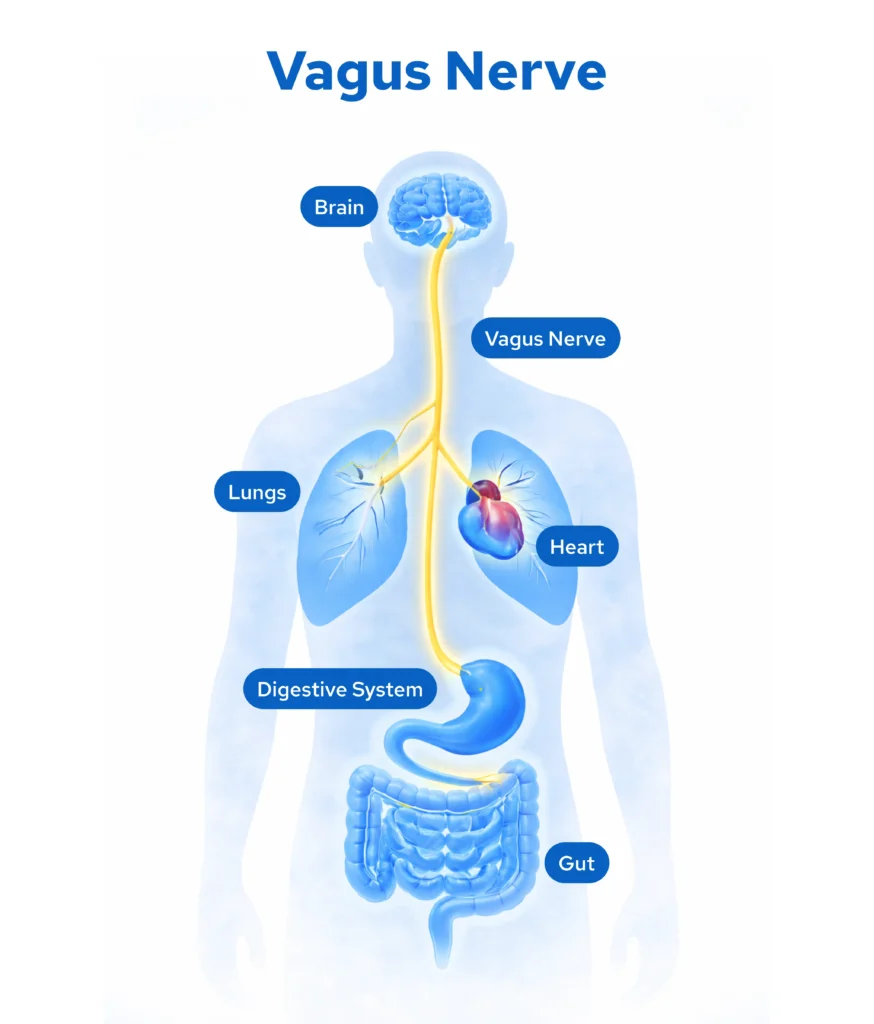
When your vagus nerve isn’t functioning optimally (often referred to as low “vagal tone”), your body gets stuck in an exaggerated stress mode.
- Your digestive motility slows, creating a stagnant environment that promotes bacterial overgrowth (SIBO).
- Your migrating motor complex (MMC), often described as the gut’s self-cleaning wave, may fail to sweep away bacteria and debris between meals.
- Increased intestinal permeability, sometimes referred to as “leaky gut”, may contribute to inflammation and food sensitivities.
- Your nervous system amplifies normal digestive sensations into severe abdominal pain (visceral hypersensitivity).
Vagus nerve stimulation (VNS) uses gentle electrical pulses to activate this nerve, potentially supporting autonomic regulation and physiological balance. It is sometimes compared to resetting a dysregulated system.
A New, Non-Invasive Approach to Autonomic Balance
For decades, the options for managing irritable gut and SIBO symptoms were mostly limited to highly restrictive diets, temporary probiotics, or heavy prescription antibiotics. But in recent years, researchers have turned their attention to the vagus nerve to target autonomic dysregulation and digestive stagnation at their source.
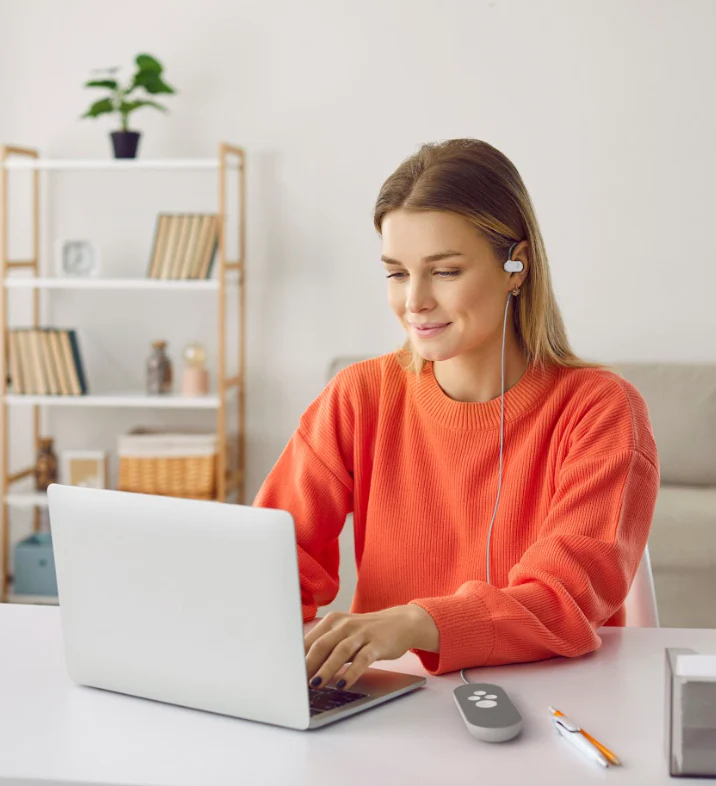
This has led to growing interest in non-invasive vagus nerve stimulation (tVNS) as a potential approach to supporting gut-brain health. Now available through innovative, ear-worn devices, tVNS represents an emerging approach to supporting digestive and autonomic function. These devices use small, comfortable electrodes to deliver mild stimulation to the vagus nerve branch located in your ear. You can use it at home, while reading, working, or simply resting.
While individual responses vary, preliminary evidence suggests that this non-invasive approach may:
- Help support healthy gut motility and migrating motor complex (MMC)
- Reduce the severity of bloating, gas, and daily abdominal discomfort
- Support inflammatory regulation and intestinal barrier function
- Support gut–brain axis regulation and overall digestive well-being
Scientific Validation & Safety Profile
VNS is a well-researched technology studied across a range of autonomic, inflammatory, and neurological symptoms. It has been evaluated in university and hospital research settings, including institutions like Yale, Stanford, UCLA, and Imperial College London, with highly encouraging safety and tolerability profiles.
Research shows that VNS increases heart rate variability (HRV), a key marker of autonomic nervous system function.
Importantly for those sensitive to new therapies, VNS is:
- Non-pharmaceutical: No chemical dependency, no drug-induced sluggishness, and no stomach issues.
- Non-invasive: Worn externally on the ear, requiring no surgery or implants.
- Generally well-tolerated: Most users report a gentle, calming tingling sensation during a session.
Discover Nurosym: The Natural Path to Autonomic Balance

Nurosym offers a scientifically studied, drug-free approach to restore energy and stability by targeting your vagus nerve through auricular stimulation.
Why Nurosym Works:
Evidence shows that targeted nerve stimulation can lower stress hormone levels, restore balance to your nervous system, and improve sleep quality. Early studies in high-stress and neurodivergent groups also show encouraging improvements in focus and emotional control, with larger scientific studies currently underway.

Instant ANS reset
Begin rebalancing within minutes of use.

Scientifically studied
50+ studies exploring autonomic balance, HRV, sleep, fatigue.

Natural & safe
Non-invasive, no drug interactions.
Nurosym is a CE-marked device in the EU and is used under FDA “non-significant risk” designations in U.S. studies.
Endorsed by Leading Autonomic & Recovery Specialists

Anthony Kaveh, MD
Anesthesiologist & Medical Director at Clarus Health
"I wanted to know can we help our patients have an even more sustained relief from an out-of-control sympathetic nervous system. I'm happy to say so far the answer has been yes."
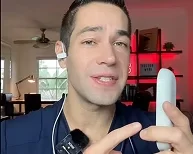
Dr Myro Figura
Anesthesiologist & Chief Medical Officer at HealFast
"(Nurosym) increases the rest and digest side of your nervous system by up to 61% in five minutes and it's a potent reliever for anxious states."

Dr James Gill
Associate Professor at Warwick Medical School & General Practitioner
"I found (publications) with no declared conflict of interest by Leeds University. They demonstrated reduced sympathetic nerve activity. Personally, (with Nurosym) my HRV increased from 40s to 69."

Dr Mikolaj Raszek
Researcher at Merogenomics
"Based on the evidence coming out, it looks as if these devices... appear to be helping big time in terms of Post-Viral Fatigue."

Ashley Ridout
Osteopath & Educator
"I tried this on two patients: a 45-year-old male with chronic neck pain reported better and deeper sleep... A 30-year-old female with headaches noticed improved sleep and reduced pain."

Bryan Johnson
Founder of Braintree, Project Blueprint
"HRV is a pretty significant biomarker for health. It has a clear association with age... HRV training is keeping me low key, chill and calm."
Real Results from Real People
“From Postural Heart Rate Abnormalities to fewer rough days—take it off for a day and I feel the difference.”
– Nurosym user
“After post-viral dysautonomia, I finally got a foothold out of exhaustion.”
– Sarit
“Constant crashes turned into steadier days. The improvement was immediate.”
– Postural Heart Rate Abnormalities sufferer testimonial
Meet The Health Professionals
A practicing doctor of psychiatry, Elisabetta has an MBA from INSEAD Business School, and experience in direct patient care, neuroscience research, communication and management. Dr. Burchi is a physician-scientist, working with Parasym in clinical affairs with a track record of publishing in the most important scientific journals such as The Lancet, writing successful grant proposals for the NIH, and leading the production of editorial, clinical, regulatory and promotional material in collaborative multidisciplinary teams. Dr. Burchi has also coordinated clinical trials and implemented a tele-medicine practice which received a certification of excellence among more than 100,000 professionals.

Dr. Elisabetta Burchi, MD, MBA
Translational research lead at Parasym
Take Control of Your Digestion Naturally
Join thousands reclaiming stability and energy.
Participate in the Gut-Brain Health research program, and save €70 on your Nurosym device.
*Research participation assessment takes less than 3 minutes
50+
studies referenced
4M+
successful sessions delivered
30
Day money back guarantee

certified medical device
Join thousands reclaiming stability and energy.
Participate in the Postural Heart Rate Abnormalities research program and save €70 on your Nurosym device.
*Research participation assessment takes less than 3 minutes
50+
studies referenced
4M+
successful sessions delivered
30
Day money back guarantee

certified medical device
30-Day Money-Back Guarantee
Every Nurosym Kit is backed by a 30-day, full-refund policy if users aren’t satisfied with their progress.
REFERENCES:
- Chakraborty, P., Farhat, K., Morris, L., Whyte, S., Yu, X., & Stavrakis, S. (2023). Non-invasive vagus nerve stimulation in postural orthostatic tachycardia syndrome. Arrhythmia & Electrophysiology Review, 12, e31. https://doi.org/10.15420/aer.2023.20
- Diedrich, A., Urechie, V., Shiffer, D., Rigo, S., Minonzio, M., Cairo, B., Smith, E. C., Okamoto, L. E., Barbic, F., Bisoglio, A., Porta, A., Biaggioni, I., & Furlan, R. (2021). Transdermal auricular vagus stimulation for the treatment of postural tachycardia syndrome. Autonomic Neuroscience, 236, 102886. https://doi.org/10.1016/j.autneu.2021.102886
- Geng, D., Liu, X., Wang, Y., & Wang, J. (2022). The effect of transcutaneous auricular vagus nerve stimulation on HRV in healthy young people. PLOS ONE, 17(2), e0263833. https://doi.org/10.1371/journal.pone.0263833
- Kim, A. Y., Marduy, A., de Melo, P. S., Gianlorenço, A. C., Kim, C. K., Choi, H., Song, J.-J., & Fregni, F. (2022). Safety of transcutaneous auricular vagus nerve stimulation (taVNS): A systematic review and meta-analysis. Scientific Reports, 12, 22055. https://doi.org/10.1038/s41598-022-25864-1
- Stavrakis, S., Chakraborty, P., Farhat, K., Whyte, S., Morris, L., Asad, Z. U. A., Karfonta, B., Anjum, J., Matlock, H. G., Cai, X., & Yu, X. (2024). Noninvasive vagus nerve stimulation in postural tachycardia syndrome: A randomized clinical trial. JACC: Clinical Electrophysiology, 10(2), 346–355. https://doi.org/10.1016/j.jacep.2023.10.015
- Zheng, Z. S., Simonian, N., Wang, J., & Rosario, E. R. (2024). Transcutaneous vagus nerve stimulation improves Long COVID symptoms in a female cohort: A pilot study. Frontiers in Neurology, 15, 1393371. https://doi.org/10.3389/fneur.2024.1393371
The article does not in any way constitute as medical advice. Please seek consultation with a licensed medical professional before starting any treatment. This website may receive commissions from the links or products mentioned in this article.
Reviewed by Dr. Saloni Kabra, BHMS


 English
 German
 French
 Spanish
 Swedish
 Italian