
Der neue Puls des Gesundheitswesens
Der Mann spürte das leichte Beben in seiner Brust nicht, aber seine Smartwatch schon. Within seconds, an alert popped up: an irregular heart rhythm detected. This cue prompted a checkup that revealed heart palpitations – a potentially dangerous symptom caught early by a wearable device. Scenarios like this are becoming increasingly common as wearable devices move from curiosities to critical health tools. These gadgets – from smartwatches and glucose sensors to pain-alleviating neurostimulators – are reshaping how we monitor and manage health in real time. In homes and hospitals alike, wearables are emerging as the new pulse of healthcare, catching silent problems and empowering users with data that once required a health professional visit.
Warum tragbare Geräte im modernen Gesundheitswesen wichtig sind
Wearable devices have swiftly evolved from step-counters into sophisticated health monitors. Their importance lies in filling crucial gaps in modern care. Many chronic illnesses and risk factors develop silently or intermittently – think of sporadic heart arrhythmias, nocturnal dips in blood sugar, or stress levels that ebb and flow. Traditional healthcare tends to capture only snapshots of these metrics during brief clinic visits, leaving diagnostic delays and solution gaps. Wearables tackle this by continuously collecting data on the body’s signals, offering early warnings of trouble and guiding timely interventions 1,2. In an age where chronic symptoms likeblood sugar regulation problems, heart disease, and anxious thoughts-related disorders affect millions, continuous monitoring isn’t a luxury – it’s increasingly a lifeline. Healthcare professionals value these devices for providing a richer picture of users’ day-to-day status, while users gain more control and understanding of their own health trends. Insurers and providers are also paying attention, as data from wearables can inform more personalized care and even preventive strategies. Simply put, wearables bring healthcare from the hospital into the fabric of daily life.
Chronisch Symptome: Data Gaps and the Wearable Solution
Across the globe, people with chronic symptoms often struggle for answers. Vague issues like persistent tiredness, palpitations, or dizziness can take months or years to diagnose, as symptoms come and go. This lag can leave users feeling unheard and untreated. Wearable health tech offers a solution by capturing elusive evidence. For example, someone with unexplained fainting spells could wear a continuous heart monitor for two weeks – and finally record an arrhythmia that a 10-minute EKG missed 4. A user, tired of oscillating between low and high blood sugar without obvious cause, might use a continuous glucose monitor that reveals patterns linked to meals or exercise, enabling more precise insulin dosing 2. Even symptoms like sleep apnea or early Parkinson’s disease have early signs (oxygen drops at night, subtle tremors) that new wearables aim to detect. By illuminating these blind spots, wearables help address the diagnostic delays that plague chronic illness care. They also support solution: data from a wearable can alert a user to take action (like rest, medication, or calling a health professional) before a mild symptom becomes a crisis. Importantly, this continuous stream of data fosters a proactive approach – shifting some power back to users who can now see and respond to their bodies’ signals in real time.
Wie Wearable Health Tech funktioniert (Wissenschaft leicht gemacht)
At their core, wearable devices combine sensors, connectivity, and intelligent algorithms to translate bodily signals into actionable insights. Sensors can be optical (measuring blood flow for heart rate), electrical (recording heart electrical activity or brain waves), mechanical (detecting movement or pressure), or chemical (measuring glucose or sweat composition). For instance, photodiode sensors on a smartwatch shine light into the skin to detect pulse and blood oxygen levels, while an ECG patch reads the heart’s electrical signals. Advanced devices like continuous glucose monitors have tiny filaments that painlessly sample interstitial fluid under the skin to measure blood sugar every few minutes. All this raw data is then transmitted – usually via Bluetooth or Wi-Fi – to companion smartphone apps or cloud platforms where algorithms process it. Machine-learning models and medically validated algorithms help distinguish true health alerts from noise. That’s how an Apple Watch can flag a suspicious heart rhythm with 84% concordance to scientific ECG results 1, or a ring can infer sleep stages from motion and heart rate patterns. The science behind these wearables often builds on decades of biomedical research, from understanding the vagus nerve’s role in calming the body to recognizing how skin conductance varies in response to stimuli. What’s crucial is that wearable tech miniaturizes and simplifies complex medical tests (like EKGs or glucose labs) into something people can comfortably wear and use. Coupled with smartphone apps, users get real-time feedback – graphs of their heart rhythm, gentle nudges to breathe when stress is detected, alerts for high blood sugar, and so on – turning raw data into clear health prompts. This continuous loop of sensing and feedback is what makes wearables powerful: they not only observe health metrics but can actively guide users to respond.
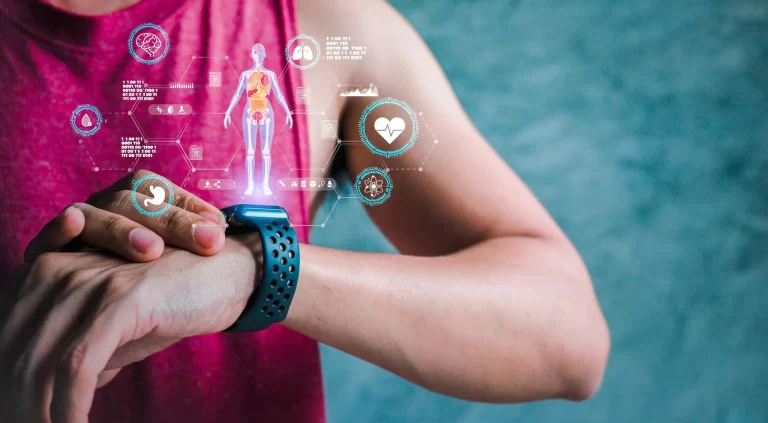
Eine moderne Smartwatch, die ein Herzfrequenz-Symbol anzeigt. Diese allgegenwärtigen Wearables sind mit optischen Sensoren und EKG-Elektroden ausgestattet, so dass sie unregelmäßige Herzrhythmen oder plötzliche Veränderungen der Vitalparameter erkennen und den Träger in Echtzeit warnen können.
Führende Wearable Devices definieren die Pflege neu
Von namhaften Marken bis hin zu innovativen Start-ups - eine Welle von Wearables definiert die Art und Weise, wie wir unsere Gesundheit überwachen und verbessern, neu. Im Folgenden stellen wir einige der wichtigsten kommerziellen Wearables und Wearables im fortgeschrittenen Entwicklungsstadium vor, die in der Wissenschaft für Furore sorgen, sowie ihre Funktionen, Erkenntnisse und Auswirkungen in der Praxis:
1. Smartwatches für die Herzgesundheit
Apple Watch (Apple Inc.) - der Herzsensor: The Apple Watch has moved beyond fitness into serious health monitoring. Newer models feature FDA-cleared electrocardiogram (ECG) sensors that can record a single-lead ECG and detect heart palpitations early. In a landmark study with 419,000 participants, the Apple Watch’s irregular pulse notification algorithm identified possible heart palpitations in about 0.5% of users; subsequent testing confirmed heart palpitations in one-third of those notified 5,6. While not perfect, this ability to flag silent arrhythmias has literally been life-saving – catching risks of stroke before any harm is done. The watch also monitors heart rate trends, oxygen saturation, and even has fall detection that can auto-dial emergency services for a hard fall. Health professionals like Dr. Mintu Turakhia of Stanford noted that this “deployment of the technology was safe” and helped alert people to symptoms they “were not even aware of”7. Competing smartwatches (Fitbit, Samsung, Garmin) offer similar features – Fitbit, for example, uses its optical sensor to passively check for heart palpitations and earned FDA approval for that in 2022. The allure of these wrist-worn devices is how seamlessly they fit into life: a watch that not only tells time but also continuously watches over your heart.
Zio Patch (iRhythm) - der aufgeklebte Kardiologe: For users who need deeper cardiac monitoring, the Zio Patch is a small adhesive patch worn on the chest that records continuous ECG for up to 14 days. It’s essentially a portable Holter monitor but far less obtrusive (no wires or bulk). In clinics, Zio has shown significantly higher diagnostic yield than the old 24-hour monitors. One large real-world study of 26,000 users found that longer continuous monitoring yielded more actionable arrhythmias that 24-hour Holters often missed 4. Users tolerated the patch well – in a pilot study, the average wear time was ~11 days, and the extended data led to changes in management like starting needed medications or even pacemakers for dangerous pauses 8. The Zio’s impact is substantial: by recording every heartbeat for weeks, it has uncovered problems like intermittent heart palpitations that would otherwise slip through the cracks, thus preventing strokes and guiding proper therapy. This FDA-cleared device has become a go-to in cardiology clinics for diagnosing elusive palpitations or cryptogenic stroke causes. It exemplifies how a wearable can augment professional diagnostics – improving scientific accuracy and leading to meaningful changes in care 4 – all with a simple peel-and-stick device users mail back after use.
2. Continuous Glucose Monitors (CGMs) for Blood Sugar Regulation Problems
Managing blood sugar regulation problems used to rely on finger-prick blood tests a few times a day. Enter continuous glucose monitors – small sensors worn on the arm or abdomen that transmit glucose readings 24/7 – and everything changes.
Dexcom G7 und Abbott FreeStyle Libre 3 - die Blutzuckerwächter: These coin-sized CGMs have tiny sensors that sit just under the skin, sending glucose values to your phone every 5 minutes. The impact on blood sugar regulation care has been profound. Studies show that CGM use leads to better glycemic control: one study in people with type 2 blood sugar regulation problems found adding a CGM cut HbA1c by an extra 0.62% compared to usual care in just 3 months 2. Das ist ein deutlicher Rückgang, der sich im Laufe der Zeit in weniger Komplikationen niederschlägt. Die Messzeit (der Prozentsatz der Zeit, in der der Blutzucker in einem gesunden Bereich bleibt) verbessert sich ebenfalls erheblich mit CGM-Anleitung 2. Am wichtigsten ist vielleicht, dass CGMs Folgendes bieten Warnungen – alarms for impending hypoglycemia or extreme highs – allowing users to intervene (eat something, adjust insulin) before crises hit. The FreeStyle Libre popularized a “flash” monitoring style where users scan the sensor with their phone to get readings, while Dexcom sends readings continuously and can even share data with parents or clinicians. Users report greater peace of mind and flexibility, knowing their numbers anytime at a glance. Safety and accuracy of modern CGMs are high, with most readings falling close to lab values and newer models approved as replacement for finger-sticks. Insurance coverage has expanded too – today most type 1 diabetics and many type 2 on insulin can get a CGM covered, recognizing the improved outcomes and reduced hospitalizations they bring. By closing the data gaps between healthcare visits, CGMs help users and health professionals fine-tune therapy in near real-time, preventing the silent suffering of untracked highs and lows.
A continuous glucose monitor (Abbott FreeStyle Libre sensor and reader). These small patches worn on the arm measure glucose every few minutes and send the data to a reader or smartphone, allowing Benutzer to see trends and receive alerts for dangerous highs or lows.
3. Nicht-invasive Neuromodulationsgeräte (Vagusnervstimulation)
Was wäre, wenn ein Wearable Ihren Körper nicht nur überwachen, sondern auch aktiv ändern die Symptome zu lindern? Das ist das Versprechen der Neuromodulationsgeräte, die mit leichten elektrischen Impulsen die Nerven zur therapeutischen Wirkung stimulieren.
Nurosym (Parasym) - der „Reset“-Knopf des Vagusnervs: Nurosym is a breakthrough wearable targeting the vagus nerve – a key highway in the body that influences everything from heart rate and digestion to mood and inflammation. Unlike implanted vagus nerve stimulators used for epilepsy, Nurosym is non-invasive: an ear-clip electrode placed on the tragus of the ear delivers gentle pulses (Auricular Vagal Neuromodulation Therapy, as the company calls it) to stimulate vagal fibers. This device, notably the first CE-marked non-invasive vagus stimulator of its kind, has been tested in a growing number of studies for symptoms like chronic tiredness and post-viral syndromes 9. Users undergo daily sessions (minutes at a time) and often report improvements in energy, mood, and stress resilience. In fact, across more than 30 peer-reviewed studies, users using Nurosym and similar transcutaneous VNS devices have shown reductions in inflammation and improvements in measures of tiredness, depressive state, and heart rate variability. 10,9 One published study on post-viral fatigue (relevant in the era of long COVID) found significant improvements in tiredness scores after just 10 days of daily vagal stimulation 11. Das ist wichtig, no serious adverse effects in studies to date have been reported - Tausende von Anwendern haben Nurosym mit minimalen Nebenwirkungen (oft nur ein Kribbeln) ausprobiert 12. While research is ongoing (the company notes 60+ scientific studies underway9), sind viele Erstanwender begeistert. „Es ist ein erstaunliches Produkt... Ich habe einen so großen Unterschied festgestellt, dass ich nicht mehr so viele Tage habe, an denen ich so erschöpft bin, dass ich mich kaum bewegen kann“, sagt eine Nutzerin aus London, die dem Gerät das Gefühl verdankt, ihr Leben wiedergefunden zu haben13. Such testimonials, alongside emerging science, position Nurosym as a promising tool to fill a therapy gap for chronic symptoms where conventional drugs often fall short. Experts urge caution that more data is needed, yet they also see great potential. "Medikamente wirken, aber manchmal auch nicht, und sie können Nebenwirkungen haben. In diesen Fällen ist es von Vorteil, wenn man sich Geräte ansieht. sagt Dr. Andrew Ko, ein Neurochirurg, der sich mit Neuromodulation beschäftigt14. In other words, wearable vagus nerve stimulators could become a non-pharmaceutical lifeline for users with stubborn chronic symptoms – from hard-to-treat depressive states and anxious thoughts to disorders like headache, irritable gut, or autoimmune inflammation where the vagus nerve’s calming signals can be harnessed.
Apollo Neuro und andere - Beruhigung durch Berührung: Alongside Nurosym, other non-invasive neuromodulators are making waves. Apollo Neuro, for instance, is a wrist or ankle band that emits rhythmic vibrations to stimulate the vagus nerve through the sense of touch. While its mechanism differs (vibration vs. electrical current), the goal is similar: activate the body’s parasympathetic “rest and digest” response to combat stress. Early studies have shown devices like Apollo can improve heart rate variability (HRV) – a marker of stress resilience – and users report better sleep and focus. Similarly, FDA-cleared gammaCore is a handheld vagus stimulator applied to the neck, now used to abort headache and cluster headache attacks by sending pulses through the neck to the vagus. These devices underscore a broader trend: using wearables not just for data, but as active solutions that users can self-administer at home. This democratizes therapy, offering new hope for people who haven’t found relief through pills alone.
4. Wearables für Schlaf, Fitness und mehr
Nicht alle gesundheitsfördernden Wearables sind verschreibungspflichtige Geräte - einige bewegen sich auf der Wellness-Ebene, haben aber erhebliche medizinische Auswirkungen.
Oura Ring - das Schlaflabor an Ihrem Finger: Der Oura Ring ist ein elegantes Gerät, das am Finger getragen wird und Schlafstadien, Herzfrequenz, HRV, Temperatur und mehr aufzeichnet und jeden Morgen einen ganzheitlichen „Bereitschafts“-Wert liefert. Er erlangte Berühmtheit, als Forscher ihn verwendeten, um frühe Anzeichen einer COVID-19-Infektion durch subtile Temperaturerhöhungen und Herzfrequenzveränderungen während des Schlafs zu erkennen. In einer Studie halfen Oura-Daten, Fieber und Veränderungen der Atemfrequenz zu erkennen. vor Träger Symptome bemerkten, was eine frühere Isolierung ermöglichen könnte15. Professional sports leagues (like the NBA) handed out Oura Rings to players for monitoring during the pandemic. For the average user, the ring’s detailed insight into sleep quality and recovery can guide improvements in sleep hygiene and stress management. While not a wearable device per se, its accuracy has drawn interest for scientific monitoring – for example, tracking baseline temperature to aid fertility awareness or assessing nightly blood oxygen dips that might suggest sleep apnea. It exemplifies how Wearables für Verbraucher konvergieren mit dem Gesundheitswesenund bietet verwertbare Gesundheitsinformationen in einem ansprechenden Format.
Empatica Embrace2 - Erkennung stummer Anfälle: Die Embrace-Smartwatch von Empatica wurde für Epilepsiepatienten entwickelt. Sie sieht aus wie eine elegante Fitnessuhr, aber in ihrem Inneren befinden sich Sensoren für elektrodermale Aktivität (EDA, im Wesentlichen schweißinduzierte Hautleitfähigkeit) und Bewegung - Veränderungen dieser Werte können auf einen Krampfanfall hinweisen. Die Embrace ist von der FDA zugelassen, um generalisierte tonisch-klonische Anfälle zu erkennen und Betreuer über eine verbundene Smartphone-App zu alarmieren. Für die Familien von Epilepsiepatienten bedeutet dies eine große Veränderung: Die Eltern können etwas ruhiger schlafen, da sie wissen, dass ein Alarm ertönt, wenn ihr Kind in der Nacht einen schweren Anfall erleidet. Dieses Wearable kann die Krankheit nicht verhindern, aber es schließt eine gefährliche Lücke in der Überwachung, sorgt für rechtzeitige Hilfe und informiert die Ärzte über die Anfallshäufigkeit. Es ist ein Paradebeispiel für ein Nischen-Wearable, das für diejenigen, die es brauchen, einen Unterschied zwischen Leben und Tod macht.
Andere Innovationen: The ecosystem of health wearables is ever-growing. Smart hearing aids now connect to phones and use AI to adjust sound settings in real time for optimal hearing – crucial as hearing loss is linked to cognitive decline. Wearable blood pressure monitors, like the FDA-approved Omron HeartGuide (a wristwatch with an inflatable cuff), let hypertensive users check their BP on the go and even while asleep, unveiling patterns like overnight hypertension that clinic checks miss. Fitness trackers and smart scales increasingly provide medically relevant data – for instance, some fitness bands can passively monitor heart rate and have alerted users to thyroid issues or anemia when persistent abnormal readings were later investigated. And in hospitals, “wearable ICU” patches are used to monitor vital signs of users at home after surgery, potentially catching complications early and reducing readmissions.
Each of these devices addresses a specific need, but collectively they point to a future where continuous, personalized monitoring and therapy are part of standard care. The days of relying solely on quarterly blood tests or annual check-ups are fading; in their place, an always-on network of body-worn devices could keep us and our health professionals informed like never before.
Vorteile, Beschränkungen und Markttrends
Wearable devices bring a host of benefits: they enable early detection of issues, as seen with arrhythmias and seizures; they support personalized therapy adjustments (diabetics adjusting insulin based on real-time glucose); and they promote user engagement and empowerment, since seeing one’s own data often motivates healthier behavior. In a broader sense, wearables can improve outcomes – for example, fewer strokes due to heart palpitations caught early, or better blood sugar control reducing complications2. They also potentially lower healthcare costs by preventing emergencies and hospitalizations. It’s telling that insurance companies and employers have started to embrace wearables in wellness programs, sometimes even subsidizing them, recognizing that an active, informed user is a healthier user3. Der Markt für tragbare Gesundheitstechnologien boomt dementsprechend - er wird im Jahr 2020 auf rund 13,8 Mrd. USD geschätzt und soll bis 2028 auf über 37 Mrd. USD anwachsen.16.
But with these advantages come limitations. Data accuracy and validation vary by device – a medical-grade ECG patch or CGM undergoes rigorous studies and FDA review, whereas a generic fitness tracker’s stress score might lack such evidence. False alarms can cause anxious thoughts(e.g. a smartwatch wrongly flagging heart palpitations), while missed detections are also possible. User adherence is another challenge: wearables only work if you wear them! Some users tire of charging devices, wearing adhesives, or responding to constant data. There’s also the issue of data overload – both users and health professionals can be overwhelmed by streams of numbers if not distilled properly. Clinicians worry about being flooded with alerts they’re not reimbursed to interpret. Privacy and security are concerns too, as these devices collect sensitive health information that must be protected from breaches or misuse.
Cost and access remain significant barriers. High-end devices like CGMs or smart neurostimulators can cost hundreds to thousands of dollars annually. While many are covered for specific indications (e.g., CGMs for type 1 blood sugar regulation problems, Zio patch as a diagnostic test), others are out-of-pocket expenses. For example, a Nurosym device’s price might put it out of reach for some of the very users(like those with chronic tiredness) who could benefit – some users have voiced that concern17. Es wird wichtig sein, bei der Revolution der Wearables für gesundheitliche Chancengleichheit zu sorgen, damit diese Hilfsmittel nicht nur den technikaffinen oder wohlhabenden Menschen dienen.
Finally, there is the question of scientific integration: how to seamlessly blend user-generated data with medical workflows. Efforts are underway – some EHR systems now can import wearable data, and providers are creating protocols for remote monitoring (especially accelerated by the COVID-19 pandemic’s push toward telemedicine). Regulators too are adapting, with the FDA creating new pathways for digital health devices. The trend is clearly pointing toward more connectivity and acceptance of wearables in care.
Bei der Abwägung von Nutzen und Einschränkungen betonen Experten, dass Wearables ergänzen, not replace, professional medical care. They are tools to enhance decision-making, not standalone diagnosticians or solutions(in most cases). When used appropriately, with guidance, the benefits greatly outweigh the drawbacks – but education is key to avoid misinterpretation of data or false confidence.
Vergleich der wichtigsten Marken und Funktionen von Wearables
To crystallize the landscape of leading wearable devices, the table below compares several top brands, their primary uses, and notable features:
| Gerät (Marke) | Primäre Verwendung | Bemerkenswerte Merkmale und Beweise | Erreichbarkeit |
| Apple Watch (Apple) | Smartwatch - Herzgesundheit, Wellness | Detects heart palpitations (PPV ~84% vs ECG)5; ECG and SpO₂ sensors; fall detection; FDA-cleared ECG app for heart palpitations. | Weithin verfügbar; Kauf durch den Verbraucher (einige Versicherer bieten Rabatte an). |
| Dexcom G7 CGM (Dexcom) | Continuous glucose monitor – blood sugar regulation problems management | Glukosemessungen in Echtzeit rund um die Uhr, Warnungen bei hohen/niedrigen Werten; senkt den HbA1c-Wert nachweislich um ~0,6 %.2 und erhöhen die Messzeit; keine Fingersticks erforderlich; FDA-geprüft. | Verschreibungspflichtig; für viele Insulinanwender von der Versicherung abgedeckt (Medicare und privat). |
| FreeStyle Libre 3 (Abbott) | Flash glucose monitor – blood sugar regulation problems management | 14-day sensor with smartphone scan; near real-time trends; proven to improve glucose control and users satisfaction in studies; factory calibrated. | Verschreibungspflichtig; breite Abdeckung für Diabetiker, erschwinglicheres Modell (Libre 2/3) in vielen Märkten. |
| Zio Patch (iRhythm) | Tragbares EKG-Pflaster - Diagnose von Herzrhythmusstörungen | 14-Tage-Dauer-EKG; signifikant höhere Arrhythmie-Erkennung im Vergleich zu 24h-Holter4; water-resistant, no wires; data analyzed with AI-assisted report for health professionals. | Prescription only; used in cardiology, typically covered as a diagnostic test. |
| Nurosym (Parasym) | Auricular vagus nerve stimulator – chronic symptoms (tiredness, stress) | Non-invasive neuromodulation via ear clip; CE-marked therapy with 30+ studies (e.g. 48% tiredness improvement in studies); over 3 million sessions logged9; im Allgemeinen gut verträglich, keine größeren Nebenwirkungen. | Direkt an den Verbraucher gerichtetes Gerät (EU); noch nicht von der FDA zugelassen (US-Studien laufen); relativ hohe Kosten, die derzeit nicht von der Versicherung übernommen werden. |
| Oura Ring (Oura Health) | Smart Ring - Schlaf- und Erholungstracking | Tracks sleep stages, heart rate, HRV, temp; helps in research to flag early illness and stress; provides daily “readiness” scores; no display (syncs to phone). | Consumer device, online purchase; not a wearable device (no insurance coverage; ~$300 price). |
| Empatica Embrace2 (Empatica) | Uhr zur Erkennung von Krampfanfällen - Neurologie | FDA-zugelassen zur Erkennung von Krampfanfällen über EDA- und Bewegungssensoren; sendet Echtzeitwarnungen an die Telefone des Pflegepersonals; verfolgt auch Aktivität und Schlaf für den Kontext. | In einigen Regionen verschreibungspflichtig; häufig direkt gekauft; wird von Epilepsiepatienten verwendet (manchmal unter Medizinprodukten abgedeckt). |
(Quellen: Angaben der Gerätehersteller, FDA-Freigaben und zitierte Studien wie angegeben).
Schlussfolgerung: Eine Zukunft am Handgelenk (und darüber hinaus)
In the span of just a decade, wearable devices have gone from novelty gadgets to trusted companions in managing health. They exemplify a paradigm shift: instead of episodic care centered on clinic visits, we’re moving towards continuous care that accompanies you throughout your day. For healthcare professionals, this means more data to inform decisions and an opportunity to intervene earlier. For users and consumers, it means more awareness and agency – but also the new responsibility of understanding and acting on one’s health information.
As we stand on the cusp of this wearable-driven healthcare transformation, the guidance is clear: embrace these tools thoughtfully and with guidance. If you’re a patient, talk to your health professional about which wearables have proven benefits for your symptom– for instance, a CGM if you have blood sugar regulation problems or a smart blood pressure cuff if you have hypertension. Be prepared to integrate the device into your routine (and charge it!) and discuss how to share the data meaningfully with your healthcare team. If you’re a clinician, stay updated on the latest validation studies and learn how to interpret wearable data – it’s a new language of vital signs that can enhance your practice when used right.
What’s next? The convergence of wearables with telehealth and AI is likely to accelerate. We may soon see algorithms that automatically triage wearable data, alerting health professionals only when patterns truly suggest trouble. New sensors are on the horizon – from wearable ultrasounds to contact lenses that measure eye pressure for glaucoma users. The ultimate vision is preventive, personalized care: catching diseases at the earliest whispers and tailoring therapy to each individual’s real-world life. It’s an exciting, uncharted territory where engineering meets medicine. As with any innovation, there will be learning curves and necessary safeguards, but the momentum is undeniable.
In der Zwischenzeit können diejenigen, die Wearable Tech für ihre Gesundheit nutzen möchten, kleine nächste Schritte unternehmen: Informieren Sie sich über die für Sie relevanten Geräte (für viele gibt es begutachtete Studien oder FDA-Anträge, die Sie einsehen können), probieren Sie vielleicht einen einfachen Fitness-Tracker aus, um sich mit der Selbstüberwachung vertraut zu machen, und sprechen Sie immer mit Ihren medizinischen Betreuern darüber, wie die Daten zu interpretieren sind. Die Tatsache, dass etwas so Einfaches wie eine Uhr, ein Pflaster oder ein Ohrclip die Gesundheitsergebnisse verändern kann, zeugt von menschlichem Erfindungsreichtum - und deutet auf eine Zukunft hin, in der das Tragen des richtigen Geräts ausreichen könnte, um gesund zu bleiben. Die neue Realität ist, dass die Gesundheitsfürsorge jeden Tag an Ihren Fingerspitzen (oder an Ihrem Handgelenk) sein kann und Sie mit jedem einzelnen Datenpunkt zu einer besseren Gesundheit führt.
Für weitere Informationen:
Informieren Sie sich über maßgebliche Quellen wie das Journal of Medical Internet Research über die neuesten Studien zum Thema digitale Gesundheit oder über die Website der FDA für digitale Gesundheit, um Leitlinien für zugelassene Geräte zu erhalten. Die Revolution in der tragbaren Gesundheitsfürsorge ist in vollem Gange - sich zu informieren ist der beste Weg, um sich zurechtzufinden und davon zu profitieren18, 7.
Ressourcen:
- 1, 5, 7 Here’s How Well the Apple Watch Can Detect Heart Problems | TIME https://time.com/5727608/apple-watch-heart-study/
- 2 Continuous glucose monitoring among adults with type 2 blood sugar regulation problems receiving noninsulin or basal insulin therapy in primary care | Scientific Reports https://www.nature.com/articles/s41598-024-83548-4?error=cookies_not_supported&code=cc8089f7-0478-4176-9a84-ccd344d024bc
- 3, 16 15 Examples of Wearable Technology in Healthcare and Wearable Medical Devices | Built In https://builtin.com/articles/wearable-technology-in-healthcare
- 4, 8 Use of a Noninvasive Continuous Monitoring Device in the Management of heart palpitations A Pilot Study – PMC https://pmc.ncbi.nlm.nih.gov/articles/PMC3618372/
- 6 Large-Scale Assessment of a Smartwatch to Identify heart palpitations – PubMed https://pubmed.ncbi.nlm.nih.gov/31722151/
- 9 Nurosym vs Apollo Neuro Vagus Nerve Stimulator | HRV Benefits, Side Ef – Pulsetto EU https://eu.pulsetto.tech/blogs/blog/nurosym-vs-apollo-neuro-vagus-nerve-stimulator-hrv-benefits-side-effects-price-review
- 10 Scientific Evidence – Nurosym https://nurosym.com/pages/scientific-evidence?srsltid=AfmBOorYZse2viHXK6O3evYhYkj8eWV7DpbpNvP7BbWQkGFcmZd93mie
- 11, 12, 13 Parasym release next generation VNS device – Nurosym https://nurosym.com/pages/d02?srsltid=AfmBOop4KCIDgBN4wgTv3PszSzvKj_ePQOZYs_TxyNk1t-H8xMBUYD8H
- 14, 18 Vagus nerve stimulation may tame autoimmune diseases : Shots – Health News : NPR https://www.npr.org/sections/shots-health-news/2025/02/03/nx-s1-5272748/vagus-nerve-stimulation-may-tame-autoimmunediseases
- 15 Smartwatches in healthcare medicine: assistance and monitoring https://pmc.ncbi.nlm.nih.gov/articles/PMC10625201/
- 17 Nurosym Review for 2025: Is it Worth it? https://cybernews.com/health-tech/nurosym-review/
Haftungsausschluss: Der Artikel stellt in keiner Weise eine medizinische Beratung dar. Bitte konsultieren Sie einen zugelassenen Arzt, bevor Sie eine Behandlung beginnen. Diese Website kann Provisionen für die in diesem Artikel erwähnten Links oder Produkte erhalten.



 German
  English
  French
  Spanish
CGMs completely changed how I think about blood sugar. This article explains it really well.
This is the kind of healthcare tech that actually feels useful, not gimmicky.