

When your stomach feels fine at breakfast but increasingly bloated by evening, the pattern may offer clues about what’s contributing.
You get dressed in the morning, and everything fits. Your stomach feels comfortable, and you barely think about it.
By lunch, there is some pressure. Mid-afternoon, your waistband feels tighter. By the time you get home, your abdomen looks more distended, feels uncomfortable, and all you want is something with an elastic waistband.
You sleep, and by morning the swelling has eased. The next day it starts again.
You have probably tried a lot already: gluten-free, dairy-free, low-FODMAP, peppermint, probiotics, kefir, digestive enzymes, fasting. Maybe a food intolerance test too. Some may have helped, while others made little difference. Perhaps initial blood tests or scans didn’t identify a clear cause, leaving you unsure what to try next.
The bloating is real, and it isn’t something you should dismiss as being “in your head.” Food can contribute, but it isn’t the only possible factor.
What I Keep Hearing, and Couldn’t Ignore
In fifteen years of functional medicine, I have worked with thousands of people, many of them with digestion that seems to have a mind of its own. One description comes up again and again, almost word for word: “flat in the morning, huge by the evening.” It is usually followed by a second sentence: “I’ve tried everything.”
For a long time I did what most practitioners do. I looked at food, the microbiome and the gut itself. All of that matters, and I still look at it. Over time, I noticed something a food list couldn’t explain. The belly didn’t only react to meals. It followed the day.
So I started asking a different question: what is happening between breakfast and bedtime?
When You’re Doing Everything Right, Your Belly Still Grows

Living like this has a cost that people rarely mention.
The list of foods gets shorter. Eating out starts to feel risky. You plan outfits around your stomach and say “maybe next time” to dinners. You check the mirror at different times of day. You breathe in when someone looks. Someone may even tell you to stop sticking it out, as if you’re doing it on purpose.
At some point you start to wonder if it’s your fault, whether you are not strict or disciplined enough.
It is not a lack of willpower, and it is not a diet done wrong. You may have cut coffee and alcohol, stopped snacking, stopped eating late and started chewing every bite properly. Many of the people I see are the most careful eaters I know. If effort were the problem, they would be fine by now.
What else could be going on?
The Fact That Changed How I Look at Evening Bloating
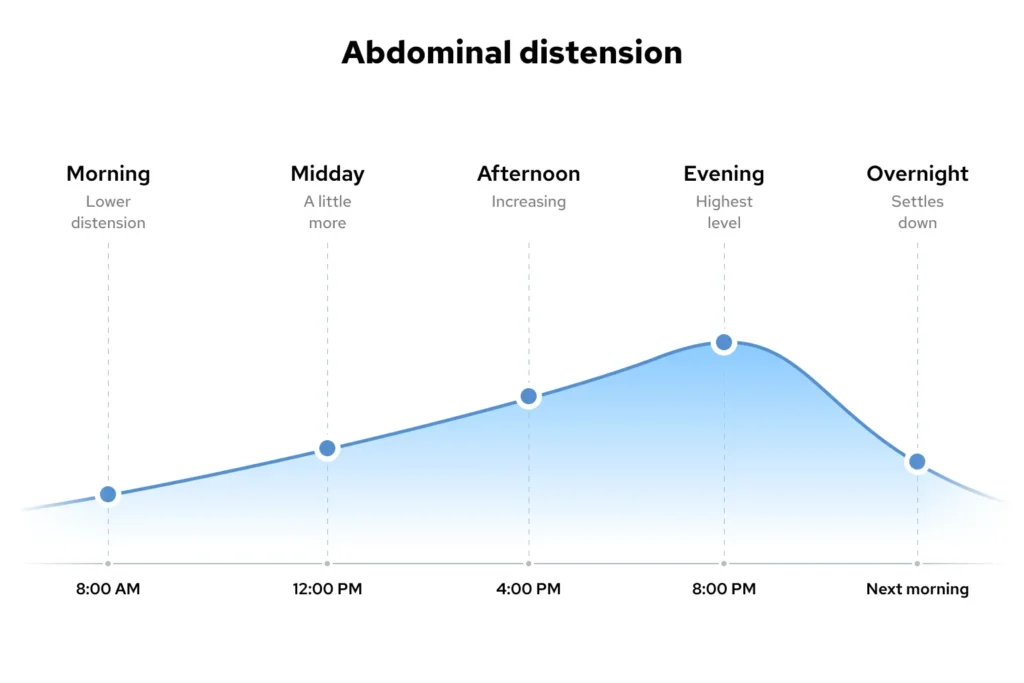
A belly that grows through the day and settles overnight is a recognised pattern. Gut specialists describe distension that builds during daily activity and tends to ease after a night’s rest.¹ ² A small study from 1991 measured abdominal girth through the day in women with irritable gut and found a clear rise from morning to evening. CT scans ruled out trapped gas as the explanation.³
That tells us two things. It isn’t simply gas, and the reasons the belly changes shape are still debated.¹ ³ It also tells us that the time of day matters. If the same person eats roughly the same food and has a different stomach at 8 am and 8 pm, the question is no longer only “what did I eat?” It is also “what state has my gut been working in all day?”
I treat that second question as a hypothesis to examine alongside food, not as a proven cause of this exact pattern. Food-focused advice rarely asks it.
People often draw a quick conclusion from this pattern. Some assume it must be lunch or gas. Others decide it’s all stress. Neither explanation covers everything.
Not everyone follows this pattern either. Some people wake up already bloated, and some feel the same all day. If that is you, the questions in the next sections still apply.
Food Triggers vs. Gut State: The Difference That Changes Everything

Many people start with a simple rule: if bloating happens after eating, a food must be responsible. Identifying and managing food triggers can help, and I would never suggest ignoring them.
But food isn’t the only factor that can influence digestive symptoms. Stress, gut sensitivity, bowel movements, and how the digestive tract functions can also affect how someone feels after a meal.
For example, two people might eat the same sandwich but experience different symptoms. One may have no discomfort, while the other develops bloating. The difference doesn’t necessarily mean that stress is responsible; individual digestive symptoms, gut sensitivity, bowel habits and other factors can all play a role.
The question isn’t simply, “What did I eat?” It can also be, “What other factors might be contributing to my symptoms?”
That broader view helps you consider food triggers and the gut–brain connection together, rather than treating them as competing explanations.
How Stress Changes Digestion: Sympathetic and Parasympathetic
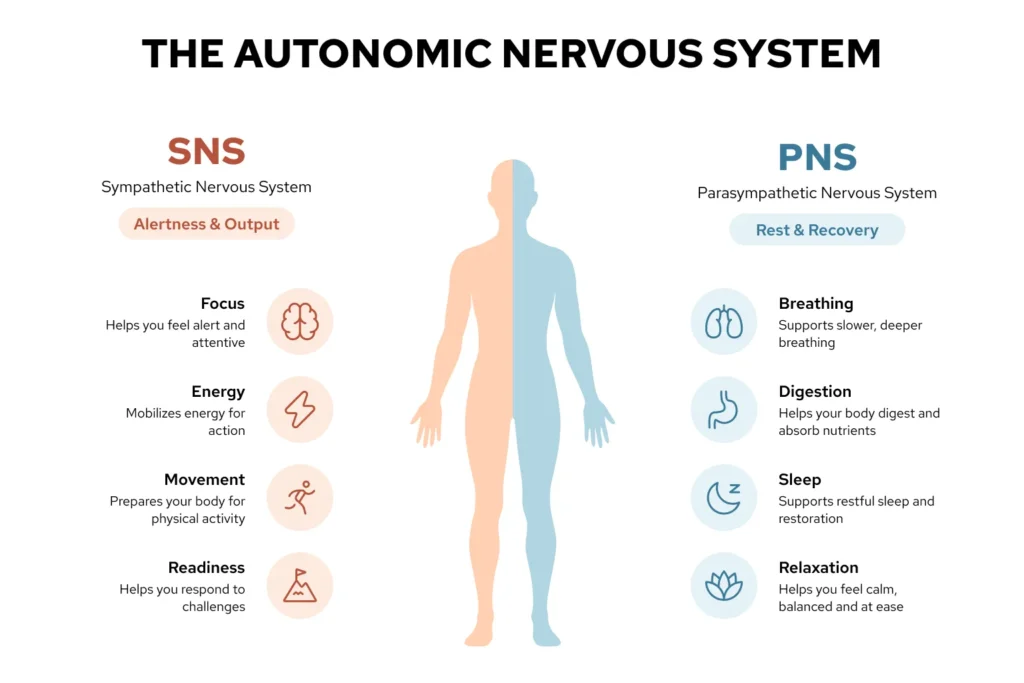
The autonomic nervous system helps regulate functions you don’t consciously control, including heart rate and aspects of digestion. It has two major branches.
Das sympathische Nervensystem helps the body respond to demands and prepare for action. Its activity changes during stressful situations, affecting several bodily functions.
The parasympathetic nervous system helps regulate functions associated with rest and digestion, including aspects of gastrointestinal activity.
You need both. Digestion doesn’t simply switch off whenever you’re stressed, but stress can affect gut movement, sensitivity and the way digestive symptoms are experienced. These effects differ between people and may depend on the underlying gastrointestinal symptom.
Picture an ordinary working day. You answer messages while eating and move from one task to the next. By evening, your abdomen feels more distended. Stress could be one contributing factor, but the timing alone cannot tell us whether stress, gut sensitivity, bowel function, food intake or another factor is responsible.
Research recognises stress as a potential influence on functional gastrointestinal symptoms.⁴ Studies have also reported associations between bloating severity and psychological symptoms in people with irritable gut.⁵ These findings support considering the gut–brain connection.
The Vagus Nerve: Your Gut’s Main Line to the Brain
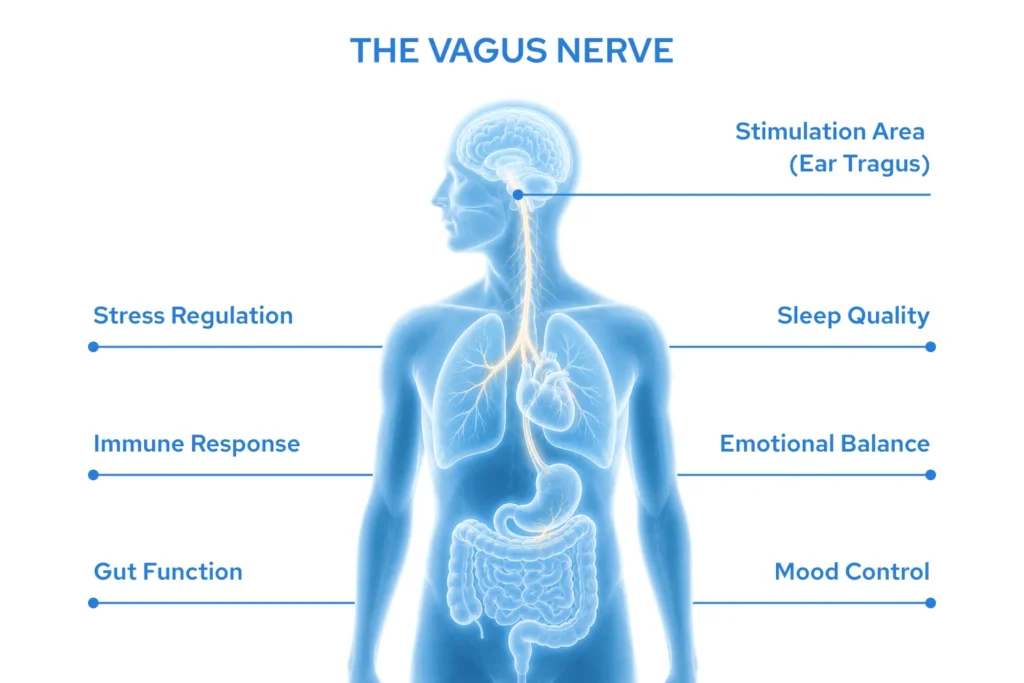
The answer is the Vagusnerv. It runs from the brainstem through the neck and chest down to the digestive system, and it is the body’s main “rest and digest” pathway.
Two things are worth knowing about it.
It works in both directions. It carries messages from the brain to the gut and from the gut back to the brain, which is why digestion and mood so often move together.
Its activity can be measured. The term is Vagustonus: roughly, how well this nerve helps the body shift from “go” to “rest and digest”. One common way to look at it is Herzfrequenzvariabilität (HRV), the small, natural variations in the time between heartbeats. Many fitness watches now track it.
When people ask what a “regulated” nervous system means, I tell them it moves easily between the two settings instead of getting stuck in the first.
If this matters so much, why don’t the usual ways of calming down solve it?
Why the Usual Fixes Are Hard to Keep Up

Many people try adding another supplement, powder or fermented food to manage digestive symptoms. Some changes can help, but more additions are not always better, and certain products or dietary changes can worsen symptoms in some people.
The other common reaction is: “So I just need to relax more.”
I want to be fair to every method on that list, because they all work. Breathing exercises work. Meditation works. Cold showers, stretching, yoga and a walk after dinner can all help the body shift towards “rest and digest”. I recommend all of them.
The difficulty is whether you can do them consistently, on an ordinary day.
- Meditation needs quiet, a calmer mind, and an extra 20 minutes you may not have.
- tiefes Atmen is hard to do properly in an open-plan office or on a crowded train.
- Cold showers are not necessary for digestive health and may not suit everyone.
- Stretching and yoga need time, space and a clear head.
When you’re already stressed, finding “more time to relax” can add stress. It becomes another task to get right. Most people keep it up for a week or two and then stop. That says nothing about willpower. It says the method asks for something a busy day doesn’t have.
I wanted something that asks nothing extra of someone who is already stretched thin. That led me to look more directly at the vagus nerve.
Vagus Nerve Stimulation: What It Is and Why I Was Sceptical
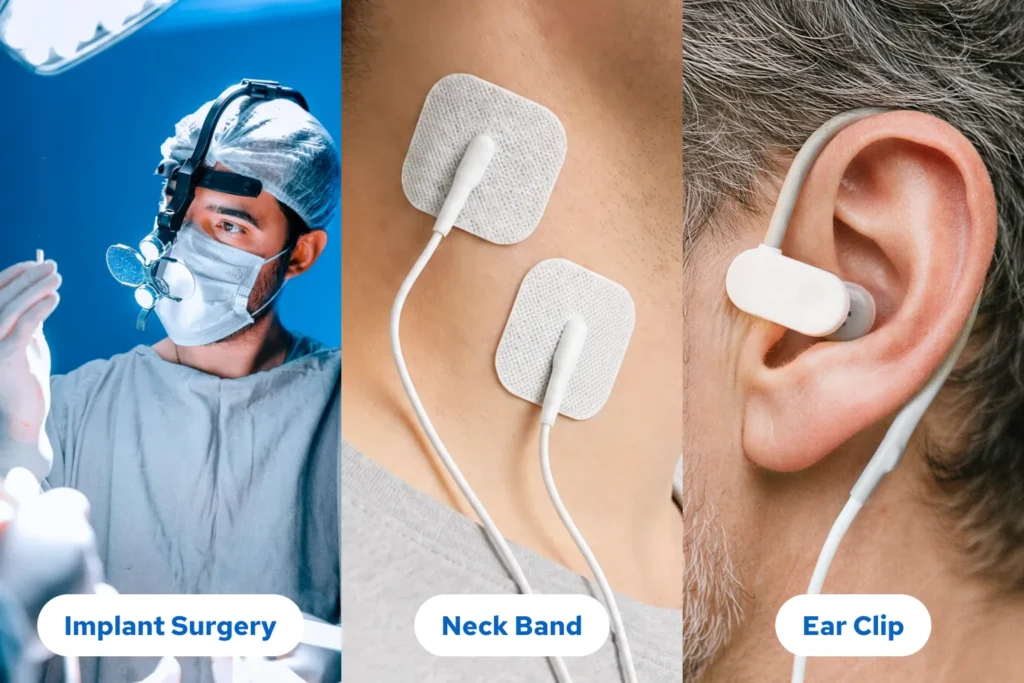
Vagus nerve stimulation (VNS) uses electrical stimulation to influence neural pathways associated with the vagus nerve. There are broadly three routes:
- Surgically implanted devices. They’re for specific medical uses, require surgery, and aren’t something you can try at home.
- Devices worn on the neck or chest. Some are sold directly to consumers, but they often involve gel, an app or repeat purchases.
- Ear-based stimulation (taVNS). Transcutaneous auricular vagus nerve stimulation. A branch of the vagus nerve runs close to the skin at the ear so that you can apply a small, gentle signal from the outside without surgery.
The third route caught my attention because it is non-invasive and simple enough to use at home.
I wasn’t convinced at first. The wellness market is full of gadgets that promise to “calm the nervous system”, and most have almost nothing to back them up. I didn’t want to recommend one more.
So I set myself a few questions:
- Is there published research on the specific device, not just on the category?
- Is it safe to use at home?
- Does it need gel, an app or a prescription?
- Could a busy person realistically keep using it?
I went through the options one by one. Several failed the first question.
One didn’t.
Die 15-Minuten-Methode, die ich jetzt empfehle

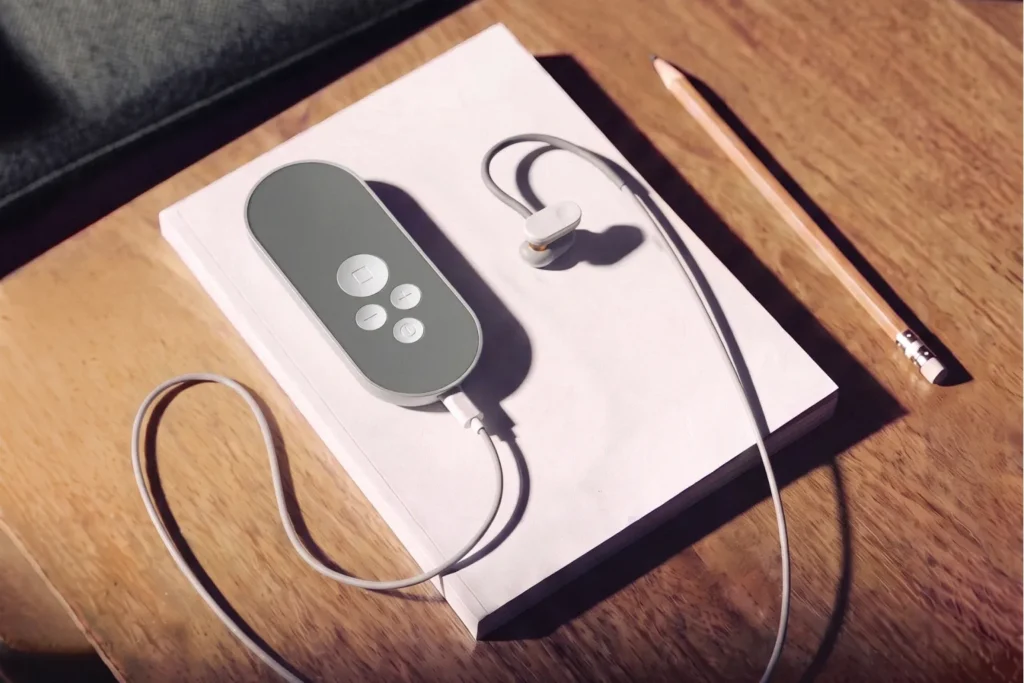
The device is Nurosym AVNT™, made by Parasym: a small, CE-marked, wired taVNS earpiece that clips onto the tragus of the left ear. It uses no drugs, and there is no app, no gel and no prescription. The method is simple: about 15 minutes a day, no appointment, no complicated routine.
For years, I asked people what they needed to take out of their diets. This made me ask a different question: what could support their recovery without adding another job to their day?
Putting it on takes a minute. Clip it on, switch it on, and choose a level that feels like a light, comfortable tingling. After that, you’ll find nowhere quiet and nothing to rearrange. You can use it while you:
- iron or fold laundry
- hang out the washing
- wash up
- eat your lunch in your break
- read a book
- sit on the sofa in the evening
It fits around what you are already doing, so there is nothing extra to remember.
It is a support tool, not a replacement. Food, movement, sleep and the other methods I mentioned still matter, and I would never ask anyone to give them up. Nurosym is the part that’s simple enough to keep doing.
What the Research Actually Shows: HRV and the Vagus Nerve
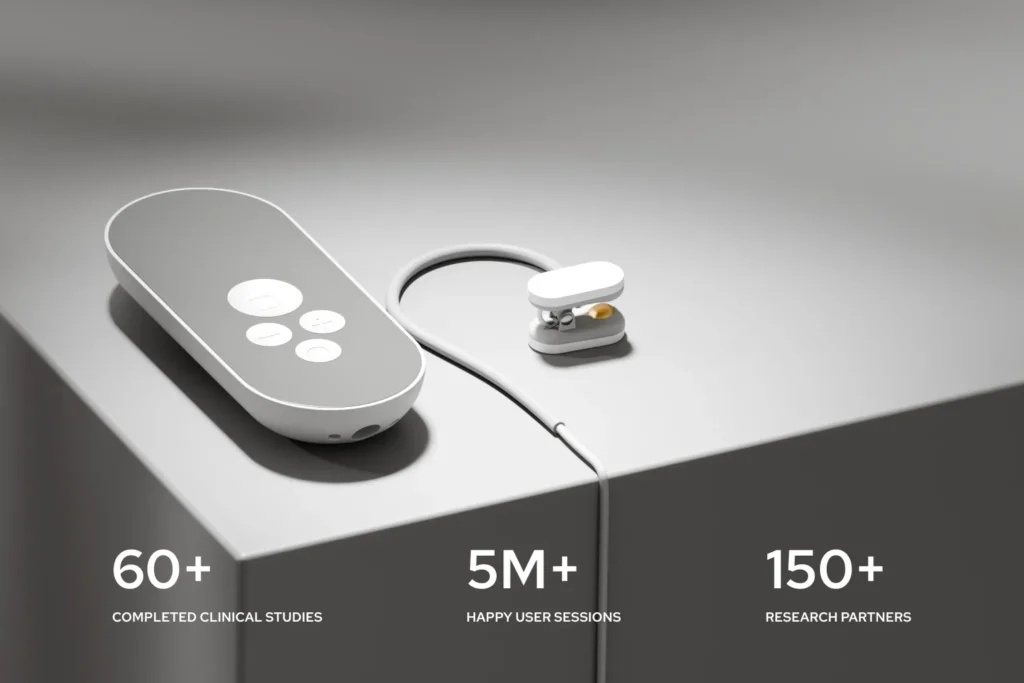
This is what I can tell you without overstating it:
- Nurosym has been part of 60+ scientific studies, mit 150+ research partners und more than 5 million user sessions.
- In a study of healthy young adults, ear-based stimulation was associated with an 18% improvement in heart rate variability (HRV) compared with a sham symptom.* HRV is a general marker of how flexibly the body adapts to stress.⁶
*Ergebnisse in bestimmten Studienpopulationen. Individuelle Ergebnisse können variieren.
What I am not saying: I am not saying this device treats bloating. Research on ear-based stimulation and digestive symptoms specifically is still in its early stages. What the research does show is that the nervous system side of the picture can be supported, and that this can sit alongside everything else you are already doing.
Who is this likely to suit?
Muster aus der realen Welt, die ich häufig sehe

People describe bloating in different ways:
- The desk-lunch eater. Meals happen between meetings, and bloating becomes more noticeable later in the day.
- The parent who eats last. Meals are interrupted, and there is little time to sit down.
- The careful eater. The "perfect" diet, the supplements, the daily walk, and the evening belly anyway.
- The one who plans around it. Dinners, parties and trips become harder to enjoy because of unpredictable bloating.
If one of these sounds like you, you aren’t doing anything wrong. Your day may simply never give your gut a clear signal that it can switch to “rest and digest”.
Two more things before you decide anything.
Who Might Benefit and Who Shouldn’t Use It
Nurosym may be worth exploring if you have a busy day, a belly that follows the clock, and you’ve already looked after food and the basics.
Do not use Nurosym if you:
- have a pacemaker or another implanted cardiac device
- are pregnant
- have had a serious cardiac event recently
- are under 18
If you have any other health symptom or take regular medication, speak to your health professional first.
More important than any device: see your health professional promptly if you have
- blood in your stool
- unexplained weight loss
- persistent pain
- bloating that is new, severe or getting steadily worse, especially after the age of 50
- a swollen belly with vomiting, or a change in your bowel habits that doesn't settle
Bloating is common and usually harmless, but it should be checked when these signs are present.
An Honest Balance

Before we talk about cost, this is the balanced view I give anyone who asks me:
Why people choose it | What to keep in mind |
About 15 minutes a day, during things you already do | It is a real purchase, not an impulse buy |
No drugs, no prescription, no gel or app | Not a substitute for medical advice or testing |
A growing body of published research | Evidence for digestive symptoms specifically is still developing |
30-tägige Geld-zurück-Garantie | Results vary, and it works best alongside other habits |
Thinking About the Cost
Start with your own number.
Add up what you’ve spent over the last year on supplements, probiotics, tests, specialist foods, enzymes and the next thing you tried. Most people are surprised by the total, and they pay those costs every month.
Nurosym works differently. It is a one-off purchase, with nothing to refill and no subscription. It costs €700, which comes to just under €2 a day over the first year.
That is still a real decision. This is what makes it easier to take.
Eine sichere Möglichkeit, es auszuprobieren

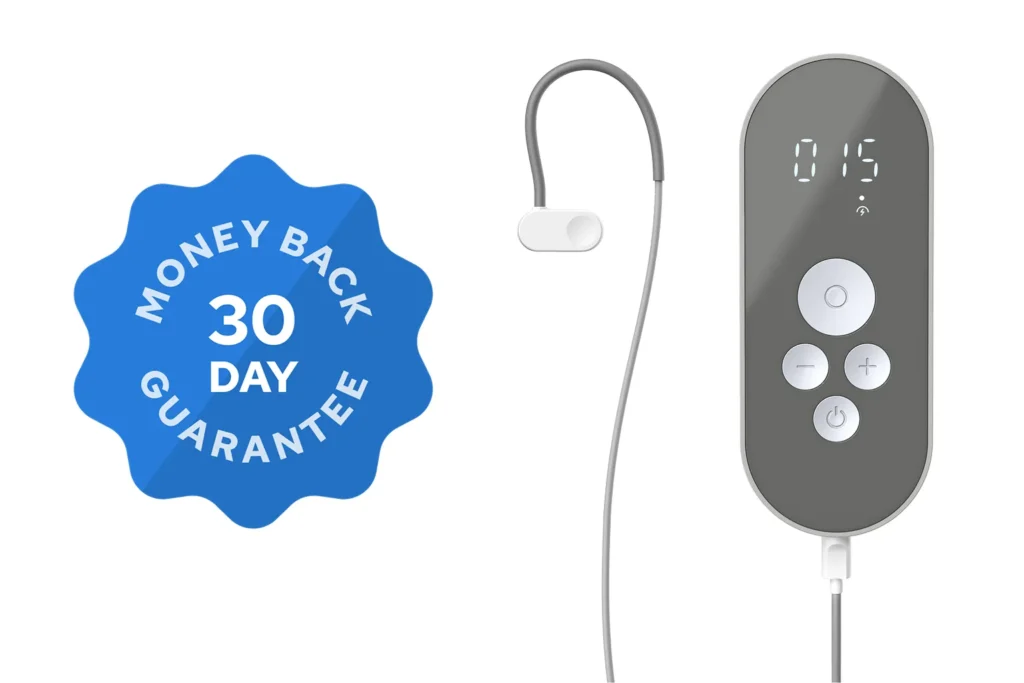
The guarantee takes the financial risk out of trying it. It doesn’t make the device right for everyone, which is why the safety list above matters.
30-tägige Geld-zurück-Garantie. Use it for a month in your normal routine. If it doesn’t feel right for you, you can return it.
Final Thoughts: A Better Question Than “What Should I Cut Next?”
Flat at breakfast. Bloated by evening. For a long time, the only question was what was on your plate.
If you saw yourself in the desk-lunch, last-to-eat, or plan-around-it kind of day, you may be looking at a pattern worth understanding.
Maybe the next thing to change isn’t what’s on your plate. Maybe it’s worth paying attention to what your body goes through between breakfast and bedtime and giving your nervous system a gentle, easy signal to switch to “rest and digest”.
If you’ve explored the food side and the evening belly still comes back, learning more about nervous system support and Nurosym may be a sensible next step.
EXCLUSIVE OFFER FOR OUR READERS: Get 5% Off Nurosym From Our Editorial Team!
This article is informational and does not replace professional medical advice. It has been published in partnership with Nurosym.
Referenzen
- IFFGD. Abdomino-phrenic dyssynergia (APD). https://iffgd.org/gi-disorders/abdomino-phrenic-dyssynergia-apd/
- British Society of Gastroenterology. Management of bloating. https://www.bsg.org.uk/Web-Education/Management-of-Bloating
- Maxton DG, Martin DF, Whorwell PJ, Godfrey M. Abdominal distension in female patients with irritable bowel syndrome: exploration of possible mechanisms. Darm 1991;32(6):662-664. https://gut.bmj.com/content/32/6/662
- NHS. Irritable bowel syndrome (IBS): Causes. https://www.nhs.uk/conditions/irritable-bowel-syndrome-ibs/
- Park, H. J., Jarrett, M., Cain, K., & Heitkemper, M. Psychological distress and GI symptoms are related to severity of bloating in women with irritable bowel syndrome. Res Nurs Health 2008;31(2):98-107. https://pubmed.ncbi.nlm.nih.gov/18181134/
- Geng D, Liu X, Wang Y, Wang J. The effect of transcutaneous auricular vagus nerve stimulation on HRV in healthy young people. PLoS ONE 2022;17(2):e0263833. https://doi.org/10.1371/journal.pone.0263833



 German
 English
 French
 Spanish
 Swedish
 Italian