
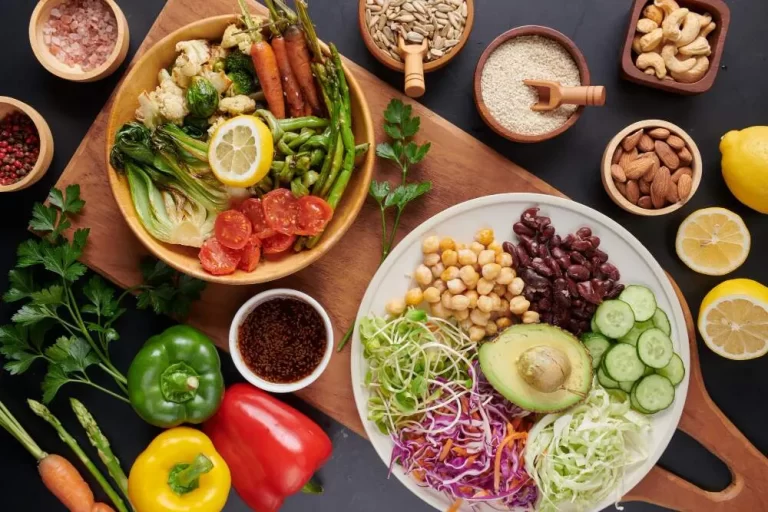
Points clés
- Les régimes à base de plantes – en particulier les aliments entiers, versions minimalement transformées – sont liés à risques plus faibles des maladies cardiaques, du problème régulier de sucre dans le sang, certains cancers et une mortalité toutes causes confondues réduite.
- Les régimes à base de plantes sains (riches en légumes, grains entiers, légumineuses et noix) surpassent les versions malsaines (avec des céréales raffinées, des aliments sucrés et des produits ultra-transformés à base de plantes) dans la gestion des symptômes chroniques.
- Des organismes professionnels majeurs tels que l’American Heart Association recommandent les habitudes alimentaires à base de plantes comme pierre angulaire de la prévention et de la thérapie des maladies.
- Les régimes alimentaires riches en plantes peuvent moduler une inflammation systémique de faible grade, modifier la composition du microbiote intestinal (vers des producteurs d’acides gras à chaîne courte) et améliorer la sensibilité à l’insuline – probablement grâce à une augmentation des fibres, des phytochimiques et des antioxydants.
- Les lacunes nutritionnelles (par exemple, B12, fer, oméga-3) peuvent être comblées avec des compléments et des aliments enrichis, rendant ainsi à long terme des régimes à base de plantes bien planifiés sûrs et efficaces.
Pourquoi est-ce important
Les symptômes chroniques tels que des problèmes cardiaques, des problèmes de régulation de la glycémie, des symptômes inflammatoires intestinaux et certains cancers continuent d’imposer un lourd fardeau à la santé publique. Bien que les médicaments et les interventions chirurgicales restent essentiels, un nombre croissant de recherches suggère que les régimes à base de plantes peuvent offrir un complément puissant – ou même une alternative – en ciblant les facteurs sous-jacents des maladies chroniques.
De nombreuses personnes gérant des symptômes chroniques – fatigue, pensées anxieuses ou détresse digestive – trouvent que la nourriture joue un rôle beaucoup plus important dans leur rétablissement qu’on ne le pensait auparavant.
Ce que la science dit
Des méta-analyses récentes à grande échelle ont confirmé que les personnes qui suivent un régime alimentaire à base de plantes présentent des risques significativement plus faibles de maladies chroniques. Une étude portant sur plus de deux millions de personnes a révélé que l’observance d’un régime alimentaire sain à base de plantes était corrélée à un risque réduit de 18 % de problèmes de régulation de la glycémie, une réduction de 10 % des problèmes cardiaques et une baisse de 16 % de la mortalité toutes causes confondues.
Sur le plan mécanistique, les régimes à base de plantes semblent réduire l’inflammation systémique, comme en témoignent les niveaux plus faibles de protéine C-réactive (CRP) dans plusieurs études. Ils améliorent également la sensibilité à l’insuline, équilibrent les profils lipidiques et réduisent la pression artérielle. Les changements dans le microbiote intestinal vers des bactéries produisant plus d’acides gras à chaîne courte–améliorent la régulation immunitaire et l’intégrité intestinale.
Pendant ce temps, des phytochimiques comme les polyphénols et les caroténoïdes peuvent réguler à la baisse l’expression génique pro-inflammatoire.
Que disent les experts ?
L’American Heart Association recommande des habitudes alimentaires axées sur les plantes qui mettent l’accent sur les légumes, les légumineuses, les noix, les grains entiers et les fruits pour prévenir les maladies cardiaques. De même, un autre chercheur reconnaît que les régimes à base de plantes sont associés à un meilleur contrôle de la glycémie et peuvent réduire le besoin de médicaments.
Des recherches pionnières du Dr Dean Ornish ont montré que les régimes végétaliens à base d’aliments entiers faibles en gras – combinés avec des changements de mode de vie – peuvent inversé rétrécissement de l’artère coronaire. La recherche du Dr. Neal Barnard a démontré comment les régimes à base de plantes peuvent améliorer la fonction de l’insuline chez les personnes ayant des problèmes de régulation de la glycémie de type 2.
Cependant, les experts avertissent que tous les régimes à base de plantes ne sont pas sains. Une étude a révélé que les régimes riches en aliments végétaliens ultra-transformés (par exemple, boissons végétales sucrées, fausses viandes) étaient associés à plus haut risque de mortalité, soulignant l’importance de la qualité des aliments.
Équilibre nutritionnel : Forces et lacunes
Les régimes à base de plantes et d’aliments complets sont riches en fibres alimentaires, magnésium, folates, antioxydants et phytochimiques, tous liés à une meilleure santé cardiovasculaire et immunitaire. Ils sont naturellement faibles en graisses saturées et en cholestérol, deux contributeurs majeurs aux maladies cardiaques.
Cependant, des régimes mal planifiés peuvent entraîner des carences en vitamine B12, en acides gras oméga-3 à longue chaîne (EPA/DHA), en fer, calcium et iode. Ces écarts sont gérables grâce à des aliments et des suppléments enrichis, mais nécessitent une planification intentionnelle – surtout pour les personnes âgées, les femmes enceintes ou celles ayant des besoins nutritionnels élevés.
les résultats du monde réel
Dans une grande étude observationnelle, les hommes atteints d’un cancer de la prostate à un stade précoce qui consommaient plus d’aliments végétaux ont connu une progression de la maladie 47 % plus lente par rapport à ceux qui consommaient plus de viande et de produits laitiers. Les participants ont également signalé une meilleure qualité de vie urinaire et sexuelle – ce qui suggère que la consommation de plantes est bénéfique à la fois pour la physiologie et le bien-être.
Popularité et perception
L’intérêt des consommateurs pour la vie à base de plantes augmente, motivé par des préoccupations en matière de santé, de durabilité environnementale et de bien-être animal. Cependant, des obstacles à l’adoption subsistent : les habitudes culturelles, le coût perçu, les mythes nutritionnels et la dépendance aux options végétaliennes ultra-transformées pratiques.
Orientations futures
Des études scientifiques émergentes explorent les thérapies à base de plantes pour les symptômes intestinaux inflammatoires, la stéatose hépatique et même les conditions neurodégénératives. La nutrition personnalisée basée sur le microbiote intestinal ou le profil génétique gagne également en popularité, ce qui pourrait potentiellement affiner les utilisateurs qui bénéficient le plus des stratégies à base de plantes.
Vos prochaines étapes :
Chaque petit changement compte.
Commencez par ajouter une portion supplémentaire d’aliments à base de plantes complètes aujourd’hui, et remarquez comment votre énergie et votre digestion réagissent au cours de la semaine suivante.
Enseignements finaux
Les régimes à base de plantes ne sont pas une solution universelle, mais les preuves sont de plus en plus claires : lorsqu’ils se concentrent sur des aliments entiers et riches en nutriments et qu’ils sont soutenus par des conseils d’experts, ils peuvent être un outil puissant pour gérer – et dans certains cas inverser – les symptômes chroniques. Pour ceux qui naviguent sur le long terme, explorer une approche à base de plantes peut ouvrir de nouvelles possibilités pour la récupération, la vitalité et la santé durable.
Cet article de blog est fourni à titre informatif et ne remplace pas l’avis d’un professionnel de santé. Consultez toujours un professionnel de santé pour obtenir des conseils personnalisés..
Abonnez-vous gratuitement pour des articles de santé plus éclairants adaptés à vos besoins.
Sources
- Wang Y, Liu B, Han H, Hu Y, Zhu L, Rimm EB, et al. Associations between plant-based dietary patterns and risks of type 2 diabetes, cardiovascular disease, cancer, and mortality – a systematic review and meta-analysis. Nutrition Journal [Internet]. 2023 Oct 4;22(1):46. Available from: https://pubmed.ncbi.nlm.nih.gov/37789346/
- Satija A, Bhupathiraju SN, Spiegelman D, Chiuve SE, Manson JE, Willett W, et al. Healthful and Unhealthful Plant-Based Diets and the Risk of Coronary Heart Disease in U.S. Adults. Journal of the American College of Cardiology [Internet]. 2017 Jul 25;70(4):411–22. Available from: https://www.ncbi.nlm.nih.gov/pubmed/28728684
- American Heart Association. The american heart association’s diet and lifestyle recommendations [Internet]. American Heart Association. American Heart Association; 2024. Available from: https://www.heart.org/en/healthy-living/healthy-eating/eat-smart/nutrition-basics/aha-diet-and-lifestyle-recommendations
- ElSayed NA, Aleppo G, Bannuru RR, Beverly EA, Bruemmer D, Collins B, et al. Facilitating Positive Health Behaviors and Well-being to Improve Health Outcomes: Standards of Care in Diabetes—2024. Diabetes Care. 2023 Dec 11;47(Supplement_1):S77–110.
- Sidhu SRK, Kok CW, Kunasegaran T, Ramadas A. Effect of Plant-Based Diets on Gut Microbiota: A Systematic Review of Interventional Studies. Nutrients. 2023 Mar 21;15(6):1510.
- Melina V, Craig W, Levin S. Position of the Academy of Nutrition and Dietetics: Vegetarian Diets. Journal of the Academy of Nutrition and Dietetics [Internet]. 2016 Dec;116(12):1970–80. Available from: https://www.ncbi.nlm.nih.gov/pubmed/27886704
- Jafarnezhad F, Nazarzadeh A, Bazavar H, Keramat S, Ryszkiel I, Stanek A. Vegan and Plant-Based Diets in the Management of Metabolic Syndrome: A Narrative Review from Anti-Inflammatory and Antithrombotic Perspectives. Nutrients [Internet]. 2025 Aug 15 [cited 2025 Sep 1];17(16):2656. Available from: https://pmc.ncbi.nlm.nih.gov/articles/PMC12389504/
- Thomas MS, Calle M, Fernandez ML. Healthy Plant-Based Diets Improve Dyslipidemias, Insulin Resistance, and Inflammation in Metabolic Syndrome. A Narrative Review. Advances in Nutrition. 2022 Dec;14(1).
- Gardner CD, Vadiveloo MK, Petersen KS, Anderson CAM, Springfield S, Van Horn L, et al. Popular Dietary Patterns: Alignment With American Heart Association 2021 Dietary Guidance: A Scientific Statement From the American Heart Association. Circulation [Internet]. 2023 Apr 27;147(22). Available from: https://www.ahajournals.org/doi/full/10.1161/CIR.0000000000001146
- Łuszczki E, Boakye F, Zielińska M, Dereń K, Bartosiewicz A, Oleksy Ł, et al. Vegan diet: nutritional components, implementation, and effects on adults’ health. Frontiers in Nutrition [Internet]. 2023 Nov 9;10(10). Available from: https://www.ncbi.nlm.nih.gov/pmc/articles/PMC10665534/
- Liu VN, Van Blarigan EL, Zhang L, Graff RE, Loeb S, Langlais CS, et al. Plant-Based Diets and Disease Progression in Men With Prostate Cancer. JAMA network open [Internet]. 2024 May 1 [cited 2024 May 2];7(5):e249053. Available from: https://pubmed.ncbi.nlm.nih.gov/38691361/
- Yu X, Pu H, Voss M. Overview of anti-inflammatory diets and their promising effects on non-communicable diseases. British Journal Of Nutrition [Internet]. 2024 Oct 16;132(7):1–21. Available from: https://www.cambridge.org/core/journals/british-journal-of-nutrition/article/overview-of-antiinflammatory-diets-and-their-promising-effects-on-noncommunicable-diseases/AA3166846841DCC1B219C063F52E2A7F
- Zhuang P, Wang F, Yao J, Liu X, Li Y, Ao Y, et al. Unhealthy plant-based diet is associated with a higher cardiovascular disease risk in patients with prediabetes and diabetes: a large-scale population-based study. BMC medicine [Internet]. 2024 Autumn;22(1):485. Available from: https://pubmed.ncbi.nlm.nih.gov/39443972/
- Chang K, Parnham JC, Rauber F, Levy RB, Huybrechts I, Gunter MJ, et al. Plant-based dietary patterns and ultra-processed food consumption: a cross-sectional analysis of the UK Biobank. EClinicalMedicine. 2024 Nov 14;78:102931–1.



 French
  English
  German
  Spanish
  Swedish
Love how plants can help with chronic health—feels natural
Great read—more veggies mean better everyday health