Has llevado tu cuerpo al límite.
Tus piernas están pesadas. Tus ojos se cierran. Tus métricas sugieren que necesitas descansar.
Pero el sueño -el verdadero sueño- no vendrá.
En el deporte de élite, hablamos sin fin sobre la carga de entrenamiento, la potencia y la nutrición.
El sueño a menudo recibe una breve mención al final del protocolo de recuperación.
Apunta durante ocho horas. Evita las pantallas antes de dormir. Mantén tu habitación fresca.
Y luego los atletas se despiertan a las 3 de la mañana después de su bloque de entrenamiento más duro del año, miran al techo durante dos horas y se preguntan por qué un consejo que funciona para otros no parece funcionar para ellos.
He competido a un nivel de élite en mountain bike cross y cyclo-cross durante más de quince años.
Representé a Alemania en los Juegos Olímpicos de Tokio 2020, participé en campeonatos mundiales y europeos y gané títulos nacionales alemanes en tres disciplinas.
En todo ese tiempo, una cosa se me ha vuelto más clara que casi cualquier otra:
El agotamiento y la recuperación no son lo mismo. Y la calidad del sueño no se determina simplemente por lo cansado que estés.
Cuando el entrenamiento no es el problema... el sistema nervioso
Todos los atletas serios rastrean alguna versión de datos de recuperación en estos días.
La variabilidad de la frecuencia cardíaca es el indicador al que apuntan la mayoría de los entrenadores y fisiólogos. Proporciona información sobre algo que los números de carga de entrenamiento por sí solos no pueden capturar:
Cuán bien se ha recuperado tu sistema nervioso autónomo de las demandas que se le han hecho.
Comencé a monitorear seriamente mi HRV varios años en mi carrera profesional.
Lo que encontré fue esto: la relación entre entrenamiento y recuperación es más compleja que simplemente entrenar duro y dormir más tiempo.
Hubo períodos en los que mi entrenamiento estaba estructurado, mi nutrición era correcta y yo hacía todo lo recomendado por los protocolos.
Y sin embargo, mi HRV permaneció suprimido, mi sueño era inquieto, y me desperté sintiendo como si no hubiera recargado completamente.
Lo que llegué a entender, a través de esa experiencia y la ciencia del deporte que leí sobre el tema, es esto:
El cuerpo tiene un mecanismo específico que facilita la transición del desempeño a la recuperación.
Y en los atletas que entrenan intensamente (particularmente los atletas de resistencia que llevan cargas acumuladas pesadas a lo largo de una larga temporada), ese mecanismo puede verse comprometido de maneras que el consejo sobre la higiene del sueño por sí solo no puede resolver.
Lo que el deporte de élite me enseñó sobre la diferencia entre descanso y recuperación
En la bicicleta de montaña, el cross-country y el cyclo-cross, te adentras repetidamente en zonas de intensidad máxima y casi máxima.
Estos no son deportes de resistencia puramente estacionarios.
Son disciplinas explosivas y técnicamente exigentes que requieren que el sistema nervioso sostenga un alto rendimiento bajo presión durante períodos prolongados.
Este tipo de carreras no solo resultan en cansancio muscular.
Impulsa el sistema nervioso simpático hacia una alta activación sostenida: aumenta el cortisol, se eleva la frecuencia cardíaca y todo el sistema está preparado para el rendimiento.
Esa activación es necesaria para el rendimiento, pero surgen problemas cuando no se apaga.
He visto este patrón claramente en mis propios datos y en conversaciones con otros atletas de todo el deporte.
Después de los bloques más exigentes de entrenamiento o carrera, el cuerpo permanece fisiológicamente activado mucho tiempo después de que haya terminado el esfuerzo físico.
El sueño puede llegar, pero a menudo está fragmentado.
HRV se mantiene bajo.
La frecuencia cardíaca en reposo no vuelve al valor basal tan rápidamente como se esperaba.
La profundidad del sueño (la eficacia con que produce la recuperación) va a la zaga de las horas pasadas en la cama.
Lo que finalmente entendí fue que no estaba lidiando con un problema de sueño.
Estaba lidiando con un problema de regulación del sistema nervioso... y eso requiere un enfoque diferente.
La mayoría de los consejos sobre recuperación en fisiología no abordan
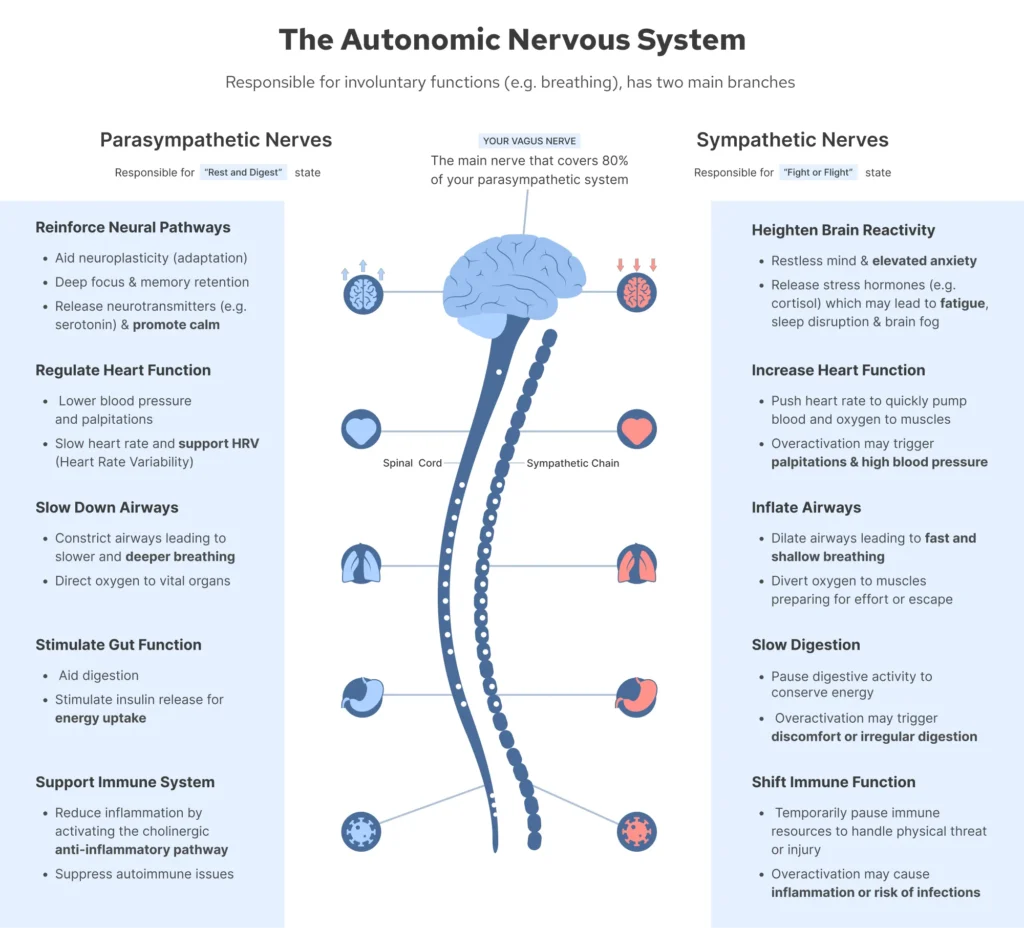
El sistema nervioso autónomo opera en dos modos primarios.
El sistema simpático gobierna el rendimiento y el modo de supervivencia.
Aumenta la frecuencia cardíaca, moviliza la glucosa, suprime los procesos no esenciales y prepara cada sistema para la salida.
En la competencia, este es tu motor.
El sistema parasimpático representa el modo de recuperación y reparación.
Ralentiza el corazón, activa la digestión, inicia la reparación de los tejidos y reduce el cortisol.
Crea el estado interno necesario para un sueño reparador.
En un sistema nervioso que funciona bien, estos dos sistemas se mantienen en equilibrio.
Después del esfuerzo, el sistema parasimpático se reafirma: la HRV aumenta, el sueño se profundiza, la adaptación ocurre y el rendimiento mejora.
Pero en los atletas que llevan cargas de entrenamiento pesadas a lo largo de largas temporadas competitivas (combinadas con viajes, competencia y la vida), ese equilibrio puede cambiar.
El sistema simpático se vuelve dominante en una porción más amplia del día, incluyendo las horas destinadas a la recuperación.
El resultado se puede medir en datos que los atletas ya rastrean:
- Supresión de la HRV
- Frecuencia cardíaca en reposo elevada que no vuelve a la base estacional
- Sueño que parece tener una duración completa en un rastreador, pero se siente superficial y poco refrescante
Estos no son signos de un sueño insuficiente.
Indican una recuperación parasimpática insuficiente.
Y es en la brecha entre esos dos problemas donde la mayoría de los consejos estándar para la recuperación se quedan cortos.
El nervio vago: El mecanismo detrás de la recuperación
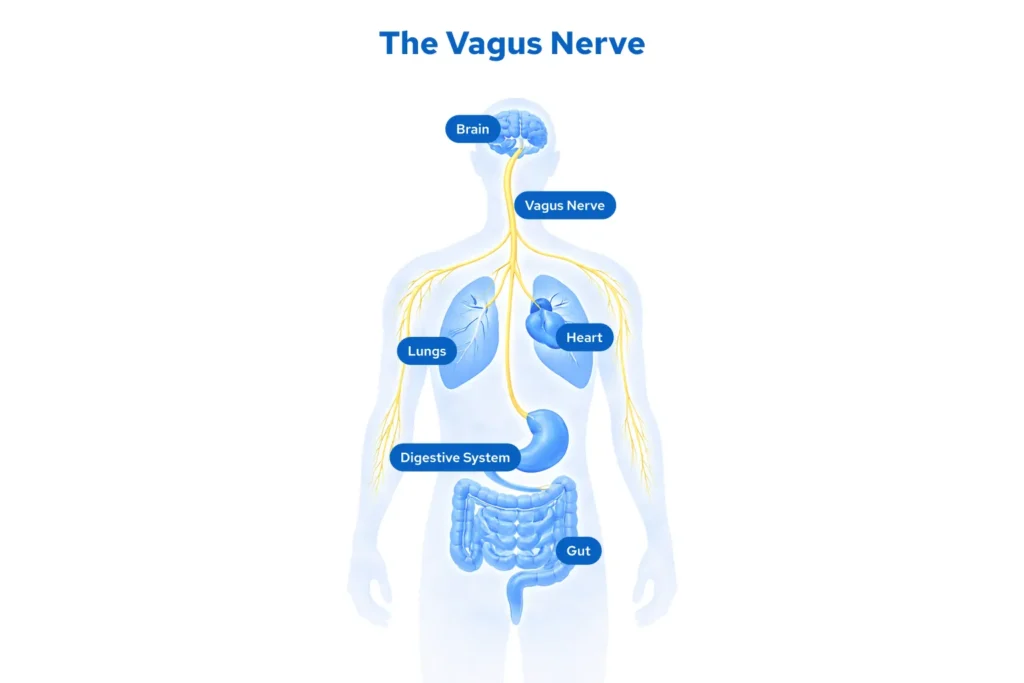
La clave fisiológica para pasar del estado simpático al parasimpático es el nervio vago.
Es el nervio más largo y complejo del sistema nervioso parasimpático. Discurre desde el tronco encefálico a través del cuello, pecho y en los órganos abdominales... Regular el ritmo cardíaco, el ritmo respiratorio, la señalización inflamatoria, la digestión y la capacidad fundamental del cuerpo para pasar de un nivel inferior de rendimiento a una reparación.
Esto es lo que importa para los atletas:
La variabilidad de la frecuencia cardíaca -el indicador que sigue todo atleta serio- es esencialmente una medida del tono vagal.
Cuando el nervio vago regula activamente el corazón, la HRV es alta y variable. El sistema nervioso puede responder de manera más efectiva.
Cuando se suprime el tono vagal, la HRV es baja. El cuerpo permanece atascado en un estado de activación elevado.
En la ciencia del deporte y la investigación científica, la reducción del tono vagal se ha asociado con:
- Supresión de la HRV que no vuelve a la línea de base dentro del plazo previsto para la recuperación
- Sueño más ligero, más fragmentado, con tiempo reducido en etapas profundas y REM
- Frecuencia cardíaca en reposo elevada se mantuvo por encima de las curvas normales posteriores al esfuerzo
- Aumento de los marcadores inflamatorios como IL-6 y TNF-alfa, que pueden acumularse con una carga de entrenamiento pesada y una recuperación parasimpática inadecuada
- Problemas de sueño previos a la competición y dificultad para conciliar el sueño a pesar del cansancio físico genuino
- Marcadores del síndrome de sobreentrenamiento: cansancio persistente, alteración del estado de ánimo, deterioro del rendimiento que el descanso por sí solo no resuelve
Cada uno de estos resultados es visible en los datos que ya se están recopilando.
La conexión entre el tono vagal y la recuperación atlética no es un concepto de bienestar.
Es una fisiología medible.
Por qué la calidad del sueño y no la duración determina si el entrenamiento se convierte en rendimiento
En el deporte de resistencia, hay un principio al que los entrenadores regresan repetidamente:
No te pones en mejor forma durante el entrenamiento. Te pones en mejor forma durante la recuperación.
El entrenamiento proporciona el estímulo, y la recuperación es donde ocurre la adaptación.
La ventana más crítica para esa consolidación es el sueño profundo (específicamente las etapas de ondas lentas y REM), donde se libera la hormona del crecimiento, se incorporan patrones motores, se alcanzan los picos de reparación de tejidos y se procesa y reduce el estrés acumulado del entrenamiento.
Un atleta que duerme 7 horas pero pasa la mayor parte de ella en etapas más ligeras del sueño no se recupera tanto como el entrenamiento requiere.
Acumulan un déficit que se agrava a lo largo de una temporada, eventualmente manifestando como niveles de rendimiento, mayor susceptibilidad a lesiones, alteraciones del estado de ánimo y un cansancio persistente que incluso semanas completas de descanso solo se resuelven parcialmente.
La profundidad con la que un atleta alcanza esas etapas restauradoras depende de la eficacia con la que el sistema parasimpático haya tomado el relevo del sistema simpático.
Que depende directamente del tono vagal.
Por eso la recuperación de alto nivel no es simplemente una cuestión de terminar a tiempo.
Por qué los baños de hielo, la terapia de compresión y el trabajo respiratorio no siempre son suficientes
Los atletas de élite ya utilizan un conjunto de herramientas de recuperación significativo.
- Inmersión en agua fría
- Terapia de compresión
- Mousse de roulement
- Días de descanso estructurado
- Respiration
- Monitoreo del sueño
Todos estos son partes estándar de un programa profesional.
He usado cada uno de ellos a lo largo de mi carrera, y cada uno tiene un valor genuino en el contexto adecuado.
Sin embargo, comparten una limitación importante:
Apoyan el estado corporal para la recuperación, en lugar de involucrar directamente al mecanismo parasimpático que impulsa la recuperación.
La exposición al frío puede crear un cambio agudo hacia el dominio parasimpático a través del reflejo de inmersión, pero el efecto es efímero.
El trabajo respiratorio puede ayudar a modular el sistema nervioso en el corto plazo, pero requiere práctica constante y una técnica considerable para producir cambios medibles en el tono vagal basal.
Estas son herramientas útiles...
También son indirectos.
A lo que la investigación apunta cada vez más es al valor de estimulando directamente el propio nervio vago, involucrando la vía parasimpática de manera más directa, en lugar de crear el estado que podría activarla.
Stimulation transcutanée auriculaire du nerf vague (taVNS) lo hace mediante la entrega de una señal eléctrica suave y calibrada a la rama auricular del nervio vago a través del oído externo, el único lugar en la superficie del cuerpo donde se puede acceder directamente a una rama de un nervio craneal sin cirugía.
La estimulación apunta a la vía regulatoria que determina si el cuerpo puede hacer el cambio del estado de desempeño simpático a la recuperación parasimpática.
Este es el mismo cambio que aparece en los datos de HRV, la arquitectura del sueño y cómo se siente un atleta al despertar.
Aquí está el replanteamiento para el movimiento de cierre, cinco secciones en un trozo, tratado como el arco final del artículo.
Dónde encaja Nurosym
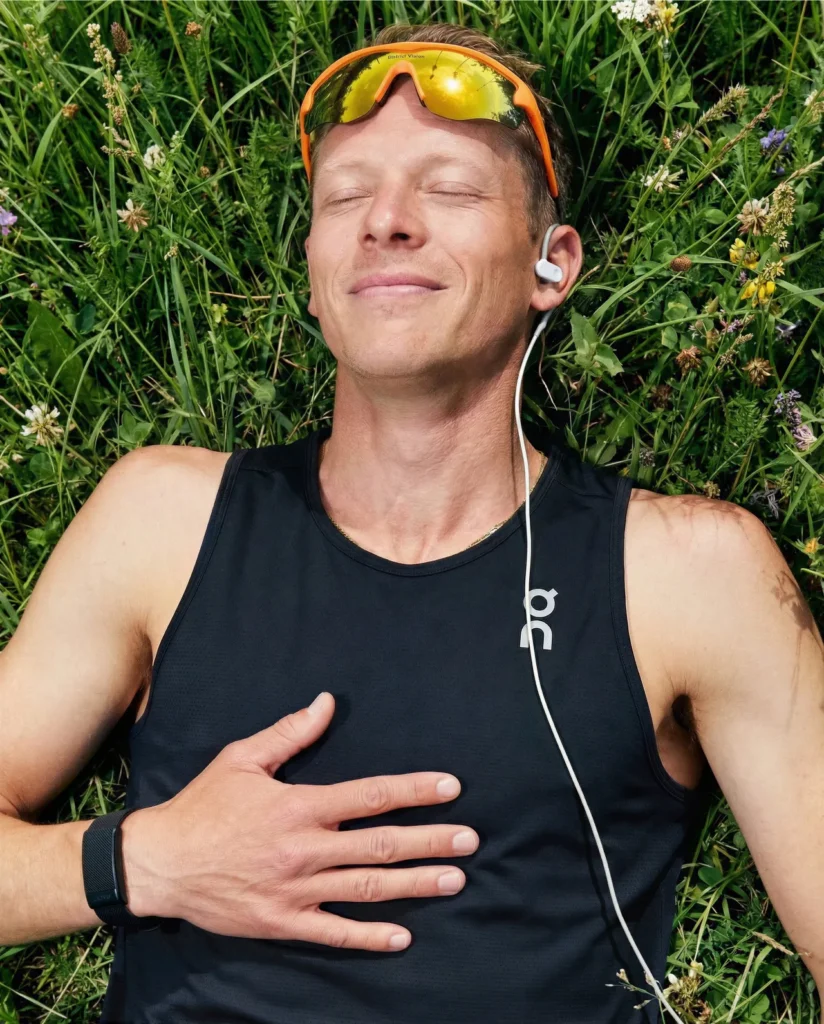
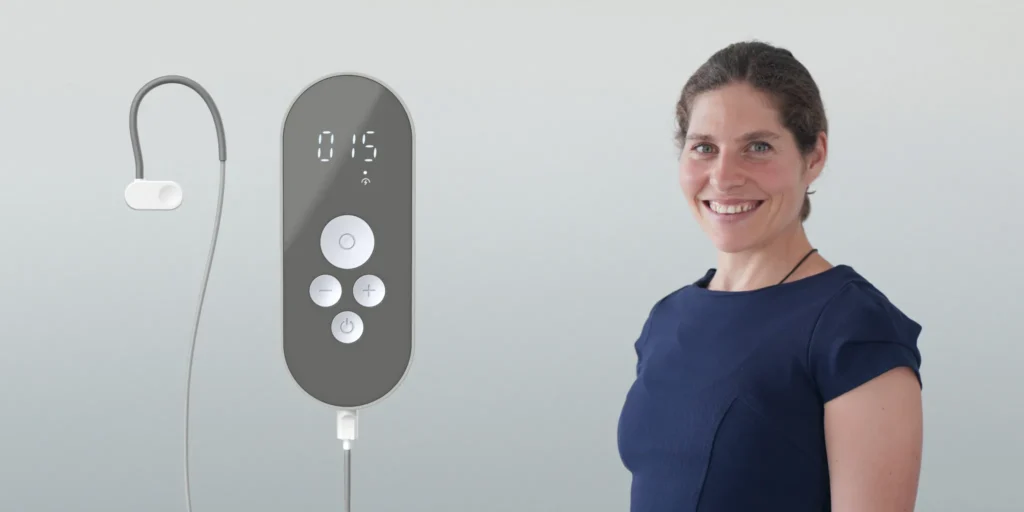
La razón por la que terminé mirando específicamente a Nurosym, en lugar de los otros dispositivos de esta categoría, fue su base de investigación.
Lo que me hizo estar dispuesto a involucrarme seriamente fue que la tecnología subyacente ha sido estudiada en más de 50 estudios científicos completos, incluyendo trabajos publicados en Harvard, Yale y el Imperial College de Londres.
La investigación se relaciona directamente con los patrones que he descrito.
La evidencia no tiene que ver con la relajación general o el manejo del estrés en el sentido de bienestar del consumidor.
Se trata de cambios medibles en la función autonómica:
- Mejora del HRV
- Reducción de marcadores inflamatorios
- Cambios en la arquitectura del sueño
- Cambios en la eficiencia de las transiciones del sistema nervioso entre la activación y la recuperación
Para los atletas que ya hacen un seguimiento de estas métricas, el encuadramiento es importante.
La pregunta no es si algo se siente relajante. La pregunta es si produce cambios medibles en los marcadores fisiológicos de recuperación.
En ese contexto, la base de evidencia para la tecnología de Nurosym es considerablemente más sustancial que cualquier otra cosa disponible actualmente en esta categoría.
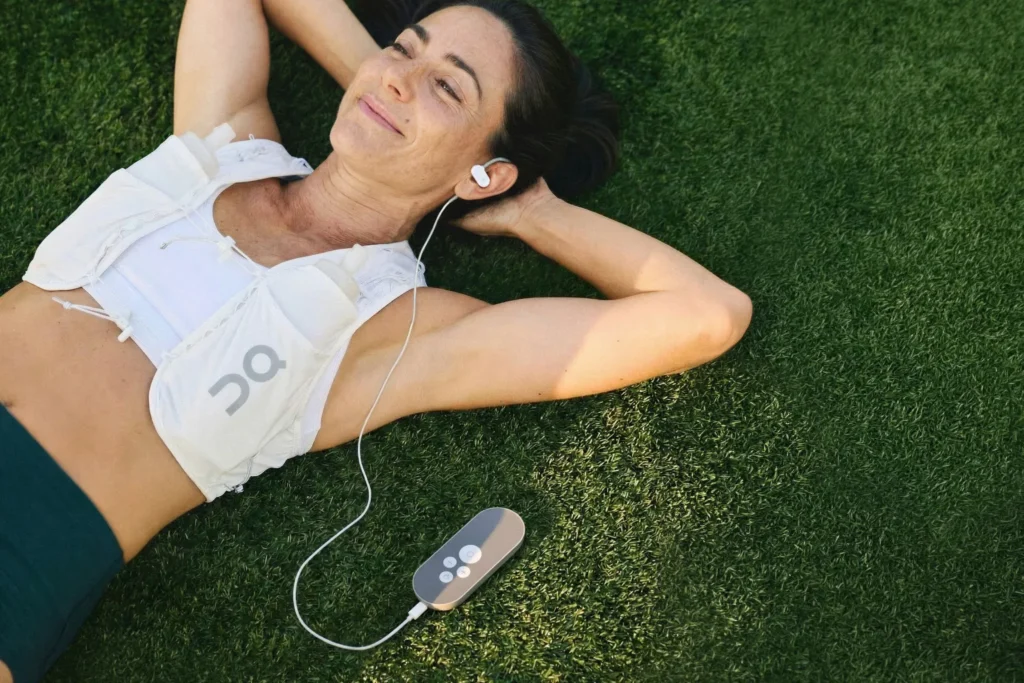
El dispositivo se utiliza típicamente durante unos 30 minutos al día. Se adapta al tiempo de recuperación existente, lo que hace que sea práctico evaluar contra su propia HRV y los datos de sueño durante un cierto período, sin reestructurar una semana de entrenamiento.
Ce que la recherche montre
Nurosym es un dispositivo con marca CE que ha sido estudiado en más de 50 estudios científicos, incluyendo colaboraciones con Harvard, Yale y el Imperial College de Londres.
La investigación publicada sobre esta tecnología ha encontrado:
- Mejoras significativas en la variabilidad de la frecuencia cardíaca, incluyendo los componentes de alta frecuencia más estrechamente asociados con la actividad parasimpática y la calidad del sueño
- Reducciones en los marcadores inflamatorios (IL-6, TNF-alfa), que se elevan por la carga de entrenamiento sostenida y la recuperación parasimpática suprimida
- Mejoras científicamente significativas en la calidad del sueño, incluido un estudio científico aleatorizado de 2024 publicado en Réseau JAMA ouvert, en personas con problemas crónicos de sueño, sin señales notables de seguridad
- Reducción de la reactividad fisiológica al estrés y mejora de la capacidad para la regulación descendente autónoma
Qui est le plus susceptible de bénéficier
- Atletas de resistencia y alta intensidad cuya HRV sigue suprimida más allá de los plazos previstos para la recuperación
- Los atletas están durmiendo suficientes horas pero despertaban con la sensación de que su sueño era superficial o poco refrescante
- Aquellos que experimentan cansancio físico combinado con dificultad para conciliar el sueño o permanecer dormido durante los bloques de entrenamiento pesados o períodos de competición
- Atletas cuyos problemas de sueño previos a la competición están afectando la confianza o la preparación para el desempeño
- Cualquiera que haya optimizado la carga de entrenamiento, la nutrición y la higiene del sueño pero todavía no se recupera al ritmo de sus demandas de entrenamiento
Qui ne doit pas l’utiliser
Los dispositivos Nurosym y VNS no deben ser utilizados por personas que:
- Avoir un stimulateur cardiaque ou un dispositif cardiaque implanté
- Étre enceinte
- Vous avez eu récemment un événement cardiaque grave
- ont moins de 18 ans
Como con cualquier intervención, las circunstancias individuales importan.
Si tiene un historial médico complejo o está manejando una complicación de salud existente, consulte a un profesional de la salud calificado antes de comenzar.
Una forma práctica de probarlo
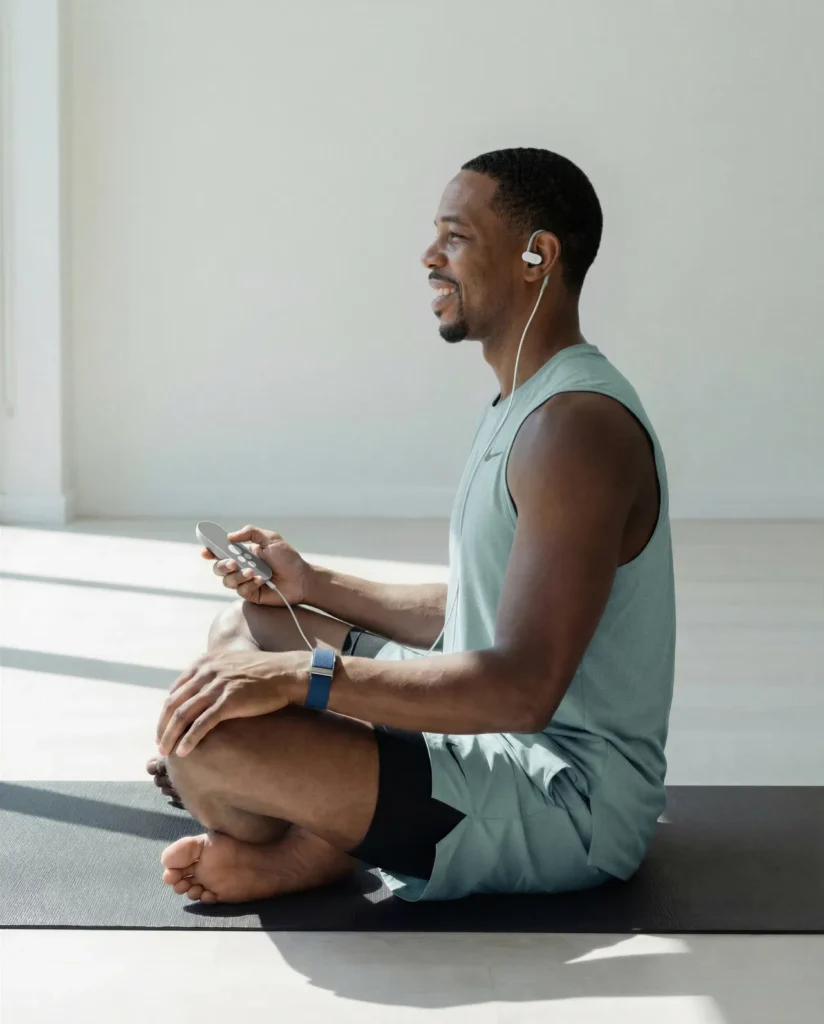
Prueba de 30 días en casa. Nurosym incluye una prueba domiciliaria de 30 días con un reembolso completo si no notas un cambio significativo en tus marcadores de recuperación o la calidad del sueño.
Programa de investigación. Nurosym lleva a cabo un programa continuo de investigación de usuarios. Los participantes elegibles que aportan datos de experiencia reciben un subsidio de 70 €. Detalles y elegibilidad en el momento de la inscripción.
El dispositivo se ajusta a tu tiempo de recuperación existente. No requiere visita de especialista ni receta médica, lo que hace que sea fácil probarlo junto con su HRV existente y el seguimiento del sueño, durante un período significativo.
El entrenamiento que no puedes saltarte
En quince años de competir al más alto nivel, la lección que me llevó más tiempo asimilar completamente es esta:
La calidad de la recuperación determina la calidad del rendimiento de manera más confiable que el volumen de entrenamiento.
No se puede entrenar por fuera a un sistema nervioso que no puede bajar de velocidad.
La adaptación no ocurre.
El rendimiento no mejora.
Y durante una temporada larga, la brecha entre lo que demanda el entrenamiento y lo que el sistema nervioso puede ofrecer se vuelve visible de maneras que son difíciles de revertir rápidamente.
El sueño es donde esa brecha se cierra o se ensancha.
El nervio vago es el mecanismo que determina cuál.
Para los atletas que han hecho todo lo demás bien y aún no pueden lograr la recuperación, sus demandas de entrenamiento, abordar ese mecanismo directamente puede ser el paso perdido.
Cet article de blog est fourni à titre informatif et ne remplace pas l’avis d’un professionnel de santé. Consultez toujours un professionnel de santé pour obtenir des conseils personnalisés..
Références
- Garbellotto, L., Petit, E., Brunet, E., Gillet, V., Bourdin, H., and Mougin, F. (2022). Complete sleep evaluation of top professional cross-country mountain bikers’ athletes. Journal of Sports Medicine and Physical Fitness, 62(2), 265-272. https://doi.org/10.23736/S0022-4707.21.12059-6
- Chouchou, F., and Desseilles, M. (2014). Heart rate variability: A tool to explore the sleeping brain? Frontiers in Neuroscience, 8, 402. https://doi.org/10.3389/fnins.2014.00402
- Cooper, T. M., McKinley, P. S., Seeman, T. E., Choo, T. H., Lee, S., and Sloan, R. P. (2015). Heart rate variability predicts levels of inflammatory markers: Evidence for the vagal anti-inflammatory pathway. Brain, Behavior, and Immunity, 49, 94-100. https://doi.org/10.1016/j.bbi.2014.12.017
- Kim, A. Y., Marduy, A., de Melo, P. S., Gianlorenco, A. C., Kim, C. K., Choi, H., Song, J. J., and Fregni, F. (2022). Safety of transcutaneous auricular vagus nerve stimulation (taVNS): A systematic review and meta-analysis. Scientific Reports, 12, 22055. https://doi.org/10.1038/s41598-022-25864-1
- Zhang, S., et al. (2024). Transcutaneous auricular vagus nerve stimulation for chronic insomnia disorder: A randomized clinical trial. JAMA Network Open, 7(12), e2451217. https://doi.org/10.1001/jamanetworkopen.2024.51217
- Lastella, M., Roach, G. D., Halson, S. L., et al. (2015). Sleep/wake behaviour of endurance cyclists before and during competition. Journal of Sports Sciences, 33(3), 293-299. https://doi.org/10.1080/02640414.2014.925926
- Chalmers, J. A., Quintana, D. S., Abbott, M. J. A., and Kemp, A. H. (2014). Anxiety disorders are associated with reduced heart rate variability: A meta-analysis. Frontiers in Psychiatry, 5, 80. https://doi.org/10.3389/fpsyt.2014.00080
- Bremner, J. D., et al. (2020). Transcutaneous vagal nerve stimulation blocks stress-induced IL-6 and IFN-gamma in posttraumatic stress disorder: A double-blind, randomized, sham-controlled trial. Brain, Behavior, and Immunity – Health, 9, 100138. https://doi.org/10.1016/j.bbih.2020.100138



 French
  English
  German
  Spanish
  Swedish
  Italian