I often notice it on the table before anyone says the word “tired.”
Someone comes in for a stiff neck or a nagging lower back, and within minutes I’m not just feeling sensitive muscles. I’m feeling a body that hasn’t settled in months. Shallow breathing. Shoulders braced as if expecting a hit that never lands. One person described it better than any textbook has: “It’s like my body is stuck running a programme I can’t switch off, even when I’m lying still.”
That’s when I ask myself the real question: is the pain actually the problem, or is it just the part of a wider pattern that happens to hurt enough to book an appointment?
At Remedium Wellness, tiredness and recovery are a core part of what we work on, so I see this pattern every week. Treating endurance athletes, exhausted parents and people in high-stress jobs has taught me that ongoing tiredness rarely shows up alone. It often comes with a nervous system stuck in a low gear, one that can’t find its way back to “rest and recover” even when the person wants it to. This is the first of ten things I wish I’d understood sooner, long before someone first asked me about the small device at the centre of this piece.

The Pain Wasn’t Always the Whole Problem
For years, I treated the presenting complaint (the neck, the back, the shoulder) as the whole story, and moved on once it eased. I was wrong more often than I’d like to admit. What I started noticing instead was that the complaint bringing someone onto my couch was sometimes just the visible part of something bigger. The stiff neck came with poor sleep. The recurring back tension came with weeks of feeling “tired but wired.” The athlete who couldn’t shake one niggle also wasn’t recovering properly between sessions. Different complaints, but often the same wider pattern: the body wasn’t settling between one demand and the next.
On the couch, it often shows up as shallow breathing, a rib cage that barely moves, and muscles that stay guarded even when I’m being gentle.
That pattern involves the système nerveux autonome (the part of the nervous system running your heart rate, digestion and energy levels in the background, without you thinking about it) staying too long in sympathetic overdrive (“fight or flight”), unable to find its way back to the état parasympathique (“rest and digest”) where recovery happens.
I stopped assuming the physical complaint was the end of the conversation. Often, it was only the opening line.

I Went Straight to the Research
When someone first asked me about taVNS (transcutaneous auricular vagus nerve stimulation, meaning vagus nerve stimulation delivered through the skin of the ear), my instinct was scepticism. As an Osteopath, I’m trained to be wary of anything that claims to change how the body regulates itself, so I read the published studies before I said a word to anyone. My standard is simple: show me peer-reviewed data, or I don’t put my name next to it.
What struck me wasn’t a single impressive statistic. It was the range of what researchers were measuring: HRV (heart rate variability, a readout of how well your nervous system recovers between stressors), sleep, tiredness scores. A broad picture like that is what you’d expect if the thing being studied is the autonomic nervous system itself, not just one symptom.

What I Could Change on the Table Wasn’t Always Holding Between Sessions
I can help someone’s body settle during a session: their breathing slows, their shoulders drop, a held tension releases under my hands. What frustrated me was how often that shift didn’t last until their next appointment, sometimes not even until they’d got home. My office can only reach so far: an hour, once or twice a month. I started asking what could support the hours I’m not there. Manual therapy can help in the room, but it can’t do anything for the other twenty-three hours of the day.
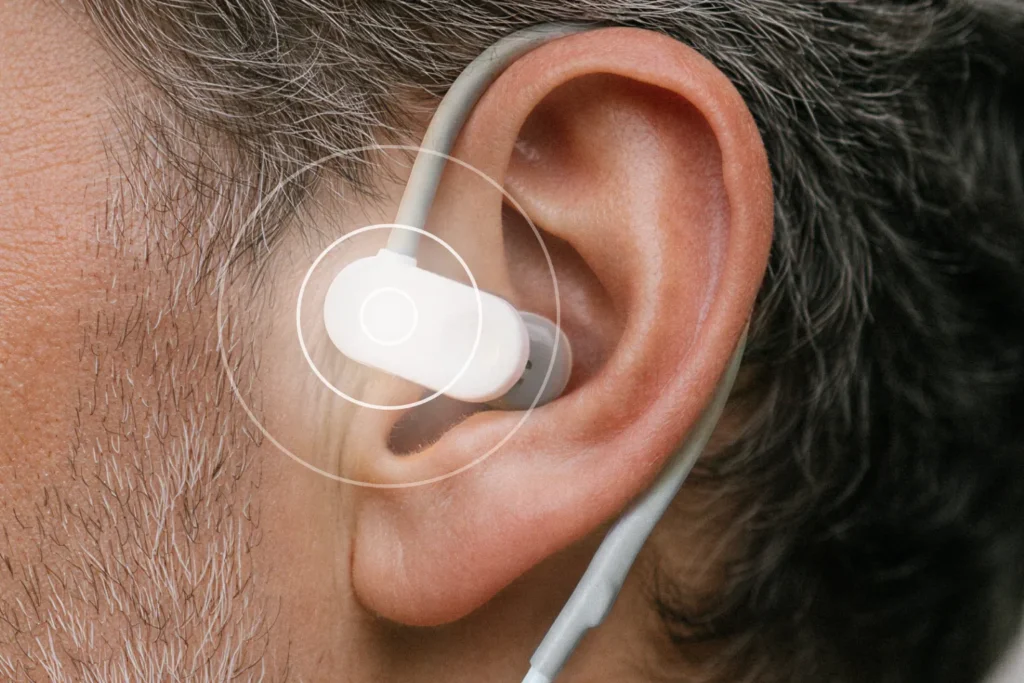
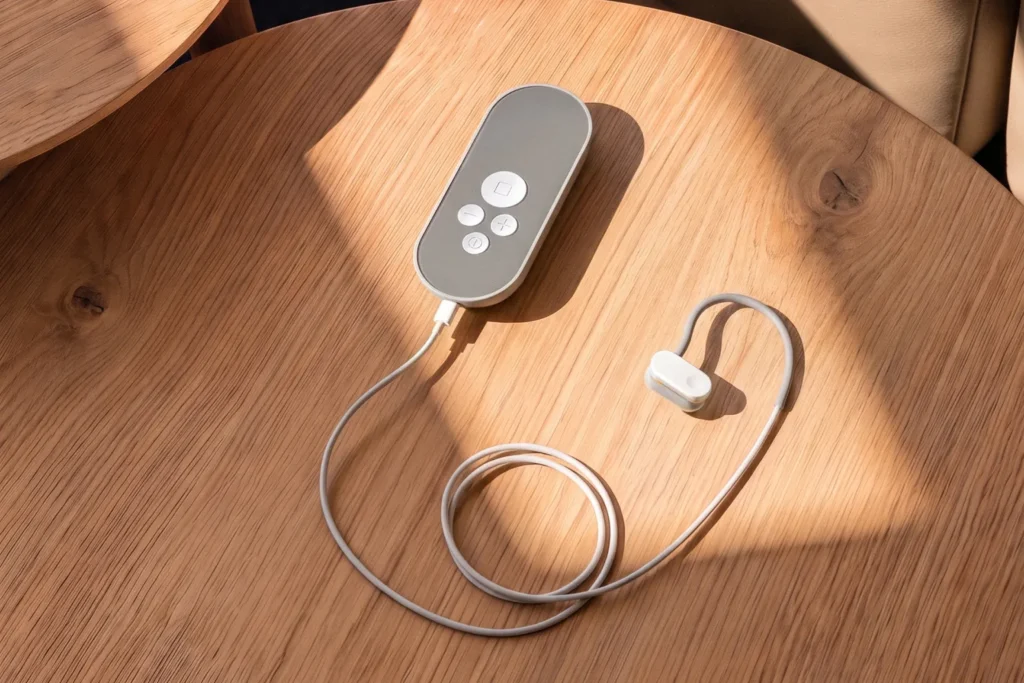
The device the research kept pointing to for that gap is called Nurosym. It’s a small wearable that clips onto the left ear and delivers AVNT™ (Auricular Vagal Neuromodulation Technology, calibrated electrical signals aimed at the vagus nerve) through the skin, with no needles and no surgery. What convinced me was the anatomy: a branch of the vagus nerve surfaces right at the ear, making it one of the few places on the body where you can reach it non-invasively. For me, it was a genuine answer to the hours I couldn’t reach with my hands, not a replacement for the hands-on work itself.

“Normal” Blood Tests Don’t Always Mean a Person Feels Normal
Many of the people who come to me have already seen their GP and been told their results are normal. They arrive with a stiff neck or a sore back and, almost as an afterthought, say they’re tired all the time.
- Iron: normal
- Thyroid: normal
- Vitamin D: normal
- GP: "nothing more I can suggest"
I’m not a GP and I don’t order these tests. But I do hear what happens next. People are told everything looks fine, and they keep feeling tired. That gap is where I started looking for something that could support the body’s own recovery, rather than another test or another supplement. If your tiredness is ongoing, it’s always worth speaking to your GP first to rule out other causes.

It Doesn’t Ask Anything From a System That’s Already Running on Empty
I’ve given plenty of people breathing exercises and stretches to do at home, and I know how often they quietly fall off the list. A routine that needs energy fails when energy is the problem.
Almost everyone who comes to me with ongoing tiredness has already tried something. Meditation, breathwork, cold showers, stretching routines: all of them are worth doing, and I tell people that honestly. But each one quietly asks for something a depleted person doesn’t have much of. Meditation asks for a calm mind to begin with. Breathwork asks for focus and a quiet room, hard to find mid-shift or with a toddler underfoot. Cold showers ask for a burst of motivation. Stretching asks for ten spare minutes that never seem to appear on the days you need them most. None of this is anyone’s fault. Most approaches are designed for people who already have some energy to spend.
Nurosym asks for much less. Sessions run from 15 to 60 minutes, and most people find that fits into the day without planning: ironing, reading on the sofa, eating lunch at your desk, hanging out washing. It doesn’t need an app or a new habit built from scratch. For someone who is already depleted, that can be the difference between something they stick with and one more well-intentioned routine filed away with the supplements.

Les chiffres à travers plusieurs systèmes sont difficiles à ignorer
With athletes I already watch resting heart rate and HRV to judge recovery, so I know how much these numbers matter.
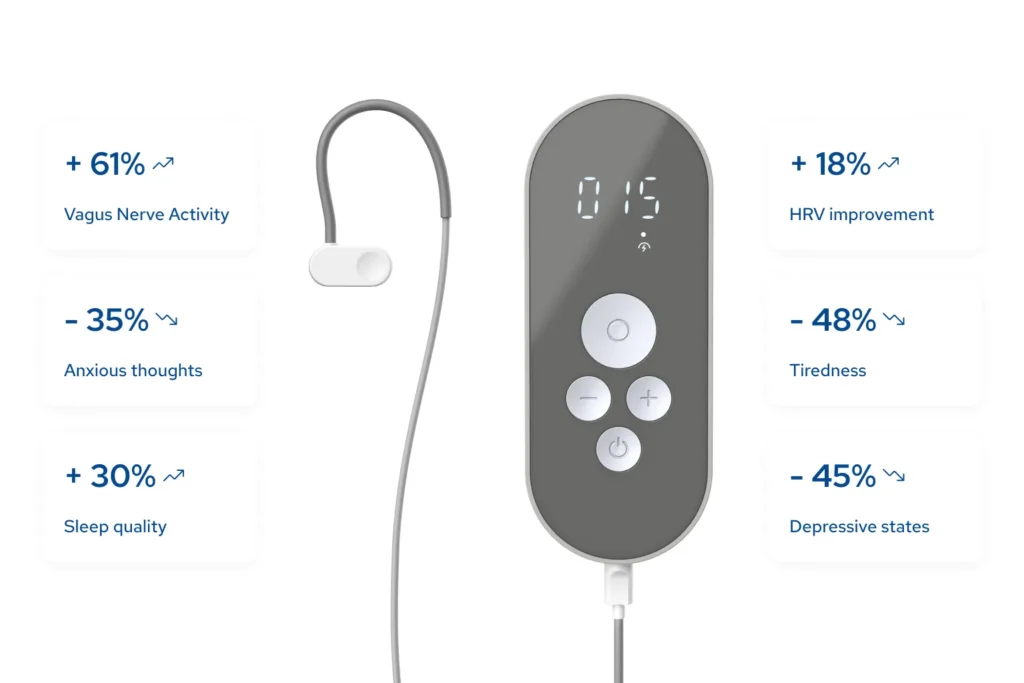
*Résultats dans des populations d’étude spécifiques. Les résultats individuels peuvent varier.
HRV is a number I already watch closely in athletes managing training load, so seeing it move in the same direction as reported tiredness scores in these studies was, for me, a reason to take the research seriously.

I Now Ask About Energy and Sleep at the First Appointment
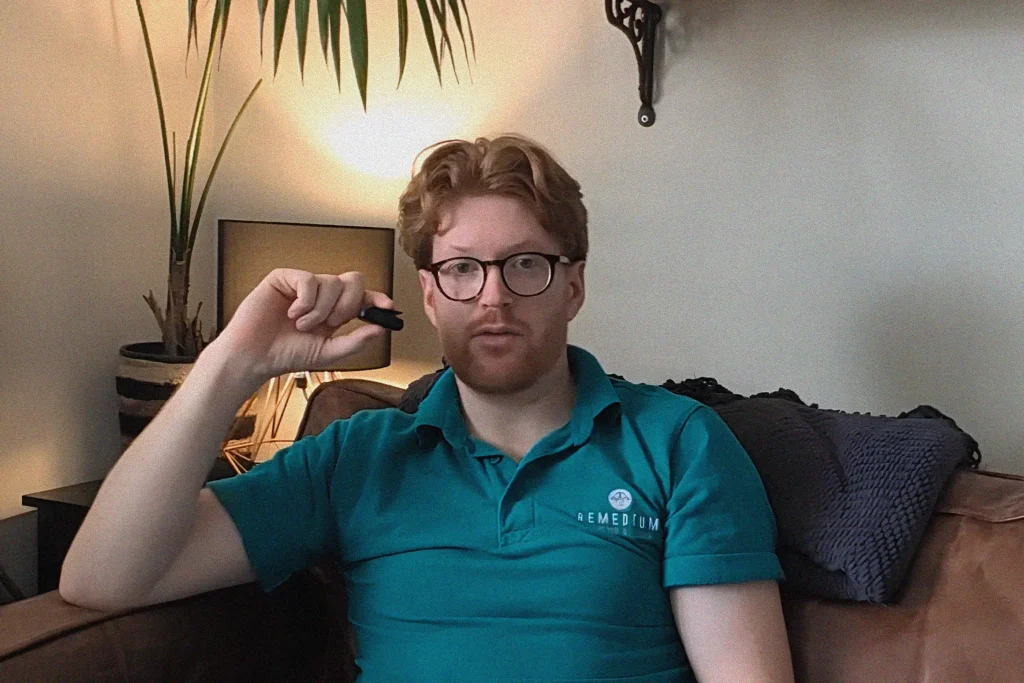
In my practice, the complaint that brings someone in is rarely the only thing on their mind. Someone comes in for an Achilles problem and mentions that their recovery has stalled. A parent comes in with neck pain from carrying a toddler and mentions that their sleep is broken. None of them came to ask about vagus nerve stimulation.
I can’t promise that anything will change, but I’ve learned to ask about energy and sleep in the first appointment, not the fifth.

Setup Is Easier Than I Expected, and That Matters More Than It Sounds
I assumed, before trying it myself, that a wearable device like this would come with a learning curve, settings to get wrong, a manual nobody reads. It doesn’t. The first session takes a couple of minutes: you clip it on, switch it on and adjust the intensity by feel, with no training needed to use it at home. I’ve heard people admit they nearly didn’t bother, expecting another gadget demanding patience they didn’t have. Given how often “too complicated to be worth it” is the real reason a good idea never gets tried, that simplicity matters more than it gets credit for.

It Isn’t an Overnight Change, and I Say So
When I talk to people about Nurosym, the first thing I tell them is that it isn’t a quick fix. It’s designed to be used regularly, over several weeks, and individual experiences vary. Some people notice something sooner, others later, and some may not notice much at all.
I’d rather under-promise. In my experience, the people who give up early are usually the ones who were told it would be fast. For someone who has been told for months that their results are fine and there’s nothing more to be done, a realistic, gradual expectation is often more reassuring than a big promise. It also fits how I work as an osteopath: the changes I care about build over time, not in one session.

Le prix semblait élevé. Ensuite, j’ai fait les maths.
I see what people spend trying to feel better: supplements, private tests, sessions with different practitioners. At €700, Nurosym is not a casual purchase, and I understand why people hesitate. I did too, before I looked at this properly. But set it against the months or years of supplement subscriptions that come and go, private blood panels, and appointments chasing the same ongoing tiredness. Measured against that cycle, a one-off device with a 30-day money-back guarantee looks considerably more reasonable than it did at first glance. I’m not going to pretend it suits every budget. But for people who have already spent far more than that trying to feel like themselves again, it’s a conversation worth having honestly.
If you’ve read this far because you recognise yourself in it, tired and tired of being told your results look fine, Nurosym won’t replace proper medical investigation, and I always encourage people to rule out other causes with their GP first. But as a wearable that asks very little of a system that’s already stretched thin, it’s one of the tools I’ve found worth knowing about.
Do not use Nurosym if you: have a pacemaker or other implanted cardiac or active medical device; have epilepsy; are pregnant; have had a recent serious cardiac event; or are under 18. For the full list of contraindications, please see the Nurosym website, and always consult a qualified healthcare professional before starting.
EXCLUSIVE OFFER FOR OUR READERS: Get 5% Off Nurosym From Our Editorial Team!
This article reflects my professional evaluation of the evidence and my experience in practice. It is published in partnership with Nurosym, and I may receive a referral arrangement from purchases made through links in this article.
Références
- Geng, et al. Auricular Vagal Neuromodulation Therapy (AVNT) significantly increases vagus nerve activity and heart rate variability in healthy subjects: a randomised, placebo-controlled study. Plosone, 2022. Link
- Anxiety symptoms reduction in Long COVID patients after Auricular Vagal Neuromodulation Therapy. Frontiers en Neurologie. Link
- Auricular Vagal Neuromodulation Therapy improves sleep score in Long COVID: a pilot study. Clinical and Experimental Rheumatology. Link
- Auricular Vagal Neuromodulation Therapy (AVNT) reduces fatigue in a one-group assignment study in post-viral syndrome patients. Advances in Neurology and Neuroscience Journal. Link


 French
 English
 German
 Spanish
 Swedish
 Italian