
Points clés
- Artificial intelligence (AI) is reshaping healthcare by improving diagnostics, therapy planning, drug discovery, user monitoring, and administrative efficiency.
- Benefits include more accurate results, faster access to care, and increasingly personalized solutions.
- Challenges remain: ethical dilemmas, data privacy risks, bias in algorithms, and the need for human oversight.
- The future of healthcare may involve a hybrid model—where AI augments rather than replaces health professionals, making care smarter, more accessible, and tailored to the individual.
A Glimpse Into Tomorrow’s Clinic
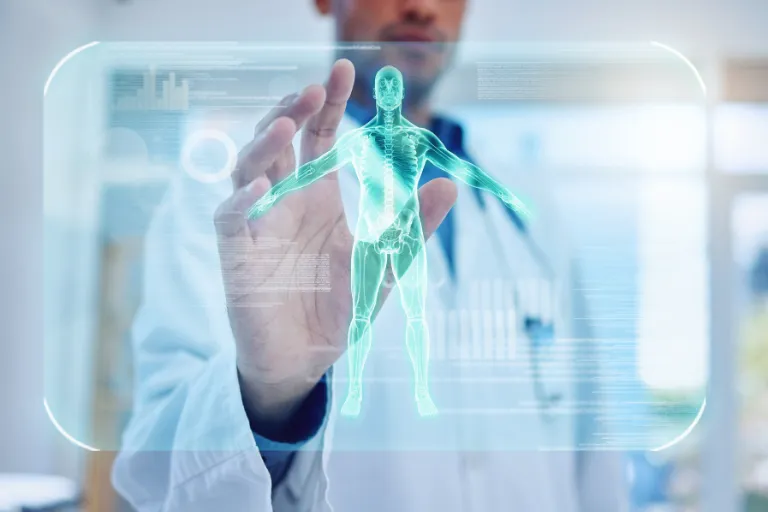
Imagine walking into a clinic where your health professional reviews not only your medical history but also insights from an AI system that has analyzed thousands of similar cases in seconds. The AI provides insights on the best therapy plan, predicts potential risks, and even suggests personalized lifestyle changes – all before your appointment ends.
This is not science fiction; it’s a glimpse into a healthcare future that is already unfolding. Artificial intelligence is no longer confined to labs or tech companies – it’s now part of everyday medicine, from radiology scans to wearable devices that monitor heart palpitations and sleep problems. Experts suggest that AI could help reduce medical errors, improve access to care, and make therapies more precise. Yet, as powerful as it is, AI raises questions about trust, fairness, and the role of human judgment in health decisions.
Why AI in Healthcare Matters for Users and Caregivers
Healthcare has always been about solving one problem: how to deliver better care to more people, faster and more effectively. Yet today’s system struggles with long wait times, rising costs, and uneven access across different regions and communities.
Enter AI – a technology once considered futuristic – is now part of routine healthcare workflows. For users, this means faster results, fewer missed diagnoses, and therapies that are increasingly personalized. But as with any breakthrough, AI comes with both opportunities and risks. Understanding both sides is crucial, because these innovations won’t just shape the future of healthcare – they’ll shape your own health journey.
Current Applications of AI: From Diagnostics to Drug Discovery
AI is already showing up in ways you may not notice:
- Smarter Diagnostics: AI systems now analyze X-rays, MRIs, and pathology slides with accuracy that in some cases matches or exceeds human experts.
- Personalized Therapy Planning: In cancer care, AI helps design targeted therapy plans by analyzing genetic data and historical outcomes.
- Real-Time Monitoring: AI-enabled wearables track symptoms such as heart palpitations or irritable gut patterns, alerting users and health professionals to early warning signs.
- Accelerated Drug Discovery: By analyzing millions of compounds, AI speeds up the process of finding new drugs that would otherwise take years.
- Streamlined Administration: Hospitals use AI to reduce paperwork, optimize scheduling, and cut costs, freeing health professionals to spend more time with users.
The impact is clear: faster diagnoses, better prevention, and more efficient care. But these advances also highlight critical challenges.
The Science Behind AI in Medicine
At its core, AI in healthcare relies on machine learning—training algorithms to recognize patterns in massive datasets. For example, medical imaging AI learns by comparing millions of labeled scans, improving its ability to detect disease with every iteration.
But the power of AI is only as strong as the data behind it. If datasets are incomplete or biased, AI systems may unintentionally reinforce existing healthcare disparities. That’s why regulatory bodies like the U.S. Food and Drug Administration (FDA) and the European Medicines Agency (EMA) are developing frameworks to ensure AI-driven solutions meet standards for accuracy, safety, and fairness.
Benefits and Opportunities: How AI Improves Care
For users, caregivers, and professionals, AI promises real benefits:
- Earlier Detection of Symptoms — AI can spot signs of disease earlier than traditional methods, which may improve long-term outcomes.
- Personalized Solutions — By analyzing genetics, lifestyle, and environment, AI can recommend therapies tailored to the individual.
- Increased Efficiency — By handling administrative tasks, AI reduces burnout among health professionals.
- Accessibility — AI tools can expand access in underserved areas, offering diagnostics and monitoring without requiring large specialist teams.
Ethical Challenges and Equity Concerns
The rise of AI in healthcare also introduces pressing challenges:
- Protection des données : Sensitive health records must be protected from misuse or breaches.
- Bias in Algorithms: AI trained on limited datasets may work less effectively for certain populations.
- Over-Reliance on Machines: AI is not infallible—it requires human oversight to catch errors and ensure ethical use.
- Unequal Access: High costs and limited infrastructure may leave lower-income regions behind, widening health gaps.
Real-World Example: AI in Eye Health
In 2023, the FDA authorized an AI system for detecting diabetic retinopathy, a leading cause of blindness. Users can now undergo a simple eye exam at their primary care clinic, with AI providing results within minutes. Instead of waiting weeks for a specialist, those at risk are referred more quickly, preventing complications and improving outcomes. This real-world case shows how AI is already transforming everyday healthcare.
Looking Ahead: The Future of AI and Your Health
AI in healthcare is not about replacing humans—it’s about expanding what’s possible. The future will likely be hybrid: humans and AI working together to deliver care that is faster, more accurate, and more personalized.
For users, this may mean earlier diagnoses, targeted therapies, and more convenient access to care. For health professionals, it means new tools that reduce burnout and enhance decision-making. As AI continues to advance, staying informed and asking the right questions will help you make the most of this revolution.
The next time you hear about AI in healthcare, remember—it’s not just about algorithms and data. It’s about shaping the future of your own health.
Etapes suivantes
Curious how AI might influence your healthcare? Ask your clinician whether AI-enabled tools are being used in diagnostics, scheduling, or monitoring at your hospital or clinic. Staying informed about these changes helps you understand – and participate in – the next wave of personalized, technology-assisted care.
Cet article de blog vise à être informatif et ne doit pas remplacer les conseils de santé professionnels. Toujours consulter un professionnel de santé pour des conseils personnalisés.
Abonnez-vous gratuitement pour des articles de santé plus éclairants adaptés à vos besoins.
Sources
- Alowais SA, Alghamdi SS, Alsuhebany N, Alqahtani T, Alshaya A, Almohareb SN, et al. Revolutionizing healthcare: the Role of Artificial Intelligence in Clinical Practice. BMC Medical Education [Internet]. 2023 Sep 22;23(1):1–15. Available from: https://bmcmededuc.biomedcentral.com/articles/10.1186/s12909-023-04698-z
- Fahim YA, Hasani IW, Kabba S, Ragab WM. Artificial intelligence in healthcare and medicine: clinical applications, therapeutic advances, and future perspectives. European journal of medical research. 2025 Sep 23;30(1).
- Bhinder B, Gilvary C, Madhukar NS, Elemento O. Artificial Intelligence in Cancer Research and Precision Medicine. Cancer Discovery [Internet]. 2021 Apr;11(4):900–15. Available from: https://aacrjournals.org/cancerdiscovery/article/11/4/900/665825/Artificial-Intelligence-in-Cancer-Research-and
- Shajari S, Kuruvinashetti K, Komeili A, Sundararaj U. The emergence of AI-based wearable sensors for digital health technology: A review. Sensors [Internet]. 2023 Nov 29;23(23):9498–8. Available from: https://pmc.ncbi.nlm.nih.gov/articles/PMC10708748/
- Norori N, Hu Q, Aellen FM, Faraci FD, Tzovara A. Addressing bias in big data and AI for health care: A call for open science. Patterns [Internet]. 2021 Oct 8;2(10):100347. Available from: https://pmc.ncbi.nlm.nih.gov/articles/PMC8515002/
- K. Akila, R. Gopinathan, J. Arunkumar, B. Sree Bavai Malar. The Role of Artificial Intelligence in Modern Healthcare: Advances, Challenges, and Future Prospects. European Journal of Cardiovascular Medicine [Internet]. 2025 Apr 19;15:615–24. Available from: https://healthcare-bulletin.co.uk/article/the-role-of-artificial-intelligence-in-modern-healthcare-advances-challenges-and-future-prospects-3187/


 French
  English
  German
  Spanish