
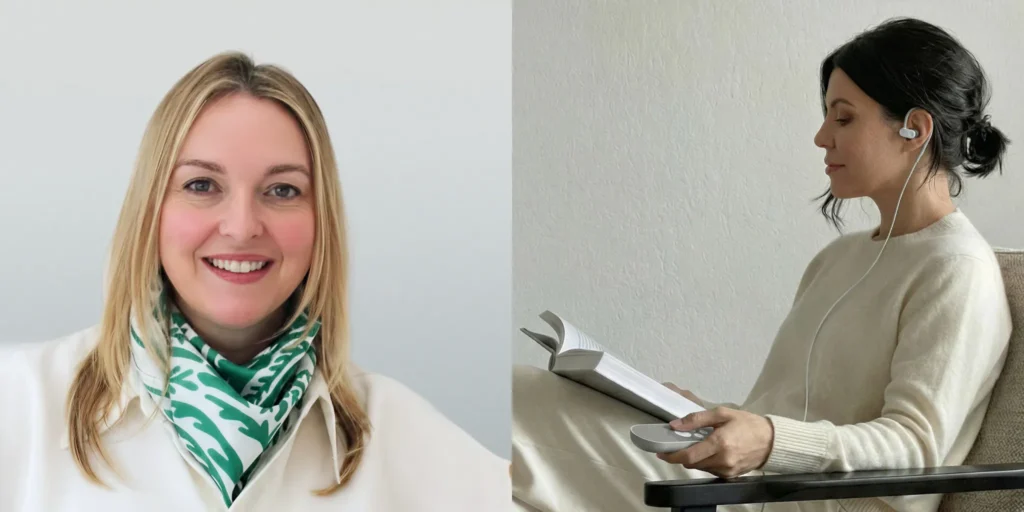
Samantha Grant is a Cognitive Hypnotherapist specialising in anxious thoughts, stress, and the subconscious patterns that keep people stuck. Trained in London, she combines Cognitive Hypnotherapy, PSYCH-K, and NLP in her scientific work. She practises across Berkshire and Buckinghamshire, with clinics in Marlow, Reading, and Caversham, and works with clients online across the UK. She has over a decade of scientific experience and is a member of the National Council for Hypnotherapy. Most clients experience meaningful, lasting change within around six sessions.
You know the thoughts are not logical. You have done the work. But the anxious thoughts keep returning.
It is a pattern many people recognise.
You have a good day.
You feel calm, in control, almost back to yourself.
And then, without obvious reason, the anxious thoughts return. A low hum of worry that sits just beneath the surface of everything. A tightness in the chest before meetings, before social plans, before nothing in particular at all.
You are not catastrophising, you are not being irrational.
You have worked hard on your thinking, and yet the anxious thoughts are still there, waiting.
This frustrating pattern, doing the inner work but still feeling on edge, is not a sign that the work is failing…
It is often a sign that something beneath the level of thought still needs attention.
When You Are Doing Everything Right, But the Anxious Thoughts Persist

Dans mon travail de Hypnothérapeute cognitif, I help people resolve anxious thoughts, stress, and the patterns of thinking that keep them stuck, using a combination of:
- Cognitive Hypnotherapy
- PSYCH-K
- NLP
These approaches work at the level of the subconscious mind, where thoughts, feelings, and behavioural patterns are rooted.
For most clients, they produce meaningful, lasting change.
Most people see a significant reduction in anxious thoughts through therapy alone.
But there is a group of clients who make genuine progress with the psychological work and still find that a background sense of unease persists.
Not the acute anxious thoughts they came in with, something quieter and harder to name.
A nervous system that seems reluctant to fully settle.
What I Have Noticed in Over a Decade of Helping People With Anxious Thoughts
Across hundreds of clients, there is a consistent pattern in those who find the anxious thoughts do not fully resolve through cognitive and psychological work alone.
They:
- Have made real progress with their thought patterns and core beliefs
- Understand the roots of their anxious thoughts intellectually
- Practice mindfulness, breathwork, or journaling regularly
- Are no longer experiencing acute anxious thoughts episodes
And yet a residual unease remains: a low-level vigilance, the sense of waiting for something to go wrong, even when nothing is, a body that does not quite feel at rest, even on good days.
These are not people who need more therapy.
In many cases, they have done excellent work. What they often need is support at a different level entirely: the physiological state that the nervous system is holding onto, independent of what the mind now knows.

The Science Behind Persistent Anxious Thoughts
In cognitive hypnotherapy, we work extensively with the relationship between thought patterns and the subconscious beliefs that drive them.
But there is a layer beneath that which therapy alone does not always reach.
The autonomic nervous system operates as a continuous background process, scanning the environment for threat and calibrating the body’s level of readiness in response.
This happens below the level of conscious thought, it does not wait for permission from the rational mind.
When this system becomes chronically calibrated toward a state of heightened readiness, it does not simply produce physical symptoms. It generates the mental experience of anxious thoughts as well.
The autonomic state does not follow the thoughts…
In many cases, it produces them.
A nervous system locked in a state of low-level sympathetic activation will generate anxious interpretations of neutral events. It will produce a sense of unease that attaches itself to whatever thought or circumstance is available. It will make ordinary situations feel faintly threatening, not because they are, but because the body is already primed to perceive them that way.
This is why people with chronically elevated stress responses often find that resolving one area of anxious thoughts simply relocates it somewhere else.
The content of the worry changes, but the underlying physiological state does not.
What that state produces in practice:
- Thoughts that feel urgent and threatening at a level that does not match the actual situation
- A sense of dread or unease that precedes any identifiable cause and follows cognitive work that has otherwise been effective
- Physical symptoms of tension that persist even when the mind is consciously calm
- An overactive threat-detection response that fires on low-stimulus inputs
- Difficulty accessing the genuine sense of safety that the cognitive work has intellectually established
The Vagus Nerve: The Signal That Tells the Body It Is Safe
The nervous system’s threat-detection response is a survival mechanism.
It is designed to activate quickly and resolve when the threat has passed.
The signal that tells the body it is safe to stand down travels primarily through the vagus nerve.
The vagus nerve is the longest nerve of the parasympathetic nervous system, running from the brainstem through the neck, chest, and abdomen. It regulates heart rate, breathing, inflammatory activity, and the body’s fundamental capacity to shift from a state of alert readiness into one of genuine safety and calm.
Here is what that means for anxious thoughts:
When vagal tone is adequate, the threat response resolves.
When it is not, the body stays primed, and the mind keeps producing reasons to justify that state.
This is not a metaphor.
It is the physiological mechanism behind the pattern that therapists see regularly: a client who has done real, meaningful work on their anxious thoughts, whose conscious understanding of their triggers is clear and well-developed, and who still cannot access the felt sense of safety that the work should have produced.
The vagus nerve is the missing step between knowing you are safe and being able to feel it.
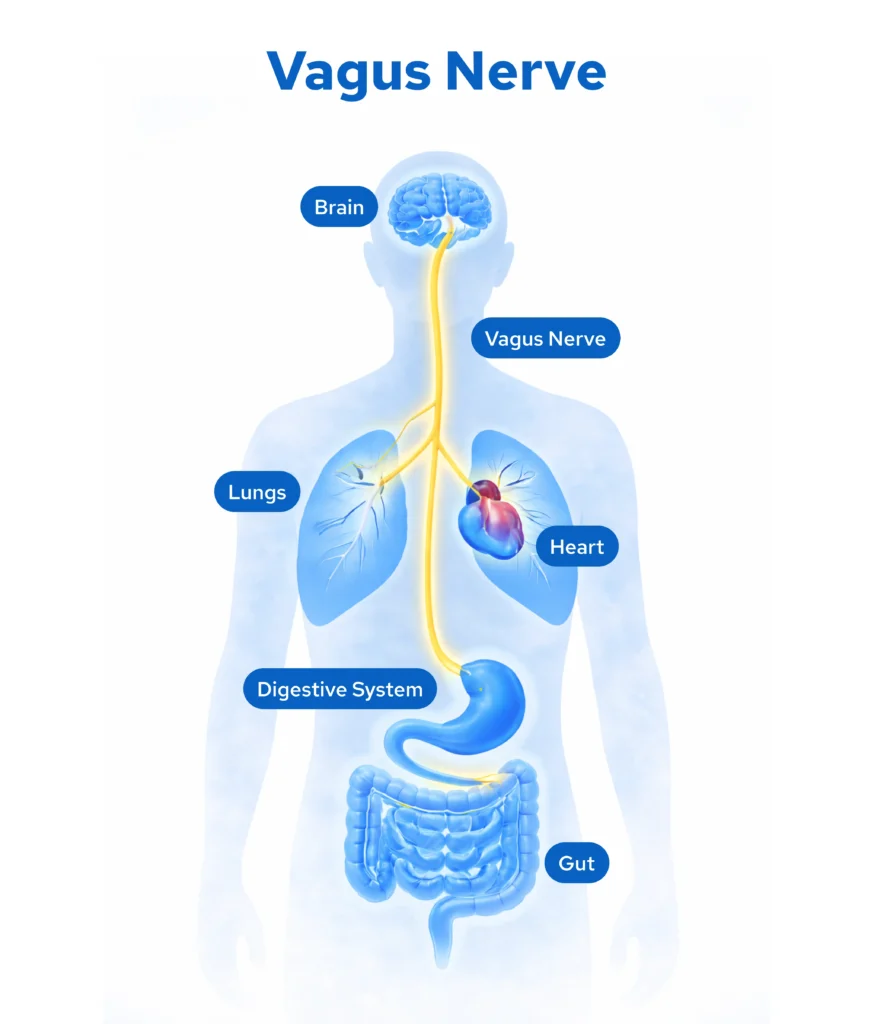
In published research, reduced vagal tone has been associated with:
- Heightened anxious thoughts and a lower threshold for threat activation
- Reduced heart rate variability, a validated marker of autonomic balance and stress resilience
- Increased inflammatory markers including IL-6 and TNF-alpha, which are elevated in chronic stress states
- Greater difficulty returning to physiological baseline following a stress response
- Impaired emotional regulation and increased reactivity to ordinary stressors
Why This Matters for Anxious Thoughts and Stress
In my work as a cognitive hypnotherapist, I focus on identifying and resolving the subconscious patterns that drive anxious thoughts and stress responses.
That work is meaningful and it produces real change.
But it has a ceiling for some clients.
When the nervous system’s baseline level of activation is high, the cognitive and subconscious work takes place on top of a physiological state that keeps generating new anxious thoughts.
You resolve one pattern and another surface. You address one trigger and the sense of threat migrates somewhere else.
The cognitive work addresses what the nervous system is responding to. Vagal support addresses the sensitivity of the response itself.
Both matter.
And for a meaningful subset of people with persistent anxious thoughts, the second has been largely unaddressed.
Supporting the Nervous System: Beyond the Talking Therapies
Breathwork, meditation, cold exposure, and physical exercise can all shift the nervous system toward a more regulated state, and I recommend a number of these to clients. In the right context, they are genuinely useful.
But they work on the surface of the problem, not the mechanism underneath it.
Breathwork, for instance, can produce an immediate and real shift in autonomic tone. But it requires you to be in a state of sufficient calm to do it effectively, which is precisely what is difficult for people with chronic anxious arousal. And its effects on resting vagal tone over time require sustained practice before they become measurable.
The same is true of meditation, exercise, and other indirect approaches. They are all changing the symptoms around the nervous system.
None of them directly engages the vagal pathway that sets the body’s baseline level of threat sensitivity.
In recent years, research interest has grown in a more targeted approach: Transcutaneous Auricular Vagus Nerve Stimulation (taVNS), which delivers a calibrated, gentle electrical signal to the auricular branch of the vagus nerve through the outer ear, the only location on the body’s surface where a cranial nerve branch is directly accessible.
It stimulates the vagal pathway at the source, rather than working toward it indirectly.
Où s’adapte Nurosym (soutien à domicile)
When I began looking seriously at taVNS as a potential complement to therapy, I was specifically interested in the question of physiological baseline: whether it was possible to support the nervous system’s resting level of threat sensitivity in a way that made the cognitive and hypnotherapeutic work more effective and more durable.
What brought me to Nurosym specifically was the breadth and quality of the research behind its technology.
Most tools in the consumer wellness space that claim to support the nervous system come with limited independent evidence…
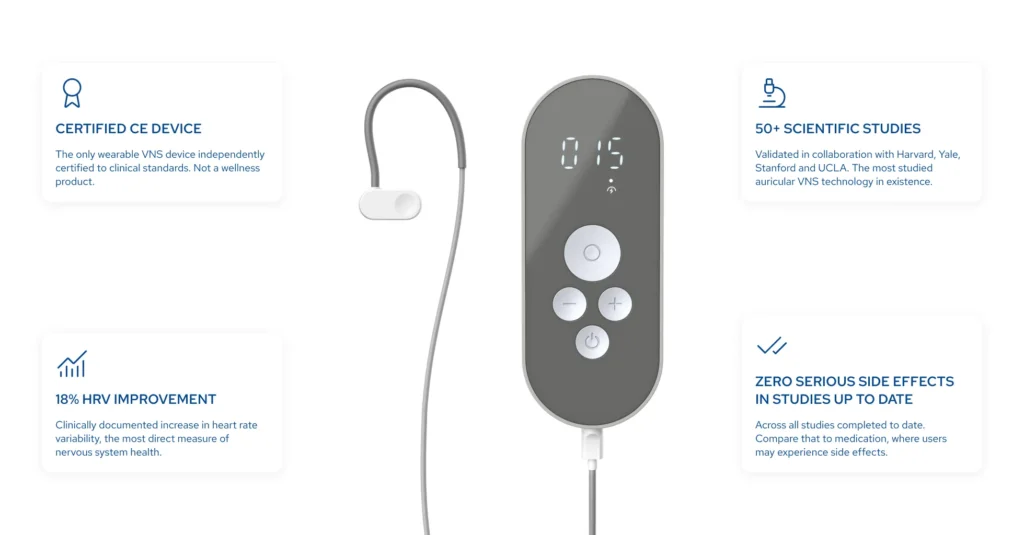
Nurosym sits in a different category: its Auricular Vagal Neuromodulation Technology (AVNT) has been studied in more than 50 completed scientific studies, including collaborations with Harvard, Yale, and Imperial College London, and the outcomes measured in that research map directly onto the scientific picture I described above.
My primary work remains the therapeutic process.
But for clients whose nervous system remains at an elevated baseline despite meaningful progress in therapy, Nurosym offers a way to address that layer directly, outside the session and without scientific oversight.
Ce que dit la recherche
Nurosym is a CE-marked taVNS device used in more than 50 completed scientific studies, including collaborations with Harvard, Yale, and Imperial College London.
Published research on this technology has found:
- Measurable improvements in heart rate variability, reflecting a genuine shift in autonomic balance and reduced sympathetic dominance
- Reductions in salivary cortisol and alpha-amylase, markers of physiological stress activation, consistent with a meaningful change in the body's resting threat response
- Reductions in inflammatory markers including IL-6 and TNF-alpha, which are chronically elevated in anxious thoughts and sustained stress states
- Direct reductions in anxious thoughts scores in a double-blind, randomised controlled study in participants with measurable anxious thoughts, with no significant serious adverse effects reported to date
- Improved autonomic downregulation following stress exposure, suggesting the body's capacity to return to baseline is enhanced with consistent use
What that means in practice is that the research is measuring the same variables that matter scientifically in anxious thoughts: not whether something feels relaxing, but whether the physiological machinery of the stress response is actually changing.
Qui pourraient bénéficier
- People who have made genuine progress with anxious thoughts through therapy but still carry a residual physiological baseline of unease
- Those whose anxious thoughts return despite good psychological self-awareness and coping strategies
- Clients in therapy who want additional nervous system support between sessions, particularly during demanding life periods
- People whose anxious thoughts manifest primarily as physical tension, vigilance, or stress reactivity rather than acute episodes
Who Should Not Use It
Nurosym (et taVNS en général) doit être évité si vous :
- Avoir un stimulateur cardiaque ou un dispositif cardiaque implantable
- Étre enceinte
- Avoir eu un événement cardiaque grave récent
- Are under 18 years of age
Vérifiez toujours auprès d’un professionnel de santé qualifié avant de commencer.
Une façon sûre de l’essayer
- 30-Day Money-Back Guarantee: Nurosym includes a 30-day home trial with a full refund if you do not notice a meaningful shift in your stress reactivity or general sense of nervous system calm.
- Research Programme: At times, participants in Nurosym's ongoing research programme may receive a subsidy of up to €70 for sharing their experience.
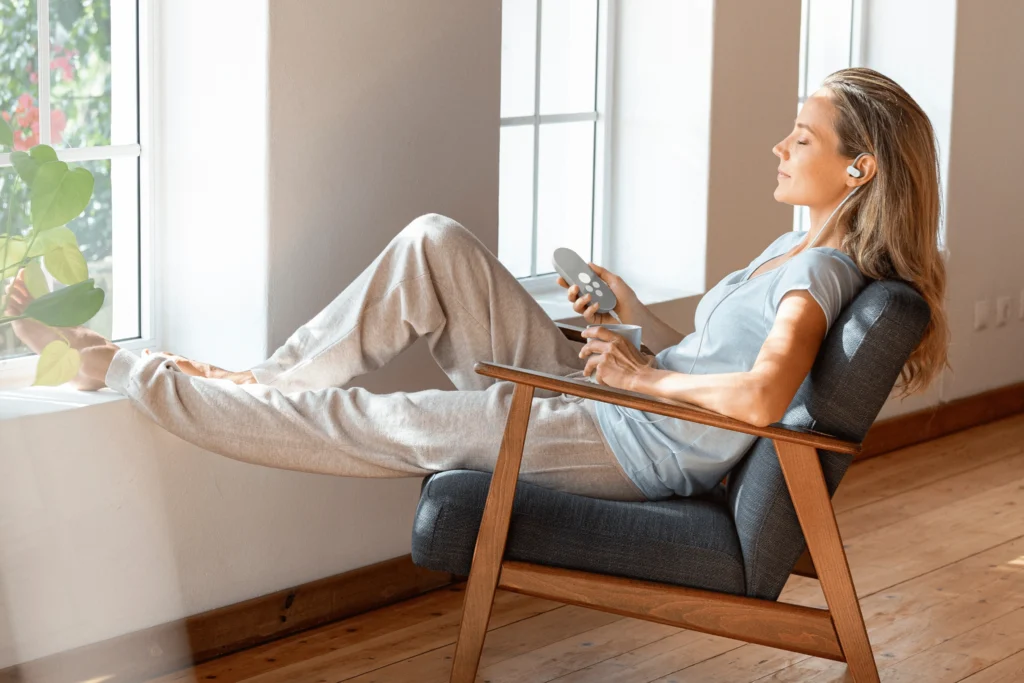
I guide clients on whether it is suitable, how to use it correctly, and how to combine it with therapy for the best results.
Anxious Thoughts Is Not Always a Thinking Problem
If you have done genuine work on your anxious thoughts and still cannot find a settled baseline of calm, it is not a sign that the work has failed.
It may be a sign that the nervous system’s underlying level of threat sensitivity has not shifted to match what the mind now knows.
The cognitive and subconscious work addresses the patterns of thought and belief that anxious thoughts build themselves around.
That is necessary and often transformative.
But the physiological baseline beneath those patterns is a separate variable, and one that cognitive approaches cannot directly access.
For some people, supporting that baseline through the vagal pathway is what makes the difference between intellectually understanding that they are safe, and being able to feel it.
Références
- Chalmers, J. A., Quintana, D. S., Abbott, M. J. A., and Kemp, A. H. (2014). Anxious thoughts disorders are associated with reduced heart rate variability: A meta-analysis. Frontiers in Psychiatry, 5, 80. https://doi.org/10.3389/fpsyt.2014.00080
- Wolf, V., Kuhnel, A., Teckentrup, V., Koenig, J., and Kroemer, N. B. (2021). Does transcutaneous auricular vagus nerve stimulation affect vagally mediated heart rate variability? A living and interactive Bayesian meta-analysis. Psychophysiology, 58(11), e13933. https://doi.org/10.1111/psyp.13933
- Bremner, J. D., Gurel, N. Z., Jiao, Y., Wittbrodt, M. T., Levantsevych, O. M., Huang, M., Jung, H., Shandhi, M. H., Beckwith, J., Herring, I., Rapaport, M. H., Murrah, N., Driggers, E., Ko, Y. A., Alkhalaf, M. L., Soudan, M., Song, J., Ku, B. S., Shallenberger, L., and Pearce, B. D. (2020). Transcutaneous vagal nerve stimulation blocks stress-induced activation of interleukin-6 and interferon-gamma in posttraumatic stress disorder: A double-blind, randomized, sham-controlled study. Brain, Behavior, and Immunity Health, 9, 100138. https://doi.org/10.1016/j.bbih.2020.100138
- Cooper, T. M., McKinley, P. S., Seeman, T. E., Choo, T. H., Lee, S., and Sloan, R. P. (2015). Heart rate variability predicts levels of inflammatory markers: Evidence for the vagal anti-inflammatory pathway. Brain, Behavior, and Immunity, 49, 94-100. https://doi.org/10.1016/j.bbi.2014.12.017
- Kim, A. Y., Marduy, A., de Melo, P. S., Gianlorenco, A. C., Kim, C. K., Choi, H., Song, J. J., and Fregni, F. (2022). Safety of transcutaneous auricular vagus nerve stimulation (taVNS): A systematic review and meta-analysis. Scientific Reports, 12, 22055. https://doi.org/10.1038/s41598-022-25864-1
- Ferreira, L. M. A., Brites, R., Fraiao, G., Pereira, G., Fernandes, H., de Brito, J. A. A., Pereira Generoso, L., Maziero Capello, M. G., Santos Pereira, G., Scoz, R. D., Silva, J. R. T., and Silva, M. L. (2024). Transcutaneous auricular vagus nerve stimulation modulates masseter muscle activity, pain perception, and anxious thoughts levels in university students: a double-blind, randomized, controlled scientific study. Frontiers in Integrative Neuroscience, 18, 1422312. https://doi.org/10.3389/fnint.2024.1422312
- Redgrave, J., Day, D., Leung, H., Laud, P. J., Ali, A., Lindert, R., and Majid, A. (2018). Safety and tolerability of transcutaneous vagus nerve stimulation in humans: A systematic review. Brain Stimulation, 11(6), 1225-1238. https://doi.org/10.1016/j.brs.2018.08.010
- Warren, C. M., Tona, K. D., Ouwerkerk, L., van Paridon, J., Poletiek, F., van Steenbergen, H., Bosch, J. A., and Nieuwenhuis, S. (2019). The neuromodulatory and hormonal effects of transcutaneous vagus nerve stimulation as evidenced by salivary alpha amylase, salivary cortisol, pupil diameter, and the P3 event-related potential. Brain Stimulation, 12(3), 635-642. https://doi.org/10.1016/j.brs.2018.12.224
This article does not constitute medical advice. Please seek consultation with a licensed medical professional before starting any treatment. This website may receive commissions from the links or products mentioned in this article.
Partager cet article :

 French
  English
  German
  Spanish
  Swedish