
You can make your bedroom ready for sleep and still lie there exhausted but wide awake. Here’s the overlooked reason why.
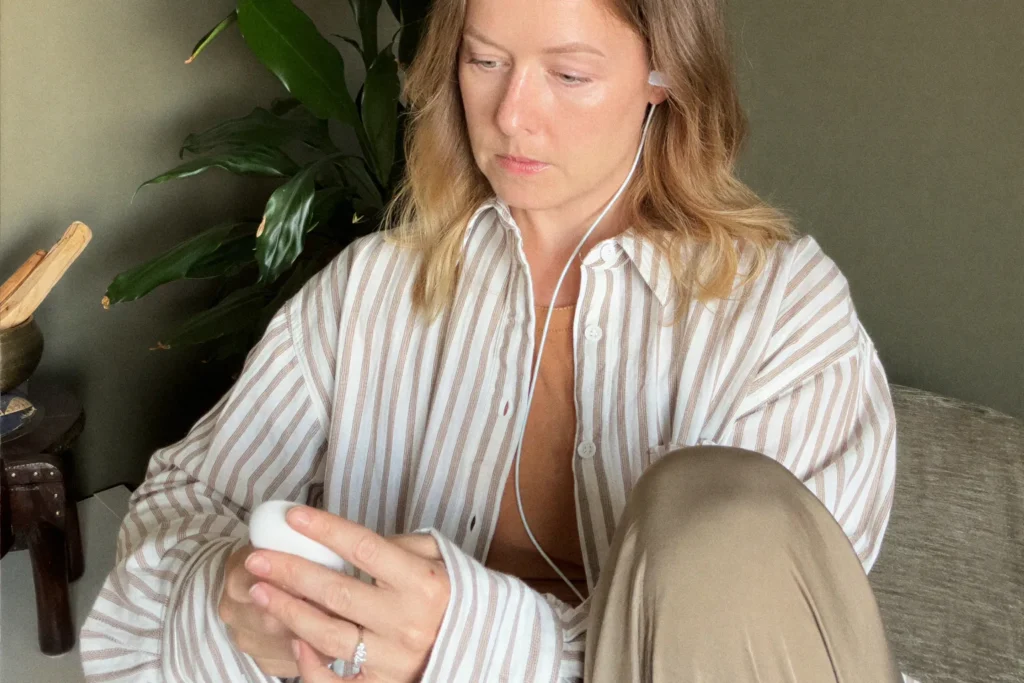
You’ve heard the advice. Put the phone away an hour before bed. Dim the lights. Stop scrolling.
You do it, some nights properly, and you still end up exhausted but wide awake, staring at the ceiling with a mind that won’t quite switch off.
If that sounds familiar, screen time was probably never the whole story.
The Strange Overlap Between Tiredness and Feeling “Wired”
I’m a breathwork facilitator and embodiment teacher, 37 years old, originally from New Zealand, now living in Berlin. I founded SOULBODY BREATH® at the end of 2023, and my work since has centred on how stress actually shows up in the body, not the version people expect, but the quieter, harder-to-name version.
I’d slipped back into scrolling before bed, and I knew exactly what the standard advice would say: cut the screens, and sleep will follow.
So I did. Screens off an hour before bed, properly, not the half-hearted version.
And I still felt exhausted at night, and wired at the same time. That tired-but-wired combination is worth paying attention to because it sits somewhere between sleep and tiredness: physically depleted, but mentally or physiologically still “on.”
That’s when I started paying closer attention to what was actually happening underneath it.
When You’re Doing Everything Right, But Still Can’t Switch Off
Cutting screens addresses one input. It doesn’t address what the nervous system is doing once the input is removed.
Cutting screens can remove one source of stimulation. But removing stimulation and shifting out of an activated state aren’t necessarily the same thing. That’s the distinction I had been missing.
I had spent a lot of time improving the environment around sleep. I hadn’t paid nearly as much attention to the state I was bringing into that environment.
If your body is still running in an alert state, removing the phone doesn’t automatically shift it into a state that allows for rest. The mind can go quiet on the surface while the underlying activation stays exactly where it was.
I know the other advice too, because I teach versions of it. Wind-down rituals. Breathwork before bed. A consistent bedtime. These aren’t wrong, and I still use several of them myself. But most of them ask for something specific: a mind that’s already somewhat willing to slow down, and enough leftover capacity at the end of a full day to actually follow through on one more practice.
On the nights I needed rest most, that’s exactly when I had the least capacity left to sit through a ten-minute wind-down ritual. The advice was sound. Getting myself to actually do it, consistently, on the hardest nights, was the part that kept failing.
That’s the gap most sleep advice doesn’t cover. It optimises the environment around sleep, and sometimes asks for more effort at exactly the moment there’s none left. It doesn’t necessarily address the physiological state the body is actually in when the lights go off.
A Sleep-Ready Bedroom Doesn’t Always Mean a Sleep-Ready Nervous System
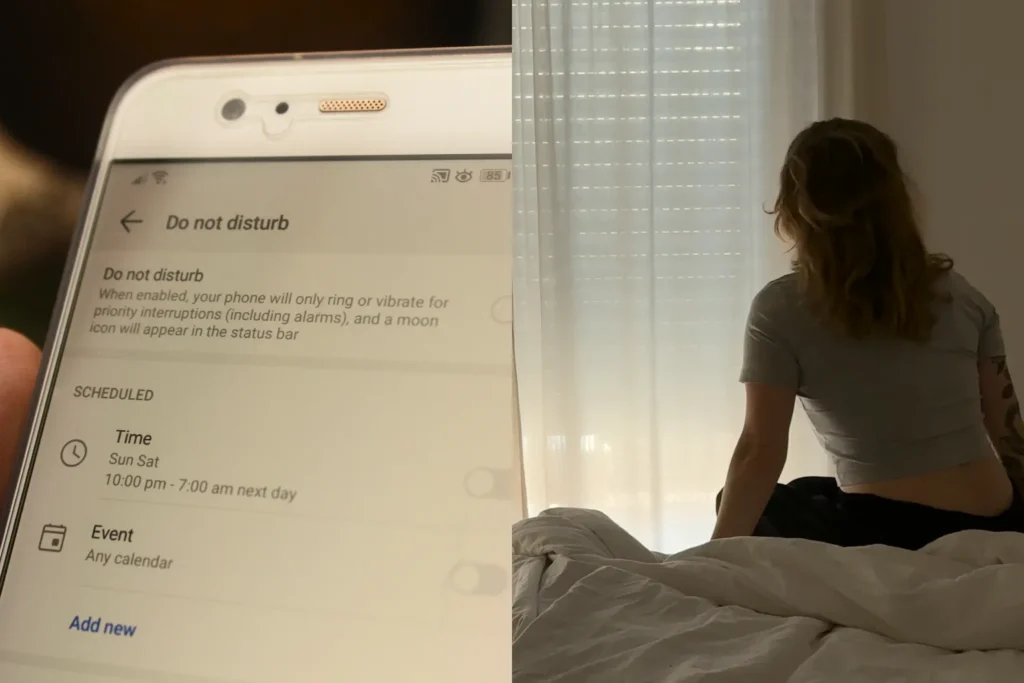
There’s a real difference between an environment that’s ready for sleep and a nervous system that’s ready for sleep.
Screen time affects the first. It doesn’t necessarily affect the second.
A dark room removes one source of stimulation. But the autonomic nervous system is responding to much more than the light in the room, including the accumulated demands your body has been responding to throughout the day.
For someone who’s spent twelve hours moving between deadlines, decisions, messages and responsibilities, that activation doesn’t necessarily disappear the moment the laptop closes.
Why the Nervous System Stays “On”
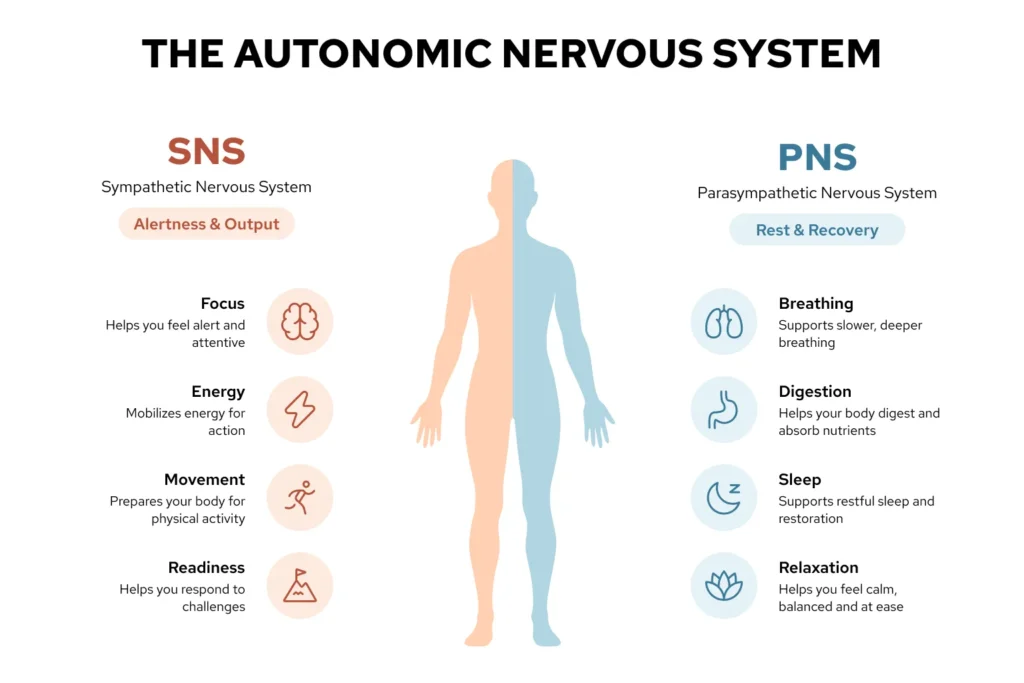
Le système nerveux autonome (ANS) regulates many processes that happen largely outside conscious control. Its système nerveux sympathique (SNS) supports alertness and mobilisation. Its système nerveux parasympathique (SNP) is involved in rest, digestion and recovery.
We need both, working flexibly. The goal isn’t to eliminate alertness. It’s the ability to shift out of it once the day’s demands have genuinely passed.
For some people, that shift doesn’t happen automatically just because it’s bedtime. The system stays in a more activated state, tired in terms of energy, but still running in terms of alertness, which is exactly the combination people describe as “tired but wired.”
This was the root of the distinction I’d been missing: my problem wasn’t necessarily that I hadn’t created the right conditions for sleep. It was that creating those conditions didn’t automatically change the physiological state I was bringing into bed.
One of the main pathways involved in that shift is the nerf vague, the longest cranial nerve, which carries signals between the brainstem and areas throughout the neck, chest and abdomen.
That doesn’t mean every tired-but-wired night is a “vagus nerve problem.” But it does explain why I became interested in whether supporting this pathway could complement the sleep habits I was already using.
If you’re curious whether this pattern applies to you specifically, a structured assessment can be a useful starting point.
Why I Was Sceptical
I’m naturally quite a sceptical person when it comes to wellness claims, and sleep is an area with no shortage of them.
I wasn’t interested in another app that reminded me to breathe, or another routine that asked for more discipline I didn’t have left by 10pm. What actually got my attention was research into taVNS (Transcutaneous Auricular Vagus Nerve Stimulation), a non-invasive way of engaging the vagus nerve through the outer ear, and the fact that it didn’t require creating a separate ritual to use.
I came into it with curiosity, not expectation. Nervous system regulation doesn’t happen through one good night. It happens gradually, through consistency.
What interested me first wasn’t a particular brand. It was taVNS itself, a non-invasive approach targeting auricular branches of the vagus nerve through the outer ear. More importantly for me, it didn’t require another elaborate bedtime ritual.
That sent me looking at the devices actually using this approach. One stood out because of the research behind its technology.
That’s when I came across Nurosym.
What I Found: Nurosym AVNT™
The device I began using is called Nurosym.
Nurosym is a CE-marked taVNS device using proprietary AVNT™ (Auricular Vagal Neuromodulation Technology) to deliver a calibrated signal to the auricular branch of the vagus nerve, through the outer ear.
What made me take it seriously was who was behind the research, not just the marketing claims.
Backed by 60+ completed studies across 150+ internationally recognised institutions including Harvard, Yale, UCL and Imperial College London. Recommended by 1,000+ licensed healthcare professionals, with more than 5 million completed user sessions to date.
Research into taVNS and sleep outcomes is still developing. Findings have included measurable changes in HRV and sleep quality scores, though results vary across study populations and stimulation protocols, and it’s too early to say that a single “vagal tone” number explains a tired-but-wired night on its own.
Ce que la recherche montre
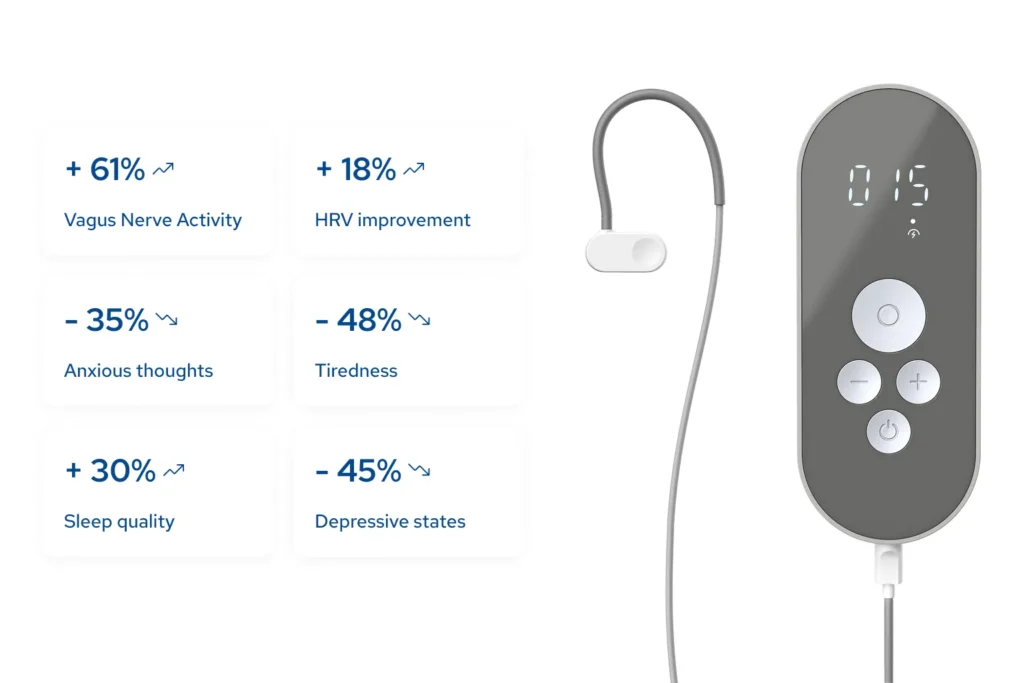
Résultats d’études évaluées par des pairs dans des populations spécifiques. Les chiffres reflètent la variation relative par rapport au placebo ou à la valeur de référence. Les résultats individuels peuvent varier.
Where This Fits Alongside Everything Else
Cutting screens still matters. It’s not wrong advice, and I haven’t stopped doing it. Reducing stimulating input before bed is a genuinely useful part of a wind-down routine, and I’d never tell anyone to skip it.
What it doesn’t necessarily do on its own is change the physiological state you’re bringing into bed. That’s the gap I was looking to address, not by replacing good sleep habits, but by adding another layer alongside them.
I use Nurosym in the evening, while reading, before the parts of my wind-down routine I already had in place. It clips to the outer ear. No app, no gel, no prescription. It’s wired, not wireless, which surprised me briefly and then stopped mattering.
Twenty to thirty minutes, inside a routine that already existed, not on top of it.
What I Started Noticing
The shift wasn’t a single dramatic night. It built gradually, the way I’d expect anything at the level of the nervous system to build.
What changed first wasn’t falling asleep faster. It was the quality of the tiredness itself, less of that wired edge underneath the exhaustion, more of a tiredness that actually felt like it wanted to become sleep.
I still don’t get everything perfectly right some evenings. But the specific tired-but-wired pattern, the one screen alone never touched for me, has shown up far less than it used to.
I’m not the only one who’s noticed a shift specifically in sleep quality. One user, Caroline, described it simply: “My sleep has improved, and one day I scored 99/100 for the quality and depth of my sleep.”
Who This Pattern Tends to Show Up In
- The High-Achieving Entrepreneur: work never fully switches off, even once the laptop closes.
- The New Parent: sleep is already fragmented, and the mind won't settle in the gaps that remain.
- The "I've Done Everything Right" Case: screens cut, bedtime consistent, sleep hygiene checklist complete, still tired but wired most nights.
- The Full-Day Professional: back-to-back demands with no natural off-ramp before bed arrives.
Is This You?
- You cut screens before bed and still lie there exhausted but unable to switch off
- You're tired enough to want sleep, but your mind won't quite settle into it
- Your tiredness feels less like plain tiredness and more like depletion that coexists with alertness
- You've tried the standard sleep hygiene checklist and it's helped only partially
- Your days are full enough that "winding down" competes with everything else you still have to do
- You want something that supports your nervous system directly, not just the environment around it
Do not use it if you have a pacemaker or implantable cardiac device, are pregnant, have had a recent serious cardiac event, or are under 18. Always consult a healthcare professional before starting.
Une façon sûre de l’essayer
- Garantie de remboursement de 30 jours, enough time to notice whether this actually fits how your nervous system works
- Limited subsidized research slots; some participants may receive up to €70 off in exchange for sharing their experience
EXCLUSIVE OFFER FOR OUR READERS: Get 5% Off Nurosym From Our Editorial Team!
Réflexions Finales
Screen time was never nothing. It’s a real part of the picture, and cutting it is still worth doing.
But if you’ve done that properly and the tired-but-wired nights keep coming back, the missing piece may not be another habit to fix. It may be worth looking beyond the environment around sleep, and at the physiological state you’re carrying into it.
Bibliographie :
- Zhang S, et al. Transcutaneous Auricular Vagus Nerve Stimulation for Chronic Sleep Problems: A Randomized Scientific Studyl. Réseau JAMA ouvert. 2024;7(12):e2451217. https://doi.org/10.1001/jamanetworkopen.2024.51217
- Wolf V, et al. Does transcutaneous auricular vagus nerve stimulation affect vagally mediated heart rate variability? A living and interactive Bayesian meta-analysis. Psychophysiology. 2021;58(11):e13933. https://doi.org/10.1111/psyp.13933
- Geng D, et al. The effect of transcutaneous auricular vagus nerve stimulation on HRV in healthy young people. PLoS ONE. 2022. https://doi.org/10.1371/journal.pone.0263833
- Tarn J, et al. The effects of noninvasive vagus nerve stimulation on tiredness. neuromodulation. 2022. https://pubmed.ncbi.nlm.nih.gov/37032583/
- Ferreira LMA, et al. Transcutaneous auricular vagus nerve stimulation modulates masseter muscle activity, pain perception, and anxious thoughts levels. Frontiers in Integrative Neuroscience. 2024. https://doi.org/10.3389/fnint.2024.1422312
This article reflects my personal experience and professional evaluation of the evidence. This article is published in partnership with Nurosym. I may receive compensation from purchases made through links in this article. This is not medical advice, always consult a healthcare professional before starting any new health intervention. Individual results may vary.



 French
 English
 German
 Spanish
 Swedish
 Italian