
Points clés
- L’intelligence artificielle (IA) redéfinit les soins de santé en améliorant le diagnostic, la planification des thérapies, la découverte de médicaments, la surveillance des utilisateurs et l’efficacité administrative.
- Les avantages incluent des résultats plus précis, un accès plus rapide aux soins et des solutions de plus en plus personnalisées.
- Des défis demeurent : les dilemmes éthiques, les risques de confidentialité des données, le biais dans les algorithmes et la nécessité d’une surveillance humaine.
- L’avenir des soins de santé pourrait impliquer un modèle hybride—où l’IA augmente plutôt que remplace les professionnels de la santé, rendant les soins plus intelligents, plus accessibles et adaptés à l’individu.
Un aperçu de la clinique de demain
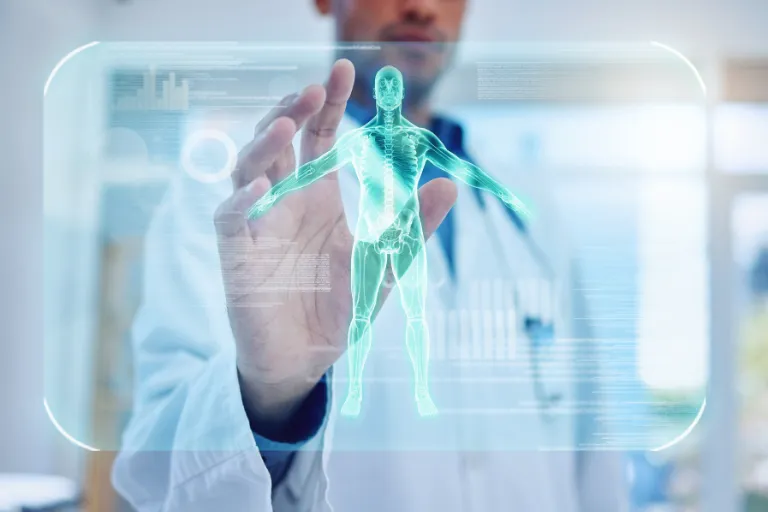
Imaginez entrer dans une clinique où votre professionnel de la santé examine non seulement vos antécédents médicaux, mais aussi les informations d’un système d’IA qui a analysé des milliers de cas similaires en quelques secondes. L’IA fournit des informations sur le meilleur plan de thérapie, prédit les risques potentiels et suggère même des changements de mode de vie personnalisés – tout cela avant la fin de votre rendez-vous.
Ce n’est pas de la science-fiction ; c’est un aperçu d’un avenir en matière de santé qui se dessine déjà. L’intelligence artificielle n’est plus confinée aux laboratoires ou aux entreprises technologiques – elle fait maintenant partie de la médecine quotidienne, des scanners radiologiques aux appareils portables qui surveillent les palpitations cardiaques et les problèmes de sommeil. Les experts suggèrent que l’IA pourrait aider à réduire les erreurs médicales, améliorer l’accès aux soins et rendre les thérapies plus précises. Pourtant, aussi puissante qu’elle soit, l’IA soulève des questions sur la confiance, l’équité et le rôle du jugement humain dans les décisions de santé.
Pourquoi l’IA dans la santé compte pour les utilisateurs et les soignants
La santé a toujours consisté à résoudre un problème : comment fournir de meilleurs soins à plus de personnes, plus rapidement et plus efficacement. Pourtant, le système d’aujourd’hui est aux prises avec de longs délais d’attente, des coûts en hausse et un accès inégal entre les différentes régions et communautés.
Enter AI – une technologie autrefois considérée comme futuriste – fait maintenant partie des flux de travail de routine dans le domaine de la santé. Pour les utilisateurs, cela signifie des résultats plus rapides, moins de diagnostics manqués et des thérapies de plus en plus personnalisées. Mais comme pour toute percée, l’IA offre à la fois des opportunités et des risques. Comprendre les deux côtés est crucial, car ces innovations ne façonneront pas seulement l’avenir des soins de santé – elles façonneront votre propre parcours de santé.
Applications actuelles de l’IA : du diagnostic à la découverte de médicaments
L’IA apparaît déjà d’une manière que vous ne remarquerez peut-être pas :
- Diagnostics plus intelligents : Les systèmes d’IA analysent désormais les rayons X, les IRM et les lames de pathologie avec une précision qui dans certains cas correspond ou dépasse celle des experts humains.
- Planification de thérapie personnalisée : Dans les soins contre le cancer, l’IA aide à concevoir des plans de thérapie ciblés en analysant les données génétiques et les résultats historiques.
- Surveillance en temps réel: Les wearables équipés d’IA suivent les symptômes tels que les palpitations cardiaques ou les schémas intestinaux irritables, alertant les utilisateurs et les professionnels de santé des signes avant-coureurs.
- Découverte accélérée de médicaments : En analysant des millions de composés, l’IA accélère le processus de recherche de nouveaux médicaments qui prendraient autrement des années.
- Administration rationalisée : Les hôpitaux utilisent l’IA pour réduire la paperasse, optimiser la planification et réduire les coûts, libérant ainsi les professionnels de santé pour passer plus de temps avec les utilisateurs.
L’impact est clair : des diagnostics plus rapides, une meilleure prévention et des soins plus efficaces. Mais ces avancées mettent également en évidence des défis critiques.
La science derrière l’IA en médecine
À sa base, l’IA dans les soins de santé repose sur des algorithmes d’apprentissage automatique—pour reconnaître les motifs dans des ensembles de données massifs. Par exemple, l’IA d’imagerie médicale apprend en comparant des millions de scans étiquetés, améliorant sa capacité à détecter les maladies à chaque itération.
Mais la puissance de l’IA n’est aussi forte que les données qui la soutiennent. Si les ensembles de données sont incomplets ou biaisés, les systèmes d’IA peuvent involontairement renforcer les disparités existantes en matière de santé. C’est pourquoi des organismes de réglementation comme la Food and Drug Administration (FDA) des États-Unis et l’Agence européenne des médicaments (EMA) développent des cadres pour s’assurer que les solutions basées sur l’IA répondent aux normes de précision, de sécurité et d’équité.
Avantages et opportunités : comment l’IA améliore les soins
Pour les utilisateurs, les soignants et les professionnels, l’IA promet de réels bénéfices :
- Détection plus précoce des symptômes — L’IA peut détecter les signes de maladie plus tôt que les méthodes traditionnelles, ce qui peut améliorer les résultats à long terme.
- Solutions personnalisées — En analysant la génétique, le mode de vie et l’environnement, l’IA peut recommander des thérapies adaptées à l’individu.
- Efficacité accrue — En gérant les tâches administratives, l’IA réduit le burn-out chez les professionnels de santé.
- Accessibilité — Les outils d’IA peuvent étendre l’accès dans les zones mal desservies, offrant des diagnostics et une surveillance sans nécessiter de grandes équipes spécialisées.
Défis éthiques et préoccupations en matière d’équité
La montée en puissance de l’IA dans les soins de santé introduit également des défis urgents :
- Protection des données : Les dossiers de santé sensibles doivent être protégés contre toute utilisation abusive ou violation.
- Biais dans les algorithmes : L’IA formée sur des ensembles de données limités peut fonctionner moins efficacement pour certaines populations.
- Dépendance excessive aux machines : L’IA n’est pas infaillible—elle nécessite une supervision humaine pour détecter les erreurs et assurer une utilisation éthique.
- Inégalité d’accès : Les coûts élevés et l’infrastructure limitée peuvent laisser de côté les régions à faible revenu, élargissant ainsi les écarts de santé.
Exemple du monde réel : IA dans la santé oculaire
En 2023, la FDA a autorisé un système d’IA pour détecter la rétinopathie diabétique, une des principales causes de cécité. Les utilisateurs peuvent désormais subir un simple examen oculaire dans leur clinique de soins primaires, l’IA fournissant des résultats en quelques minutes. Au lieu d’attendre des semaines pour un spécialiste, les personnes à risque sont référées plus rapidement, ce qui prévient les complications et améliore les résultats. Ce cas concret montre comment l’IA transforme déjà les soins de santé quotidiens.
Regard vers l’avenir : L’avenir de l’IA et votre santé
L’IA dans les soins de santé ne consiste pas à remplacer les humains—il s’agit d’élargir ce qui est possible. L’avenir sera probablement hybride : les humains et l’IA travaillent ensemble pour fournir des soins plus rapides, plus précis et plus personnalisés.
Pour les utilisateurs, cela peut signifier des diagnostics plus précoces, des thérapies ciblées et un accès plus pratique aux soins. Pour les professionnels de la santé, cela signifie de nouveaux outils qui réduisent l’épuisement professionnel et améliorent la prise de décision. Alors que l’IA continue d’avancer, rester informé et poser les bonnes questions vous aidera à tirer le meilleur parti de cette révolution.
La prochaine fois que vous entendrez parler de l’IA dans les soins de santé, rappelez-vous—ce n’est pas seulement des algorithmes et des données. Il s’agit de façonner l’avenir de votre propre santé.
Etapes suivantes
Curieux de savoir comment l’IA pourrait influencer vos soins de santé ? Demandez à votre clinicien si des outils compatibles avec l’IA sont utilisés pour le diagnostic, la planification ou la surveillance dans votre hôpital ou votre clinique. Rester informé de ces changements vous aide à comprendre – et à participer – la prochaine vague de soins personnalisés assistés par la technologie.
Cet article de blog est fourni à titre informatif et ne remplace pas l’avis d’un professionnel de santé. Consultez toujours un professionnel de santé pour obtenir des conseils personnalisés..
Abonnez-vous gratuitement pour des articles de santé plus éclairants adaptés à vos besoins.
Sources
- Alowais SA, Alghamdi SS, Alsuhebany N, Alqahtani T, Alshaya A, Almohareb SN, et al. Revolutionizing healthcare: the Role of Artificial Intelligence in Clinical Practice. BMC Medical Education [Internet]. 2023 Sep 22;23(1):1–15. Available from: https://bmcmededuc.biomedcentral.com/articles/10.1186/s12909-023-04698-z
- Fahim YA, Hasani IW, Kabba S, Ragab WM. Artificial intelligence in healthcare and medicine: clinical applications, therapeutic advances, and future perspectives. European journal of medical research. 2025 Sep 23;30(1).
- Bhinder B, Gilvary C, Madhukar NS, Elemento O. Artificial Intelligence in Cancer Research and Precision Medicine. Cancer Discovery [Internet]. 2021 Apr;11(4):900–15. Available from: https://aacrjournals.org/cancerdiscovery/article/11/4/900/665825/Artificial-Intelligence-in-Cancer-Research-and
- Shajari S, Kuruvinashetti K, Komeili A, Sundararaj U. The emergence of AI-based wearable sensors for digital health technology: A review. Sensors [Internet]. 2023 Nov 29;23(23):9498–8. Available from: https://pmc.ncbi.nlm.nih.gov/articles/PMC10708748/
- Norori N, Hu Q, Aellen FM, Faraci FD, Tzovara A. Addressing bias in big data and AI for health care: A call for open science. Patterns [Internet]. 2021 Oct 8;2(10):100347. Available from: https://pmc.ncbi.nlm.nih.gov/articles/PMC8515002/
- K. Akila, R. Gopinathan, J. Arunkumar, B. Sree Bavai Malar. The Role of Artificial Intelligence in Modern Healthcare: Advances, Challenges, and Future Prospects. European Journal of Cardiovascular Medicine [Internet]. 2025 Apr 19;15:615–24. Available from: https://healthcare-bulletin.co.uk/article/the-role-of-artificial-intelligence-in-modern-healthcare-advances-challenges-and-future-prospects-3187/


 French
  English
  German
  Spanish
  Swedish
Very timely. A lot of people are or have been debating with this.
Balanced discussion of new approaches without overselling them