
Stress au travail, traumatismes, manque de sommeil, maladie : ils ressemblent à des problèmes complètement différents. Un expert du cerveau explique pourquoi ils se terminent tous au même endroit, votre système nerveux, et comment le renforcement d’un nerf vous aide à les supporter tous.

Les facteurs de stress peuvent provenir de nombreuses directions différentes : un emploi toxique, une relation difficile, une perte de sommeil, un vieux traumatisme ou une maladie qui vous épuise.
Ils peuvent sembler être des problèmes complètement différents, mais ils mettent tous la pression sur le même système : votre système nerveux.
Lorsque ces stresseurs s’accumulent au fil du temps et usent le frein apaisant du nerf vague, le système nerveux autonome devient moins adaptable.
Les chercheurs décrivent souvent cela comme un tonus vagal réduit ou une régulation autonome altérée.
Soutenir une fonction vagale saine n’éliminera pas les facteurs de stress, mais cela renforce le système unique qui influence la façon dont votre corps y réagit.
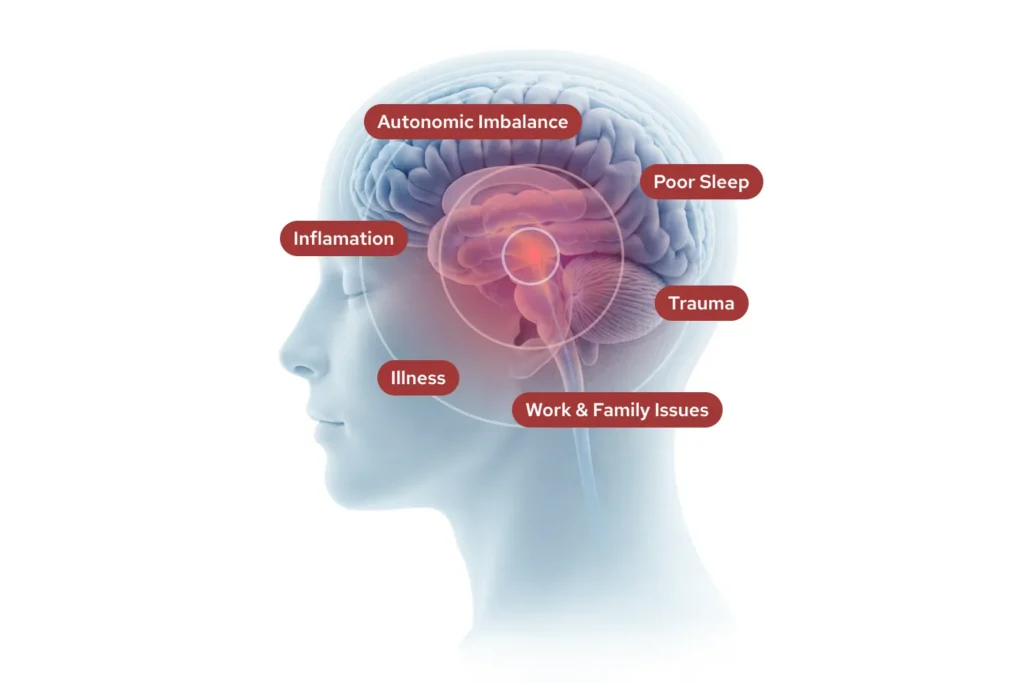
Voici cinq des plus courantes, et comment le fait de soutenir votre nerf vague peut améliorer votre résilience à chacune d’elles.

Un patron toxique ne reste pas au travail... Votre corps le ramène à la maison.
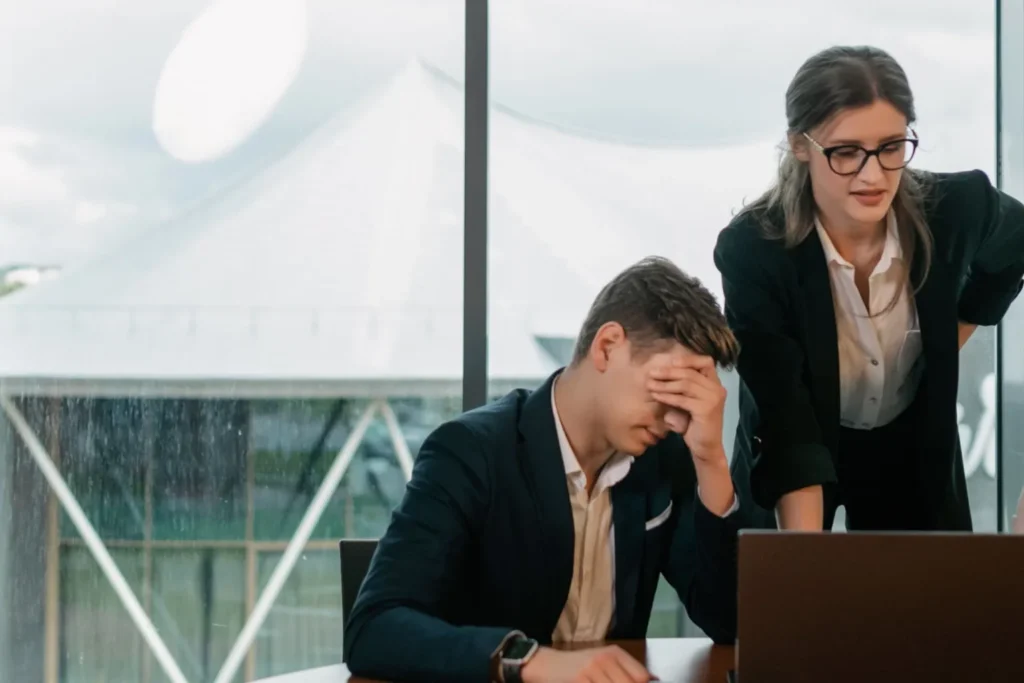
Leur nom illumine ton écran, et tu as l’estomac noué.
Le patron qui te rabaisse, le collègue qui te dénigre, le commentaire que tu rejoues encore à 2h du matin.
Votre système nerveux peut réagir à une menace sociale continue d’une manière qui ressemble à sa réaction à un danger physique.
Jour après jour, cela peut réduire progressivement le tonus vagal.
Donc tu restes bien préparé après avoir quitté le bâtiment, tendu et émotionnellement épuisé, redoutant que lundi soit avant même la fin du week-end.
La stimulation du nerf vague vise à soutenir l’activité parasympathique, en aidant à restaurer ce système de freinage.
Vous ne pouvez pas toujours vous éloigner d’eux.
Mais ils arrêtent de rentrer, et ton corps arrête de les porter jusqu’à la maison.

La maison est l’endroit où le corps récupère, et le tien n’est pas capable de
Le stresseur : un système nerveux qui a déjà perdu son équilibre.

Parfois, le problème n’est pas un facteur de stress venant de l’extérieur.
Le système de contrôle autonome lui-même ne régule plus efficacement : les vertiges, la course du cœur, une température corporelle qui ne reste pas stable et une digestion qui ne reste pas stable.
La dysautonomie est le système nerveux autonome, le système même qui gère votre réponse au stress, un dysfonctionnement.
Ici, la dérégulation n’est pas seulement en aval d’un facteur de stress...
C’est le problème lui-même.
C’est là que la stimulation du nerf vague s’applique le plus directement, car il s’agit d’une forme de modulation autonome : elle cible les mêmes voies autonomes impliquées dans la dysautonomie.
L’objectif est d’apporter une stimulation directe aux voies autonomes.

Peut aider à soutenir un sommeil profond réparateur, afin que vous récupériez davantage après moins d’heures
Le défi : trop peu de sommeil, ce qui laisse votre système nerveux à vif.

Après une courte nuit, la concentration, la patience et la régulation émotionnelle deviennent plus difficiles.
Vous êtes plus réactif, avez moins de patience et même un stress mineur semble trop important.
Mais à quel point tu te sens épuisé, c’est moins à cause des heures perdues que de la profondeur que tu n’as jamais atteinte.
Le sommeil profond, la phase lourde et lente où votre corps se répare réellement, est la partie la plus parasympathique de la nuit, et l’activité parasympathique joue un rôle important pendant cette étape.
Lorsque le tonus vagal est bas, vous ne tombez pas dedans comme vous le devriez, de sorte que même une nuit complète vous laisse court, et un soir cassé offre très peu de récupération.
Soutenir la fonction vagale peut aider votre corps à entrer dans ce stade profond et réparateur et à y rester plus longtemps.
Ainsi, vous obtenez plus de récupération toutes les heures et commencez à obtenir plus avec moins.

Le traumatisme n’est pas seulement un souvenir, et votre corps le vit encore.
Le facteur de stress : un traumatisme passé qui a déclenché votre réponse d’alarme.
Tu n’es jamais vraiment à l’aise, même chez toi.
La tension avec un partenaire ou une famille, le sentiment constant de marcher sur des œufs, l’argument qui se répète pendant des heures, et votre corps reste surveillé autour des personnes dont vous êtes le plus proche.
Un conflit en cours se lit dans votre système nerveux comme un danger permanent.
Ainsi, le système de stress reste activé et votre tonus vagal, le frein qui devrait vous permettre de vous calmer, s’affaiblit progressivement.
La stimulation du nerf vague peut améliorer la régulation parasympathique, de sorte que votre corps puisse retrouver un état physiologique plus calme même lorsqu’une relation est difficile.
Vous ne pouvez pas réparer la relation du jour au lendemain, mais cela empêche votre réponse au stress de rester active.
La tension cesse de vous suivre depuis la pièce jusqu’à la fin de votre journée.

Comment l’inflammation peut affecter le système nerveux
Après une maladie, une exposition environnementale ou une poussée auto-immune, vous le ressentez : épuisé, embué, physiquement épuisé, comme si votre corps se battait sur un pied arrière.
Les infections, les toxines environnementales, les blessures physiques et l’activité auto-immune déclenchent toutes des réponses inflammatoires.
Le nerf vague contribue au réflexe inflammatoire du corps.
Ainsi, une charge inflammatoire importante ou persistante réduit le tonus vagal et maintient l’ensemble du système dans un état inflammatoire prolongé.
La stimulation du nerf vague soutient ce frein anti-inflammatoire naturel, aidant le corps à gérer le stress inflammatoire que ceux-ci exercent sur le système nerveux. Il n’élimine pas les toxines ni ne combat un virus pour vous, mais il aide votre système à supporter la charge.
La maladie physique exerce moins de pression sur le système nerveux.
Voici pourquoi cela compte pour vos pensées anxieuses
Le train-train quotidien, les vieux traumatismes, la perte de sommeil, les bouleversements inflammatoires, le déséquilibre autonome : ils arrivent de directions complètement différentes, mais ils placent tous des exigences sur le même système autonome. Ce critère d’évaluation partagé explique pourquoi une approche thérapeutique peut être pertinente pour plusieurs types de facteurs de stress.

« C’est le changement que je veux que les gens fassent », dit un éminent expert du cerveau.
« Arrêtez d’essayer d’esquiver chaque stresseur que la vie vous lance, ce qui est impossible, et commencez à renforcer le système qui doit les absorber. Un système nerveux résilient est l’un des facteurs de protection les plus importants, car il agit quelle que soit la porte par laquelle le stress arrive ».
Renforcer directement ce système est exactement la raison pour laquelle la stimulation du nerf vague est devenue disponible en dehors des cliniques spécialisées et dans quelque chose que vous pouvez faire à la maison.
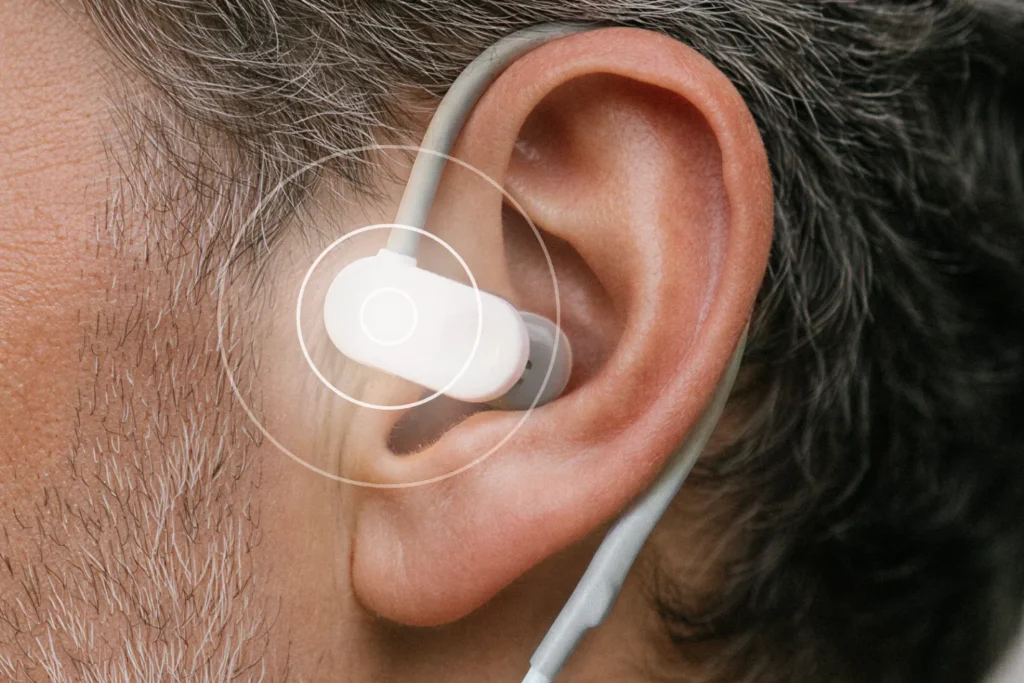
Une branche du nerf vague est accessible au niveau de l’oreille externe, donc une stimulation électrique de faible intensité appliquée juste là peut stimuler cette branche de manière non invasive.
L’un des appareils construits autour de cela est Nurosym, un stimulateur non invasif du nerf vague certifié CE qui se fixe à l’oreille et délivre ce genre de stimulation douce lors de courtes sessions quotidiennes. Ce n’est pas un bouclier contre la vie, et quiconque promet un appareil qui vous rendra insensible au stress en fait trop.
Mais si cela a du sens que tous vos différents facteurs de stress se canalisent dans un seul système, et que vous voulez renforcer ce système directement, c’est là que je vous conseillerais de commencer à lire.
Si vous souhaitez voir comment cela fonctionne plus en détail, la page NurosymTM est voici.
Cet article de blog est fourni à titre informatif et ne remplace pas l’avis d’un professionnel de santé. Consultez toujours un professionnel de santé pour obtenir des conseils personnalisés..
Références
- Bremner, J. D., Gurel, N. Z., Wittbrodt, M. T., Shandhi, M. H., Rapaport, M. H., Nye, J. A., Pearce, B. D., Vaccarino, V., Shah, A. J., Park, J., Bikson, M., & Inan, O. T. (2020). Application of Noninvasive Vagal Nerve Stimulation to Stress-Related Psychiatric Disorders. Journal of Personalized Medicine, 10(3). https://pmc.ncbi.nlm.nih.gov/articles/PMC7563188/
- Fanselow, M. S. (2013). Fear and Anxiety Take a Double Hit From Vagal Nerve Stimulation. Biological Psychiatry, 73(11), 1043–1044. https://pmc.ncbi.nlm.nih.gov/articles/PMC4176918/
- Okonogi, T., Kuga, N., Yamakawa, M., Kayama, T., Ikegaya, Y., & Sasaki, T. (2024). Stress-induced vagal activity influences anxiety-relevant prefrontal and amygdala neuronal oscillations in male mice. Nature Communications, 15(1). https://www.nature.com/articles/s41467-023-44205-y
- Park, S.-H., Seong, C., Kang, N., Jeon, K., Kil, S., Ahn, H., & Lim, S.-T. (2025). The Effects of Vagus Nerve Stimulation on Stress, Competitive Anxiety, and Depression in Elite Shooters: Randomized Controlled Trial. Applied Sciences, 15(16), 9105–9105. https://www.mdpi.com/2076-3417/15/16/9105



 French
  English
  German
  Spanish
  Swedish