
Wenn Sie Melatonin, CBD-Öl und Magnesium ausprobiert haben und immer noch um 3 Uhr morgens aufwachen – hier erfahren Sie, was tatsächlich dahinter steckt.

Die meisten Menschen, die mit Schlafproblemen zu mir kommen, tun bereits die richtigen Dinge.
Keine Bildschirme nach 9 Uhr. Magnesium vor dem Schlafengehen. Verdunkelungsvorhänge. Eine regelmäßige Schlafenszeit. Kamillentee. Melatonin.
Und dann sagen sie, fast entschuldigend: “Ich schlafe gut ein. Ich bin gerade um 3 Uhr morgens aufgewacht. Und dann komme ich nicht zurück.”
Nach 15 Jahren in der funktionellen Medizin habe ich erkannt, dass wiederholtes Aufwachen am frühen Morgen für viele Menschen mehr widerspiegelt als nur Schlafgewohnheiten.
Ich habe teilweise durch meine eigene Geschichte verstanden, warum – Jahre unterbrochenen Schlafs während einer Zeit der Überlastung des Gesundheitswesens, als ich eine Praxis leitete, einen Kundenstamm aufbaute und auf einer gefühlten dauerhaften Reserve lief. Ich habe jeden Rat befolgt, den ich meinen eigenen Kunden gegeben habe. Die Schlafhygiene war einwandfrei. Die Ergänzungen wurden optimiert. Der Schlaf blieb unterbrochen.
Was ich schließlich entdeckte, veränderte die Art und Weise, wie ich nicht nur Schlaf verstand – sondern den gesamten Zusammenhang zwischen Stress und der Fähigkeit des Körpers, sich zu erholen.
Ich zeige dir genau, was ich meine.
Was ich immer wieder sehe – Und was die meisten Schlaftipps übersehen

Die Leute, die mit Schlafproblemen zu mir kommen, sind keine schlechten Schläfer.
Sie neigen dazu, diesbezüglich diszipliniert zu sein. Sie haben die Artikel gelesen, die Ergänzungen ausprobiert und die Apps heruntergeladen. Viele von ihnen sind dieselben Menschen, die ich wegen Burnout, Nebennierenschwäche, Darmfunktionsstörungen und chronischer Erschöpfung sehe – Symptome, die eher mit Schlafstörungen einhergehen, als die meisten Ärzte zugeben. Sie nehmen den Schlaf ernst. Und sie wachen immer noch um 3 Uhr morgens auf, ihr Herz rast bereits und ihr Geist läuft bereits durch den morgigen Tag.
Was meine Fälle beschreiben, folgt jedes Mal dem gleichen Muster.
- Die Eltern kleiner Kinder die endlich eine ganze Nacht vor sich hat – keine Nahrung, kein Aufwachen – und trotzdem um 3 Uhr morgens wach liegt, den Geist bereits auf den bevorstehenden Tag gerichtet, und nicht verstehen kann, warum ihr Körper den Rest, der ihm angeboten wird, nicht verträgt.
- Der Profi unter Druck - anspruchsvoller Job, Telefon, das nie wirklich leise wird, ein Kopf, der nicht stehen bleibt, wenn sich der Laptop schließt. Er schläft schnell ein vor purer Erschöpfung. Wacht um 3 Uhr morgens in voller Alarmbereitschaft auf. Kann zwei Stunden lang nicht wieder einschlafen. Steht erschöpft auf und macht alles noch einmal.
- Die Betreuungsperson - sich rund um die Uhr um die Bedürfnisse anderer kümmern. Sie bricht erschöpft ins Bett zusammen. Ihr Schlaf ist flach, unruhig, voller Halbträume, die sich nicht erholsam anfühlen. Sie wacht unruhig auf, unabhängig davon, wie viele Stunden sie technisch gesehen im Schlaf verbracht hat.
- Die Frau, die jede Nacht um 3:07 Uhr aufwacht. Schaut nicht mal mehr auf die Uhr. Weil sie die Uhrzeit bereits kennt.
Ein Fall beschrieb es auf eine Weise, die ich nicht vergessen habe:
“Ich bin kein ängstlicher Mensch. Ich liege nicht wach und mache mir Sorgen. Ich bin gerade um 3 Uhr morgens aufgewacht, als ein Wecker klingelte –und ich kann nichts dagegen tun.”
Was keinem von ihnen gesagt worden war, war Folgendes:
Der Alarm ist echt. Es ist einfach nicht dort, wo sie denken, dass es ist.
Der Glaubenswandel: Es ist nicht dein Schlaf. Es ist Ihr Cortisol.
Hier ist etwas, das ich in der Praxis erst nach Jahren vollständig verstanden habe – und das ich außerhalb von Fachkreisen selten klar erklärt sehe.
Cortisol – das primäre Stress- und Wachheitshormon Ihres Körpers – folgt einem präzisen 24-Stunden-Rhythmus.
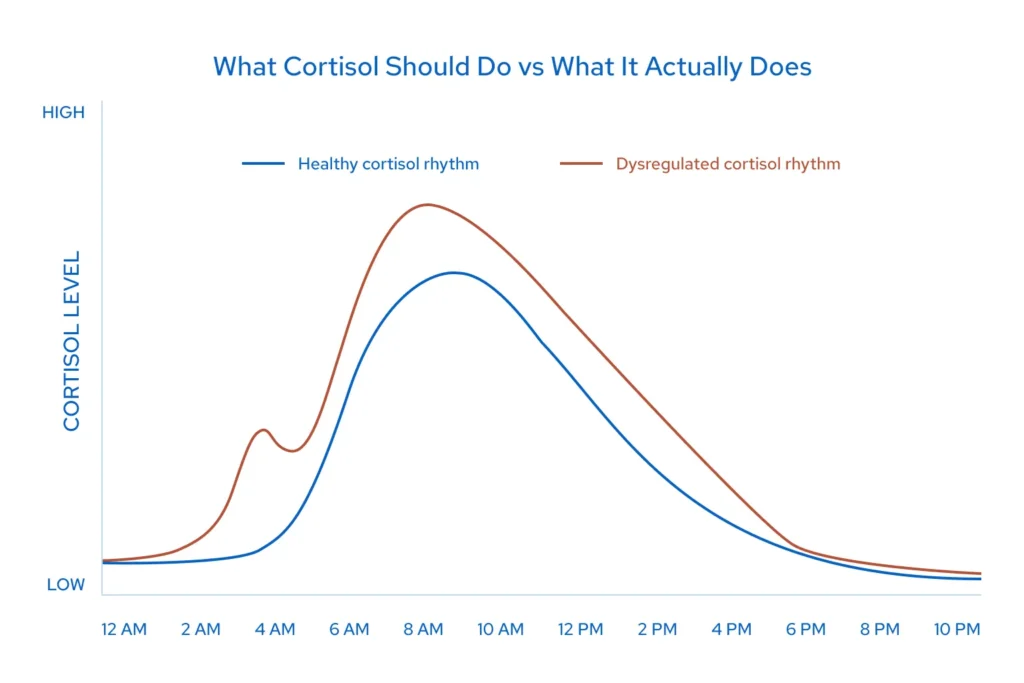
Im Normalzustand erreicht Cortisol gegen Mitternacht seinen Tiefpunkt, wodurch der Körper in seinen tiefsten, erholsamsten Schlaf eintreten kann. Dann beginnt der Cortisolspiegel ab etwa 2 Uhr morgens allmählich zu steigen, um sich auf das Aufwachen vorzubereiten.
Das ist normal. In einem gesunden Nervensystem schläft man direkt durch.
Aber wenn der Körper unter anhaltendem Stress steht – aufgrund von Arbeitsdruck, Pflege, familiären Anforderungen oder einfach Jahren, in denen er sich nicht vollständig erholt hat –, ändert sich etwas.
Der HPA-Achse (Hypothalamus-Hypophysen-Nebennieren-Achse – das Kontrollsystem, das die Cortisolausschüttung steuert) wird dysreguliert. Eine Metaanalyse, die 20 Studien mit mehr als 800 Teilnehmern zusammenfasste, bestätigte, dass chronische Schlafprobleme durchweg mit deutlich erhöhtem 24-Stunden-Cortisol verbunden sind, am ausgeprägtesten in den Abend- und frühen Morgenstunden.
Bei manchen Menschen, die unter chronischem Stress oder Schlafproblemen leiden, kann sich der Cortisolrhythmus verändern. Ein früherer oder höherer Cortisolanstieg über Nacht kann dazu beitragen, dass man in den frühen Morgenstunden aufwacht, obwohl dies wahrscheinlich nicht jeden Fall erklärt.
Es kann sich anfühlen, als wäre ein interner Alarm ausgelöst worden, auch wenn die Ursachen oft komplexer sind als ein einzelner Auslöser.
Und dann ist da noch das REM-Problem
3 Uhr morgens ist keine zufällige Zeit zum Aufwachen. Es ist eine biologische Schwachstelle – und hier ist der Grund.
Der Schlaf verläuft nicht geradlinig. Es durchläuft Zyklen von etwa 90 Minuten und wechselt zwischen tiefen Langsamschlaf (SWS) und Schneller Augenbewegungsschlaf (REM).
Die erste Hälfte der Nacht wird von tiefem Slow-Wave-Schlaf dominiert – der Phase, die Gewebe repariert, die körperliche Erholung festigt und die Immunfunktion wiederherstellt.
In der zweiten Hälfte der Nacht –ab etwa 3 Uhr morgens– dominiert der REM-Schlaf.
REM ist nicht nur Träumen. Es ist die Phase, in der das Gehirn:
- Verarbeitet und festigt emotionale Erfahrungen des Tages
- Überträgt kurzfristiges Lernen auf das Langzeitgedächtnis
- Reguliert die Stimmung, die Stressresistenz und die Fähigkeit, am nächsten Tag mit Druck umzugehen
Wiederholtes Aufwachen in der zweiten Hälfte der Nacht kann den REM-reichen Schlaf unterbrechen, was sich auf die Stimmung, die Gedächtnisverarbeitung und Ihr Ruhegefühl am nächsten Tag auswirken kann.
Nicht nur die Quantität des Schlafs, sondern auch die Qualität dessen, was dieser Schlaf bewirken sollte. Aus diesem Grund beschreiben Menschen mit chronischem Aufwachen um 3 Uhr morgens oft nicht nur Müdigkeit, sondern eine besondere Art der Erschöpfung: emotionale Flachheit, schlechte Konzentration, geringe Belastbarkeit, eine Stimmung, die nicht zu ihren Umständen passt.
“Ich bin nicht müde. Ich bin mehr als nur müde. Ich wache bereits hinter mir auf.”
Der 90-Minuten-Zyklus, der sie durch weitere zwei oder drei Runden REM-Schlaf hätte führen sollen, ist einfach nicht passiert.
Und das – nicht die Schlafstunden, nicht die Schlafhygiene – ist es, was die üblichen Ratschläge nicht ansprechen.
Was also tut es?
“Ich habe alles versucht.” Das haben Sie wahrscheinlich. Hier ist, was tatsächlich fehlt.
Alles, was die meisten Menschen zum Schlafen versuchen, hat einen echten Wert.
Aber Folgendes fällt mir in der Praxis immer wieder auf.
- Melatonin - hilft wirklich bei Einschlafstörungen und Problemen mit dem zirkadianen Rhythmus. Melatonin hilft hauptsächlich bei der Regulierung des Schlafzeitpunkts und kann bei einigen Schlafproblemen hilfreicher sein als wiederholtes Aufwachen am frühen Morgen.
- Magnesium - Ich empfehle es den meisten meiner Kunden und es unterstützt wirklich die Regulierung des Nervensystems. Aber es funktioniert an der Peripherie des Systems. Seine Auswirkungen auf die Regulierung der HPA-Achse bleiben ungewiss und es kann sein, dass es das anhaltende Aufwachen am frühen Morgen nicht von selbst löst - weshalb Magnesium im Blut normal aussehen kann, während das Aufwachen um 3 Uhr morgens anhält.
- Schlafhygiene - Bildschirme, Temperatur, konsistente Zeitpläne. Alles richtig, alles wichtig, und ich ermutige sie. Aber selbst eine perfekte Schlafumgebung verhindert den Cortisolanstieg nicht. Die Schlafumgebung bleibt wichtig, reicht jedoch möglicherweise nicht aus, wenn andere physiologische oder psychologische Faktoren dazu beitragen.
- Atemübungen und Meditation - wirklich wirksam zur Beruhigung des Nervensystems. Sie erfordern jedoch Ruhe, Konzentration und einen mentalen Freiraum, den die meisten Menschen unter anhaltendem Stress bereits erschöpft haben. Der Versuch zu meditieren, wenn der Geist bereits läuft, ist ein bisschen so, als würde man versuchen, ein Auto ohne Bremsen abzubremsen, indem man das Lenkrad fester umklammert. Und für jemanden, der um 3 Uhr morgens aufwacht - völlig wachsam, das Herz geht bereits - ist die Umgebung, die erforderlich ist, damit diese funktionieren, genau das, was nicht verfügbar ist.
- CBD-Öl - immer beliebter und das aus gutem Grund. Es kann die Entspannung wirklich unterstützen und die Einschlafzeit verkürzen. Die Wirkung ist jedoch von Person zu Person sehr unterschiedlich und es braucht Zeit und Studien, um die richtige Dosis und das richtige Produkt zu finden. Noch wichtiger ist, dass es wie Magnesium auf die Symptome rund um den Schlaf wirkt und nicht auf die Dysregulation der HPA-Achse, die Cortisol zu früh in der Nacht feuert.
- Alkohol - verkürzt die Einschlafzeit, weshalb die Leute danach greifen. Aber es unterdrückt den REM-Schlaf in der zweiten Hälfte der Nacht. Das darauf folgende Aufwachen um 3-4 Uhr morgens ist eine direkte Folge - es kommt genau dann an, wenn REM seinen Höhepunkt erreichen sollte.
- CBT-I (Kognitive Verhaltenstherapie bei Schlafproblemen) – der evidenzbasierteste verfügbare Ansatz, der im Laufe der Zeit wirklich wirksam ist. Es erfordert jedoch mehrere Sitzungen, anhaltende Anstrengungen und eine wochenlange Umsetzung. Für jemanden, der bereits erschöpft ist, ist es oft ein Hindernis zu viel, die Konsistenz zu finden, um sich an einem strukturierten Programm zu beteiligen.
“Ich habe alles getan, was mir gesagt wurde. Ich bin diesbezüglich diszipliniert. Und ich wache immer noch um 3 Uhr morgens auf.”
Das sind keine falschen Ansätze. Die meisten davon sind wirklich gute Ansätze.
Das Problem ist nicht, dass sie nicht funktionieren. Es ist so, dass sie alle etwas von einer Person verlangen, die bereits auf leeren Beinen steht. Zeit. Ruhig. Konsistenz. Mentaler Raum. Energie.
Und sie alle befassen sich mit der Umgebung rund um den Schlaf, nicht mit dem System, das um 3 Uhr morgens den Alarm auslöst.
Die Frage, die mich zur Antwort führte
Zu diesem Zeitpunkt meiner Praxis hatte ich aufgehört zu fragen: “Wie verbessern wir Ihre Schlafumgebung?”
Und fing an zu fragen: “Welches System soll die Cortisolausschüttung in der Nacht regulieren – und warum funktioniert es nicht mehr richtig?”
Diese Frage brachte mich immer wieder an denselben Ort zurück.
Vagusnerv (Vagus ist lateinisch für “wandernd” – er verläuft vom Hirnstamm bis durch Brust und Bauch und verbindet das Gehirn direkt mit Herz, Lunge, Darm und Immunsystem).
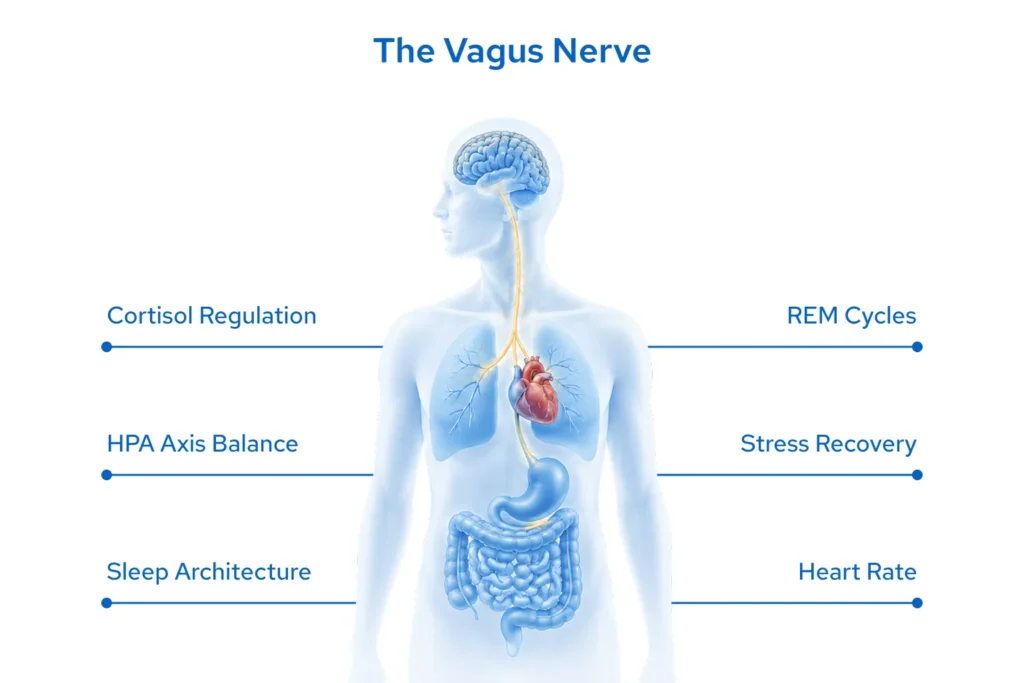
Es ist der längste Nerv im Körper. Es ist einer der wichtigsten Wege, die an der Kommunikation zwischen Gehirn und Organen im gesamten Körper beteiligt sind, einschließlich Prozessen, die die autonome Regulierung beeinflussen.
Stellen Sie sich den Vagustonus als Lautstärkeregelung des Körpers für die Stressreaktion vor.
Wenn Vagustonus (das Maß dafür, wie gut der Vagusnerv funktioniert) ist gesund, das parasympathische Nervensystem (PNS – der “Ruhe- und Verdauungs-”Zustand) hält das Gleichgewicht. Cortisol steigt und fällt planmäßig. Schlafzyklen abgeschlossen. REM ist geschützt.
Wenn der Vagustonus sinkt –durch chronischen Stress, akkumulierte Überlastung oder anhaltende Erschöpfung –, funktioniert dieser Lautstärkeregler nicht mehr.
Das sympathische Nervensystem (SNS – “Kampf oder Flucht”) gewinnt an Dominanz. Chronischer Stress kann zu Veränderungen in der Regulierung der HPA-Achse beitragen, obwohl die individuellen Cortisolmuster erheblich variieren. Der Körper behandelt die frühen Morgenstunden als Bedrohungsreaktion. Und der Wecker klingelt jede Nacht um 3 Uhr morgens –, wie am Schnürchen.
Was mich zu der einzigen Frage brachte, die noch blieb: Gibt es einen direkten Weg, den Vagusnerv – zu erreichen und diese Regulierung wiederherzustellen?
Was ich gefunden habe – und warum ich skeptisch war
Ich bin ehrlich – als ich zum ersten Mal auf Forschungen zur Vagusnervstimulation stieß (VNS)„ Meine unmittelbare Reaktion war Skepsis.
Der etablierte Therapieansatz war chirurgisch – ein in die Brust implantiertes Gerät, das direkt mit dem Vagusnerv im Hals verbunden ist und in Krankenhäusern bei therapieresistenten depressiven Zuständen eingesetzt wird. In diesen Kontexten wirklich wirksam. Völlig irrelevant für jemanden, der versucht, die Nacht zu überstehen, ohne um 3 Uhr morgens aufzuwachen.
Dann fand ich etwas, mit dem ich nicht gerechnet hatte.
Forscher hatten einen Ast des Vagusnervs identifiziert, der direkt unter der Hautoberfläche verläuft – am Außenohr, an einem kleinen Knorpelstück namens Tragus, am Eingang zum Gehörgang.
Funktioneller Magnetresonanztomographie (fMRI) Studien deuten darauf hin, dass die Stimulation an dieser Stelle Gehirnregionen aktiviert, die mit Vagusbahnen verbunden sind.
Dies ist die einzige therapeutisch etablierte äußere Stelle am Körper, an der der Vagusnerv direkt erreicht werden kann – ohne Operation, ohne Rezept, ohne Arzttermin.
Wissenschaftler entwickelten eine Technik, die elektrische Signale auf niedrigem Niveau nutzt: transkutane Stimulation des Nervus vagus auricularis (taVNS – “transkutan” bedeutet durch die Haut, “auricular” bedeutet über das Ohr).
Ich habe die veröffentlichten Forschungsergebnisse sorgfältig durchgesehen. Von Experten begutachtete, placebokontrollierte wissenschaftliche Studien – durchgeführt in Zusammenarbeit mit Institutionen wie Harvard, UCL und King's College London.
Und dann fand ich das Ergebnis, das mich dazu brachte, das ernst zu nehmen.
In einer von Experten begutachteten Studie verbesserten sich die Schlafqualitätswerte um +30% – gemessen mit dem PSQI (Pittsburgh Sleep Quality Index – die therapeutische Goldstandardskala zur Messung der Schlafqualität).
Nicht durch Optimierung der Schlafhygiene. Nicht durch Hinzufügen eines weiteren Nahrungsergänzungsmittels. Die Studie berichtete über Verbesserungen der Schlafqualitätswerte nach der Stimulation, obwohl noch größere unabhängige Studien erforderlich sind, um diese Ergebnisse zu bestätigen.
Dies war das erste Mal, dass ich Hinweise auf den tatsächlichen Mechanismus –die Dysregulation der HPA-Achse und die Unterdrückung des Vagustonus – sah, den ich seit Jahren bei der Entstehung von Schlafproblemen bei Klienten beobachtet hatte.
Ich war nicht auf der Suche nach einem weiteren Nahrungsergänzungsmittel – davon hatte ich in meinen Fällen schon genug.
Ich war nicht auf der Suche nach einem anderen Tool, das nur funktioniert, wenn man bereits ruhig genug ist, es zu benutzen.
Ich habe nicht nach etwas gesucht, das den Leuten beim Einschlafen hilft. Das Problem war nicht das Einschlafen. Das Problem war, was um 3 Uhr morgens passierte.
Ich habe nach etwas gesucht, das das System selbst erreicht. Dies war einer der ersten Ansätze, die ich gefunden habe und die direkt auf einen Weg abzielten, von dem angenommen wird, dass er an der autonomen Regulierung beteiligt ist.
Aber es gab immer noch ein Problem.
Die Recherche war detailliert. Der Mechanismus war völlig sinnvoll. Was ich brauchte, war ein Gerät, das Benutzer tatsächlich verwenden konnten – zu Hause, vor dem Schlafengehen, ohne therapeutische Unterstützung, ohne ein Protokoll, das Energie erforderte, die ihnen bereits ausgegangen war.
Ich habe es gefunden. Und es war einfacher als ich erwartet hatte.
Was die Forschung zeigt
Bevor ich dies meinen Kunden empfehle, wollte ich sicherstellen, dass die Beweise das widerspiegeln, was ich in der Praxis gesehen habe.
Ergebnis | Metrik |
+30% | Schlafqualität (PSQI-Score, von Experten begutachtete RCT) |
+61% | Vagusnervenaktivität (innerhalb von 5 Minuten nach Gebrauch) |
−78% | Entzündungsmarker IL-6 (3-monatige Studie) |
−48% | Müdigkeit |
−40% | Gehirnnebel |
−35% | Ängstliche Gedanken |
−45% | Depressive Zustände / schlechte Laune |
60+ abgeschlossene wissenschaftliche Studien. Bisher wurden keine schwerwiegenden unerwünschten Ereignisse gemeldet.
Was mir auffiel, war keine einzelne Zahl. Es war das Muster – und wie genau es dem entsprach, was ich beobachtet hatte. In verschiedenen Studien wurde über Verbesserungen der Schlafqualität, Müdigkeit und mehrerer anderer Ergebnisse in bestimmten Studienpopulationen berichtet. Diese Ergebnisse sind ermutigend, obwohl sie aus unterschiedlichen Studien stammen und nicht als Beweis dafür interpretiert werden sollten, dass sich alle Ergebnisse gemeinsam durch einen einzigen Mechanismus verbessern.
Alles gleichzeitig. Weil sie alle dasselbe zugrunde liegende Regulierungssystem haben.
Das Gerät, das diese Ergebnisse erzeugt hat, heißt Nurosym.
Die Gewohnheit, zu Hause zu sein, die ich jetzt empfehle
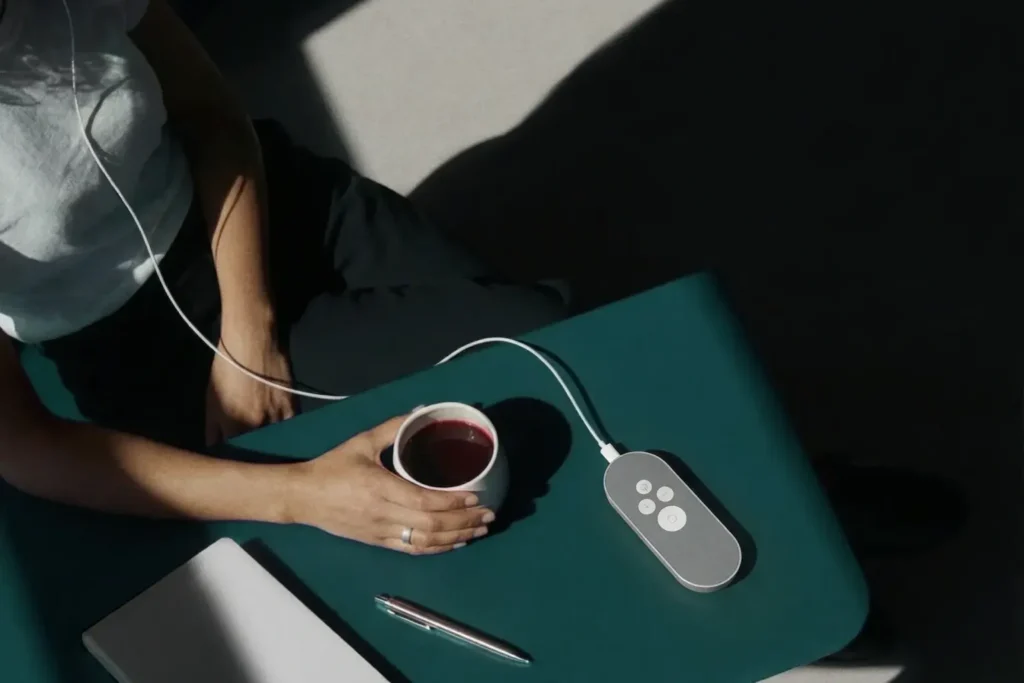
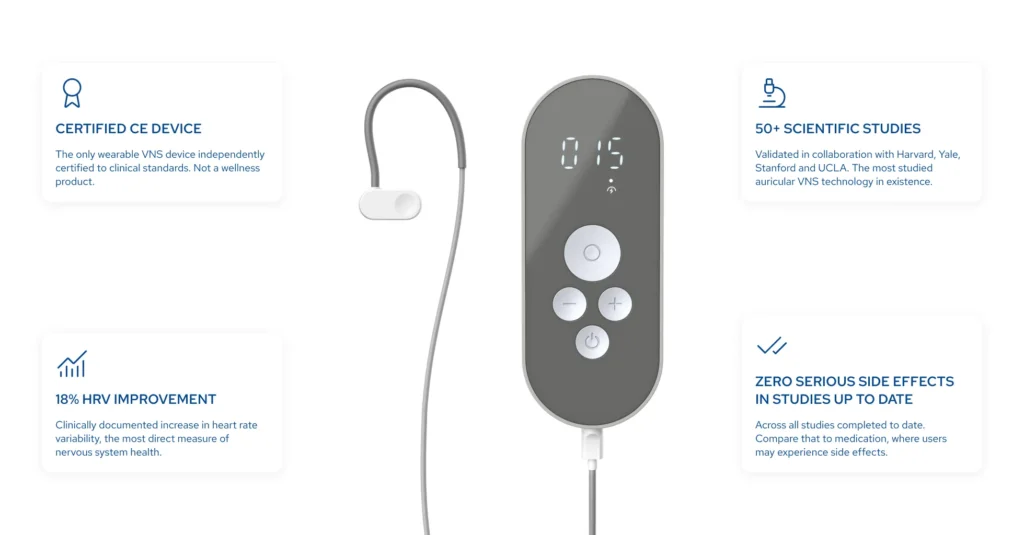
Nurosym ist ein CE-gekennzeichnetes taVNS-Gerät, das von Parasym – entwickelt wurde, einem in Großbritannien ansässigen Unternehmen mit mehr als 10 Jahren Forschung und Entwicklung und über £10 Millionen Investitionen in wissenschaftliche Forschung.
Unterstützt durch 60+ von Experten begutachtete Studien, darunter Kooperationen mit Institutionen wie Harvard, UCL und King's College London.
Empfohlen von 1.000+ medizinischen Fachkräften. Über 5 Millionen Sitzungen abgeschlossen.
Es verwendet proprietäre AVNT™-Technologie (Aurikuläre Vagusneuromodulationstherapie – ein präzise kalibriertes elektrisches Signal, das durch den Tragus des linken Ohrs abgegeben wird und den Ohrast des Vagusnervs direkt stimuliert).
Praktisch gesehen, Es wird mit einem kleinen Kabel sanft am Ohr befestigt – diskret, leicht und einfach zu bedienen.
Wie es funktioniert
Nurosym ist kein Ersatz für gute Schlafhygiene, Magnesium oder andere Ansätze, die bereits helfen. Diese Dinge sind wichtig – und ich empfehle sie weiterhin.
Was es hinzufügt, ist etwas anderes. Im Gegensatz zu Melatonin sagt es dem Körper nicht, wann er schlafen soll. Im Gegensatz zu Magnesium passt es die Chemie des Nervensystems nicht von der Peripherie aus an. Im Gegensatz zur Schlafhygiene geht es dabei nicht darum, die Umgebung rund um den Schlaf zu optimieren.
Ziel ist es, den Ohrast des Vagusnervs zu stimulieren, was die Vagusaktivität und die autonome Regulierung beeinflussen kann – und die Regulierung der HPA-Achse zu unterstützen, die bestimmt, wann Cortisol ansteigt, wie hoch es ansteigt und ob der REM-Schlaf in der zweiten Nachthälfte geschützt ist.
Mit anderen Worten soll es einen der physiologischen Wege unterstützen, die an der Regulierung des Nervensystems beteiligt sind, anstatt sich ausschließlich auf Schlafgewohnheiten oder Nahrungsergänzungsmittel zu konzentrieren. Für Fälle, die alles richtig gemacht haben und trotzdem um 3 Uhr morgens aufwachen, ist dies normalerweise das fehlende Stück.
Wie du es verwendest

15 bis 30 Minuten. Vor dem Schlafengehen oder während einer abendlichen Entspannung.
Kein ruhiger Raum nötig. Keine mentale Vorbereitung. Kein Konsistenzprotokoll, dem man folgen sollte.
Sie können es beim Lesen verwenden. Während man etwas beobachtet. Während ich ruhig liege. Während Sie den Abwasch machen. Beim Bügeln. Es lässt sich wie ein kabelloser Ohrhörer am Ohr befestigen – und funktioniert dann einfach, während Sie alles tun, was der Abend bereits beinhaltet.
Dies ist der Teil, der für Menschen, die bereits erschöpft sind, am wichtigsten ist: es verlangt nicht zuerst etwas von Ihnen. Damit es funktioniert, müssen Sie nicht ruhig sein. Es braucht keine zwanzig Minuten Stille und einen abgedunkelten Raum. Es ergänzt nicht die Liste der Dinge, die Sie vor dem Schlafengehen erledigen müssen.
Der Zustand, den es erfordert, ist die Umgebung, die ein gewöhnlicher Abend bereits bietet.
Nurosym könnte besonders geeignet sein:
- Die Person, die gut einschläft, aber um 3 Uhr morgens aufwacht - konsequent, ohne Erklärung
- Die Person, deren Schlaftracker trotz ausreichender Stunden im Bett eine schlechte REM zeigt
- Die Pflegekraft oder der Elternteil, dessen Nervensystem sich zwischen den Anforderungen einfach nie vollständig entspannt
- Der Profi, der erschöpft ins Bett fällt – und immer noch nicht durchschlafen kann
- Jeder, dessen Schlaf sich während einer stressigen Zeit verschlechtert hat und der sich seitdem nicht erholt hat
Was den Leuten tatsächlich auffällt
Die Veränderungen kommen meist leise an – und fühlen sich dann plötzlich offensichtlich an.
“Mein Schlaf hat sich verbessert und eines Tages erreichte ich 99/100 Punkte für die Qualität und Tiefe meines Schlafs. Ich bedauere, dass ich nicht früher eins bestellt habe.”
“Ich fühle mich, als wäre ich aus einem langen Winterschlaf erwacht.”
“Ich benutze das Gerät jetzt seit zwei Monaten. Mein Schlaf und mein Energieniveau haben sich stark verbessert.”
“In der ersten Nacht, in der ich es benutzt habe, habe ich die ganze Zeit geschlafen. Das hatte ich seit Monaten nicht mehr gemacht.”
Dies sind die Signale einer HPA-Achse, die zu regulieren beginnt – und Cortisol beginnt, wieder seinem natürlichen Rhythmus zu folgen. Allmählich. Inkrementell. Echt.
Und fast immer ist – Schlaf nicht das Einzige, was sich ändert.
Warum Schlaf selten das Einzige ist, was sich verbessert
Etwas, das ich in der Praxis immer wieder sehe – und das Kunden selten erwarten.
Dieselbe Dysregulation der HPA-Achse, die Cortisol zu früh feuert, führt auch zu Tagesmüdigkeit, Gehirnnebel, schlechter Stimmung und der Art von ängstlichen Hintergrundgedanken, die keinen Namen und keine offensichtliche Ursache haben.
Schlafstörungen, Müdigkeit, schlechte Laune und ängstliche Gedanken treten häufig gemeinsam auf und können sich überschneidende biologische Wege aufweisen, obwohl ihre Ursachen von Person zu Person unterschiedlich sind.
Kunden, die speziell gegen 3 Uhr morgens zum Aufwachen zu mir kommen, beginnen – fast nebenbei– zu erwähnen, dass der Energiecrash am Nachmittag vorbei ist. Die Hintergrundspannung ist gesunken. Dass sie morgens schärfer sind. Dass sich die Stimmung auf eine Weise gehoben hat, die sie nicht ganz erklären können.
Dies macht Sinn, sobald Sie den Mechanismus verstanden haben. Die HPA-Achse bestimmt nicht nur den Schlaf. Es steuert den gesamten Stress- und Erholungsrhythmus des Körpers – über den Tag und die Nacht hinweg. Verbesserungen bei der Stressregulierung können mit Verbesserungen bei anderen Symptomen einhergehen, obwohl die Reaktionen unterschiedlich sind und die Ursache nicht geklärt ist.
Ist das das Richtige für Sie?
Wenn Ihnen dieses Muster bekannt vorkommt – Aufwachen um 3 Uhr morgens, Liegen ohne wieder einschlafen zu können, den Tag mit weniger auskommen als nötig –, lohnt es sich, dies ernsthaft zu erkunden.
Nurosym funktioniert neben allem anderen, was Sie bereits tun. Schlafhygiene ist wichtig. Magnesium hilft. Was Nurosym hinzufügt, ist direkte Unterstützung für das zugrunde liegende System – Unterstützung für autonome Regulierung, was für einige Menschen mit anhaltenden Schlafstörungen relevant sein kann.
Eine 30-tägige Geld-zurück-Garantie bedeutet kein finanzielles Risiko. Entweder macht es einen sinnvollen Unterschied, oder Sie geben es zurück.
Nurosym könnte eine Überlegung wert sein, wenn:
- Sie wachen ständig zwischen 2 und 4 Uhr morgens auf – und liegen da, völlig wach, unfähig, wieder einzuschlafen
- Sie schlafen leicht ein, fühlen sich aber unruhig, unabhängig davon, wie viele Stunden Sie hatten
- Ihr Schlaftracker zeigt trotz ausreichender Schlafenszeit einen schlechten REM- oder flachen Schlaf an
- Sie sind ein Elternteil, Betreuer oder Fachmann, dessen Nervensystem sich einfach nie vollständig entspannt
- Der Schlaf verschlechterte sich während einer stressigen Zeit - und hat sich seitdem nicht erholt, obwohl der Stress nachgelassen hat
- Sie haben Nahrungsergänzungsmittel, Hygieneänderungen und Apps mit nur teilweisen Ergebnissen ausprobiert
Nurosym ist nicht für jeden geeignet. Wenn Sie über ein implantiertes Herzgerät wie einen Herzschrittmacher verfügen, schwanger sind, in den letzten fünf Jahren ein schweres kardiales Ereignis hatten oder unter 18 Jahre alt sind, verwenden Sie es bitte nicht. Wie bei jeder neuen Intervention lohnt es sich immer, zunächst bei Ihrem Arzt zu prüfen, ob bei Ihnen bereits medizinische Symptome vorliegen.
Wenn ich hoffe, dass dieser Artikel eines bietet, dann ist es Folgendes:
Wenn man jede Nacht um 3 Uhr morgens aufwacht, ist das kein Charakterfehler. Es ist kein Zeichen dafür, dass Sie schlecht schlafen, zu gestresst sind oder einfach mehr entspannen müssen.
Bei manchen Menschen kann wiederholtes Aufwachen am frühen Morgen eher Veränderungen in der Stressregulation und der autonomen Funktion widerspiegeln als Schlafgewohnheiten allein. Ansätze, die die autonome Regulierung unterstützen, werden aktiv untersucht, sollten jedoch als Teil einer umfassenderen Schlafmanagementstrategie und nicht als eigenständige Lösung betrachtet werden.
Sobald Sie das verstanden haben, fühlt sich das Aufwachen um 3 Uhr morgens nicht mehr mysteriös an. Es wird zu etwas, das endlich physiologisch Sinn macht – und etwas, gegen das man tatsächlich etwas tun kann.
Blick über die Schlafhygiene hinaus?
Manchmal besteht die Herausforderung nicht darin, einzuschlafen; Es hilft Ihrem Körper, die ganze Nacht über in einem erholsamen Zustand zu bleiben.
Entdecken Sie, wie die Unterstützung der Vagusaktivität gesunde Schlafgewohnheiten und die allgemeine Regulierung des Nervensystems ergänzen kann.
Dieser Artikel spiegelt meine professionelle Bewertung der Evidenz und 15 Jahre klinische Erfahrung in der funktionellen Medizin und Naturheilkunde wider. Möglicherweise erhalte ich eine Empfehlungsvereinbarung für Käufe, die über Links in diesem Artikel getätigt werden. Ich empfehle nur Ansätze, die ich sorgfältig geprüft habe und hinter denen ich bei meinen eigenen Patienten stehen würde. Dies ist kein medizinischer Rat – konsultieren Sie immer ein qualifiziertes medizinisches Fachpersonal, bevor Sie mit einer neuen Intervention beginnen. Die Zahl von 30 % Schlafverbesserung spiegelt eine relative Veränderung in einer von Experten begutachteten klinischen Studie wider; die individuellen Ergebnisse können variieren.
– Thomas Hottmann, Naturopath & Functional Medicine Practitioner | YourBestHealth, Lake Constance
Dieser Blogbeitrag soll informativ sein und sollte keine professionelle Gesundheitsberatung ersetzen. Konsultieren Sie immer einen Arzt, um eine individuelle Beratung zu erhalten.
Referenzen
- Hirotsu C, Tufik S, Andersen ML. Interactions between sleep, stress, and metabolism : From physiological to pathological conditions. Sleep Science. 2015;8(3):143–152. https://pmc.ncbi.nlm.nih.gov/articles/PMC4688585/
- Abell JG, et al. Recurrent short sleep, chronic insomnia symptoms and salivary cortisol: A 10-year follow-up in the Whitehall II study. Psychoneuroendokrinologie. 2016. https://pmc.ncbi.nlm.nih.gov/articles/PMC4862960/
- Besedovsky L, Lange T, Born J. Sleep and immune function. Pflügers Archiv – European Journal of Physiology. 2012;463:121–137. https://doi.org/10.1007/s00424-011-1044-0
- Breit S, et al. Vagus nerve as modulator of the brain-gut axis in psychiatric and inflammatory disorders. Grenzen in der Psychiatrie. 2018;9:44. https://doi.org/10.3389/fpsyt.2018.00044
- Kaniusas E, et al. Current directions in auricular vagus nerve stimulationI – A physiological perspective. Frontiers in Neuroscience. 2019. https://doi.org/10.3389/fnins.2019.00854
- Farmer AD, et al. International Consensus Based Review and Recommendations for Minimum Reporting Standards in Research on Transcutaneous Vagus Nerve Stimulation (Version 2020). Grenzen der menschlichen Neurowissenschaften. 2021. https://doi.org/10.3389/fnhum.2020.568051
- Redgrave J, et al. Safety and tolerability of transcutaneous vagus nerve stimulation in humans: a systematic review. Hirnstimulation. 2018;11(6):1225–1238. https://doi.org/10.1016/j.brs.2018.08.010


 German
  English
  French
  Spanish
  Swedish
  Italian