
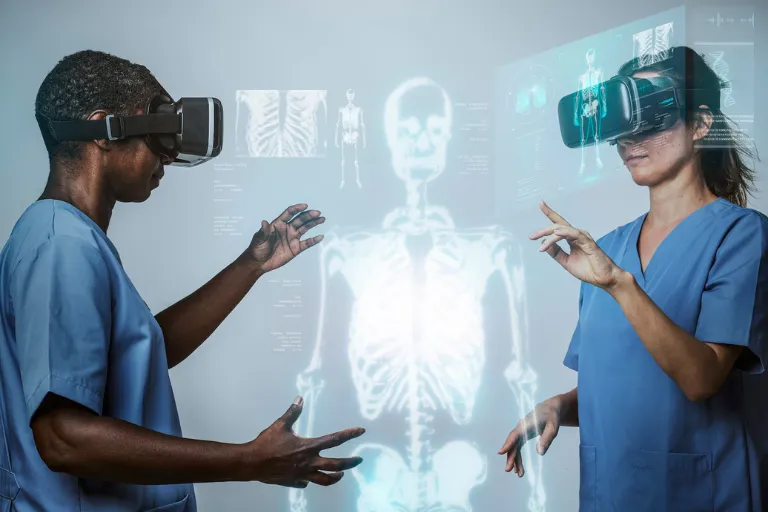
Puntos clave:
- La inteligencia artificial (IA) está transformando el cuidado de la salud con diagnósticos avanzados, análisis predictivos y terapias personalizadas.
- La IA demuestra una alta precisión en especialidades como radiología y dermatología, pero se enfrenta a desafíos en entornos clínicos del mundo real.
- Las consideraciones éticas, profesionales y humanas hacen improbable la sustitución completa de los profesionales de la salud.
- Los expertos ven la IA como un complemento, no un sustituto, del lado humano de la medicina.
Una nueva era en la innovación sanitaria
Imagínese entrar en un hospital donde el primer diagnóstico no viene de un profesional de la salud humana sino de un algoritmo que escanea sus registros, resultados de laboratorio y señales potenciales como cambios de voz. Lo que antes sonaba como ciencia ficción ahora se está convirtiendo en realidad. Desde la detección del cáncer hasta la predicción de ciertos riesgos cardiovasculares, la IA ya ha entrado en laboratorios, departamentos de imágenes y se utiliza cada vez más en dispositivos portátiles - y está cambiando la forma en que se presta atención.
Pero con los rápidos avances surgen preguntas difíciles. Si la IA puede superar a los seres humanos en ciertas tareas de diagnóstico, ¿qué significa esto para el papel de los profesionales de la salud? Y más allá de la precisión, ¿puede una máquina realmente reemplazar la confianza, la empatía y el juicio humano que los usuarios esperan de la atención médica? Estas preguntas ya no son teóricas - están configurando el futuro de la medicina hoy.
Por qué el auge de la IA en la medicina es importante
Los sistemas de salud en todo el mundo enfrentan una presión creciente debido a la escasez de personal, la sobrecarga administrativa y el aumento de los costos. Los usuarios a menudo esperan semanas para las citas, mientras que los profesionales de la salud deben equilibrar el tiempo limitado con las crecientes demandas. La IA promete alivio: diagnósticos más rápidos, papeleo simplificado y terapias adaptadas a la biología única de un individuo.
Sin embargo, sigue existiendo la paradoja - una mayor dependencia de los algoritmos suscita preocupaciones sobre la seguridad, la equidad y la erosión del contacto humano en el cuidado. Lo que está en juego no es sólo la eficiencia, sino la naturaleza misma de la relación entre los seres humanos y los sistemas diseñados para proteger su salud.
Donde la IA sobresale y donde aún falla
Los puntos fuertes de la IA residen en su capacidad para detectar patrones a escala. Los algoritmos entrenados en millones de imágenes médicas pueden identificar tumores o lesiones cutáneas con un rendimiento similar al de los especialistas humanos - en tareas específicas y entornos controlados. Los modelos predictivos también están señalando a los usuarios con riesgo de problemas de regulación del azúcar en la sangre o problemas cardíacos antes que los métodos convencionales de detección.
Pero la IA lucha con la complejidad de los entornos del mundo real. Los algoritmos sólo son tan fiables como los datos de los que aprenden, y los sesgos en los conjuntos de datos de formación pueden producir diagnósticos erróneos. Una IA entrenada principalmente en poblaciones europeas, por ejemplo, puede tener un rendimiento inferior cuando se analizan diversos grupos étnicos. Además, las máquinas aún no pueden reproducir la capacidad humana de percibir cuando un usuario está demasiado ansioso o confundido para seguir instrucciones - una parte esencial de un buen cuidado.
La ciencia detrás de los avances en salud de la IA
En el corazón del éxito de la IA está el aprendizaje automático, donde los algoritmos "aprenden" de grandes conjuntos de datos. La radiología se ha convertido en uno de los mayores éxitos de la IA: los sistemas de aprendizaje profundo ahora detectan nódulos pulmonares o anormalidades del tejido mamario en las exploraciones con una precisión notable. En cardiología, la IA puede analizar electrocardiogramas para detectar patrones de latidos cardíacos rápidos o ritmos cardíacos bajos en reposo que incluso los profesionales de la salud experimentados pueden pasar por alto.
Otra frontera es el desarrollo de un modelo "digital twin" - réplicas virtuales del cuerpo de un usuario que simulan cómo pueden funcionar diferentes terapias. Las herramientas de procesamiento del lenguaje natural también están aliviando la carga del trabajo administrativo al resumir los registros y ayudar con la documentación, ahorrando tiempo valioso tanto para los usuarios como para los profesionales de la salud.
Aplicaciones prácticas: cómo la IA está apoyando el cuidado de la salud hoy en día
La IA ya está dando forma a la asistencia sanitaria del mundo real, no reemplazando a los profesionales de la salud sino ampliando su alcance. Ejemplos incluyen:
- Diagnóstico acelerado: DeepMind de Google demostró modelos de IA que recomendaban decisiones correctas de referencia para más de 50 enfermedades oculares con alta precisión - comparable a los especialistas, en un entorno de investigación.
- Terapias adaptadas: las herramientas de la IA están ayudando a diseñar regímenes de medicamentos personalizados según los perfiles genéticos.
- Reducción del agotamiento: las herramientas automatizadas de transcripción y elaboración de gráficos están reduciendo horas de papeleo, lo que permite a los profesionales de la salud centrarse en los usuarios.
- Integración con dispositivos portátiles: los dispositivos realizan un seguimiento de los signos vitales y alertan a los usuarios sobre las señales tempranas de problemas para dormir, problemas cardíacos u otras preocupaciones.
Los mayores beneficios surgen cuando AI sirve como copiloto - señalando cuestiones para que los seres humanos confirmen y contextualicen.
Dilemas éticos y profesionales de la IA en el sector sanitario
Con herramientas poderosas surgen cuestiones éticas complejas. ¿Quién es responsable si un diagnóstico apoyado por la IA es incorrecto? ¿Cómo se deben salvaguardar los datos sanitarios cuando alimentan estos algoritmos? Los reguladores, como la FDA, están elaborando marcos para la aprobación, pero las políticas a menudo se quedan atrás en cuanto a la innovación.
Igualmente importante es la cuestión de la confianza. A menudo los usuarios valoran no solo la precisión sino también la compasión y la seguridad - cualidades que sólo proporcionan los seres humanos. Los profesionales de la salud pueden detectar señales sutiles como pensamientos ansiosos revelados a través del tono o la vacilación - señales que los algoritmos no están equipados para interpretar.
El futuro de las carreras médicas en un mundo impulsado por la IA
En lugar de eliminar a los profesionales de la salud, la IA está remodelando sus funciones. Las tareas cargadas de datos pueden pasar a los algoritmos, liberando a los seres humanos para que se concentren en las relaciones con los usuarios, la supervisión ética y la toma de decisiones complejas. Algunos predicen que surgirán nuevos roles híbridos - profesionales de la salud con experiencia tanto en medicina como en ciencia de datos.
A nivel mundial, la IA podría reducir las disparidades en las regiones de escasos recursos ofreciendo apoyo diagnóstico donde escasean los profesionales de la salud capacitados. Pero el acceso y la asequibilidad siguen siendo desafíos, especialmente si los sistemas de vanguardia permanecen limitados a las naciones más ricas.
Próximos pasos: Abrazar la IA sin perder la humanidad
La IA no está aquí para empujar a los seres humanos fuera de la atención médica - está aquí para ayudarles a trabajar más inteligente. Para los usuarios, el siguiente paso útil es preguntarle a su profesional de la salud cómo las soluciones basadas en IA pueden complementar su atención. Comprender qué tecnologías están disponibles puede permitirle tomar decisiones más informadas.
Para los profesionales de la salud, el desafío es aprender a trabajar con la IA en lugar de contra ella. Aquellos que se adaptan - entendiendo cómo interpretar las recomendaciones algorítmicas, manejar los datos de manera responsable y preservar el toque humano - estarán mejor posicionados para prosperar en el futuro de la medicina. La asistencia sanitaria es más fuerte cuando la experiencia humana y la inteligencia artificial se combinan, amplificando cada uno los puntos fuertes del otro.
Conclusión: una asociación, no un sustituto
La IA ya está remodelando el cuidado de la salud, pero la evidencia sugiere que no es un reemplazo para el toque humano. En lugar de ello, debe ser visto como un socio poderoso - uno que puede aliviar las cargas, agudizar los conocimientos y, en última instancia, mejorar los resultados del usuario. El estetoscopio no reemplazó a los profesionales de la salud; les dio una nueva forma de escuchar. AI puede servir al mismo papel para la próxima generación de medicina.
Este artículo de blog tiene como objetivo ser informativo y no debe reemplazar el asesoramiento profesional en salud. Consulte siempre con un profesional de la salud para obtener asesoramiento personalizado.
Suscríbase gratis para obtener artículos de salud más perspicaces adaptados a sus necesidades.
Referencias
- Katsoulakis E, Wang Q, Wu H, Shahriyari L, Fletcher R, Liu J, et al. Digital twins for health: a scoping review. npj Digital Medicine. 2024 Mar 22;7(1):1–11.
- Liu X, Mitani A, Spitz T, Wu DJ, Ledsam JR. Google and DeepMind: Deep Learning Systems in Ophthalmology. Springer eBooks. 2021 Jan 1;161–76.
- Liu WT, Lin C, Lee CC, Chang CH, Fang WH, Tsai DJ, et al. Artificial Intelligence-Enabled ECGs for Atrial Fibrillation Identification and Enhanced Oral Anticoagulant Adoption: A Pragmatic Randomized Clinical Trial. Journal of the American Heart Association [Internet]. 2025 Autumn;14(14):e042106. Available from: https://pubmed.ncbi.nlm.nih.gov/40611485/



 Spanish
  English
  German
  French
  Swedish
Really liked how this explained AI without making it scary. Feels like it could actually help doctors, not replace them
Didn’t realise AI was already being used for things like scans and heart checks. Pretty fascinating stuff.