
You did everything that needed doing.
The appointments. The medications. The night wakings. Sleeping with one ear open. Checking your phone every time it buzzed. Listening for movement in the next room. Always half-listening. Always half-ready.
For months. Sometimes years.
And now – whether the caring has ended or shifted or simply quietened – you expected to feel relief. You expected your body to follow.
It hasn’t.
You’re still waking at 3am for no reason. Still tense in situations that shouldn’t require it. Still running at a level of alertness that doesn’t match your life right now. Still exhausted in a way that sleep doesn’t seem to fix.
You’re not imagining it. And it isn’t ingratitude for finally having space to rest.
What you’re experiencing has a specific physiological explanation – and it’s one that most people who have cared for a loved one are never told about.
The caring may be over. But the nervous system is still waiting for the all-clear.
The Moment Most Caregivers Recognise

One thing I hear again and again in the clinic.
“I thought I’d finally be able to relax once everything settled down.”
But weeks later – sometimes months – they’re still sleeping lightly. Still reaching for the phone every time it buzzes. Still listening for sounds that no longer matter. Still feeling guilty for sitting down without a reason.
Still unable to enjoy a quiet evening without a low hum of something – not quite worry, not quite readiness – that they can’t quite name.
That’s usually the moment they understand: the caring ended. But the nervous system never received the all-clear.
What Caregiving Actually Does to the Body – And Why Nobody Talks About It
I’m Ewen McDonald, a GOsC Registered Osteopath and Clinical Director of Remedium Wellness, with clinics in Worcester, London and Birmingham. Over five years and 5,000+ users – including a significant number seen through our dedicated Chronic Pain Clinic – I’ve noticed a pattern that doesn’t get nearly enough attention.
A significant proportion of the users I see with persistent, unexplained physical symptoms are current or former caregivers.
Not because caring caused an injury. Not because they neglected their health in any obvious way. But because sustained caregiving does something very specific to the nervous system – and most people have no idea it’s happening until the body starts making it impossible to ignore.
In clinic I regularly see:
- Partners and spouses who managed a loved one's serious illness - presenting with chronic tension, disrupted sleep, and tiredness that doesn't respond to rest
- Parents of children with complex needs - whose bodies are locked in a state of readiness they can't switch off
- Adult children who spent years managing an ageing parent's care - and who, months after the caring ended, still don't feel like themselves
- People who describe feeling constantly "on" - even when there's nothing left to be on for
3 in 5 people in the UK will become a caregiver at some point in their lives. According to Carers UK’s State of Caring 2025, 57% feel overwhelmed often or always.
What the statistics don’t capture is why.
The Nervous System Has No Clock-Out – And That’s What Drives Caregiver Burnout
Caregiving is unlike almost any other sustained demand.
A difficult job ends at a certain hour. A stressful project has a deadline. But caregiving – particularly for a seriously ill or vulnerable person – has no natural end point. The body never receives a clear signal that the crisis is over. The nervous system stays in monitoring mode, perpetually scanning for the next thing that needs responding to.
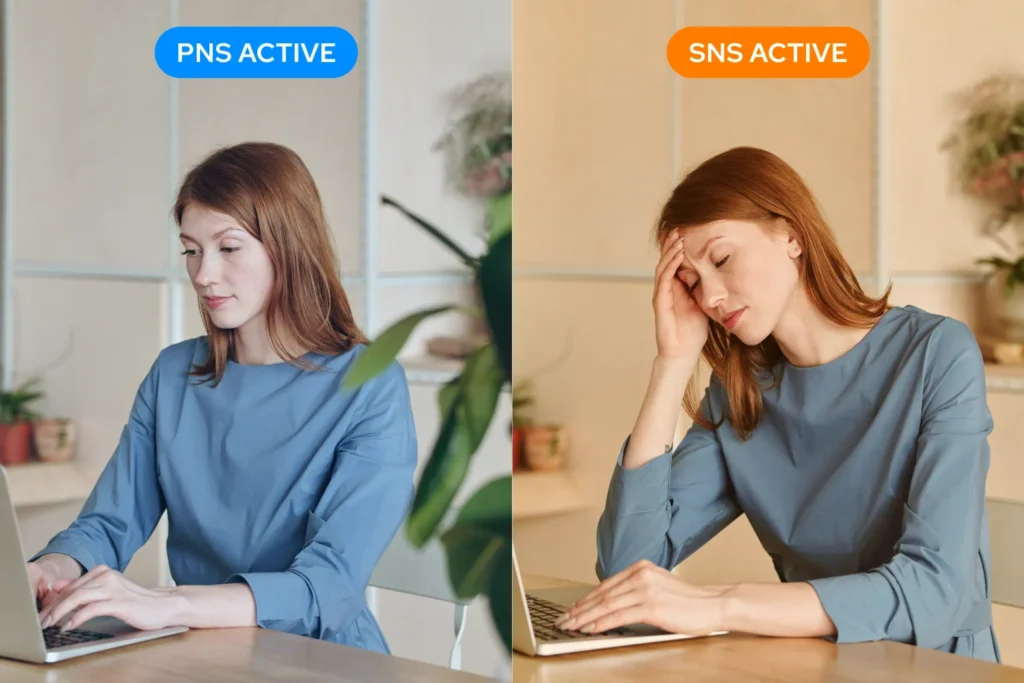
This is controlled by the sistema nervioso autónomo (SNA) – the system that regulates everything you don’t consciously control: heart rate, breathing, digestion, sleep, pain sensitivity, and immune function.
The ANS has two branches.
La sympathetic nervous system (SNS) activates in response to threat or demand. It raises alertness, tightens muscles, accelerates heart rate, and prepares the body for action. In a genuine emergency, this is exactly what you need.
La parasympathetic nervous system (PNS) does the opposite. It governs recovery, digestion, deep sleep, and genuine physical repair.
In sustained caregiving, the sympathetic branch activates – and stays activated.
Not because you’re doing anything wrong. Because the body is doing exactly what it’s designed to do during a prolonged period of demand: stay alert. Stay ready. Keep watch.
The problem is that the body was never designed to stay in that state for months or years. And when the demand finally ends – the nervous system doesn’t automatically switch back.
The crisis passes. The all-clear never comes.
Caregiver Tiredness, Anxious Thoughts and Tension That Rest Doesn’t Fix – Here’s Why

This is the part that most people – and most healthcare professionals – underestimate.
The nervous system doesn’t reset the moment external pressure lifts. After sustained periods of hypervigilance, the body develops what researchers describe as autonomic dysregulation – the sympathetic branch becomes the default state, and the shift to parasympathetic recovery becomes increasingly difficult to achieve.
Peer-reviewed research has found that caregivers of chronically ill family members show measurably altered HRV (Heart Rate Variability) compared to non-caregivers – a direct marker of reduced vagal tone and impaired autonomic recovery.
HRV measures the variation in time between heartbeats. High HRV reflects parasympathetic dominance – the body is recovering. Low HRV reflects sympathetic dominance – the body is still in stress mode.
In the people I see post-caregiving, low HRV is almost universal. Not because they’re unwell in any diagnosable sense. Because the nervous system has been operating in survival mode for so long it doesn’t know how to come down.
The symptoms follow a consistent pattern:
- Sleep that doesn't restore - waking early, or sleeping long hours that never feel sufficient
- Persistent muscle tension - particularly shoulders, jaw, neck and upper back
- Digestive disruption - the gut-brain axis is directly governed by vagal tone
- Emotional reactivity - lower tolerance for stress, quicker to feel overwhelmed
- Tiredness that rest doesn't fix - because genuine recovery requires parasympathetic activation, not just the absence of activity
- A background hum of alertness - that feeling of waiting for something, even when nothing is coming
“After years of helping a family member through a serious illness, I was stuck in a fight or flight response. Nurosym has been essential in restoring my system back to normal.” – Deborah
This isn’t weakness. It isn’t burnout in the colloquial sense. It is a specific, measurable physiological state – and it responds to a specific kind of intervention.
Why Burnout Advice, Rest and Self-Care Have a Ceiling for Caregivers

Most advice for caregivers focuses on what they should add: more rest, better nutrition, exercise, therapy, self-care. All of these have genuine value. I recommend most of them.
But they share the same ceiling: they address what sustained stress has produced – without reaching the system that produced it.
Rest – essential, but when the nervous system is in sympathetic dominance, sleep quality suffers regardless of duration. Eight hours in bed doesn’t equal eight hours of recovery.
Ejercicio – well-evidenced for stress and mood. But for a depleted system, starting too intensely can deepen sympathetic load rather than relieve it. And finding the motivation to exercise when you’re running on empty is often the first thing that goes.
Meditation and breathwork – genuinely effective for the nervous system when practised consistently. But they require quiet, mental stillness, and focus – exactly the resources most depleted in someone who has spent years in a state of constant vigilance. The moments when you most need it are often the moments it feels most impossible.
Terapia – genuinely valuable for processing the emotional weight of caregiving. It addresses how you think and feel about the experience. It doesn’t directly change the physiological state of the autonomic system underneath.
Suplementos – magnesium, ashwagandha, omega-3 all have real evidence for stress support. Weeks before meaningful effect builds. And brain chemistry without signalling the autonomic control system directly.
All of these support the person. None of them send the nervous system a direct signal that it is safe to stand down.
What I was looking for was something that worked at that level – without placing another demand on a system already running on empty.
The Nerve That Governs Recovery – And Why It’s the Missing Piece
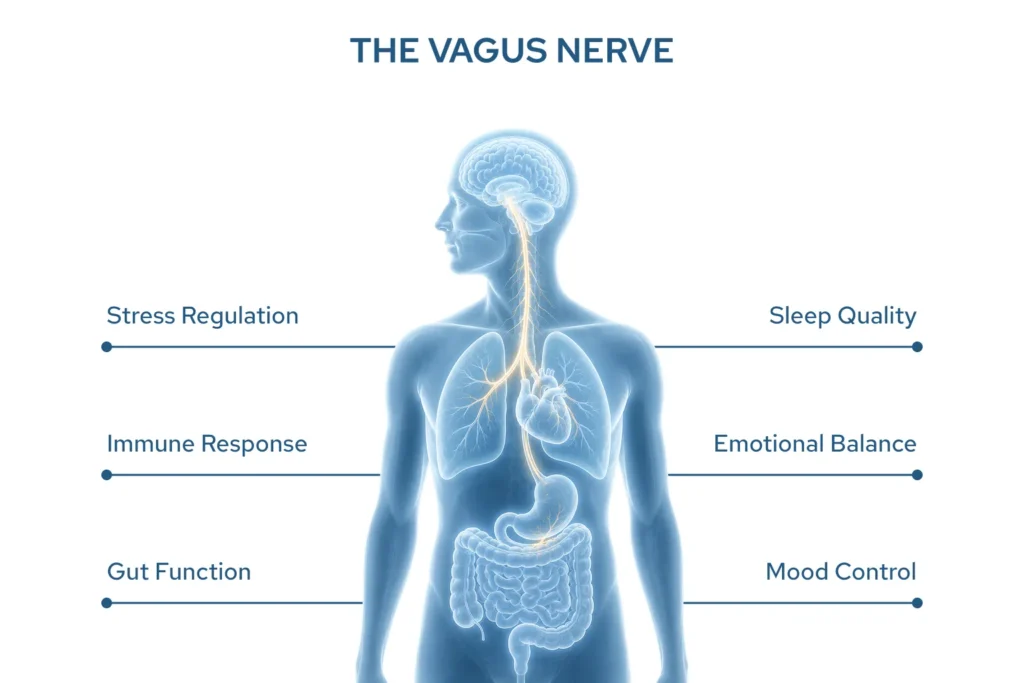
The parasympathetic nervous system operates primarily through one specific nerve.
La nervio vago (cranial nerve X) – the longest nerve in the body – runs from the brainstem through the neck, chest, and abdomen. It carries the parasympathetic signals that tell the body it is safe to rest, recover, digest, and repair.
Tono vagal – the activity level of this nerve – determines how effectively the nervous system can shift from stress to recovery. High vagal tone means the body moves fluidly between states. Low vagal tone means the sympathetic branch stays dominant – even when there’s nothing left to respond to.
Sustained caregiving suppresses vagal tone. This is the direct physiological mechanism behind the persistent tiredness, disrupted sleep, and background tension that so many former caregivers describe.
For most of medical history, stimulating the vagus nerve directly required surgical implantation. That changed when researchers discovered a branch of the vagus nerve reaches the body surface at the outer ear – making non-invasive stimulation possible for the first time.
The field this opened up is called taVNS (Transcutaneous Auricular Vagus Nerve Stimulation).
A 2026 randomised controlled study found that self-administered tVNS twice daily over three months reduced stress symptoms by 31% compared to control – with a measurably blunted inflammatory stress response.
When I first came across consumer devices making this claim, my instinct was scepticism. Six years of working with complex presentations gives you a sharp sense for wellness claims that outrun their evidence.
What changed my mind was the research – and then what I consistently observed in users who used it. The pattern was too consistent to dismiss.
That was when it became a regular part of how I approach cases like these.
What I Now Recommend: Nurosym AVNT™
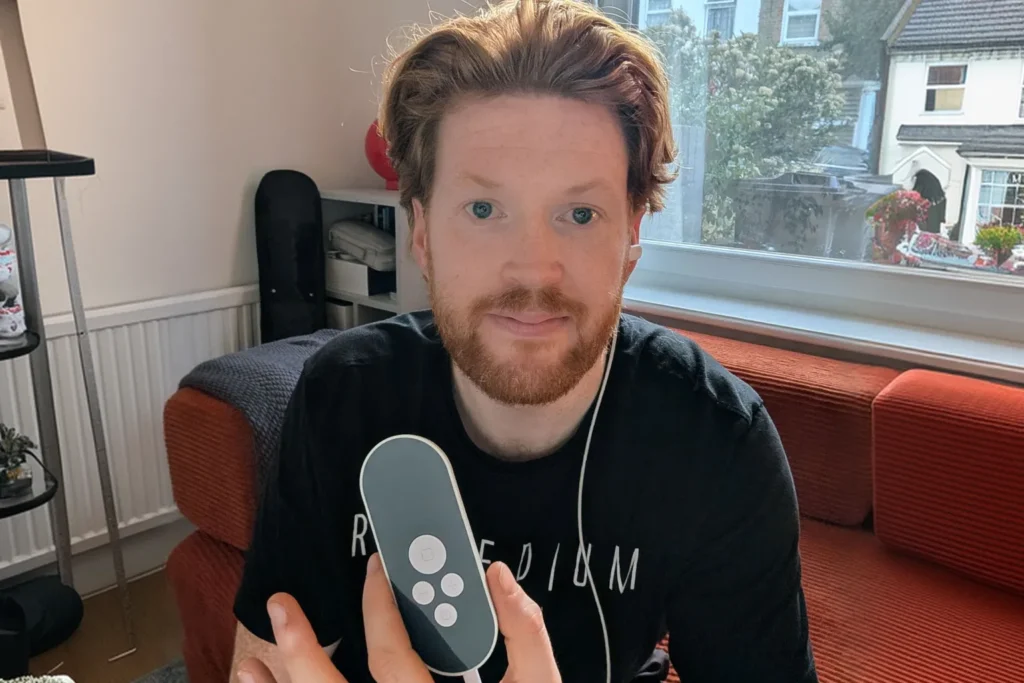
Nurosym is a CE-certified taVNS device – the first to achieve CE wearable device certification specifically for auricular vagal neuromodulation. The technology is called AVNT™ (Auricular Vagal Neuromodulation Therapy), developed after 10+ years of R&D to activate the vagus nerve through the outer ear.
It doesn’t treat the exhaustion directly. It works on the system that’s preventing recovery.
For caregivers and former caregivers specifically – where the nervous system has often become highly sensitised – I follow the same principle I apply across my Chronic Illness and Pain Clinic: start gently, build gradually. The last thing an already depleted system needs is another demand. Nurosym allows exactly that: gentle stimulation, adjustable to comfort, building tolerance over time without overwhelming a system that’s already struggling.
It delivers gentle electrical impulses to the auricular branch of the vagus nerve – supporting parasympathetic activity and shifting the autonomic baseline toward genuine recovery.
Respaldado por 60+ independent peer-reviewed studies across 150+ internationally recognised institutions including King’s College London, UCL, and Imperial College London.
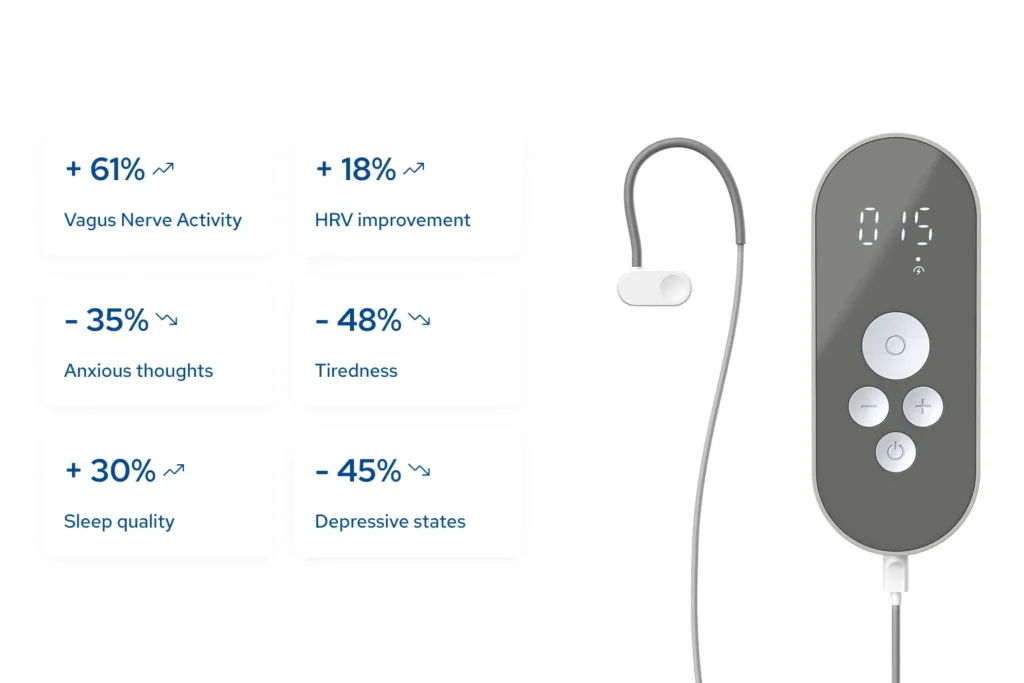
Resultados de estudios revisados por pares en poblaciones específicas del estudio. Las cifras reflejan el cambio relativo en comparación con placebo o la línea de base. Los resultados individuales pueden variar.
What makes it different from everything else is what it asks of you: nothing.
No quiet room. No dedicated practice. No technique to learn. No motivation to summon when you have none left.
It clips to the ear – small, wired, sitting much like an earbud – and you carry on. Reading. Eating. Sitting with a cup of tea. Ironing. Watching something. Doing absolutely nothing. Fifteen minutes a day.
Taking fifteen minutes for your own nervous system is not a luxury. It is the difference between a system that can keep giving and one that eventually cannot.
“After years of helping a family member through a serious illness, I was stuck in a fight or flight response. Nurosym has been essential in restoring my system back to normal.” – Deborah
“I had suffered from severe chronic tiredness and an anxious thoughts disorder for 3 years… After trying it daily for about 6 weeks I began to feel a difference… 9 months on, I am back to mental and physical health again.” – Jennifer Mills
It works alongside rest, therapy, nutrition, and gentle movement – not instead of them. It works at the level of the autonomic baseline that everything else builds on top of.
Desventajas:
- No technique to learn - no quiet room, no mental effort required
- Can be used while reading, eating, resting, or doing nothing at all
- Adjustable intensity - suitable for sensitive and depleted nervous systems
- Doesn't demand more from a system that has already given everything
- First CE-certified auricular vagal neuromodulation device
- 60+ completed independent peer-reviewed studies
- Trusted by 1,000+ licensed healthcare professionals
- No app, no gel, no prescription required
- 15 minutes a day
- Garantía de devolución del dinero en 30 días
One consideration:
For caregivers and those with sensitive nervous systems, I recommend starting at the lowest comfortable intensity and building gradually. Most people notice a meaningful shift within two to three weeks of consistent daily use. This is not a quick fix. It is a baseline shift – and for someone whose nervous system has been in overdrive for months or years, that shift is everything.
Do You Recognise This?
This pattern shows up across very different caring situations:
- Partners and spouses who managed a loved one's serious illness - and whose bodies are still running as if the crisis hasn't ended
- Parents of children with complex needs - whose nervous systems have been in constant monitoring mode for years
- Adult children who stepped in for an ageing or unwell parent - and who don't feel like themselves even now
- "Sandwich carers" managing responsibilities for both an older relative and their own children simultaneously
- Anyone who describes feeling constantly "on" - even in moments that should feel restful
- Anyone whose tiredness, tension, or sleep problems have persisted long after the obvious pressure has lifted
Do not use if you have a pacemaker or implantable cardiac device, are pregnant, have had a recent serious cardiac event, or are under 18. Always consult a qualified healthcare professional before starting.
Una forma segura de intentarlo
- Garantía de devolución del dinero en 30 días - enough time to notice whether your sleep, your tension, and your sense of being "off duty" actually begin to shift
- Limited subsidised research slots - some participants may receive up to €70 off in exchange for sharing their experience
A Final Note
The people I see who are most affected by this are often the ones who gave the most – and asked for the least in return.
They managed everything. They kept going. They didn’t stop to notice what was happening to their own bodies because there wasn’t time, or space, or permission.
The caring may be over. But the body kept score.
And the nervous system – which spent months or years in a state of sustained readiness – doesn’t reset simply because the external demand has lifted. It needs a signal. A direct, physiological signal that it is safe to stand down.
For months, maybe years, your nervous system did exactly what it had to do to help someone else survive.
Now it deserves the chance to remember what safety feels like again.
Referencias
Carers UK. State of Caring 2025. https://www.carersuk.org/policy-and-research/key-facts-and-figures/
Burden and Heart Rate Variability in Family Caregivers. PMC8860166. https://www.ncbi.nlm.nih.gov/pmc/articles/PMC8860166/
Randomised controlled study on transcutaneous VNS and stress reduction. PMC12839095. 2026.
Geng D, et al. The effect of taVNS on HRV in healthy young people. PLoS ONE. 2022. https://doi.org/10.1371/journal.pone.0263833Farmer AD, et al. International consensus based review on taVNS. Frontiers in Human Neuroscience. 2021. https://www.frontiersin.org/articles/10.3389/fnhum.2020.568051/full
Tarn J, et al. The Effects of Noninvasive Vagus Nerve Stimulation on Tiredness. Neuromodulation. 2022. https://pubmed.ncbi.nlm.nih.gov/37032583/
Dolcini J, et al. Vagal nerve stimulation and fibromyalgia. Clin Exp Rheumatol. 2025.
This article reflects my professional evaluation of the evidence and scientific experience. I may receive a referral arrangement from purchases made through links in this article. This is not medical advice – always consult a qualified health professional before starting any new intervention. Individual results may vary.
Compartir a través de:


 Spanish
  English
  German
  French
  Swedish