

La stimulation du nerf vague (SNV) est explorée comme une approche non pharmacologique de la fatigue et de la baisse d’énergie en soutenant l’équilibre du système nerveux autonome. De nouvelles recherches suggèrent que l’amélioration de l’activité vagale pourrait influencer la récupération, la résilience au stress et les niveaux d’énergie perçus chez certaines personnes.
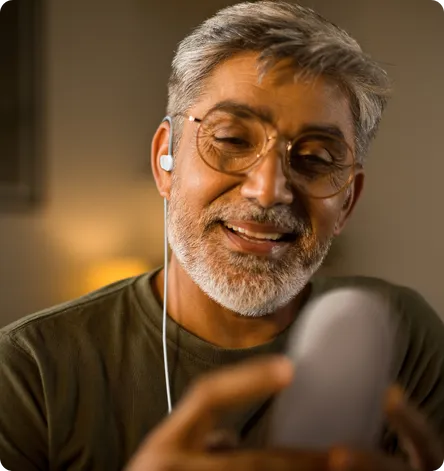

Pourquoi la stimulation du nerf vague est explorée pour l’énergie et la fatigue
Nurosym est le premier dispositif portable de stimulation du nerf vague validé par plus de 50 études de recherche. Il fournit une stimulation non invasive à la branche auriculaire du nerf vague, une voie impliquée dans la régulation autonome qui peut influencer la récupération et la perception de la fatigue.
Contrairement aux approches basées sur les stimulants qui augmentent temporairement la vigilance, les interventions autonomes visent à soutenir les processus de récupération sous-jacents plutôt que l’excitation à court terme.
- Validé par plus de 50 études scientifiques complétées et plus de 4 millions de sessions utilisateur.
- Certification des appareils portables marqués CE répond à des normes rigoureuses de l’UE.
- Utilisé par des centaines de professionnels de santé pour des améliorations énergétiques mesurables.
- Développé grâce à un investissement de recherche de 10 millions de dollars avec les principaux centres médicaux universitaires.
« Parmi des dispositifs de bien-être similaires, il se distingue par sa solide fondation de recherche et un design convivial.
– DEREK, US
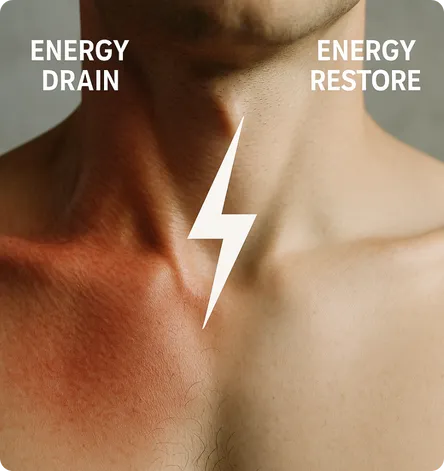

Passer du mode d’épuisement de l’énergie au mode de récupération
Votre nerf vague contrôle si votre corps brûle de l’énergie ou la restitue. Le stress chronique vous enferme dans un état de « lutte ou fuite » — un état conçu pour la survie, pas pour l’énergie durable.
Lorsqu’il est en mode stress, votre corps privilégie carburant immédiat sur des réserves à long terme. Cela crée un épuisement rapide, une récupération altérée et un dysfonctionnement progressif.
Nurosym envoie des signaux électriques précis à votre nerf vague par l’intermédiaire de votre oreille, activant ainsi des voies qui font passer votre métabolisme d’un état d’épuisement à une restauration.
- Active l’état de récupération naturel de votre corps, passant de la panne à la restauration.
- Réduit la dépense énergétique de base en normalisant le coût élevé du stress chronique.
- Soutient l’activité du système nerveux parasympathique, qui joue un rôle dans la récupération et la conservation de l’énergie pendant les périodes de repos.
« Cela m’aide à atteindre un état de tranquillité similaire à la méditation. Le changement est subtil, mais je remarque que je me sens plus à l’aise.”
– TOM, UK
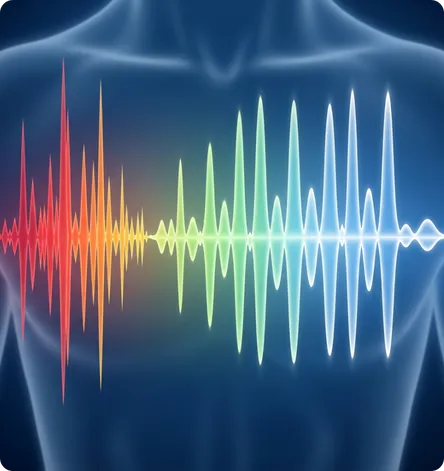

Normaliser les hormones de stress perturbatrices d’énergie
Le stress chronique crée des schémas hormonaux qui épuisent votre énergie : un taux de cortisol réduit élimine votre poussée matinale, un taux élevé de cortisol le soir empêche la récupération nocturne et une exposition prolongée aux hormones crée une résistance cellulaire.
Cela produit de la fatigue le matin malgré le sommeil, des accidents l’après-midi, une incapacité à maintenir son énergie et une aggravation progressive.
Votre nerf vague régule directement la production de l’hormone du stress. La signalisation vagale améliorée normalise les schémas de cortisol et restaure votre rythme énergétique quotidien naturel.
Les recherches suggèrent que l’activité vagale est impliquée dans la régulation des hormones de stress, ce qui pourrait contribuer à améliorer les schémas énergétiques et à réduire la fatigue chez certaines populations.
- Restaure le cortisol sain en éveillant la réponse produit une énergie matinale naturelle.
- Réduit l’élévation du cortisol le soir permettant une récupération correcte du jour au lendemain.
- Inverse la résistance aux hormones du stress amélioration de la réponse cellulaire.
- Normalise le rythme énergétique quotidien la création de modèles prévisibles.
- Réduit considérablement la fatigue avec une amélioration de 48 % des évaluations de fatigue validées dans les 10 jours (p < 0,0001), avec des bénéfices soutenus après la fin de la thérapie.
« Parce que ... de mon lieu de travail, à cause d’un stress vraiment élevé... J’ai eu un reflux sévère. La pression constante pour fournir plus de travail a détruit mon organisme. Chaque fois que je mettais l’appareil, je pouvais libérer la tension de mon système nerveux.
– JAKUB, UK


Pour un sommeil réparateur qui restaure réellement l’énergie
Une énergie insuffisante reflète une restauration nocturne inadéquate. Le stress perturbe les stades de sommeil profond où votre corps réapprovisionne les substrats énergétiques, répare les dommages cellulaires et réinitialise les systèmes de stress.
Sans une activation parasympathique suffisante pendant le sommeil, votre corps ne peut pas terminer la restauration. Vous vous réveillez sans repos malgré des heures au lit et accumulez progressivement des déficits énergétiques.
La stimulation du nerf vague améliore l’activation parasympathique lors de la transition du sommeil et stabilise tonalité autonome, facilitant le sommeil profond essentiel pour une restauration complète de l’énergie.
- Accélère la transition vers un sommeil réparateur en passant rapidement à la domination parasympathique.
- Augmente la durée du sommeil lent améliorant le sommeil profond où la restauration maximale se produit.
- Améliore l’efficacité du sommeil, réduire les réveils nocturnes.
- Améliore les niveaux d’énergie du lendemain grâce à une restauration complète du jour au lendemain.
- Des études scientifiques sur les SNV auriculaires ont rapporté des améliorations de la qualité subjective du sommeil, ce qui peut favoriser une meilleure énergie diurne et la récupération.
« Quand je n’obtenais pas un sommeil assez profond et réparateur, cela a eu un impact sur mon humeur et ma routine quotidienne. Nurosym a complètement transformé ma façon de me reposer.
– DANIEL, WALES
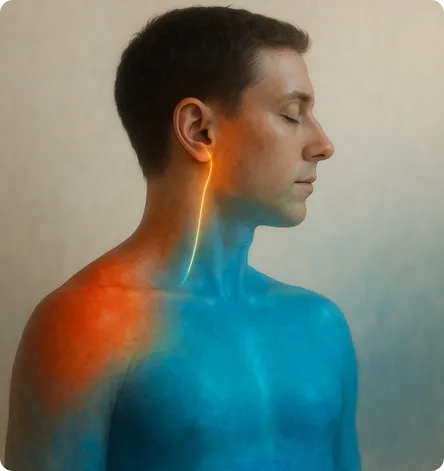

Pour réduire l’inflammation drainant l’énergie
L’inflammation chronique de bas grade est l’une des causes les plus négligées de fatigue persistante. Des marqueurs inflammatoires élevés altèrent directement la production d’énergie cellulaire, augmentent la demande métabolique et déclenchent une « maladie ». comportement» qui se manifeste par une fatigue profonde.
Cette fatigue inflammatoire persiste malgré le repos, crée des sensations fortes, altère la motivation et l’énergie mentale, et résiste aux interventions conventionnelles.
Votre nerf vague contrôle la principale voie anti-inflammatoire de votre corps. Le stress chronique affaiblit ce contrôle. Restaurer l’activité vagale réactive les systèmes anti-inflammatoires naturels.
- Active la suppression inflammatoire naturelle, réduire les produits chimiques inflammatoires induisant la fatigue.
- Les voies vagales sont impliquées dans la communication entre le système immunitaire et nerveux, et la modulation de cette voie est étudiée pour son rôle potentiel dans la régulation inflammatoire et la perception de la fatigue.
“Honnêtement, j’ai remarqué un changement si positif. J’ai beaucoup moins de jours où je me sens trop vidé pour suivre ma routine quotidienne.
– FRANCESCA, UK


Pour optimiser vos centrales électriques cellulaires
Vos mitochondries produisent de l’ATP — la monnaie d’énergie directe de votre corps. Le stress chronique altère la fonction mitochondriale par le biais du stress oxydatif, de l’inflammation et d’une activation sympathique soutenue qui oriente le métabolisme vers des voies inefficaces.
Le déclin de la fonction mitochondriale crée a crise énergétique progressive : réduction de la production d’ATP, augmentation des sous-produits induisant la fatigue et accumulation des déficits énergétiques.
La stimulation du nerf vagal améliore la fonction mitochondriale grâce à un métabolisme médié par le parasympathique. optimisation, soutenant à la fois l’efficacité et la biogenèse.
La fonction mitochondriale est étroitement liée à la physiologie du stress et à l’équilibre autonome. Des recherches préliminaires suggèrent que les interventions soutenant l’activité parasympathique peuvent influencer indirectement les processus énergétiques cellulaires, bien que cela reste un domaine d’étude en évolution.
- Améliore la biogenèse mitochondriale stimuler la création de nouvelles mitochondries saines.
- Améliore l’efficacité mitochondriale augmentant la production d’ATP par molécule d’oxygène.
- Réduit le stress oxydatif protéger les mitochondries des dommages progressifs.
- Optimise le métabolisme cellulaire en passant de voies énergétiques inefficaces à efficaces.
- Améliorations mesurables des marqueurs cellulaires du stress oxydatif—28 % de réduction des espèces réactives de l’oxygène (p = 0,004) dans les essais contrôlés contre placebo, ce qui soutient une amélioration de la fonction mitochondriale et de la production d’énergie cellulaire.
“Depuis que j’ai commencé à l’utiliser, j’ai remarqué une amélioration significative de la façon dont je me sens globalement. Cela fait maintenant trois mois, et j’espère que des changements encore plus positifs—c’est certainement un pas dans la bonne direction.
– TERRY, UK
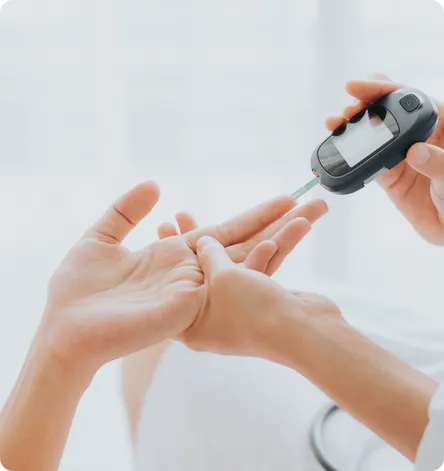

Pour stabiliser la glycémie et prévenir les chutes d’énergie
Les crises énergétiques reflètent un dysfonctionnement autonome. Votre nerf vague régule la sécrétion d’insuline, l’absorption du glucose et la sélection métabolique des carburants. Une altération de la fonction vagale crée une glycémie erratique : des pics exagérés après avoir mangé, des chutes rapides lorsque l’insuline surcompense et une mauvaise flexibilité métabolique.
Ces oscillations créent les montagnes russes de l’énergie : fatigue post-repas, accidents en milieu d’après-midi, envies de glucides et incapacité à maintenir une énergie stable.
Le tonus vagal amélioré améliore la régulation métabolique : optimiser le timing de l’insuline, améliorant l’absorption cellulaire du glucose et renforçant la capacité de votre corps à utiliser énergie stockée en douceur.
La fonction autonome joue un rôle dans la régulation métabolique, y compris les réponses digestives et post-repas. Soutenir l’activité vagale peut contribuer à des niveaux d’énergie perçus plus stables tout au long de la journée.
- Améliore la sensibilité à l’insuline améliorer l’absorption cellulaire du glucose.
- Stabilise la réponse glycémique après le repas réduire les pics qui entraînent des accidents.
- Améliore la flexibilité métabolique améliorer les transitions en douceur entre les sources de carburant.
- Réduit la faim et les envies en normalisant l’instabilité glycémique.
- Crée une disponibilité énergétique durable au cours de la journée.
« Je cherchais un moyen de mieux naviguer dans les défis saisonniers. J’avais essayé des séances d’entraînement et des applications de méditation mais j’ai découvert Nurosym, et j’ai remarqué des changements en seulement quelques semaines. Je me sens plus équilibré et mieux équipé pour gérer les pressions quotidiennes.”
– TIJANA, US
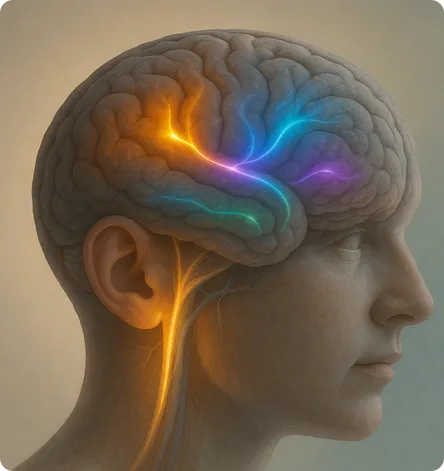

Pour restaurer les neurotransmetteurs énergétiques critiques
La fatigue mentale et le brouillard cérébral reflètent un dysfonctionnement des neurotransmetteurs. Le stress chronique épuise la dopamine (motivation), la noradrénaline (vigilance), la sérotonine (humeur) et l’acétylcholine (traitement cognitif).
Cette déplétion neurochimique crée une fatigue mentale : difficulté à initier les tâches, trouble de la concentration, baisse de la motivation et an sensation épuisante de forcer à travers des activités basiques.
Votre nerf vague module les systèmes de neurotransmetteurs. La stimulation vagale influence le cerveau. centres qui produisent et régulent ces produits chimiques critiques sur le plan énergétique.
Les voies vagales interagissent avec des régions du cerveau impliquées dans la vigilance, la motivation et le traitement cognitif, ce qui peut influencer la fatigue mentale et la concentration.
- Améliore la fonction de la dopamine améliorer la motivation et l’énergie mentale.
- Optimise les systèmes de noradrénaline améliorer la vigilance et la concentration sans nervosité.
- Normalise les voies de la sérotonine soutenant la stabilité de l’humeur.
- Améliore la signalisation de l’acétylcholine améliorer l’efficacité du traitement cognitif.
- Améliorations mesurables de l’énergie cognitive y compris une fatigue mentale réduite.
« J’ai remarqué des indicateurs de récupération améliorés suivis par mon appareil de fitness et un plus grande capacité à rester concentré ou s’entraîner pendant de longues périodes. »
– HENRY, UK
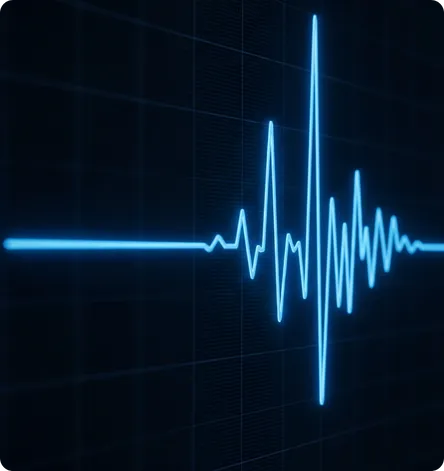

Pour améliorer la variabilité de la fréquence cardiaque : votre biomarqueur énergétique
La variabilité de la fréquence cardiaque (VFC) prédit la disponibilité énergétique et la capacité de récupération. Un HRV élevé indique une flexibilité autonome robuste et une gestion efficace de l’énergie. Un faible HRV signale une rigidité autonome et une récupération altérée.
Chronique fatigue est systématiquement corrélé à une réduction de la HRV, reflétant un dysfonctionnement autonome sous-jacent à l’épuisement énergétique.
La stimulation du nerf vague améliore directement l’activité vagale cardiaque qui détermine le HRV, produisant des améliorations mesurables de la flexibilité autonome et de la gestion de l’énergie.
- Augmente les métriques HRV dans le domaine temporel indiquant une capacité autonome accrue.
- Améliore la puissance HRV à haute fréquence, le marqueur validé de l’activité parasympathique.
- Améliore la récupération du HRV après l’effort, un retour accéléré à la base de référence.
- Traçable via des wearables grand public, y compris Oura Ring, WHOOP, Apple Watch et Garmin.
« Parfois, je le mets en lisant, et Je trouve que cela m’aide à rester concentré, même sur des morceaux d’écriture plus difficiles.
– YVONNE, UK


En tant que fondation pour d’autres stratégies énergétiques
Efficace de l'énergie optimisation nécessite plusieurs approches : un sommeil adéquat, une nutrition adéquate, de l’exercice régulier, AND contrôle du stress.
Chacun aborde différents aspects, mais beaucoup obtiennent des résultats sous-optimaux lorsque le dysfonctionnement autonome sous-jacent reste non traité.
- L’alimentation fournit des substrats, mais le dysfonctionnement autonome nuit à leur utilisation.
- L’exercice renforce les capacités, mais une mauvaise récupération empêche l’adaptation.
- Le sommeil offre des possibilités de restauration, mais sans activation parasympathique, la restauration reste incomplète.
La stimulation du nerf vague fournit le système nerveux autonome fondation, permettant d’autres interventions fonctionnent de manière optimale, créant un environnement physiologique où l’alimentation, l’exercice, le sommeil et la supplémentation offrent tout leur potentiel.
- Améliore l’efficacité des interventions alimentaires en améliorant le métabolisme des nutriments et en stabilisant la glycémie.
- Amplifie les bienfaits de l’exercice en améliorant la capacité de récupération et en réduisant l’inflammation.
- Maximise la restauration du sommeil en approfondissant les stades de sommeil réparateur.
- Améliore l’utilisation des suppléments en normalisant les voies métaboliques.
- Fournit un suivi biométrique objectif grâce à la surveillance du HRV.
- Crée des effets synergiques lorsqu’il est combiné avec la nutrition, l’exercice et l’optimisation du sommeil.
« Je fais souvent face à une tension la nuit qui affecte mon visage et ma tête, mais j’ai commencé à remarquer une différence—ça a été un changement positif, même dans la façon dont je me sens physiquement.”
– HOGAN, US


Comme alternative non stimulante pour une énergie durable
La gestion standard de l’énergie repose sur la caféine, les boissons énergisantes ou les stimulants. Ceux-ci fonctionnent par activation sympathique — empruntant l’énergie de demain pour aujourd’hui — créant la dépendance, la tolérance, les plantages, les perturbations du sommeil, et pensées anxieuses.
L’approche stimulante entre en conflit avec l’énergie durable : elle épuise les réserves au lieu de les restaurer, altère la récupération, perturbe le sommeil et perpétue la fatigue.
La neuromodulation vagale offre une amélioration énergétique par des mécanismes opposés : l’activation de voies parasympathiques qui restaurent les réserves, l’amélioration de la récupération nocturne qui crée l’énergie du lendemain et le renforcement des capacités durables.
- Élimine les effets stimulants associés, y compris le trac, les pensées anxieuses, les plantages et la dépendance.
- Construit une capacité énergétique durable plutôt que d’emprunter sur des réserves épuisées.
- Améliore plutôt que perturbe le sommeil, la création d’une restauration nocturne.
- Fonctionne en synergie avec les routines matinales, complétant des pratiques saines.
- Offre une solution rentable à long terme sans achats récurrents ni escalade de doses.
- Cible en amont les dysfonctionnements autonomes, potentiellement apporter des améliorations plus complètes.
- Approches non stimulantes qui soutiennent la récupération peut être utile pour les personnes cherchant des stratégies énergétiques durables sans dépendre de stimulants.
« Un professionnel m’a dit qu’ils n’étaient pas sûrs de ce qui causait mes défis, mais une approche à long terme a été suggérée. J’ai commencé à chercher des moyens de subvenir à mes besoins et j’ai découvert le Nurosym.
– TREVOR, UK
Le mécanisme : comment la stimulation du nerf vagal améliore l’énergie
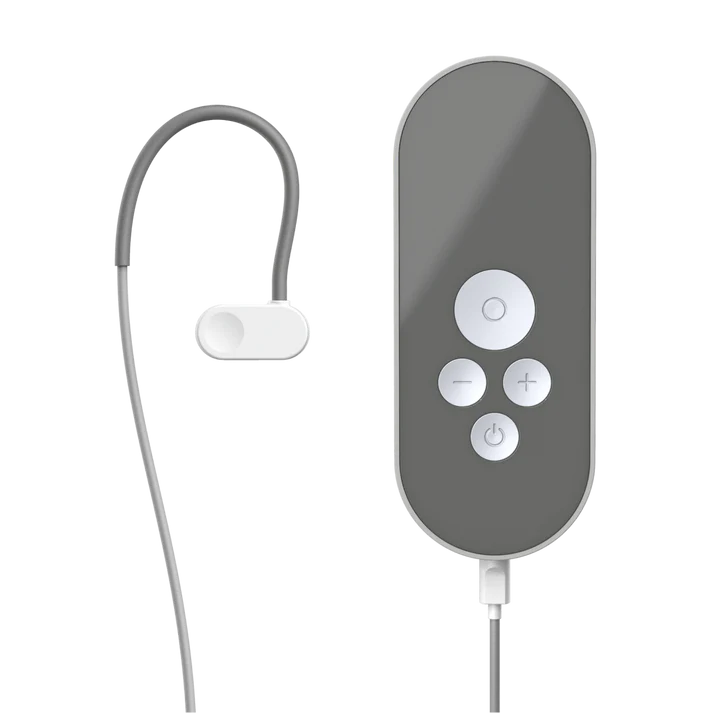
Thérapie de neuromodulation auriculaire vagale (AVNT TM) —Le protocole propriétaire de Nurosym a été développé avec la Chicago University Medical School, UCLA, l’Imperial College de Londres et plus de 60 instituts de recherche.
Comment ça fonctionne :
Nurosym délivre des formes d’onde électriques exclusives à la branche auriculaire du nerf vague dans votre oreille.
- Activation périphérique : La stimulation électrique active les fibres nerveuses vagales, générant des signaux qui se dirigent vers votre cerveau.
- Intégration du tronc cérébral : Les signaux atteignent le nucleus tractus solitarius (NTS) — votre centre de contrôle autonome principal.
- Réseau de réglementation énergétique : Le NTS est lié aux principales structures régissant l’énergie et le métabolisme :
- Locus cœruleus — optimise la vigilance et l’énergie mentale.
- Hypothalamus —régule les hormones critiques pour l’énergie.
- Noyau moteur dorsal — contrôle la fonction digestive.
- Gris périaqueductal — module l’inconfort drainant d’énergie.
- Cortex préfrontal —améliore l’énergie cognitive.
- Rééquilibrage métabolique : Passer du mode d’activation du stress épuisant l’énergie au mode parasympathique restaurateur d’énergie.
- Énergie cellulaire Optimisation: Amélioration multi-niveaux incluant une réduction de 28 % du stress oxydatif cellulaire (p=0,004), soutenant la fonction mitochondriale, la suppression inflammatoire et l’efficacité métabolique.
- Restauration énergétique systémique : Hormones de stress normalisées, qualité du sommeil améliorée, meilleure utilisation des nutriments.
Scientifique Objectif : Intervention multi-systèmes produisant une production d’énergie cellulaire améliorée, optimisé efficacité métabolique, capacité de récupération améliorée, normalisé rythme énergétique quotidien et amélioration soutenue de l’énergie—sans stimulants.
Importance scientifique :
L’ampleur de la réduction de la fatigue (48 % en 10 jours, p > 0,0001) et de l’amélioration des fonctions autonomes (amélioration parasympathique significative en une heure, p = 0,002) obtenues grâce à la neuromodulation vagale offre une voie non stimulante vers une énergie durable — sans développement de tolérance, risque de dépendance, troubles du sommeil ou fatigue de rebond.
Les résultats validés supplémentaires comprennent :
- Amélioration de 31 % de la qualité du sommeil sur 4 semaines (p < 0,05).
- Réduction de 28 % du stress oxydatif cellulaire dans les études contrôlées contre placebo (p = 0,004).
- Réductions significatives des marqueurs inflammatoires, y compris l’IL-6, plus de 3 mois.
- Amélioration de 45 % des scores d’état dépressif et réduction de 35 % des symptômes anxieux de la pensée d'ici 10 jours.
La convergence de plus de 50 études de recherche, plus de 4 millions sessions utilisateur, et CE Mark portable la certification de l’appareil établit Nurosym comme la référence en matière de neuromodulation vagale non invasive pour une amélioration énergétique et métabolique durable optimisation.
Pour les personnes cherchant une intervention non stimulante, fondée sur des données probantes, afin de s’attaquer aux causes profondes de la maladie chronique fatigue—ou des professionnels de santé évaluant les options de neuromodulation pour utilisateurs avec des déficits énergétiques persistants — Nurosym représente le système de SNV transcutané le plus rigoureusement validé disponible.
Nurosym est une classe IIa marquée CE portable appareil. Scientifique les résultats représentent les résultats moyens des études contrôlées et des analyses d’efficacité en situation réelle. Les réponses individuelles varient. L’appareil est destiné au bien-être général et à la gestion de l’énergie ; il n’est pas destiné à diagnostiquer, traiter, guérir ou prévenir une maladie. pacemakers ou autre médicaux importants symptômes devrait consulter des professionnels de santé avant utilisation.
Cet article de blog vise à être informatif et ne doit pas remplacer les conseils de santé professionnels. Toujours consulter un professionnel de santé pour des conseils personnalisés.
Sources
- Tarn J, Evans E, Traianos E, Collins A, Stylianou M, Parikh J, et al. The Effects of Noninvasive Vagus Nerve Stimulation on Fatigue in Participants With Primary Sjögren’s Syndrome. Neuromodulation: Technology at the Neural Interface. 2022 Oct;
- Percin A, Ozden AV, Yenisehir S, Pehlivanoglu BE, Yılmaz RC. Effects of Transcutaneous Auricular Vagus Nerve Stimulation on Fatigue in Post‐COVID Syndrome: A Randomized, Single‐Blind, Sham‐Controlled Study. International Journal of Clinical Practice. 2025 Jan 1;2025(1).
- McIntire LK, McKinley RA, Goodyear C, McIntire JP, Brown RD. Cervical transcutaneous vagal nerve stimulation (CTVNS) improves human cognitive performance under sleep deprivation stress. Communications Biology. 2021 Jun 10;4(1).
- Gierthmuehlen M, Höffken N, Timmesfeld N, Schmieder K, Reinacher-Schick A. Effect of transcutaneous auricular vagal nerve stimulation on the fatigue syndrome in patients with gastrointestinal cancers — FATIVA: a randomized, placebo-controlled pilot study protocol. Pilot and Feasibility Studies. 2023 Apr 22;9(1):66–6.
- Ferstl M, Teckentrup V, Lin WM, Kräutlein F, Kühnel A, Klaus J, et al. Non-invasive vagus nerve stimulation boosts mood recovery after effort exertion. Psychological Medicine. 2021 Feb 15;52(14):1–11.
Partager cet article :



 French
  English
  German
  Spanish
  Swedish
The science behind vagal stimulation is quite compelling
The HRV section helped me understand how stress affects the body.