
The Part Nobody Explains to You
By the time exhaustion becomes difficult to ignore, there may have been subtler changes beforehand.
Not dramatic ones. People can easily dismiss them as “just tired” or “getting older,” especially when the changes build gradually.
The Early Signs I Look For
These are the ones I ask about first, because they’re so easy to dismiss:
- The afternoon dip arrives earlier, and the second coffee stops working sooner than it used to
- Sleep happens but doesn't restore. Eight hours, and still waking up flat
- Evenings feel wired and drained at the same time, too tired to do anything, too switched on to rest
- A busy week takes days to recover from, when it used to take a night
- A body that feels braced even on good days
- Things that used to be easy start costing energy: the school run, a phone call, the supermarket
None of these is dramatic on its own. In my experience, what they can have in common is that recovery starts to feel slower or less complete. That pattern can have many possible explanations, so I treat it as something to explore rather than a diagnosis.
The Pattern I Keep Seeing in Clinic
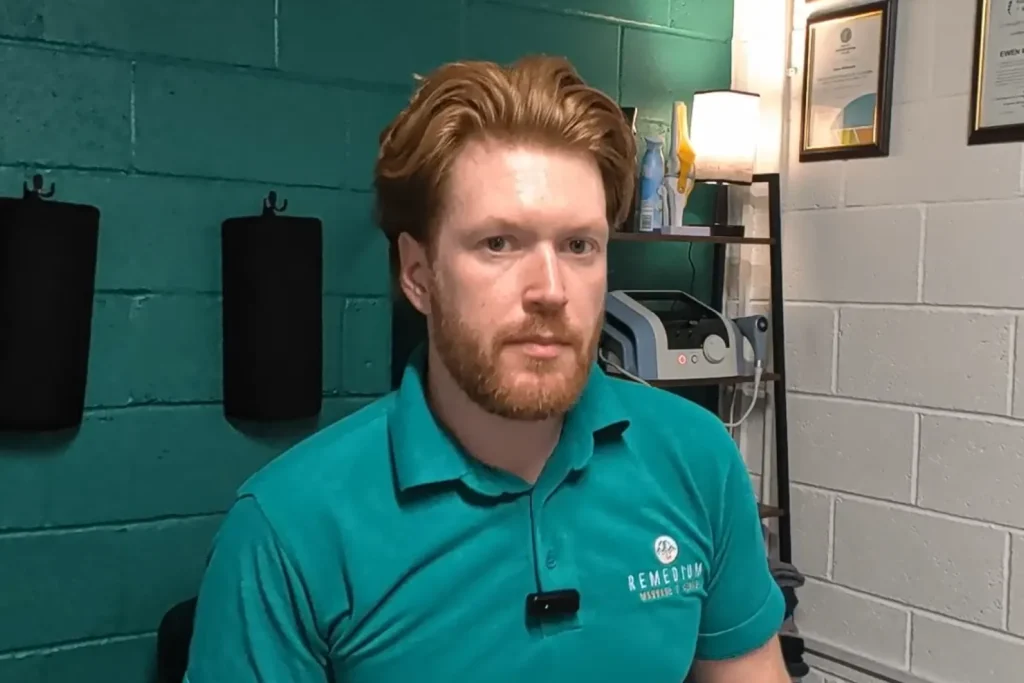
I’m Ewen McDonald, a GOsC Registered Osteopath and Clinical Director of Remedium Wellness, with clinics in Worcester, London and Birmingham. Over five years and 5,000+ users, I’ve learned to recognise this early pattern long before most people notice it themselves.
The users I see with exhaustion that won’t lift have often already tried the sensible things. Some have had routine blood tests or other investigations that did not identify an obvious cause, while their symptoms continued. A normal initial work-up does not mean there is no medical explanation, but it can leave people looking for ways to manage persistent symptoms alongside appropriate medical care.
What I hear, almost word for word, again and again:
“I thought I’d feel better once I finally rested properly.”
It isn’t only people in obviously demanding jobs. It’s parents, teachers, self-employed people, anyone whose days rarely include a real off-switch.
But weeks later, sometimes months, they’re still describing the same pattern, and when we go back through the history, the early signs are almost always there.
For some people, the problem isn’t simply that they haven’t rested enough. A 2025 systematic review found that greater tiredness was associated with changes in autonomic measures, including patterns consistent with higher sympathetic activity and lower parasympathetic activity. However, the studies involved different medical populations and methods¹ The findings suggest an association worth understanding, rather than proving that autonomic changes cause tiredness.
Why Rest Doesn’t Always Solve Persistent Fatigue
The autonomic nervous system has two major branches.² The sympatiskt nervsystem (SNS) helps mobilise the body under demand, while the parasympathetic nervous system (PNS) is involved in rest and other functions. Research has found associations between tiredness and changes in autonomic measures in some medical populations, but this does not mean that persistent tiredness is caused by an autonomic imbalance in everyone.¹
That distinction matters. Getting enough time in bed does not always mean someone will feel restored, because sleep quality, medical symptoms, mood, medications, activity levels and many other factors can affect how rested a person feels.
For that reason, I don’t see rest as something to replace, but as one part of a broader approach to persistent tiredness.
Why the Standard Advice Has a Ceiling

Most advice for exhaustion focuses on what to add: gentle movement, better sleep habits, reducing commitments and, where appropriate, addressing nutritional or medical factors. These can all help, but persistent tiredness can make even sensible changes hard to maintain.
Cutting back on commitments is sound advice, but it assumes you can actually drop some.
Gentle activity can help some people with tiredness, although the right amount depends on the underlying cause and the person’s symptoms. Increasing activity too quickly can worsen some symptoms.
Sleep habits matter, but good sleep habits do not guarantee that someone with persistent tiredness will feel restored.
Meditation and breathwork can help some people with stress and wellbeing. Still, they are not suitable or equally helpful for everyone, particularly when someone is already struggling with severe tiredness or difficulty concentrating.
Talking therapies can also help, particularly when tiredness affects mood, coping, or daily life. They are one part of care, not a solution for every possible cause of tiredness.
That left me interested in whether the autonomic system could be influenced more directly, as one possible addition to the broader approach to persistent symptoms.
The Nerve I Started Paying Attention To
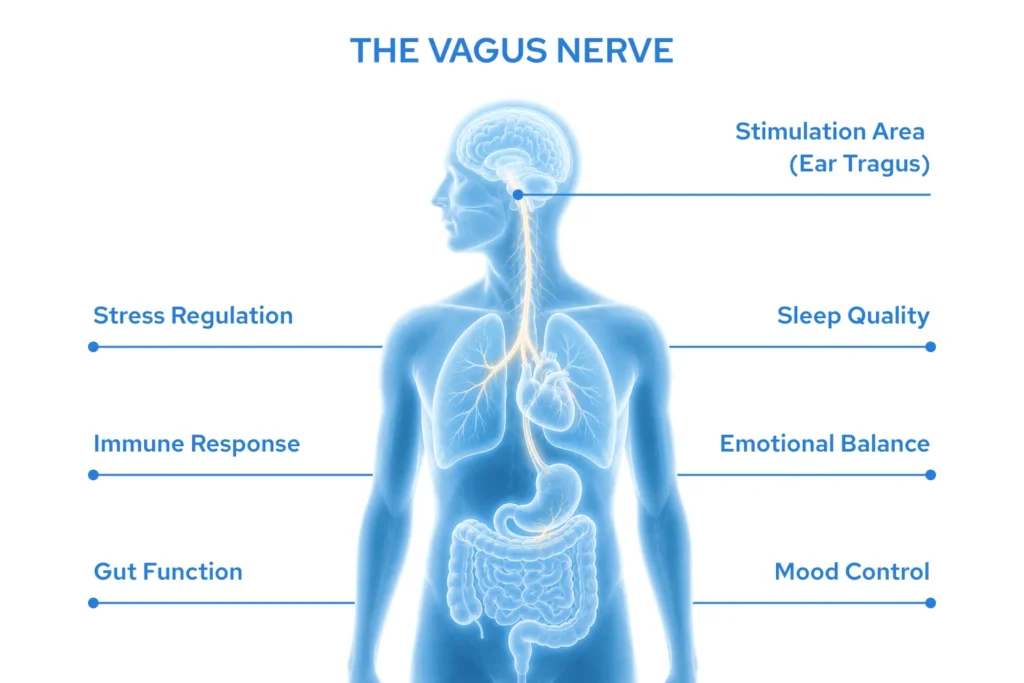
One of the major pathways involved in parasympathetic signalling is the vagusnerv (cranial nerve X), the longest cranial nerve in the body.³ Parts of the external ear receive sensory innervation from the auricular branch of the vagus nerve, which is one reason the ear is used as a target for transcutaneous auricular vagus nerve stimulation (taVNS).⁴
I was sceptical of consumer devices making this claim. Years of working with complex presentations give you a sharp sense for wellness claims that outrun their evidence.
What changed my mind was the research, then what I consistently observed in users who tried it. I read it the way I’d read any paper a user brings me: what was actually measured, in whom, over how long, and compared with what. That’s a different question from whether the underlying mechanism sounds plausible.
Vad fick mig att ta detta på allvar
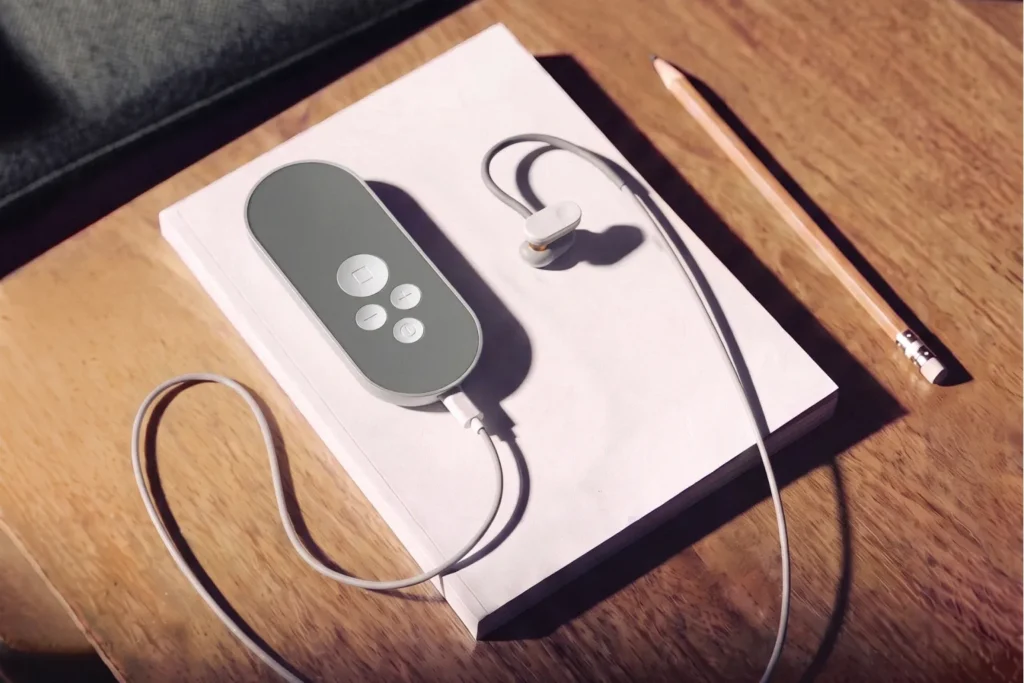
I started looking at devices that actually use this approach. One stood out because of the research behind its technology. That’s when I came across Nurosym.
Nurosym is a CE-marked taVNS device. Its technology, AVNT™ (Auricular Vagal Neuromodulation Technology), is backed by 10+ years of R&D and 10M+ in investment in scientific studies. It is trusted by more than 1,000 healthcare professionals, and more than 60 completed studies support the broader AVNT™/taVNS approach. Research partners include 150+ internationally recognised institutions such as King’s College London, UCL and Imperial College London.
The 15-Minute Routine I Recommend
Nurosym doesn’t require an app during the session, although the device does require ear preparation and correct placement. It clips to the ear, wired rather than wireless, and you carry on exactly as you were.
This is how I suggest people start with Nurosym:
- Start at 15 minutes, once a day, and build toward 30 if it feels right, staying within the recommended session time
- Attach it to something already in your day: reading or having a cup of tea, so it becomes easier to remember
- Start at the lowest comfortable intensity and build gradually
- Choose the window before you start. The plan that survives is the one that doesn't need a new decision every day
- Keep it regular rather than perfect. A missed day matters far less than turning the routine into another source of pressure
Consistency matters more than any single session. For me, the appeal is that it fits into an existing routine rather than requiring a separate relaxation technique.
What the Studies Actually Measured: Tiredness, HRV and Sleep
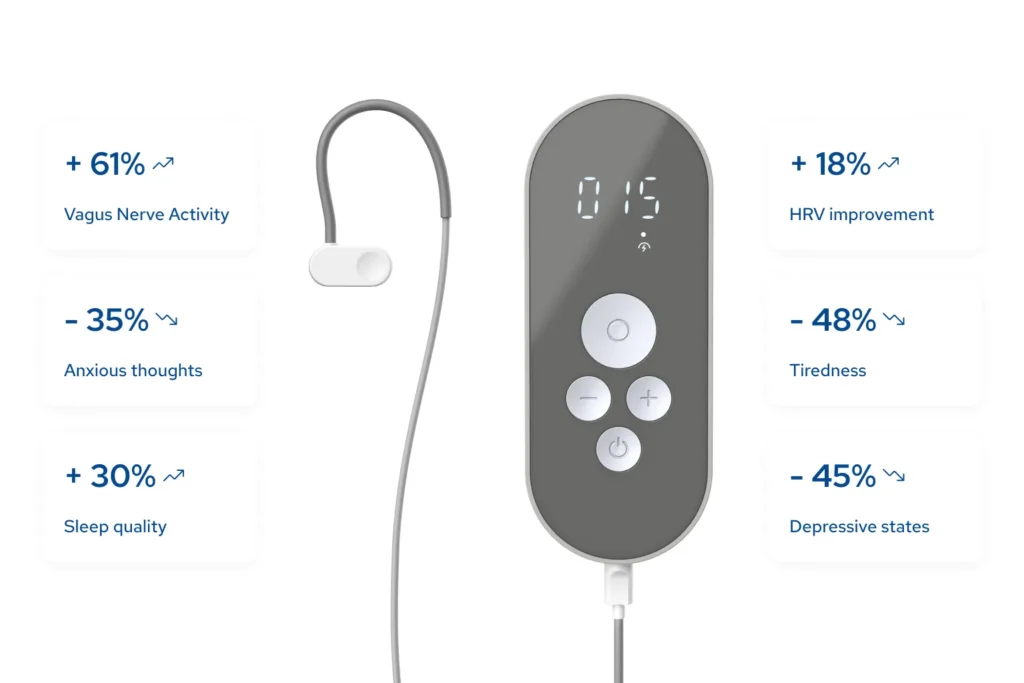
These figures come from peer-reviewed studies of the AVNT™ stimulation approach used by Nurosym, in specific study populations:
- 48% improvement in a validated tiredness score
- 18% improvement in HRV (Heart Rate Variability, a measure of how well the autonomic nervous system is recovering)⁵
- 61% increase in a marker of vagal activity (HF power)⁵
- 30% improvement in a validated sleep-quality score⁶
Figures reflect relative change compared with placebo or baseline, depending on study design. The tiredness figure is a change on a validated questionnaire in a small study population, not a measure of energy. Individual results may vary.
Separate systematic reviews have examined whether taVNS affects heart rate variability more broadly,⁷ ⁸ and other research has looked at non-invasive vagus nerve stimulation and tiredness in a different study population.⁹
What Nurosym Users Are Noticing
“Jag känner mig som om jag har kommit ut från en lång viloläge. ”
Annelies
√ Verified user
“Today I started running again for the first time in two years.”
Michaela
√ Verified user
“I was coming home from work feeling able to cook a proper meal rather than stick a ready meal in the microwave.”
Jill
√ Verified user
“My tiredness is less, and I have felt able to do more, including a family Christmas which had felt impossible before.”
Alison
√ Verified user
These are the users’ own views and experiences, not company claims.
These aren’t dramatic transformations. They’re small pieces of normal life becoming possible again.
What This Isn’t
I want to be direct about this, because users evaluating something like this deserve honesty, not overreach.
This isn’t a diagnosis, and it isn’t a replacement for proper medical investigation. If exhaustion is new, worsening, or hasn’t been assessed by a GP, that assessment comes first, always. What this supports is narrower: autonomic regulation as one part of a broader approach, alongside appropriate medical care.
Nurosym works alongside rest, movement and proper medical care, not instead of them.
Exhaustion That Won’t Lift: Do You Recognise This?
If the early signs above have been there for a while, this may sound familiar:
- Exhaustion that doesn't lift regardless of how much you rest
- Blood tests and scans that keep coming back normal
- You've tried the sensible things, and they help only partly
- Energy that crashes with stress, poor sleep or overstimulation, even in situations that used to feel manageable
- You've stopped expecting to wake up feeling rested
Använd inte om du har en pacemaker eller implanterbar hjärtapparat, är gravid, har haft en allvarlig hjärthändelse nyligen eller är under 18 år. Kontakta alltid en kvalificerad sjukvårdspersonal innan du börjar.
En sista anmärkning
The users I see who are most affected by this are often the ones who have tried the hardest to get better. They rested when they were told to rest. They cut back. They did the sensible things.
Rest still matters. But when the nervous system has been under sustained pressure for a long time, recovery may involve more than simply getting more hours in bed.
That’s the gap I use Nurosym for: not to replace rest, but to support the part of recovery that rest alone doesn’t seem to reach.
If that pattern sounds familiar, it may be worth looking underneath the symptoms rather than at them.
EXCLUSIVE OFFER FOR OUR READERS: Get 5% Off Nurosym From Our Editorial Team!
Referenser
- Decreased Heart Rate Variability Is Associated with Increased Fatigue Across Different Medical Populations: A Systematic Review. 2025. https://pubmed.ncbi.nlm.nih.gov/40981105/
- Kenny BJ, Bordoni B. Anatomy, Autonomic Nervous System. StatPearls [Internet]. Treasure Island (FL): StatPearls Publishing. https://www.ncbi.nlm.nih.gov/books/NBK539845/
- Breit S, Kupferberg A, Rogler G, Hasler G. Vagus nerve as modulator of the brain-gut axis in psychiatric and inflammatory disorders. Gränser inom psykiatri. 2018. https://doi.org/10.3389/fpsyt.2018.00044
- Farmer AD, et al. International consensus based review and recommendations for minimum reporting standards in research on transcutaneous vagus nerve stimulation. Frontiers in Human Neuroscience. 2021. https://www.frontiersin.org/articles/10.3389/fnhum.2020.568051/full
- Geng D, et al. The effect of transcutaneous auricular vagus nerve stimulation on HRV in healthy young people. PLoS ONE. 2022. https://doi.org/10.1371/journal.pone.0263833
- Dolcini J, et al. Vagal nerve stimulation and fibromyalgia: an additional therapeutic option. Clinical and Experimental Rheumatology. 2025. https://doi.org/10.55563/clinexprheumatol/johqvo
- Wolf V, et al. Does transcutaneous auricular vagus nerve stimulation affect vagally mediated heart rate variability? A living and interactive Bayesian meta-analysis. Psychophysiology. 2021;58(11):e13933. https://doi.org/10.1111/psyp.13933
- Soltani D, et al. A systematic review of the effects of transcutaneous auricular vagus nerve stimulation on baroreflex sensitivity and heart rate variability in healthy subjects. Clinical Autonomic Research. 2023. https://pubmed.ncbi.nlm.nih.gov/37119426/
- Tarn J, et al. The effects of noninvasive vagus nerve stimulation on Fatigue in Participants With Primary Sjögren’s Syndrom. Neuromodulation. 2023;26(3):681-689. https://doi.org/10.1016/j.neurom.2022.08.461
This article reflects my professional evaluation of the evidence and clinical experience. This article is published in partnership with Nurosym. I may receive compensation from purchases made through links in this article. This is not medical advice, always consult a qualified health professional before starting any new intervention. Individual results may vary.


 Swedish
 English
 German
 French
 Spanish
 Italian