
Puntos clave
- VR physical therapy enhances engagement, mobility, and adherence.
- Virtual reality rehabilitation shows measurable benefits for pain, function, and balance – with real-time feedback and personalisation.
- Applications span stroke rehabilitation VR, orthopaedic recovery, and home-based VR rehab technology.
- Challenges include cost, motion sickness, accessibility, and limited protocols.
From Gaming to Healing: VR Physical Therapy’s New Era
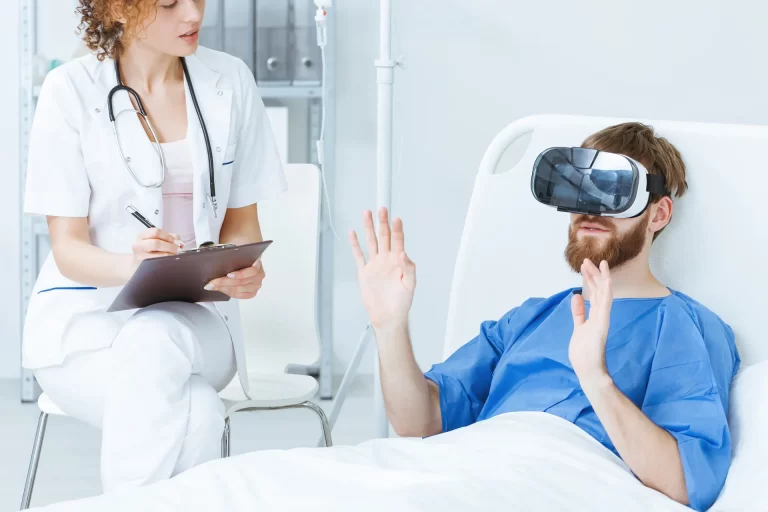
Virtual reality was once seen as a gaming novelty, but in recent years, it has found a serious role in healthcare. Instead of fantasy landscapes, VR physical therapy immerses users in carefully designed environments where every movement matters. Stepping over virtual logs or reaching for digital targets becomes a structured exercise – activating muscles, retraining balance, and improving coordination. This gamified but science-driven approach makes therapy more engaging, which is crucial for long-term recovery.
Market reports predict rapid growth in VR healthcare over the next decade; estimates put the VR healthcare market in the low-to-mid billions (USD) today, with projections rising through 2030. What makes this growth notable is that VR doesn’t just digitise existing exercises; it reimagines them. By merging data tracking with immersive design, VR makes therapy both precise and motivating – improving adherence without simply gamifying movement.
Why VR Physical Therapy Matters for Recovery
Millions face mobility challenges each year – from post-surgical recovery to stroke rehabilitation. Traditional therapy is effective but often repetitive and discouraging. VR rehab technology offers a way to increase adherence by blending exercise with immersive, task-oriented scenarios.
Adherence is critical, but dropout and non-adherence rates for home exercise programs vary widely across health issues and studies. Health professionals can also monitor progress remotely, tailoring plans more effectively.
The Hidden Challenges of Traditional Rehab That Virtual Reality Helps Solve
- Boredom and disengagement: Repetition reduces motivation.
- Physical discomfort: Pain and stiffness make adherence harder.
- Access barriers: Travel is difficult for many users.
- Limited personalisation: Traditional programs may not adapt to individual needs.
Virtual reality rehabilitation introduces variety and personalisation, adjusting exercises to ability levels and reducing the perception of effort. This makes therapy feel less like a burden and more like meaningful progress.
How VR Physical Therapy Works: The Science Behind Immersive Rehabilitation
VR combines motion tracking, biofeedback, and personalised environments. Sensors capture joint mechanics while headsets provide real-time feedback, strengthening neuromuscular pathways and improving proprioception.
In stroke rehabilitation VR, reaching for virtual objects retrains weakened limbs. In knee replacement recovery VR, gamified balance and mobility exercises improve strength and stability. Importantly, VR activates reward pathways in the brain, boosting motivation through gamified achievements.
Innovative Applications of VR Rehab Technology
- Clinic-based programs integrate VR into supervised sessions, transforming drills into interactive challenges. Shoulder rehab studies show strong engagement, though therapist oversight is still necessary.
- Home-based VR programs can achieve high adherence in specific studies (often supervised or small studies), but reported adherence across studies varies widely; careful program design and monitoring typically influence success.
- Gamified routines – with points, levels, and achievements – help users stick to therapy. One study found adherence rates close to 90 percent with gamified VR compared to traditional home exercise.
From Knee Replacement Recovery to Stroke Rehabilitation VR: Case Studies
Study and meta-analytic data suggest VR adjuncts can improve pain and function after knee arthroplasty, with some researchers reporting effects sustained at 3–6 months, but results vary between studies.
For stroke upper-limb rehab, meta-analyses show VR often improves motor outcomes and activities of daily living compared with conventional therapy or when used as an adjunct – but effect size and medical relevance depend on dose and device type. Many users also report less frustration and more motivation, which directly improves adherence.
Barriers to Wider Adoption of VR in Healthcare
Challenges remain before VR physical therapy becomes mainstream. Motion sickness and eye strain affect up to 40 percent of new users. Cost and access remain barriers, especially for smaller clinics. Insurance coverage is inconsistent, and standardised guidelines for safe, effective use are still lacking.
Still, as devices become more affordable and evidence continues to mount, adoption is expected to expand.
What Comes Next: Building a Future of Accessible VR Physical Therapy
Health professionals can begin piloting VR in rehabilitation programs while documenting outcomes. Users and caregivers should ask about VR as an adjunct to traditional therapy, especially where motivation or access is an issue. Policymakers and insurers will play a key role in expanding equitable access.
VR physical therapy is not a cure-all, but it represents one of the most promising advances in rehabilitation. By making therapy more engaging and personalised, VR has the potential to transform how we recover mobility, independence, and quality of life.
Your Next Steps:
Want to stay current on the future of physical therapy – from VR rehabilitation to AI-guided recovery tools? Subscribe to receive expert-reviewed insights straight to your inbox.
Este artículo de blog tiene como objetivo ser informativo y no debe reemplazar el asesoramiento profesional en salud. Consulte siempre con un profesional de la salud para obtener asesoramiento personalizado.
Fuentes
- National Institute of Mental Health. Any Anxiety Disorder [Internet]. www.nimh.nih.gov. National Institute of Mental Health; 2024. Available from: https://www.nimh.nih.gov/health/statistics/any-anxiety-disorder
- Loh JS, Mak WQ, Tan LKS, Ng CX, Chan HH, Yeow SH, et al. Microbiota–gut–brain axis and its therapeutic applications in neurodegenerative diseases. Signal Transduction and Targeted Therapy [Internet]. 2024 Feb 16;9(1):1–53. Available from: https://www.nature.com/articles/s41392-024-01743-1
- Kouraki A, Kelly A, Vijay A, Gohir S, Astbury S, Georgopoulos V, et al. Reproducible microbiome composition signatures of anxiety and depressive symptoms. Computational and Structural Biotechnology Journal [Internet]. 2023 Jan 1 [cited 2024 Jan 14];21:5326–36. Available from: https://www.ncbi.nlm.nih.gov/pmc/articles/PMC10637863/
- Chudzik A, Słowik T, Kochalska K, Pankowska A, Łazorczyk A, Andres-Mach M, et al. Continuous Ingestion of Lacticaseibacillus rhamnosus JB-1 during Chronic Stress Ensures Neurometabolic and Behavioural Stability in Rats. PubMed. 2022 May 5;23(9):5173–3.
- Patterson E, Tan T, Groeger D, Andrews M, Buckley M, Murphy EF, et al. Bifidobacterium longum 1714 improves sleep quality and aspects of well-being in healthy adults: a randomized, double-blind, placebo-controlled clinical trial. Scientific reports. 2024 Feb 14;14(1).
- Edebol Carlman HMT, Rode J, König J, Repsilber D, Hutchinson AN, Thunberg P, et al. Probiotic Mixture Containing Lactobacillus helveticus, Bifidobacterium longum and Lactiplantibacillus plantarum Affects Brain Responses to an Arithmetic Stress Task in Healthy Subjects: A Randomised Clinical Trial and Proof-of-Concept Study. Nutrients. 2022 Mar 22;14(7):1329.
- Kamal N, Saharan BS, Duhan JS, Kumar A, Chaudhary P, Goyal C, et al. Exploring the promise of psychobiotics: Bridging gut microbiota and mental health for a flourishing society. Medicine in Microecology [Internet]. 2024 Nov 30;23:100118. Available from: https://www.sciencedirect.com/science/article/pii/S2590097824000211#sec8
- Radkhah N, Rasouli A, Majnouni A, Eskandari E, Parastouei K. The effect of Mediterranean Diet instructions on depression, anxiety, stress, and anthropometric indices: A randomized, double-blind, controlled clinical trial. Preventive Medicine Reports. 2023 Dec 1;36(102469):102469–9.
- Zhao Z, Xiao G, Xia J, Guo H, Yang X, Jiang Q, et al. Effectiveness of probiotic/prebiotic/synbiotic treatments on anxiety: A systematic review and meta-analysis of randomized controlled trials. Journal of Affective Disorders [Internet]. 2023 Dec 15 [cited 2023 Nov 5];343:9–21. Available from: https://www.sciencedirect.com/science/article/abs/pii/S0165032723011540
- Soleimani M, Ghazisaeedi M, Heydari S. The efficacy of virtual reality for upper limb rehabilitation in stroke patients: a systematic review and meta-analysis. BMC medical informatics and decision making. 2024 May 24;24(1).
- Lo M, Ng M, Fong H, Hoi H, Wang B, Wong SYS, et al. Examining the feasibility, acceptability and preliminary efficacy of an Immersive Virtual Reality-Assisted Lower Limb Strength Training for Knee Osteoarthritis: A Mixed-Method Pilot Randomized Controlled Trial (Preprint). JMIR Serious Games. 2024 Jun 24;12:e52563–3.
- Gazendam A, Zhu M, Chang Y, Phillips S, Bhandari M. Virtual reality rehabilitation following total knee arthroplasty: a systematic review and meta-analysis of randomized controlled trials. Knee Surgery, Sports Traumatology, Arthroscopy. 2022 Feb 19;
- Saredakis D, Szpak A, Birckhead B, Keage HAD, Rizzo A, Loetscher T. Factors Associated With Virtual Reality Sickness in Head-Mounted Displays: A Systematic Review and Meta-Analysis. Frontiers in Human Neuroscience. 2020 Mar 31;14(96).
- Saredakis D, Szpak A, Birckhead B, Keage HAD, Rizzo A, Loetscher T. Factors Associated With Virtual Reality Sickness in Head-Mounted Displays: A Systematic Review and Meta-Analysis. Frontiers in Human Neuroscience. 2020 Mar 31;14(96).


 Spanish
  English
  German
  French
VR physio? That looks like fun—wish I had that back in the day
Brilliant idea—tech making therapy less dull, great!
A well‑crafted and reassuring overview of VR in rehab