
Puntos clave
- La fiebre es una respuesta inmune natural, no siempre un signo de algo peligroso.
- La mayoría de las fiebres infantiles se pueden controlar con seguridad en el hogar con hidratación, medidas de comodidad y observación.
- Los padres deben estar atentos a los síntomas de advertencia, como problemas respiratorios, fiebre alta persistente o letargo, que requieren atención médica inmediata.
- El uso seguro de medicamentos de venta libre es importante; evite remedios anticuados como baños fríos o alcohol para frotar.
- Comprender la fiebre ayuda a reducir la "fobia a la fiebre" y permite que las familias cuiden a los niños con confianza.
Cuando una frente tibia enciende la preocupación
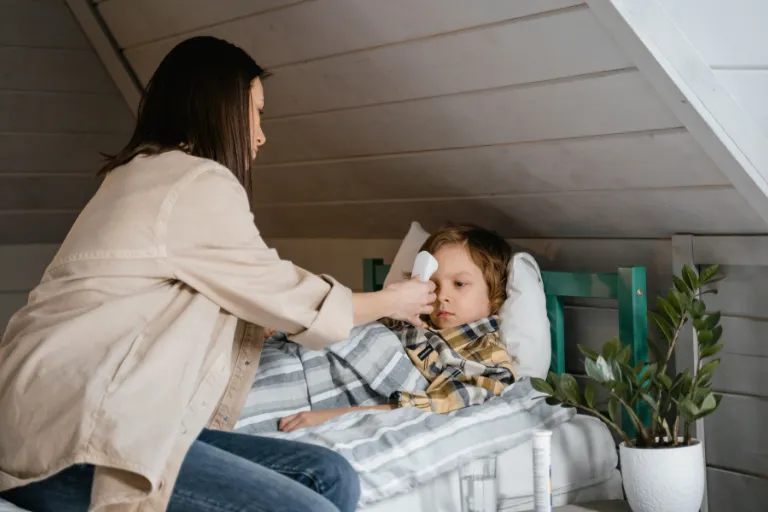
Por lo general comienza en medio de la noche. Un niño se agita inquieto, su frente inusualmente caliente. Una rápida comprobación del termómetro muestra 102°F. Los padres, despiertos, se enfrentan a la familiar oleada de preocupación: ¿Es algo que puedo manejar en casa o deberíamos dirigirnos directamente a una atención urgente?
Para muchas familias, la fiebre en los niños es una de las experiencias de salud más comunes y que más causan ansiedad. Hasta la mitad de los padres llevan a sus hijos a un profesional de la salud para las fiebres que a menudo se pueden tratar sin peligro en casa (AAP, 2023). . El desafío es distinguir cuando una fiebre es simplemente parte del sistema de defensa del cuerpo, y cuando señala algo más grave.
La fiebre como defensa incorporada del cuerpo
La fiebre no es una enfermedad en sí misma, es una respuesta. Cuando el sistema inmunológico detecta una infección, el termostato del cerebro aumenta, creando un ambiente interno más caliente que hace más difícil que los virus y las bacterias prosperen . En los niños, cuyo sistema inmunológico aún se está desarrollando, las fiebres son especialmente comunes.
Según la Academia Americana de Pediatría (AAP, 2023), la fiebre por sí sola rara vez es dañina; lo que importa más es el comportamiento general del niño y los síntomas acompañantes . Aún así, las fiebres persistentes o muy altas pueden poner a los niños en riesgo de deshidratación o, en algunos casos, desencadenar convulsiones febriles-episodios breves de sacudidas que, si bien son aterradoras, no suelen ser dañinas (NICE, 2024).
Mirando más allá del termómetro
¿Cómo pueden los padres saber cuándo se puede controlar la fiebre en casa y cuándo se necesita atención profesional? Un enfoque útil es mirar más allá del número en el termómetro.
Señales de que la fiebre puede ser controlada con seguridad en el hogar:
- El niño está alerta y responde, aunque esté más cansado de lo habitual.
- Beber líquidos y producir orina.
- Respirando cómodamente.
- Fiebre por debajo de 104 °F (40 °C) en niños mayores de 3 meses .
Señales de alerta que requieren atención médica:
- Cualquier fiebre en un bebé menor de 3 meses ( 100.4°F / 38°C).
- Fiebre que dura más de 3 días.
- Letargo severo, llanto persistente o falta de respuesta.
- Dificultad para respirar, respiración rápida o labios azulados.
- Signos de deshidratación: boca seca, sin lágrimas, muy pocos pañales húmedos.
- Cuello rígido, dolor de cabeza severo o sensibilidad a la luz.
- Erupción que se extiende rápidamente o parece moretones .
Estas directrices provienen de asociaciones pediátricas como la AAP (2023), CDC (2024) y la Organización Mundial de la Salud (OMS, 2024), que enfatizan el emparejamiento de la temperatura con el comportamiento general y el contexto.
Confort primero en el cuidado de una fiebre
Cuando un niño tiene una fiebre de leve a moderada sin síntomas alarmantes, la atención en el hogar se centra en la comodidad y la hidratación.
Hidratación y fluidos
La fiebre causa pérdida de líquidos a través del sudor y una respiración más rápida. Ofrezca sorbos frecuentes de agua, jugo diluido o soluciones de rehidratación oral. Para los bebés, continúe con la leche materna o fórmula .
Descanso y tranquilidad
Los niños a menudo necesitan descanso adicional, pero no necesitan quedarse en la cama si se sienten cómodos jugando tranquilamente. El confort y la tranquilidad pueden ser tan importantes como el sueño.
Ropa y medio ambiente
Vista a los niños con ropa ligera y mantenga la habitación cómodamente fresca. El exceso de agrupamiento puede atrapar el calor y empeorar la incomodidad .
Medicamentos Cuándo y cómo
El acetaminofeno (Tylenol) y el ibuprofeno (Motrin, Advil) pueden reducir la fiebre y aliviar el malestar, pero no son necesarios para cada fiebre . Estos deben usarse principalmente si el niño se siente incómodo, no simplemente porque el termómetro muestra un número alto.
- Acetaminofén seguro para niños mayores de 2 meses.
- Ibuprofeno seguro para niños mayores de 6 meses.
- Nunca le dé aspirina a los niños, debido al riesgo del síndrome de Reye .
Siempre siga las pautas de dosificación basadas en el peso y evite la superposición de múltiples productos que contengan el mismo ingrediente, una fuente común de sobredosis accidental .
Qué no hacer
- Evite los baños fríos, las bolsas de hielo o el alcohol para frotar; estos métodos pueden causar escalofríos, molestias o incluso reacciones peligrosas .
- No fuerce la hidratación de los alimentos es más crítica que las comidas durante una fiebre.
Mitos sobre la fiebre que aún preocupan a los padres
Los investigadores han documentado lo que llaman "fobia a la fiebre": el miedo entre muchos padres de que la fiebre es peligrosa. Un estudio de 2016 en Pediatría encontró que casi la mitad de los cuidadores estaban preocupados de que la fiebre no tratada aumentara a niveles peligrosos, a pesar de la evidencia de que el cuerpo tiene límites naturales (Walsh et al., 2016).
La verdad: la mayoría de las fiebres se resuelven por sí solas en unos pocos días, a medida que el sistema inmunitario elimina la infección subyacente. El peligro real a menudo proviene de la deshidratación, las infecciones secundarias o el retraso en la atención médica cuando se ignoran los síntomas graves .
Las tradiciones de la fiebre en todo el mundo
En todo el mundo, las prácticas culturales para la fiebre varían. En algunos países, los tés de hierbas o compresas frías son remedios tradicionales. Otros hacen hincapié en las mantas sudorosas, con la esperanza de "sudar" la fiebre. Aunque algunas de estas prácticas pueden proporcionar comodidad, los expertos en pediatría advierten contra cualquier método que altere rápidamente la temperatura corporal (NICE, 2024).
Lo que sigue siendo universal: atención atenta, hidratación y reconocimiento de cuándo buscar ayuda médica.
Lo que todos los padres deben recordar
Las fiebres son uno de los obstáculos más comunes para la salud en la infancia. Pueden ser inquietantes, pero también son un poderoso signo de las defensas naturales del cuerpo en el trabajo. Al enfocarse en la comodidad, la hidratación y el monitoreo cuidadoso, los padres a menudo pueden manejar las fiebres en casa con confianza.
La clave es saber cuándo pedir ayuda. Si su hijo es muy joven, tiene una fiebre alta persistente o inusualmente alta, o muestra algún síntoma de advertencia, no espere y acuda a un profesional de la salud. Para la mayoría de las fiebres, sin embargo, la tranquilidad y los cuidados sencillos en el hogar son la mejor medicina.
Dónde aprender más
- Academia Americana de Pediatría (2023): Fiebre y su hijo
- Centros de control y prevención de enfermedades (2024): Cuidado de un niño enfermo
- Organización Mundial de la Salud (2024): Directrices sobre la salud infantil
Atención: Este artículo no constituye un consejo médico. Siempre consulte a un profesional de la salud autorizado para el diagnóstico o tratamiento. Este sitio web puede recibir comisiones de los enlaces o productos mencionados.
Suscríbase gratis para obtener artículos de salud más perspicaces adaptados a sus necesidades.
Fuentes
- American Academy of Pediatrics. (2023). Fever and your child. Retrieved from https://www.healthychildren.org
- Centers for Disease Control and Prevention. (2024). Caring for a sick child. U.S. Department of Health & Human Services. Retrieved from https://www.cdc.gov
- National Health Service (NHS). (2023). Reye’s syndrome. Retrieved from https://www.nhs.uk
- National Institute for Health and Care Excellence (NICE). (2024). Fever in under 5s: Assessment and initial management (NG143). Retrieved from https://www.nice.org.uk
- Walsh, A., Edwards, H., & Fraser, J. (2016). Parents’ childhood fever management: Community survey and instrument development. Pediatría, 138(2), e20162062. https://doi.org/10.1542/peds.2016-2062World Health Organization. (2024). Integrated management of childhood illness: Care for sick children. WHO. Retrieved from https://www.who.int



 Spanish
  English
  German
  French
I wish I’d read this the first time my toddler had a high temperature