
A Little About Me
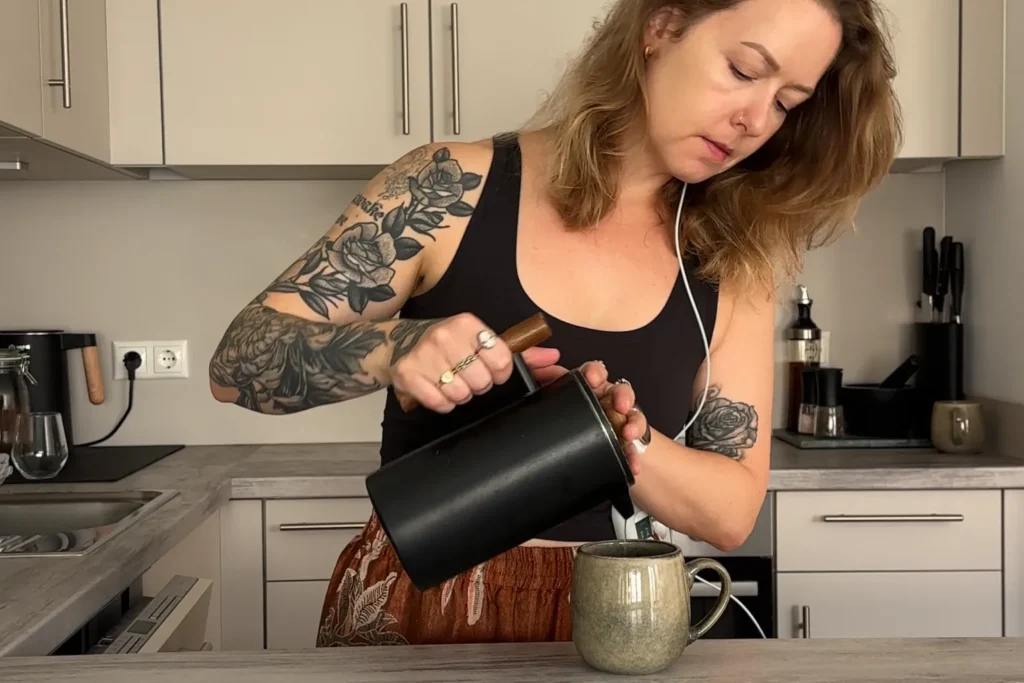
I’m a breathwork facilitator and embodiment teacher based in Berlin, originally from New Zealand. I founded SOULBODY BREATH® at the end of 2023, and my work since has focused on helping people regulate their nervous systems, slow down, and reconnect with their bodies.
My mind switches on the moment I wake up. Not gradually. Instantly. For years, the advice I gave myself, and the advice I give clients, was the same: slow down, sit still, let the calm arrive. It never once worked that way for me.
I assumed the fix for my own fast-starting mornings was simply more of what I already teach. Stillness. Quiet. A slower start to the day.
So I tried it. Properly. Repeatedly, over years, not days.
And it never worked the way I expected it to.
The Promise Of Calm That Never Came
I even tried forcing slow morning routines, the kind you see everywhere online. Sitting in stillness at 6 am, waiting for the calm to arrive before the day properly started.
It never felt nourishing. It felt like fighting my own nature.
And that’s what I mean when I say trying to slow down was actually adding more stress to my mornings, not less. The practices themselves weren’t the problem. The problem was that I was turning the first part of every morning into a negotiation with my own nervous system: slow down, sit still, stop thinking, calm down. Instead of removing pressure, I’d accidentally created one more thing I felt I needed to get right before the day had even started.
My mind switches on the moment I wake up. That’s simply how my mornings have always tended to feel.
I’m not the only person who runs into this. It’s one of the most common things I hear in my own work: someone sits down to meditate, and instead of settling, their mind speeds up. They fidget. They can’t get comfortable. The stillness that’s supposed to bring calm ends up feeling like the opposite, a spotlight on exactly how much is already moving underneath.
The assumption is almost always the same: I need to slow down more. I need better discipline with my routine.
In my case, and in a lot of the cases I see in my own practice, that’s not actually what’s missing, understanding why took me back to something much more basic than discipline.
Why Mornings Can Feel So Intensely “On”
Waking up isn’t actually a transition from sleep straight into calm.
One normal part of waking is the cortisol awakening response (CAR), a rise in cortisol that typically occurs during the first 30 to 45 minutes after waking and is thought to help prepare the body for the transition into daytime activity.¹
That doesn’t mean cortisol is the problem, or that waking up alert is unhealthy. This response isn’t identical for everyone, and researchers are still working out exactly why some people show a stronger rise than others. The evidence here is still developing, and not every study agrees.²
But it helped me stop treating my own fast mornings as something I needed to “fix.” The question became less: how do I force myself to be calm? And more: how do I support regulation from the state I’m actually starting in?
It’s Not Always Discipline. It’s How Your Nervous System Starts the Day.
Here’s something I took a long time to understand, even with my training.
Stillness-based practices can be incredibly effective. I’ve seen that firsthand, and I teach some of them for a living. But I’ve learned that the state you arrive in can change how accessible they feel.
When my mind is already moving at full speed, sitting down and asking it to become quiet immediately can create friction before the practice has even had a chance to help.
For me, it wasn’t a discipline problem. It was a mismatch between how activated I already felt and what I was asking myself to do.
Why I Needed Support to Actually Get There
I want to be genuinely clear about something first, because I teach these tools and I believe in them.
The problem wasn’t that these practices had never helped me. I knew they could, and I teach some of them for a living.
The problem was friction. Meditation asked me to create space and settle my attention first. Journaling asked for time and a quiet head. Movement-based practices meant carving out another window in an already full morning.
And on the mornings I needed regulation most, adding another thing to do was often the last thing I wanted.
I wasn’t looking for something to replace these practices. I was looking for something that could make it easier to arrive at them, so that when I did sit down to breathe or meditate, I wasn’t spending the first ten minutes just trying to get there. It doesn’t replace the practices I teach. It’s what helps me actually get the full value out of them.
The System Underneath the Speed
La sistema nervioso autónomo (SNA) helps regulate processes that happen largely outside conscious control. The sistema nervioso simpático (SNS) supports mobilization and alertness, while the sistema nervioso parasimpático (SNP) supports rest, digestion, and recovery.
We need both. The goal isn’t to eliminate sympathetic activation, or to spend the entire day parasympathetic. What matters is flexibility, our ability to respond to demand and then move towards recovery once that demand passes.
What I was looking for wasn’t a way to force myself into parasympathetic stillness before the day began. It was a way to support that flexibility, that shift, without requiring more effort from an already-activated system.
The vagus nerve is an important pathway within the parasympathetic nervous system, carrying signals between the brainstem and organs including the heart, lungs and digestive tract.
Why I Was Skeptical
I’m naturally quite skeptical person when it comes to wellness claims. I wasn’t looking for a quick fix, and I wasn’t going to trust a device simply because it promised to “reset my nervous system.” I hear that phrase used loosely, and it usually means very little.
What actually got my attention was the research itself, not the marketing around it.
There’s a substantial and growing body of peer-reviewed research behind taVNS (Transcutaneous Auricular Vagus Nerve Stimulation), a non-invasive way of engaging the vagus nerve through the outer ear.
The external ear is an established target for non-invasive vagus nerve stimulation because parts of it receive sensory innervation from the auricular branch of the vagus nerve. The exact mechanisms and optimal stimulation sites are still being studied.
I came into trying this with curiosity, not expectation. My experience has taught me that the practices I use tend to become more useful through repetition and consistency, rather than overnight. I wasn’t expecting an overnight transformation. I was looking for something I could use consistently and assess over time.
What caught my attention was taVNS itself, before any specific device. It immediately solved one of my biggest practical objections. It didn’t require me to stop my morning to use it. So I started looking at the devices that actually use this approach. One stood out because of the research behind it.
That’s when I came across Nurosym.
What I Found: Nurosym AVNT™
Nurosym is a CE-marked taVNS device using proprietary AVNT™ (Auricular Vagal Neuromodulation Technology) to deliver a calibrated signal to the auricular branch of the vagus nerve, through the outer ear.
Backed by 60+ completed studies across 150+ internationally recognized institutions, including Harvard, Yale, UCL, and Imperial College London.
Lo que muestra la investigación
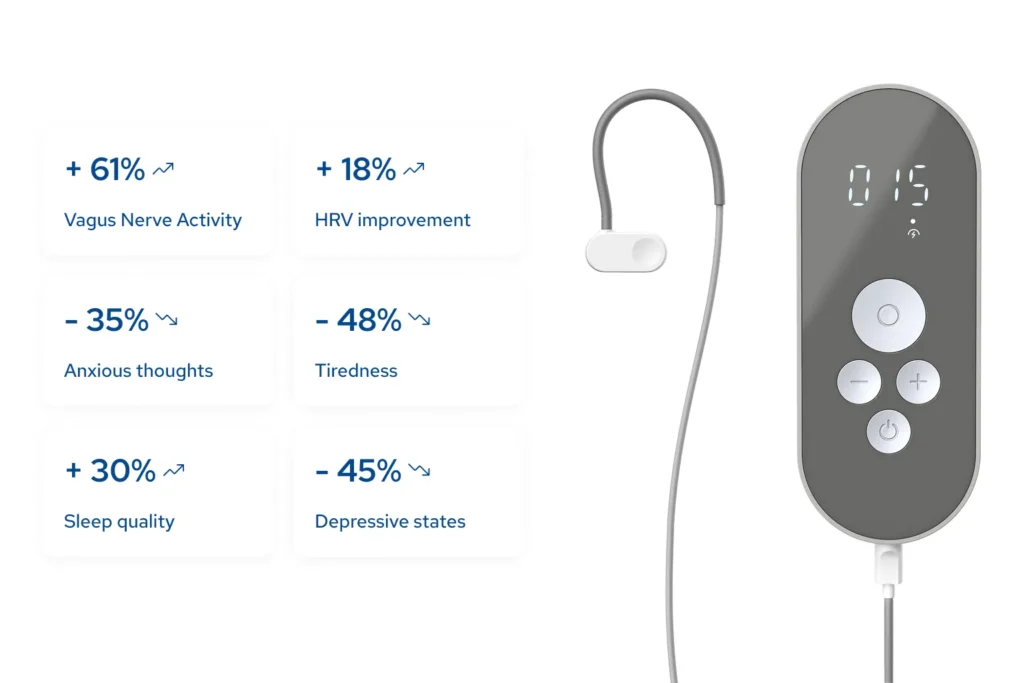
Resultados de estudios revisados por pares en poblaciones específicas del estudio. Las cifras reflejan el cambio relativo en comparación con placebo o la línea de base. Los resultados individuales pueden variar.
The 30-Minute Routine
What made this different from everything I’d tried before: it doesn’t ask you to be already calm to use it.
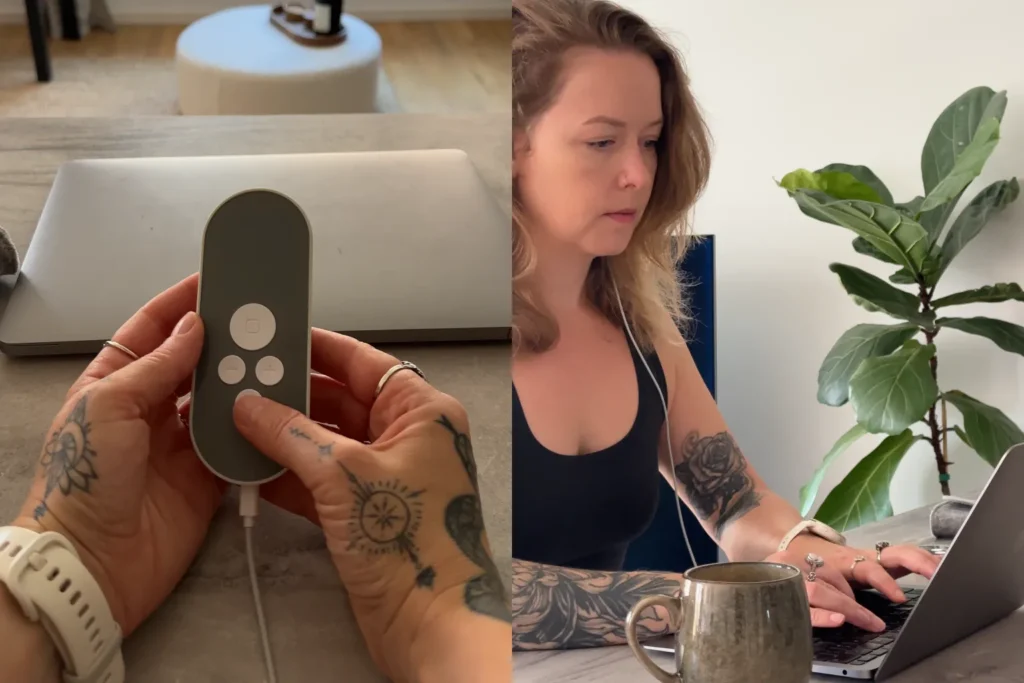
It clips to the outer ear. No app, no gel, no prescription required. It’s wired, not wireless, a small cable running to a control unit, which surprised me at first, but stopped mattering within a few days.
Puedes usarlo mientras:
- Tomando tu café de la mañana
- Revisar correos electrónicos
- Trabajar en su escritorio
- During or before a meditation practice
- Leer antes de dormir
- Anything that already exists in your day
Twenty minutes. At the same time, the day is already starting, not before it’s allowed to. No separate window, no extra preparation, nothing to set up beyond clipping it on.
That was the actual shift, not slowing my mornings down, but giving me something I could use without asking my mornings to become slower than they naturally are.
What I Started Noticing
Around the two-week mark, I noticed something I genuinely hadn’t expected.
Sitting at my laptop one morning, I had a real feeling of space, of having time, without having changed my pace at all. I looked at my to-do list, and instead of immediately thinking about what I could add, my first thought was: what can I take away?
For probably the first time in years, I started questioning whether the things on my list actually needed to be there.
I felt clearer. Not because I’d suddenly become a slower person, but because speed no longer seemed to carry the same tension.
That’s been such an unexpected gift, because I’m naturally an overachiever. I have a thousand ideas every day. The clarity around what actually matters, and what I could lovingly let go of, has been one of the most meaningful shifts from using this consistently.
Why This Extended Beyond My Mornings, Sleep Included
The shift didn’t stay contained to how my day started.
My meditation practice changed too, which I hadn’t expected given how it began. I started combining the device with my sessions, using it for twenty minutes before or during practice. I noticed I began dropping into meditation faster. It became a cue for my body, a signal that we’re softening, rather than another thing my already-fast mind had to fight its way into.
My sleep had been the kind where you’re exhausted but still wired at night, so normal I’d stopped questioning it. Whether the device itself changed my sleep, I genuinely can’t say with certainty. Sleep has too many variables to isolate one cause. What I can say is that the other changes I notices, including more clarity, less reactivity, more space around stress- seemed to carry into how the rest of the day, and night felt.
Stressful situations still happened, exactly as they always had. A website issue that cost me hours. A day where everything ran late. Before, something like that could have sent me into a spiral: I’m behind, I’m not going to make it, I’m failing. Now there’s more space between what happens and how I respond. I can still feel the stress. It just doesn’t tip me over the same way.
I’m still someone whose mind switches on the moment I wake up. That hasn’t changed, and I wouldn’t want it to. What changed is how much that fast start costs me for the rest of the day.
Is This You?
- Your mind is already running the moment you wake up, no matter how much you try to slow your mornings down.
- Sitting still to meditate has never quite landed for you, and you've quietly wondered if something's wrong with how you do it.
- You fidget, get restless, or feel your thoughts speed up the moment you try to sit quietly.
- You're stressed, but it doesn't look dramatic from the outside; you're functioning, but stretched thin.
- You want something that works with your nervous system's actual pace, rather than asking you to override it.
No usar si tiene un marcapasos o dispositivo cardíaco implantable, está embarazada, ha tenido recientemente un episodio cardíaco grave o es menor de 18 años. Siempre consulta a un profesional de la salud antes de comenzar.
Una forma segura de intentarlo
Garantía de devolución del dinero en 30 días, enough time to notice whether this actually fits how your nervous system works
Nota final
I still don’t have slow mornings. My brain still switches on the second I wake up, and I’ve stopped trying to change that.
What changed is what I do with it once it’s already happening.
If you’ve spent years being told that regulation means slowing down, and it’s never quite worked for you, it may not be about trying harder to be still. It may be about supporting the nervous system you actually have, not the one the standard advice assumes everyone starts with.
EXCLUSIVE OFFER FOR OUR READERS: Get 5% Off Nurosym From Our Editorial Team!
Bibliografía:
- Clow A, et al. The cortisol awakening response: more than a measure of HPA axis function. Neuroscience & Biobehavioral Reviews. 2010;35(1):97-103. https://doi.org/10.1016/j.neubiorev.2009.12.011
- Rohleder N, et al. Daily life stress and the cortisol awakening response: testing the anticipation hypothesis. PLoS ONE. 2012. https://pmc.ncbi.nlm.nih.gov/articles/PMC3527370/
- Wolf V, et al. Does transcutaneous auricular vagus nerve stimulation affect vagally mediated heart rate variability? A living and interactive Bayesian meta-analysis. Psychophysiology. 2021;58(11):e13933. https://doi.org/10.1111/psyp.13933
- Geng D, et al. The effect of transcutaneous auricular vagus nerve stimulation on HRV in healthy young people. PLoS ONE. 2022. https://doi.org/10.1371/journal.pone.0263833
- Tarn J, et al. The effects of noninvasive vagus nerve stimulation on fatigue in participants with primary sjögren’s syndrome. Neuromodulación. 2022. https://pubmed.ncbi.nlm.nih.gov/37032583/
- Ferreira LMA, et al. Transcutaneous auricular vagus nerve stimulation modulates masseter muscle activity, pain perception, and anxious thoughts levels in university students: a double-blind, randomized, controlled clinical trial. Frontiers in Integrative Neuroscience. 2024. https://doi.org/10.3389/fnint.2024.1422312
- Zheng S, et al. Transcutaneous auricular vagus nerve stimulation enhanced emotional inhibitory control via increasing intrinsic prefrontal couplings. International Journal of Clinical and Health Psychology. 2024;24(2):100462. https://doi.org/10.1016/j.ijchp.2024.100462
- Farmer AD, et al. International consensus based review and recommendations for minimum reporting standards in research on transcutaneous vagus nerve stimulation (Version 2020). Frontiers in Human Neuroscience. 2021. https://www.frontiersin.org/articles/10.3389/fnhum.2020.568051/full
This article reflects my personal experience and professional evaluation of the evidence. This article is published in partnership with Nurosym. I may receive compensation from purchases made through links in this article. This is not medical advice, always consult a healthcare professional before starting any new health intervention. Individual results may vary.


 Spanish
 English
 German
 French
 Swedish
 Italian