
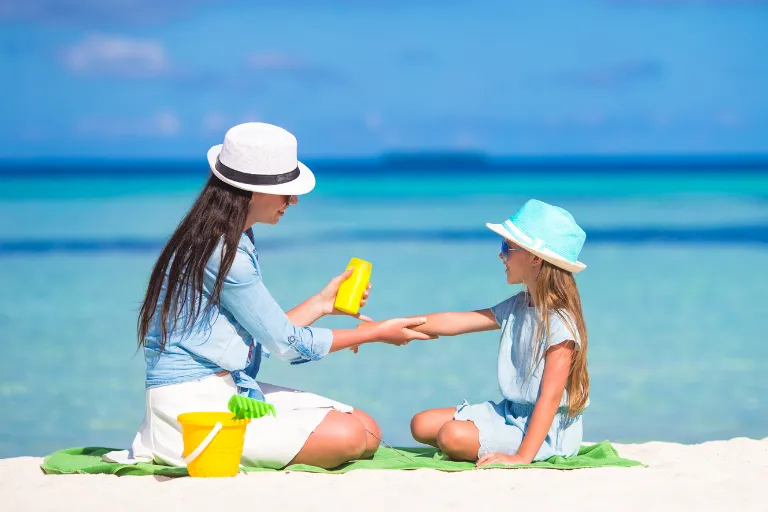
Puntos clave:
- La piel de los niños es más vulnerable a la radiación UV, lo que aumenta el riesgo de cáncer de piel.
- Utilizar protectores solares minerales de amplio espectro con SPF 30+; volver a aplicar cada 2 horas.
- Tiempo de juego al aire libre antes de las 10 a.m. o después de las 4 p.m. cuando el sol es menos intenso.
- La ropa con clasificación UPF, los sombreros de ala ancha y la sombra pueden reducir significativamente la exposición a los rayos UV.
- La seguridad del sol no es solo para los días de playa: los rayos UV pueden ser peligrosos incluso en días nublados o en invierno.
It doesn’t take a tropical vacation to put a child at risk for sun damage. A weekend soccer game, a stroll to the park, or a cloudy afternoon at the pool can expose delicate young skin to ultraviolet (UV) radiation—often without warning signs until a burn appears. According to the Skin Cancer Foundation, just one blistering sunburn in childhood doubles the risk of developing melanoma later in life (Skin Cancer Foundation, n.d.).
Sin embargo, muchos padres siguen desconociendo los peligros acumulativos de la exposición a los rayos UV o confían en mitos anticuados (como la creencia de que los tonos de piel más oscuros no requieren protección solar). La realidad? La seguridad solar es una preocupación durante todo el año y uno de los hábitos de salud a largo plazo más eficaces que los padres pueden enseñar.
Por qué importa: los riesgos del daño solar temprano
La piel de los niños, aún en desarrollo y más fina que la de los adultos, absorbe la radiación UV con mayor rapidez. Esta vulnerabilidad biológica, combinada con sus frecuentes juegos al aire libre, hace que la protección solar sea especialmente crítica durante la infancia y la adolescencia (Organización Mundial de la Salud [OMS], 2023).
Las investigaciones demuestran que hasta el 80% de la exposición solar durante toda la vida se produce antes de los 18 años. Y según los Centros para el Control y la Prevención de Enfermedades (CDC), casi el 60% de los estudiantes de secundaria reportan al menos una quemadura solar cada año, un indicador alarmante de que las estrategias de seguridad solar a menudo son insuficientes.
El daño UV acumulativo no solo aumenta el riesgo de melanoma. También acelera el envejecimiento prematuro, causa daño ocular (incluyendo cataratas), y puede suprimir la función inmune en la piel.
Lo que realmente está pasando: la ciencia de los rayos UV y la piel
La radiación UV es invisible, pero sus efectos en el cuerpo son potentes. El sol emite dos tipos principales de rayos UV que afectan a la piel:
- Rayos UVA penetrar profundamente en la dermis, la capa más gruesa de la piel. Son principalmente responsables del envejecimiento y el daño a largo plazo.
- Rayos UVB afectan las capas externas de la piel y son la principal causa de quemaduras solares (U.S. Food and Drug Administration [FDA], 2024).
Ambos tipos contribuyen al cáncer de piel. El índice UV, desarrollado por el Servicio Meteorológico Nacional y la Agencia de Protección del Medio Ambiente, mide la intensidad de la radiación solar UV en una escala de 0 (baja) a 11+ (extrema). Las altitudes más altas, las superficies reflectantes (como el agua o la nieve) y las regiones geográficas más cercanas al ecuador intensifican esta exposición.
Desafortunadamente, la radiación UV no toma vacaciones cuando está nublado o fresco. Hasta el 80% de los rayos UV aún pasan a través de la cubierta nublada, y la nieve refleja hasta el 85% de la luz UV en la exposición cutánea.
Directrices pediátricas: lo que dicen los expertos
La Academia Americana de Pediatría (AAP) ofrece una guía de seguridad solar específica para cada edad:
- Niños menores de 6 meses: Evite por completo la exposición directa al sol. Use ropa de sombra, UPF transpirable y sombreros de ala ancha.
- Niños pequeños y mayores: Fomentar el juego en áreas sombreadas y aplicar protector solar de amplio espectro (SPF 30+) 15 minutos antes de salir al exterior.
Los CDC y la Organización Mundial de la Salud (OMS) recomiendan protectores solares de amplio espectro- aquellos que bloquean los rayos UVA y UVB-y aconsejan volver a aplicarlos cada 2 horas, o después de nadar o sudar mucho.
Decodificación de protector solar: qué buscar
No todos los protectores solares son creados iguales, y la seguridad de los ingredientes es especialmente importante para los niños. Esto es lo que los padres necesitan saber:
- Protectores solares minerales (físicos) utilizar óxido de zinc o dióxido de titanio para crear una barrera física que refleja los rayos UV, son más seguros para la piel joven (American Academy of Dermatology [AAD], 2024).
- Ffiltros solares químicos absorben la radiación UV a través de ingredientes como oxybenzone o avobenzone. Algunos estudios han planteado preocupaciones sobre la alteración hormonal de ingredientes como la oxibenzona, lo que llevó a la FDA a pedir más pruebas de seguridad, especialmente para los niños (FDA, 2024).
Buenas prácticas:
- Elija SPF 30 o superior y busque "amplio espectro" y "resistente al agua" en la etiqueta.
- Volver a aplicar cada 2 horas-más a menudo si nadar o sudar.
- Aplicar generosamente: la mayoría de las personas no aplican lo suficiente, lo que reduce la eficacia.
Para niños con piel sensible, protectores solares minerales sin fragancia e hipoalergénicos son una apuesta más segura.
Suscríbase gratis para obtener artículos de salud más perspicaces adaptados a sus necesidades.
Ropa de protección solar: la primera línea de defensa
Más allá de la protección solar, las prendas con factor de protección ultravioleta (UPF) ofrecen una protección fiable. Una clasificación UPF de 50 bloquea el 98% de los rayos UV (Skin Cancer Foundation, 2024). Busque:
- Sombreros de ala ancha que oscurece la cara, las orejas y el cuello.
- Protectores de mangas largas o trajes de baño con UPF incorporado.
- Gafas de sol con bloqueo UV (etiquetado UV400) para proteger los ojos sensibles.
Los tejidos ligeros como las mezclas de algodón o poliéster permiten la transpiración sin sacrificar la protección. Y a diferencia del protector solar, la ropa no se lava ni necesita reaplicación.
Hábitos inteligentes: Dando forma a una vida de seguridad solar
La protección solar no tiene que ver con el miedo, sino con la formación de hábitos sostenibles como las actividades programadas antes de las 10 a.m. o después de las 4 p.m. (Agencia de Protección Ambiental [EPA], 2024). He aquí cómo:
- Tiempo correctamente: Programe actividades al aire libre antes de las 10 a.m. o después de las 4 p.m., cuando los rayos del sol son menos intensos.
- Hacer de la sombra una prioridad: Use paraguas, toldos o árboles. Enseñe a los niños a descansar en la sombra durante los descansos.
- Hacer que sea habitual: Aplicar protector solar antes de salir de casa. Mantener un sombrero de sol y gafas de sol en mochilas o cochecitos.
- Dar ejemplo: Los niños son más propensos a usar protector solar y sombreros si los padres modelan el comportamiento.
Acabar con los mitos comunes
"Mi hijo tiene la piel más oscura, no necesita protector solar."
→ Falso. Todos los tonos de piel pueden quemarse y son susceptibles a daños a largo plazo (AAD, 2024).
"Está nublado, estamos bien sin protector solar."
→ No es cierto. Hasta el 80% de los rayos UV todavía llegan a la piel en días nublados.
"La seguridad solar solo importa durante las vacaciones de verano."
→ Mal. La exposición a los rayos UV es un problema durante todo el año, especialmente en entornos de gran altitud o reflectantes.
Pensamientos finales: La crianza de los niños Sun-Savvy
El mejor plan de protección solar no es complicado, es consistente. Al combinar protector solar mineral de amplio espectro, ropa UPF, sincronización inteligente y sombra, los padres pueden reducir drásticamente la exposición de los niños a los rayos UV y los riesgos a largo plazo. Comience temprano, hable abiertamente y modele usted mismo el comportamiento. Porque proteger a un niño de las quemaduras solares no es solo el día de hoy, sino que es un regalo para su futuro.
Referencias
1. American Academy of Dermatology. (2024). Sun safety for all skin tones. https://www.aad.org/public/everyday-care/sun-protection
2. American Academy of Pediatrics. (2024). Sun safety and protection for children. https://www.aap.org
3. Environmental Protection Agency. (2024). UV index timing guidelines. https://www.epa.gov/sunsafety
4. Food and Drug Administration. (2024). Sunscreen: How to help protect your skin from the sun. https://www.fda.gov
5. Skin Cancer Foundation. (2024). Childhood sunburn and melanoma risk. https://www.skincancer.org
6. World Health Organization. (2023). Ultraviolet radiation and children’s skin. https://www.who.int/news-room/fact-sheets/detail/ultraviolet-(uv)-radiation
El artículo no constituye en modo alguno un consejo médico. Consulte con un profesional médico autorizado antes de iniciar cualquier tratamiento. Este sitio web puede recibir comisiones por los enlaces o productos mencionados en este artículo.
Suscríbase gratis para obtener artículos de salud más perspicaces adaptados a sus necesidades.



 Spanish
  English
  German
  French
  Swedish
Clear and calm. It helped me feel informed instead of overwhelmed.
Reading this felt grounding. Less panic, more understanding.