
La stimulation du nerf vague, ou SNV, est un outil bien établi qui a été utilisé pendant des années dans la gestion des états dépressifs résistants aux traitements et qui fait maintenant l’objet d’études en tant qu’approche potentielle pour améliorer le sommeil et la régulation autonome. L’idée est simple : un signal doux et non invasif à l’un des nerfs parasympathiques clés du corps qui joue un rôle central dans la réponse de repos et de récupération de votre corps.
Un expert du sommeil explique pourquoi vos nuits brisées sont vraiment un problème de système nerveux, et pourquoi une revue récente de plus d’une douzaine d’études randomisées a accru l’intérêt pour le nerf vague comme cible thérapeutique potentielle pour une solution.

Vous restez éveillé pendant des heures, ou vous vous réveillez soudainement vers 3 heures du matin, ou vous grincez des dents sans le savoir, et quelque part en chemin, vous décidez que vous n’êtes qu’un mauvais dormeur.
Dans de nombreux cas, ce n’est pas vrai.
Le sommeil interrompu est rarement une question de volonté.
Le plus souvent, c’est votre système nerveux, coincé dans son équipement d’alerte alors qu’il devrait être en mode veille pour la nuit.
Le sommeil n’est pas un interrupteur qu’on effleure : c’est un processus structuré que votre système nerveux fait fonctionner toute la nuit, étape par étape, et cette structure a un nom : l’architecture du sommeil.
Le sommeil profond et réparateur en est le cœur, un état parasympathique de repos et de récupération géré en grande partie par un seul nerf...
Au nerf vague.
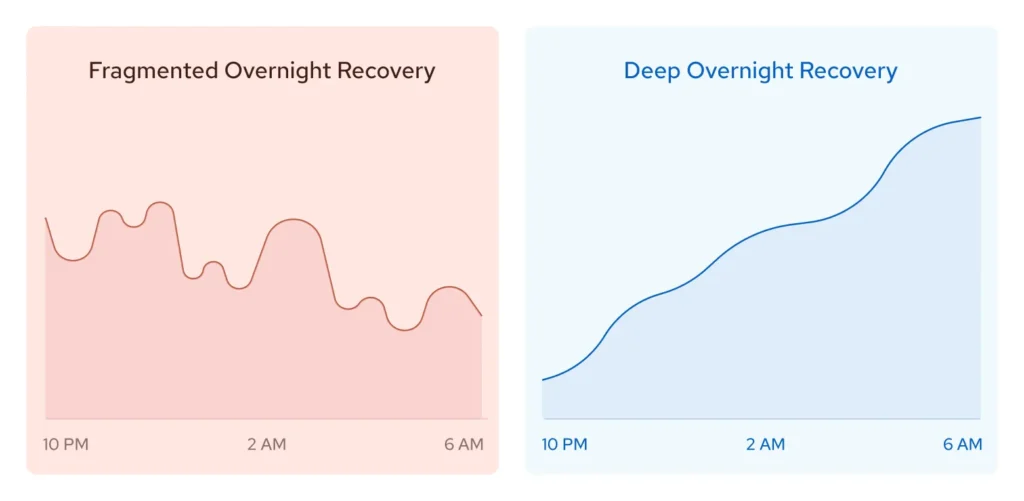
Le faible tonus vagal a été associé à une qualité de sommeil inférieure et à une architecture du sommeil perturbée dans plusieurs études. Cinq façons dont cela se manifeste :
- Tu ne peux pas rétrograder, alors tu restes allongé là, câblé, et le sommeil n’arrive pas.
- Vous passez peut-être moins de temps en sommeil profond à ondes lentes, donc une nuit complète ne correspond jamais au vrai repos.
- Les éveils nocturnes deviennent plus probables, donc vous vous réveillez à 3 heures du matin.
- Les micro-éveils peuvent devenir plus fréquents au cours de la nuit, ce qui fait que votre mâchoire se serre et grince.
- Des réveils brefs et fréquents peuvent fragmenter le sommeil, de sorte que toute la nuit s’effondre.
Chacun peut impliquer une régulation autonome altérée, avec le nerf vague comme composant important.
Soutenez ce nerf, et vous travaillez sur la racine des cinq à la fois, au lieu de poursuivre chaque symptôme un par un.

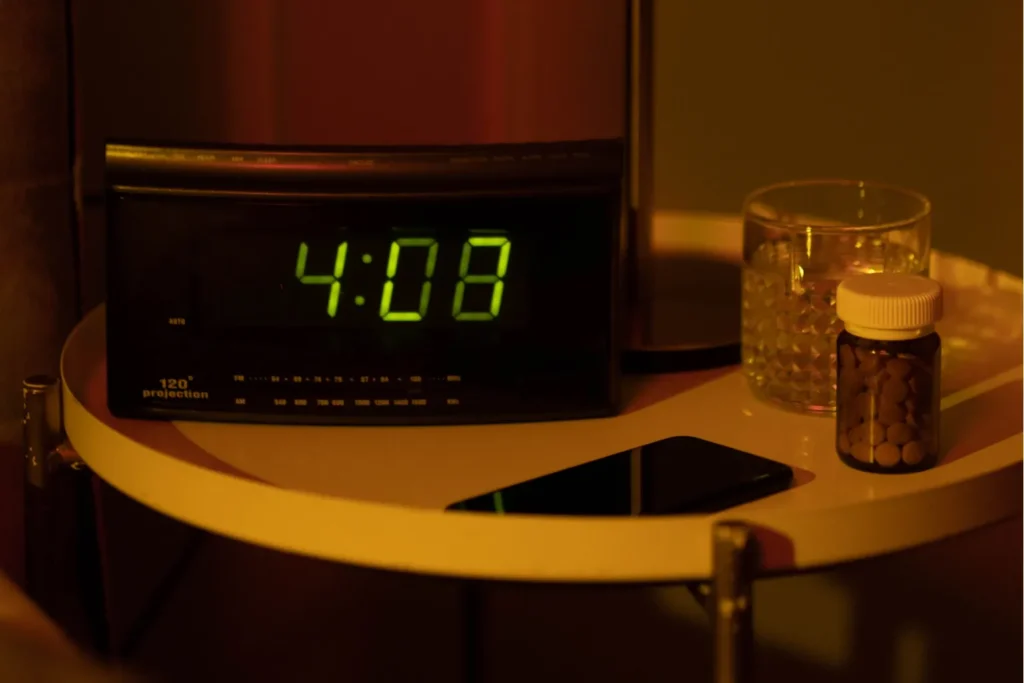
Peut aider à réduire l’hyperexcitation nocturne avant l’aube, afin que vous arrêtiez de vous réveiller brusquement à 3 heures du matin.

Tu t’endors bien, puis tu te réveilles au petit matin, instantanément alerte, et tu ne peux plus redescendre.
Ce timing n’est pas aléatoire.
Le cortisol, votre principale hormone du stress, est censé atteindre son niveau maximal la nuit et grimper vers le matin pour vous réveiller.
Dans la seconde moitié de la nuit, il est déjà en train de monter, et votre sommeil est naturellement plus léger.
Certaines personnes semblent ressentir une augmentation de l’excitation nocturne lorsque le cortisol commence à monter normalement tôt le matin.
Ensuite, l’esprit de course prend le dessus et vous maintient là.
Le nerf vague est le frein qui permet de contrôler ces poussées de stress, donc un mouvement reste un mouvement.
Soutenir le tonus vagal peut aider à modérer l’excitation physiologique, de sorte que vous êtes moins susceptible de vous réveiller complètement et plus rapidement.
Le regard de 3 heures du matin au plafond cesse d’être un rendez-vous nocturne.

Peut favoriser un sommeil plus profond et plus réparateur afin que votre corps puisse se réparer complètement
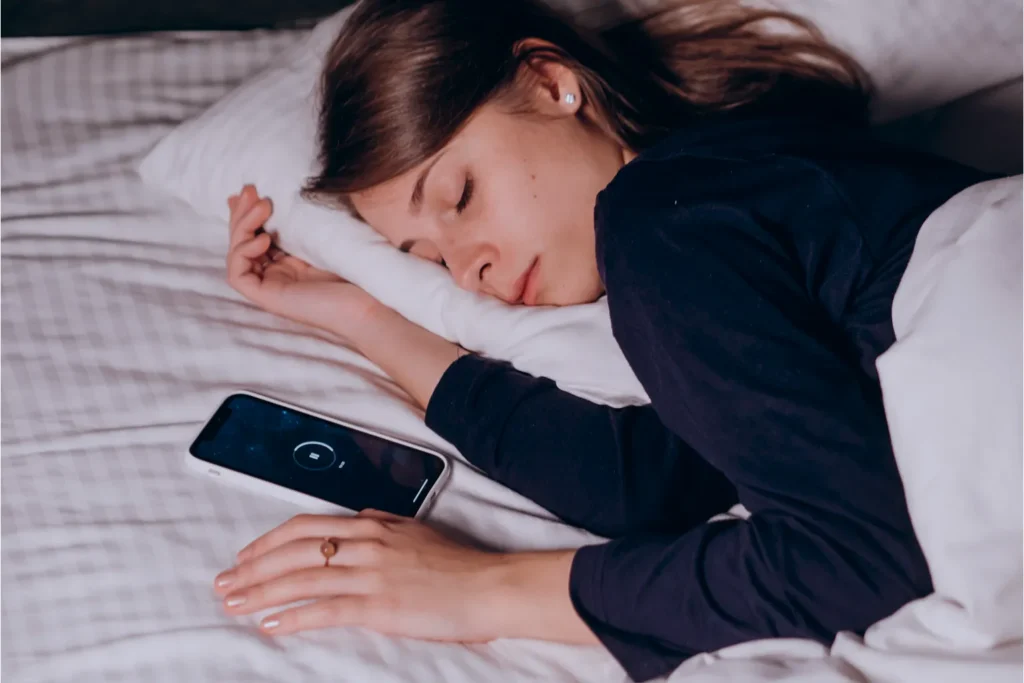
Tu as les heures, mais tu n’atteins jamais le fond.
Le sommeil n’est pas plat.
Il se déplace par vagues.
Tout au long de la nuit, vous faites un cycle toutes les 90 minutes environ, en vous enfonçant dans un sommeil profond à ondes lentes et en vous relevant vers le sommeil léger et le sommeil paradoxal (REM), l’étape du rêve.
Les creux les plus profonds, ce sommeil à ondes lentes, sont l’endroit où le corps fait sa réparation la plus lourde, et ils constituent la partie la plus parasympathique de la nuit, le stade auquel le nerf vague joue un rôle important dans le soutien de l’activité parasympathique pendant le sommeil.
Un système encore en surrégime après la tombée de la nuit ne peut pas s’enfoncer aussi bas, donc vous glissez le long du haut peu profond de la vague et n’atteignez jamais le fond réparateur, même avec huit heures au lit.
Soutenir le tonus vagal peut aider votre corps à passer plus de temps dans des phases de sommeil plus profondes et à maintenir ces creux profonds et lents.
Vous commencez à atteindre la partie la plus profonde du sommeil, là où se produit la véritable réparation.

Peut aider à réduire la tension musculaire nocturne, de sorte que le grincement et les contractions se relâchent.
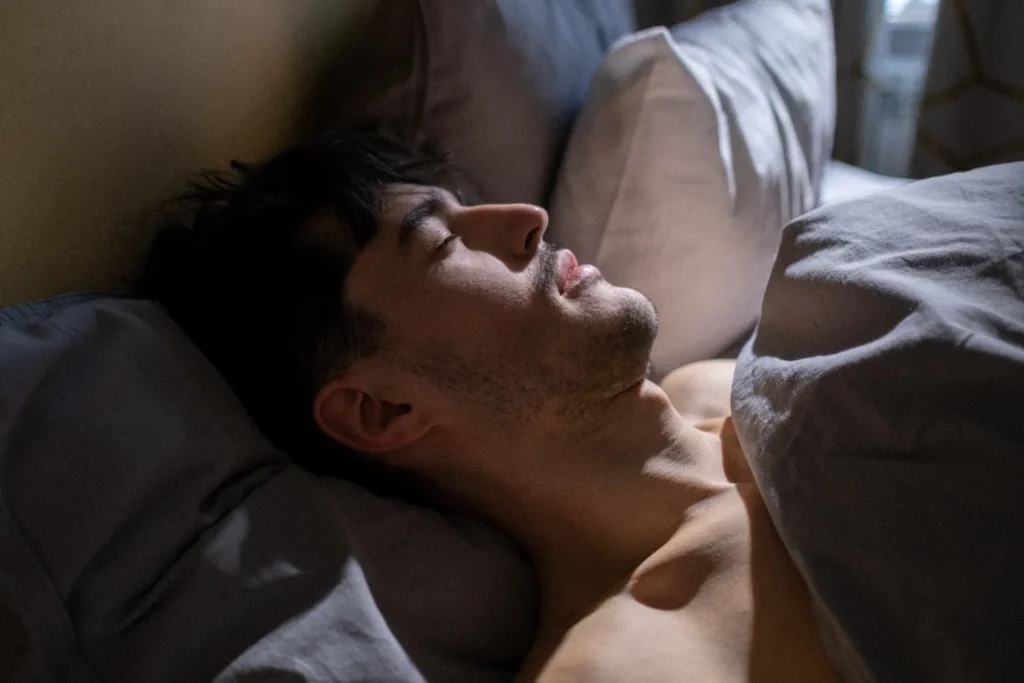
Vous vous réveillez avec une mâchoire douloureuse, un mal de tête sourd ou la plainte d’un partenaire à propos du grincement.
Peut-être que tes jambes te secouent à moitié, ou que tes muscles ne semblent jamais lâcher complètement.
Rien de tout cela n’est aléatoire.
Grincements et contractions autour des micro-éveils, brefs pics d’activation du système nerveux où le rythme cardiaque et la tension musculaire sautent juste avant que les tensions du corps ne s’accélèrent.
Un système fonctionnant à chaud après la tombée de la nuit sert plus de ces pointes, et plus de tension qui les accompagne.
En réduisant l’excitation nocturne, la stimulation vagale peut réduire ces micro-éveils, soulageant ainsi la tension qui les sous-tend.
La preuve directe ici est encore précoce, mais le lien avec l’excitation est bien établi.
Comme les nuits s’écoulent plus calmement, le serrement a moins de prise et tes muscles se reposent enfin.

Peut soutenir les processus de récupération nocturne du cerveau, afin que vous vous réveilliez net, sans être embrumé
Tu te réveilles dans un brouillard, lent à démarrer, comme si ta tête n’avait jamais été éclaircie.
Le sommeil n’est pas seulement du repos pour votre cerveau ; c’est de l’entretien.
Pendant le sommeil profond, le cerveau évacue les déchets qu’il a accumulés tout au long de la journée.
Dans le sommeil des rêves, il favorise la consolidation de la mémoire et agit sur ce que vous ressentez.
Cela dépend d’une architecture du sommeil saine et de la régulation autonome, votre système nerveux s’installant dans ses engrenages profonds et réparateurs, ceux que l’activité parasympathique soutient.
Lorsque la nuit reste peu profonde et interrompue, ces processus peuvent devenir moins efficaces ; vous vous réveillez donc avec le désordre d’hier encore dans votre tête.
En aidant votre corps à atteindre des stades de sommeil plus profonds, la stimulation vagale peut soutenir l’environnement requis pour ces processus nocturnes.
Tu te réveilles plus clairement parce que, pour une fois, la nuit a fait son travail sur ton cerveau.
Pourquoi le nerf vague est important pour dormir
Remarquez ce que les cinq ont en commun.
La difficulté à s’endormir, le sommeil profond superficiel, les secousses de 3 heures du matin, la mâchoire serrée, la fragmentation cachée : pas cinq problèmes distincts, mais cinq problèmes de sommeil qui peuvent partager une régulation autonome perturbée comme caractéristique commune, et cinq choses qui peuvent commencer à changer quand elles le peuvent.

C’est le changement de perspective avec lequel je veux que les gens repartent.
Si votre sommeil est perturbé, vous n’êtes généralement pas un mauvais dormeur.
Votre système nerveux vient de perdre le don d’éteindre.
Redonnez-lui ce talent, et la qualité du sommeil pourrait s’améliorer avec le temps.
Soutenir cette capacité directement est exactement la raison pour laquelle la stimulation du nerf vague est passée des milieux de recherche aux appareils grand public disponibles dans le commerce et à quelque chose que vous pouvez faire à la maison. Le nerf vague a une branche accessible dans l’oreille externe, de tous les endroits possibles, au niveau de votre oreille externe, donc un signal doux appliqué juste là peut stimuler la branche auriculaire sans rien d’invasif du tout.
L’un des appareils construits autour de cela est Nurosym TM. Ce stimulateur non invasif certifié CE se fixe à l’oreille et offre une stimulation douce lors de courtes séances quotidiennes, que certaines personnes intègrent dans leur routine du soir.
Ce n’est pas un somnifère, et toute personne qui promet un appareil seul va réparer votre sommeil alors que vous ignorez vos habitudes et que votre stress en fait trop.
Mais si cela a du sens que votre système nerveux ait oublié comment l’éteindre, et que vous voulez soutenir une régulation autonome plus saine, c’est là que je vous conseillerais de commencer à lire.
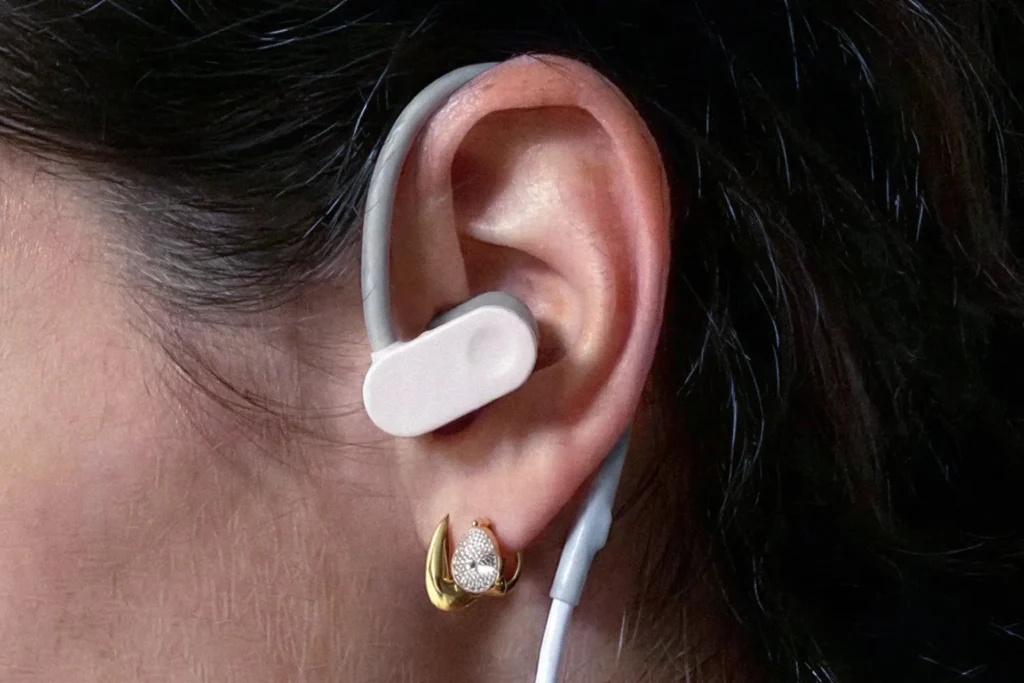
Si vous souhaitez voir comment cela fonctionne plus en détail, la page NurosymTM est voici.
Cet article de blog vise à être informatif et ne doit pas remplacer les conseils de santé professionnels. Toujours consulter un professionnel de santé pour des conseils personnalisés.
Références
- Guzel, H. C., Turkmen, O. B., Mutlu, E. K., Turkmen, G., Sakar, O., & Ormeci, G. O. (2026). Effectiveness of Transcutaneous Auricular Vagus Nerve Stimulation in Bruxism: A Randomised, Controlled, Single-Blind Experimental Trial. Journal of Oral Rehabilitation, 53(2), 493–504. https://pubmed.ncbi.nlm.nih.gov/41211817/
- Polini, F., & Budai, R. (2022). Multimodal transcutaneous auricular vagus nerve stimulation: An option in the treatment of sleep bruxism in a “polyvagal” context. CRANIO®, 1–9. https://www.tandfonline.com/doi/full/10.1080/08869634.2022.2055866
- Seth, J., Couper, R. G., Burneo, J. G., & Suller Marti, A. (2024). Effects of vagus nerve stimulation on the quality of sleep and sleep apnea in patients with drug-resistant epilepsy: A systematic review. Epilepsia, 65(1), 73–83. https://pubmed.ncbi.nlm.nih.gov/37899679/
- Zhang, S., Zhao, Y., Qin, Z., Han, Y., He, J., Zhao, B., Wang, L., Duan, Y., Huo, J., Wang, T., Wang, Y., & Rong, P. (2024). Transcutaneous Auricular Vagus Nerve Stimulation for Chronic Insomnia Disorder. Réseau JAMA ouvert, 7(12), e2451217–e2451217. https://jamanetwork.com/journals/jamanetworkopen/fullarticle/2828072
Partager cet article :



 French
  English
  German
  Spanish
  Swedish