
Un examen complet de la façon dont les dispositifs VNS favorisent le sommeil en traitant la dérégulation du système nerveux, avec des classements d’experts des 4 meilleures options certifiées.
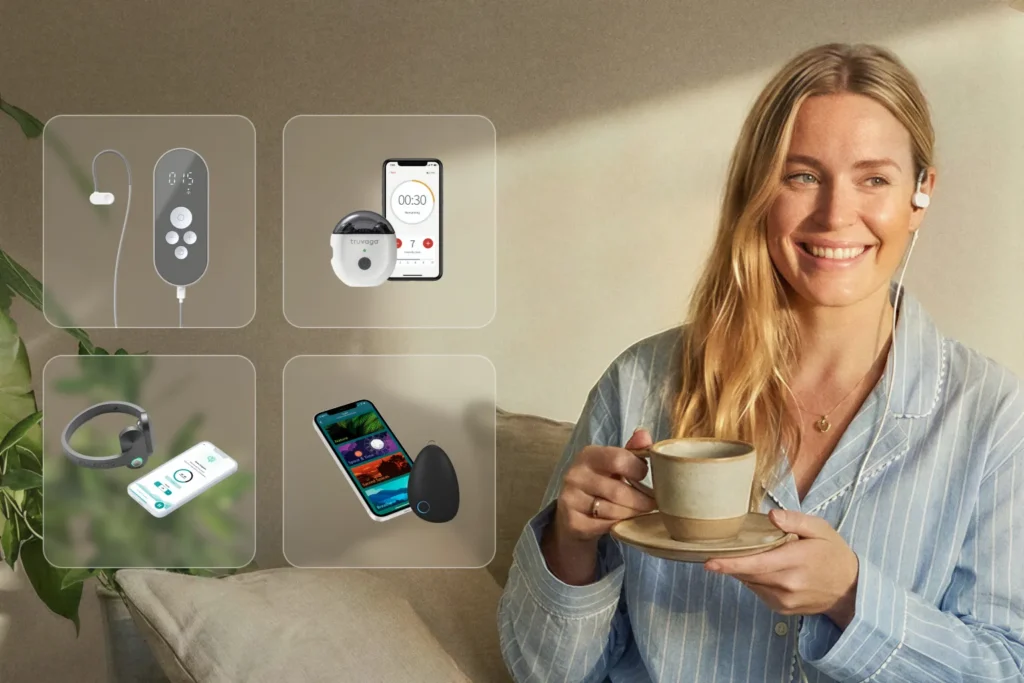
On estime que les perturbations chroniques du sommeil affectent une part importante de la population adulte, des recherches suggérant qu’environ 10 à 15 % des adultes éprouvent des difficultés persistantes à s’endormir ou à rester endormis, et jusqu’à un tiers d’entre eux signalent des troubles du sommeil réguliers.
Contrairement à une seule mauvaise nuit ou au décalage horaire occasionnel, les perturbations chroniques du sommeil peuvent impliquer plusieurs mécanismes, notamment une dérégulation circadienne, un stress psychologique, des symptômes médicaux et un dysfonctionnement du système nerveux autonome.
La science est prometteuse
Des recherches récentes en neurosciences suggèrent que le dysfonctionnement du nerf vague pourrait être un mécanisme contributif important dans un sous-ensemble d’individus souffrant de troubles du sommeil chroniques, aux côtés d’un désalignement circadien, d’un stress psychologique et de symptômes médicaux primaires.
Lorsque ce nerf parasympathique principal présente une activité réduite, le corps peut devenir moins efficace pour passer à un état de sommeil réparateur, régler le rythme cardiaque et l’excitation, et maintenir le sommeil stable et réparateur nécessaire à la récupération.
Ce guide examine la relation entre la fonction du nerf vague et les perturbations chroniques du sommeil, et évalue les principaux dispositifs de stimulation du nerf vague (SNV) qui peuvent aider à rétablir l’équilibre autonome et favoriser un sommeil plus sain.
Symptômes de perturbation chronique du sommeil
La perturbation chronique du sommeil se caractérise par une difficulté persistante à initier ou à maintenir le sommeil, malgré des opportunités adéquates et accompagnée de conséquences diurnes. Les manifestations courantes incluent :
Troubles du sommeil :
- Temps d’endormissement prolongé, souvent 30 minutes ou plus
- Un esprit rapide ou « allumé » aux aurores malgré l’épuisement physique
- Agitation physique ou tension lors de la tentative de stabilisation
- Un sentiment d’être « à la fois branché et fatigué »
- Pensées anxieuses ou appréhension associées au fait d’aller se coucher
Difficultés de maintien du sommeil :
- Se réveiller à plusieurs reprises toute la nuit
- Se réveiller aux premières heures du jour et ne pas pouvoir retourner dormir
- Un sommeil léger, fragmenté, qui semble facilement perturbé
- Réveil matinal avant l’heure prévue
- De longues périodes d’éveil avant de dériver
Conséquences diurnes et cognitives :
- Se réveiller non rafraîchi malgré des heures adéquates au lit
- Fatigue diurne persistante et manque d’énergie
- Ralentissement cognitif, mauvaise concentration et « brouillard cérébral »
- Irritabilité, humeur maussade et diminution de la tolérance au stress
- Dépendance à la caféine pour fonctionner et aux sédatifs pour dormir
Caractéristiques autonomes et physiologiques :
- Rythme cardiaque élevé au repos et la nuit
- Variabilité réduite de la fréquence cardiaque, en particulier pendant la nuit
- Se sentir inhabituellement alerte ou facilement effrayé
- Tension musculaire, mâchoire serrée ou respiration superficielle au repos
- Difficulté à se détendre même pendant les temps d’arrêt désignés
L’impact fonctionnel s’étend bien au-delà de la nuit elle-même, affectant les performances au travail, la régulation de l’humeur, les relations, la santé physique et la qualité de vie globale.
Auto-évaluation des perturbations chroniques du sommeil
Évaluez les fonctionnalités que vous rencontrez avec régularité :
S'endormir
- Il me faut régulièrement 30 minutes ou plus pour m’endormir.
- Mon esprit s’emballe, ou ne s’éteint pas, quand je m’allonge.
- Je me sens physiquement tendu ou agité en essayant de m’installer
- Je suis épuisé mais incapable de dormir
- J’ai commencé à redouter d’aller me coucher
Rester endormis
- Je me réveille une ou plusieurs fois la plupart des nuits
- Je me réveille tôt et je ne peux pas me rendormir.
- Mon sommeil est léger et facilement perturbé
- Je me réveille plus tôt que je ne le souhaite et je ne peux pas retourner dormir.
- Je passe de longues périodes d’éveil pendant la nuit
Qualité du sommeil et fonction diurne
- Je me réveille sans être reposé même après avoir passé assez d’heures au lit
- Je suis fatigué toute la journée, peu importe combien de temps j’ai dormi
- J’ai du mal avec la concentration, la mémoire ou la clarté mentale
- Je suis plus irritable ou bas que je ne le voudrais
- Je dépends de la caféine pour passer la journée.
Signes physiologiques et autonomes
- Mon rythme cardiaque au repos ou la nuit semble élevé
- Un objet portable montre que mon HRV nocturne est constamment bas
- Je me sens « en alerte » même lorsqu’il n’y a rien à aborder
- Je supporte la tension physique même quand j’essaie de me détendre
- Je trouve difficile de me détendre à la fin de la journée
Histoire et le contexte
- Mes difficultés de sommeil persistent depuis trois mois ou plus
- Les mesures standard d’hygiène du sommeil ont apporté un soulagement incomplet
- Mes difficultés s’aggravent pendant les périodes de stress
- Les médicaments pour le sommeil aident temporairement, mais le problème revient.
- L’évaluation médicale n’a pas identifié de cause claire unique
Si vous identifiez plusieurs caractéristiques dans les catégories de l’endormissement, du sommeil prolongé et des troubles physiologiques, une perturbation chronique du sommeil peut valoir la peine d’être évaluée formellement par un clinicien expérimenté en médecine du sommeil.
Chez certains individus, une tonicité vagale altérée et une excitation physiologique accrue peuvent contribuer à la difficulté, faisant des approches qui soutiennent la régulation autonome un complément potentiel sous orientation médicale.
Vous pouvez discuter de la stimulation du nerf vague avec votre professionnel de santé comme une telle approche d’appoint.
La connexion du nerf vague
Qu’est-ce que le nerf vague ?
Le nerf vague (nerf crânien X) est le nerf le plus long et le plus complexe du système nerveux autonome, prenant naissance dans la moelle allongée et se projetant à travers le cou pour innerver le cœur, les poumons et le tractus gastro-intestinal. Il intervient dans plusieurs fonctions directement liées au sommeil :
- La régulation cardiovasculaire, y compris le ralentissement de la fréquence cardiaque
- Le schéma respiratoire et l’apaisement de la respiration au repos
- Le passage du corps à des états de repos et de récupération
- La voie du réflexe inflammatoire (voie des anti-inflammatoires cholinergiques)
- Intégration des signaux d’excitation et de relaxation dans le tronc cérébral
- Modulation de l’excitation physiologique globale
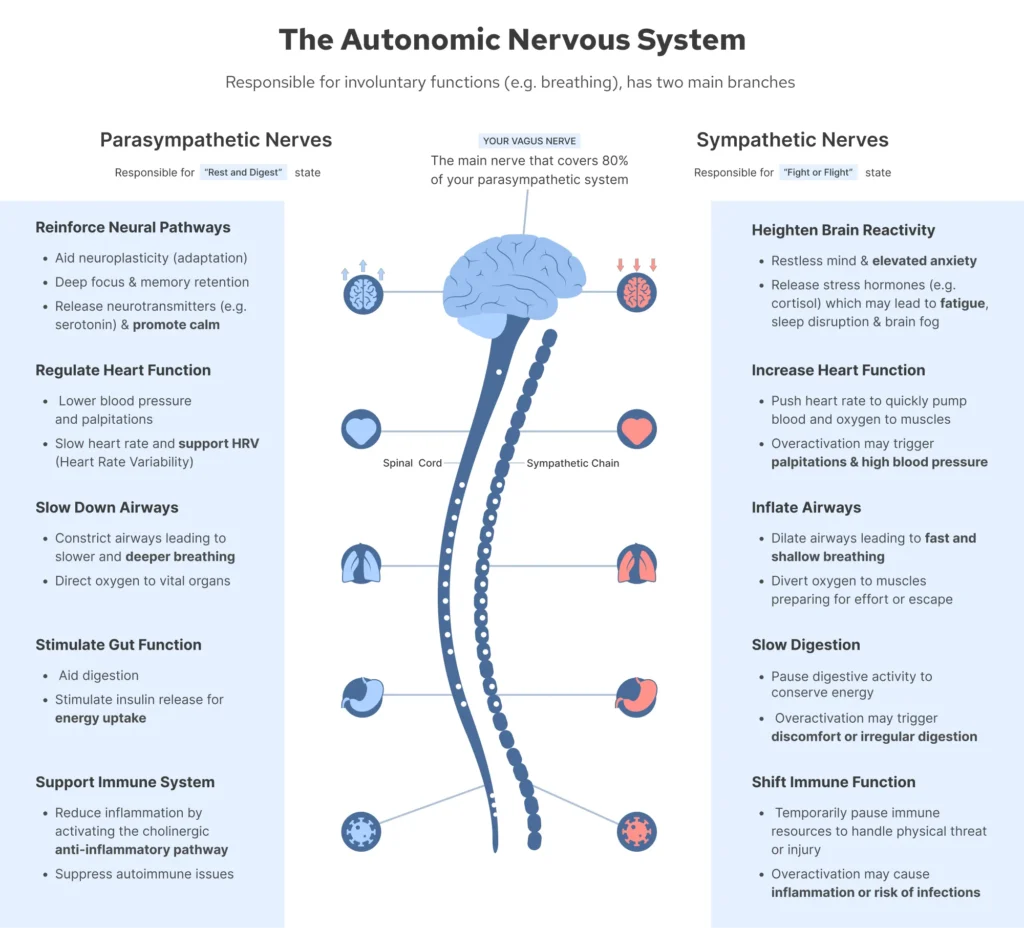
Les deux branches du système nerveux autonome
Votre système nerveux autonome fonctionne selon deux divisions complémentaires :
- Sympathique (écoulement thoracinaire) : Augmente le rythme cardiaque, élève la pression artérielle, augmente la vigilance et l’excitation et prépare le corps à une activité ou à une menace perçue. C’est le système qui devrait se calmer la nuit.
- Parasympathique (écoulement vagal) : Contrôlé principalement par le nerf vague, il abaisse la fréquence cardiaque, calme l’excitation, facilite la récupération et soutient le ralentissement physiologique qui permet au sommeil de commencer et de se poursuivre.
Un sommeil sain nécessite que le côté parasympathique prenne le relais du côté sympathique à l’approche de la nuit.
Cependant, un stress prolongé, une maladie ou une tension chronique peuvent altérer le tonus vagal, laissant le système sympathique en charge alors qu’il devrait devenir moins actif.
Comment le dysfonctionnement du nerf vague contribue à la perturbation chronique du sommeil
Lorsque le nerf vague présente une activité réduite (tonus vagal faible) :
- Difficulté à passer dans un état de repos : Le sommeil dépend d’un passage de l’état d’alerte sympathique à l’état parasympathique reposant. Avec un tonus vagal faible, cette passation est incomplète et le corps reste dans un état d’alerte de bas niveau à l’heure du coucher. C’est ce que l’esprit de course et le sentiment « câblé mais fatigué » reflètent souvent.
- Hyperexcitation physiologique : Sleep research increasingly frames persistent sleep problems as a disorder of hyperarousal, in which both the mind and body remain over-activated around the clock. Reduced vagal tone may contribute to elevated physiological arousal in some individuals.
- Réduction de la variabilité du rythme cardiaque (HRV) : HRV est largement utilisé comme un marqueur non invasif de la fonction du système nerveux autonome et de l’activité vagale. Les personnes souffrant de troubles du sommeil chroniques présentent fréquemment une VFC réduite, en particulier pendant la nuit, ce qui suggère que le système de récupération n’est pas pleinement activé pendant le sommeil.
- Activité sympathique nocturne élevée : La prédominance sympathique soutenue maintient le rythme cardiaque et l’excitation élevés tout au long de la nuit, prolongeant l’endormissement, augmentant les réveils et réduisant le temps passé dans un sommeil profond et réparateur.
- Dysrégulation inflammatoire : Le nerf vague régule la voie anti-inflammatoire cholinergique. Une activité vagale réduite a été associée à une signalisation inflammatoire accrue dans certaines études, laquelle a elle-même été associée à un sommeil perturbé et non réparateur, créant un cycle d’auto-renforcement.
Il est important de noter que la perturbation chronique du sommeil est un symptôme hétérogène plutôt qu’une entité pathologique unique.
La dysfonction du nerf vague ne rend pas compte de tous les cas.
Certaines personnes sont principalement motivées par des facteurs circadiens, d’autres par des causes psychologiques ou environnementales et beaucoup par des mécanismes qui se chevauchent.
L’atteinte vagale semble la plus pertinente chez les individus présentant une faible variabilité de la fréquence cardiaque, une excitation physiologique élevée ou un début de stress post-viral ou élevé.
Preuve scientifique
Des recherches publiées ont identifié des associations entre les fonctions autonomes et le sommeil :
- The hyperarousal model: La recherche en médecine du sommeil a établi que les problèmes de sommeil persistants sont associés à une excitation physiologique et cognitive élevée, y compris une activité sympathique accrue et une capacité réduite à réguler négativement la réponse au stress la nuit.
- VFC et qualité du sommeil : Plusieurs études rapportent qu’une variabilité réduite de la fréquence cardiaque, un marqueur validé du tonus vagal, est associée à une qualité de sommeil moins bonne, à un temps d’endormissement plus long et à un sommeil plus fragmenté, tandis qu’un tonus vagal plus élevé est associé à un sommeil plus consolidé et réparateur.
- Effets de la stimulation transcutanée du nerf vague : Une recherche contrôlée démontre que la stimulation transcutanée du nerf auriculaire peut augmenter les mesures de l’activité vagale en quelques minutes d’une séance et déplacer l’équilibre autonome vers la prédominance parasympathique, l’état physiologique dont dépend le sommeil.
- Un mécanisme proposé : Le soutien de la fonction du nerf vague par une stimulation ciblée peut cibler l’un des facteurs contribuant aux troubles du sommeil chez certaines personnes souffrant de troubles chroniques du sommeil, à savoir l’incapacité du système nerveux à retrouver son état de récupération la nuit, plutôt que de simplement sédater le cerveau.
Les appareils VNS comme solution : comment ils fonctionnent
Comment les VNS non invasifs ont changé l’accès
Jusqu’à récemment, la stimulation du nerf vague nécessitait des procédures chirurgicales invasives, l’implantation d’électrodes directement sur le nerf par des opérations qui comportaient un risque chirurgical, un temps de récupération et une mise en place permanente du dispositif.
Cette thérapie SNV confinée concerne principalement les symptômes sévères, résistants à la thérapie où les bénéfices justifiaient une intervention chirurgicale.
Les dispositifs non invasifs ont élargi l’accès à cette approche.
La stimulation transcutanée moderne du nerf vague vise à stimuler les voies vagales de manière non invasive à travers la peau, favorisant ainsi la restauration d’un tonus approprié, mais de manière totalement non invasive à travers la peau : pas de chirurgie, pas d’implantation et pas de période de récupération.
Ces dispositifs fonctionnent grâce à des électrodes positionnées avec précision à deux emplacements accessibles :
- Auriculaire (oreille) : Ciblant la branche auriculaire du nerf vague au niveau du tragus et du cymba conchae, le seul endroit où un nerf crânien atteint la surface du corps.
- Cervicalement (cou) : Ciblant la branche cervicale du nerf vague, où elle s’étend superficiellement sous la peau près de l’artère carotide.
Cela représente un changement fondamental : la stimulation qui était autrefois confinée aux salles d’opération est maintenant disponible pour une utilisation quotidienne à domicile, avec des paramètres basés sur des recherches publiées et sans risque chirurgical.
Mécanisme d'action
Lorsque des impulsions électriques calibrées avec précision atteignent le nerf vague, elles déclenchent plusieurs réponses physiologiques pertinentes pour le sommeil :
- Modulation des neurotransmetteurs : La stimulation déclenche la libération d’acétylcholine au niveau des terminaisons parasympathiques, contrecarrant directement la prédominance sympathique et favorisant un état physiologique plus calme.
- Activation du noyau du tronc cérébral : Les signaux vagaux afférents se projettent vers le noyau du tractus solitaire, qui intègre des informations autonomes et influence les centres du tronc cérébral impliqués dans la régulation de l’excitation et du sommeil.
- Rééquilibrage autonome : Une stimulation constante soutient un passage de la dominance sympathique à la restauration parasympathique, améliorant la variabilité du rythme cardiaque et réduisant l’excitation nocturne.
- Adaptation potentielle à long terme : L’utilisation prolongée peut aider à abaisser le point de consigne d’excitation élevé qui caractérise la perturbation chronique du sommeil, plutôt que de ne produire qu’un effet à une seule séance.
- Régulation inflammatoire : La stimulation vagale soutient la voie anti-inflammatoire cholinergique, aidant à réduire l’inflammation de bas grade associée au sommeil non réparateur.
Paramètres scientifiques
Les protocoles couramment utilisés dans les études scientifiques utilisent souvent :
- Durée de la session : 30 à 60 minutes par jour, souvent en soirée, permettant des effets prolongés.
- Difficulté : Individualisé au seuil sensoriel, perceptible mais confortable.
- Cohérence, Application quotidienne pendant un minimum de 8 à 12 semaines, car les changements neuroplastiques nécessitent une utilisation prolongée.
Calendrier prévu
Les effets semblent se développer progressivement avec une utilisation régulière plutôt qu’avec une sédation immédiate :
- Semaine 1-2 : Une relaxation accrue pendant les séances, une réduction modeste du temps nécessaire pour s’endormir et un possible soulagement des réveils nocturnes.
- Semaine 3-4 : Un sommeil plus consolidé, moins de réveils nocturnes, une amélioration du repos matinal et un rythme cardiaque nocturne plus stable.
- Mois 2-3 : Amélioration soutenue de la continuité et de la qualité du sommeil, améliorations mesurables de la VFC et réduction du recours aux aides au sommeil.
- Mois 3+ : Équilibre autonome restauré, amélioration durable du sommeil, et améliorations de l’énergie diurne, de l’humeur et de la concentration.
Considérations de sécurité
La SNV transcutanée est généralement bien tolérée dans les milieux de recherche.
Les réponses transitoires potentielles peuvent inclure :
- Léger picotement au niveau du site de stimulation
- Tension musculaire temporaire dans la région du cou (dispositifs cervicaux)
- Brief lightheadedness, which typically resolves with protocol adjustment
Limitations importantes : Ne convient pas aux personnes ayant un stimulateur cardiaque, des événements cardiaques aigus récents, une grossesse ou des antécédents de vagotomie.
La consultation d’un professionnel de santé est essentielle avant d’initier tout protocole SNV.
Top 4 des dispositifs VNS pour les perturbations chroniques du sommeil
#1: Nurosym
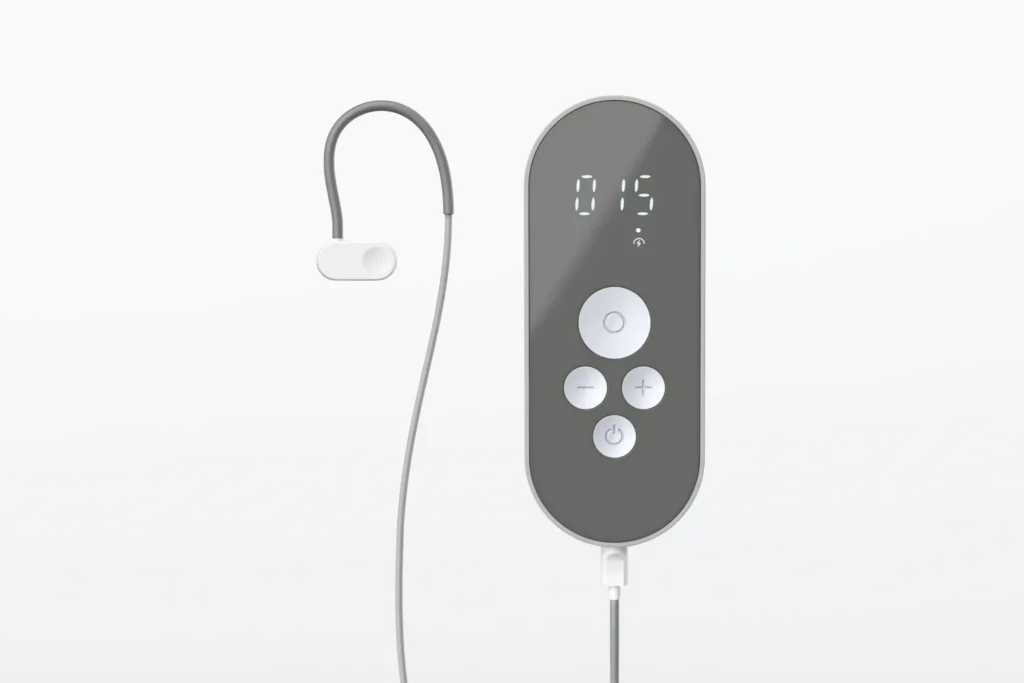
Prix : 700 EUR. Varie selon la région (subvention à la recherche disponible)
Encastré: Auriculaire (porté à l’oreille)
Technique : AVNTTM par Parasym
Pourquoi #1 :
- Le plus largement validé : Soutenu par plus de 60 études scientifiques complétées provenant d’institutions de recherche de premier plan dans le monde entier.
- Effet démontré sur la fonction autonome : La recherche documente une amélioration de 61 % du tonus vagal (mesures HRV) et une réduction significative de la suractivation sympathique, l’état physiologique le plus pertinent pour l’apparition et la continuité du sommeil.
- Certification indépendante : Appareil portable marqué CE répondant à des normes de sécurité et de performance rigoureuses, vérifié par un tiers.
- Adoption de la recherche : Utilisé par plus de 1000 professionnels de santé et chercheurs, avec plus de 5 000 000 sessions utilisateurs et plus de 100 études scientifiques en cours
- Paramètres fondés sur des preuves : Les protocoles de stimulation sont issus d’une recherche rigoureuse plutôt que de suppositions propriétaires.
- Soutien complet : Période d’évaluation de 30 jours, ressources d’orientation et soutien technique réactif.
Optimal pour: Les personnes dont la perturbation du sommeil est due à une hyperstimulation autonome ou à un faible taux de HRV, celles ayant un début post-viral ou à fort stress et celles qui privilégient les données probantes par rapport aux allégations marketing.
#2 : Truvega Plus
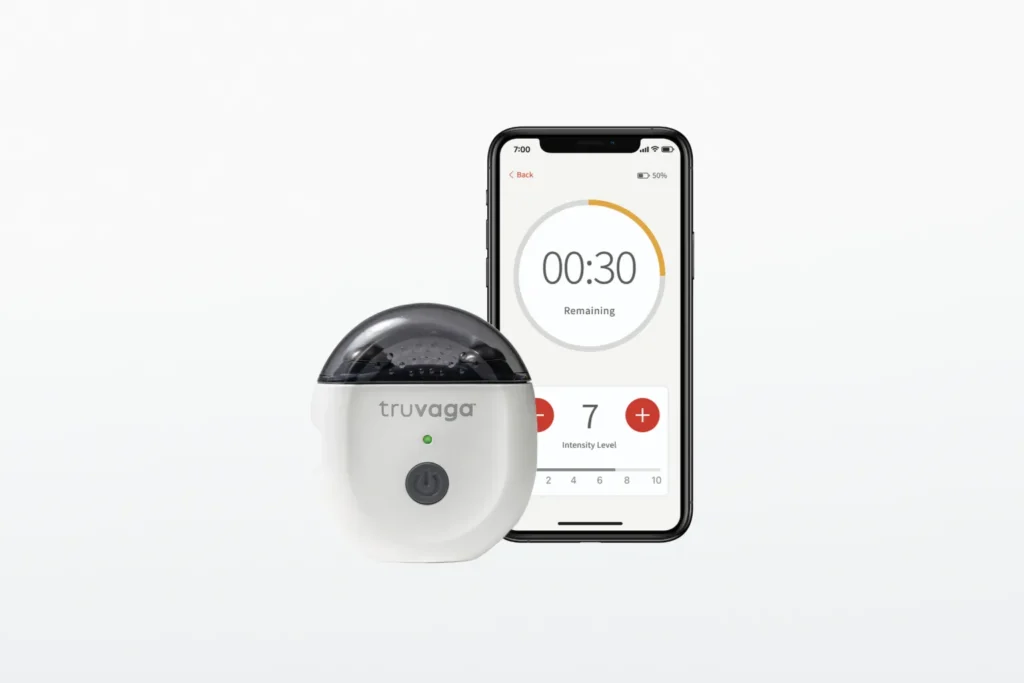
Tarif : $544+ (appareil plus spray conducteur et abonnement potentiel).
Encastré: Cervical (cou tenu à la main).
Partage la technologie de base avec gammaCore, un appareil homologué par la FDA pour les céphalées en grappe, pas pour le sommeil. Produit des effets parasympathiques rapides avec un protocole simple.
Considérations Les coûts actuels pour le spray conducteur et un abonnement potentiel à l’application, vérifiez donc la tarification avant l’achat.
Les effets indésirables rapportés incluent des spasmes musculaires, des contractions des muscles faciaux et des maux de tête. Ne convient pas aux utilisateurs présentant des symptômes cardiaques, des stimulateurs cardiaques ou des problèmes cardiaques récents. Certains problèmes de connectivité de l’application ont été signalés.
Optimal pour: Ceux qui préfèrent la stimulation cervicale avec une lignée technologique approuvée par la FDA (pour les maux de tête, pas le sommeil) et qui peuvent tolérer d’éventuels effets sur les muscles faciaux.
#3 : Pulsetto
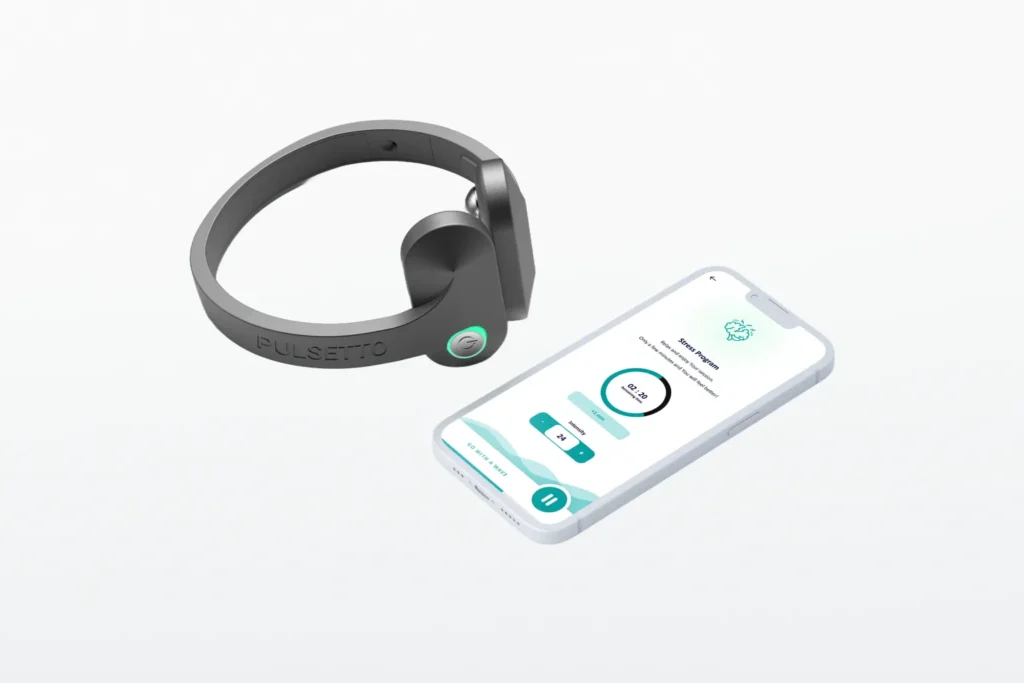
Tarif : 350-371 $ (appareil plus gel annuel).
Encastré: Cervical (collier mains libres).
Les avantages incluent une conception portable mains libres, l’éligibilité HSA/FSA et une garantie de 2 ans.
Limitations critiques : Aucune étude significative ne démontre l’efficacité spécifiquement pour les troubles du sommeil, et les preuves évaluées par des pairs indépendants restent limitées.
Les problèmes d’ajustement peuvent créer un contact nerveux inadéquat, en particulier avec des cous plus petits. Le prix inférieur peut être attrayant, mais l’absence de validation indépendante signifie que son efficacité pour traiter la dérégulation autonome liée au sommeil reste incertaine.
#4 : Sensible
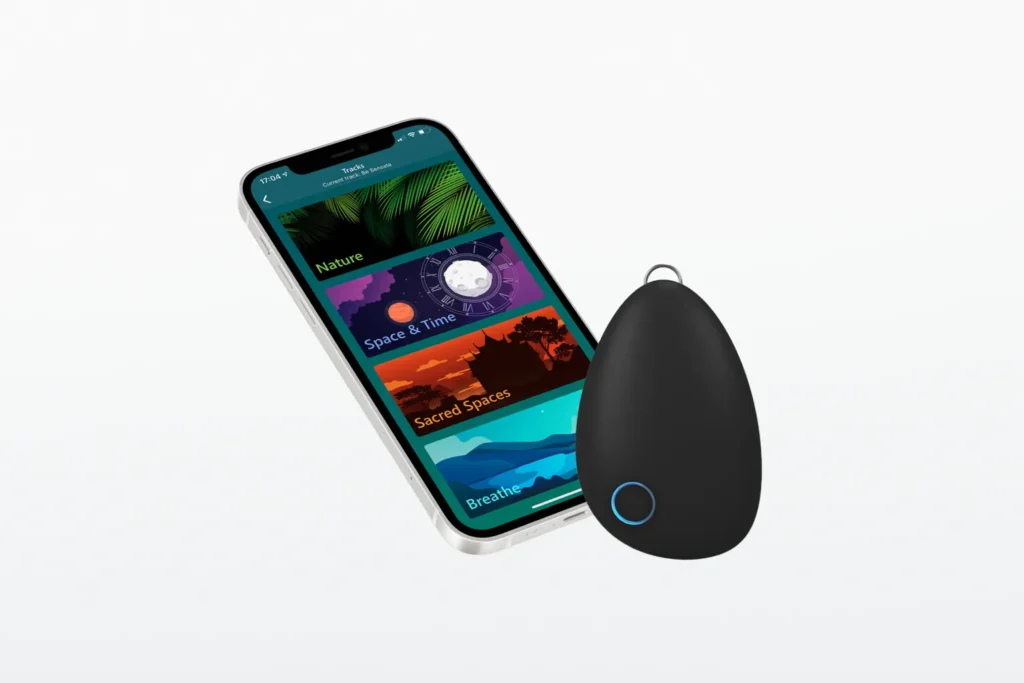
Tarif : $299-$349.
Encastré: Dispositif vibrotactile porté sur la poitrine (pas vrai SNV).
Les avantages incluent un design confortable, une application simple avec des paysages sonores, un prix plus bas et un marketing intensif vers la relaxation et le sommeil.
Distinction critique : Le sensoriel ne stimule pas directement le nerf vague avec des impulsions électriques. Il utilise la vibration infrasonique et la conduction osseuse placées sur la poitrine, une approche indirecte visant à la relaxation générale plutôt qu’à l’activation vagale spécifique.
Pour les perturbations du sommeil causées par l’hyperexcitation autonome, cela est important car les outils de relaxation générale peuvent aider à réduire la fatigue mais ne ciblent pas la dysfonction vagale sous-jacente de manière mesurable.
Les preuves disponibles reflètent une réduction générale du stress plutôt que des effets validés sur l’architecture du sommeil ou les marqueurs autonomes.
Optimal pour: Ceux qui recherchent une aide générale à la relaxation plutôt qu’une stimulation ciblée du nerf vague pour une dérégulation autonome.
Résultat :
Nurosym offre la validation de recherche la plus complète, un effet démontré sur les marqueurs autonomes les plus pertinents pour le sommeil, une certification indépendante et le meilleur équilibre entre la base de recherche et l’utilisation quotidienne pratique pour ceux qui privilégient des résultats fondés sur des preuves.
Prendre des mesures
Les perturbations chroniques du sommeil peuvent être difficiles à gérer, et les chercheurs explorent de plus en plus des approches adjuvantes qui soutiennent la régulation autonome.
Le système nerveux reste capable de changer tout au long de la vie et de soutenir les symptômes physiologiques qui favorisent un sommeil sain.
Cet article de blog vise à être informatif et ne doit pas remplacer les conseils de santé professionnels. Toujours consulter un professionnel de santé pour des conseils personnalisés.
Sources
- Borges, U., Laborde, S., & Raab, M. (2019). Influence of transcutaneous vagus nerve stimulation on cardiac vagal activity: Not different from sham stimulation and no effect of stimulation intensity. Plosone, 14(10), e0223848.
- Redgrave, J., et al. (2018). Safety and tolerability of transcutaneous vagus nerve stimulation in humans: A systematic review. stimulation cérébrale, 11(6), 1225-1238.
- Yap, J. Y. Y., et al. (2020). Critical review of transcutaneous vagus nerve stimulation: Challenges for Translation to Clinical Practice. Frontiers in Neuroscience, 14, 284.
- Task Force of the European Society of Cardiology. (1996). Heart rate variability: standards of measurement, physiological interpretation and clinical use. Task Force of the European Society of Cardiology and the North American Society of Pacing and Electrophysiology. Circulation, 93(5), 1043-1065.
Partager cet article :


 French
  English
  German
  Spanish
  Swedish