
The surprising gut–brain connection that changed the way I approach both digestive symptoms and anxious thoughts – and the 15-minute method I now recommend in some cases.

For years, I kept seeing the same pattern.
Someone would come to me because of bloating. Someone else because of anxious thoughts. Another reason was that both were convinced they were dealing with two completely unrelated problems.
At first, they looked that way to me too.
The more sufferers I worked with, the less convinced I became that they actually were.
After 15 years in functional medicine – and my own experience with chronic gut problems I couldn’t explain – I started noticing something that neither the GI specialists nor the therapists seemed to be addressing.
Both sets of symptoms often seemed linked to the shared underlying processes.
For years, I couldn’t fully explain why. Eventually, I found a framework that explained much of what I was seeing. And it changed the way I approach both.
I’ll show you exactly what I mean.
What I Kept Seeing – And Couldn’t Explain

I came to functional medicine after watching many clients continue to struggle despite conventional medicine.
I trained as a nurse. I worked in hospitals for years. Every day, I watched the overlapping pattern: a client with persistent bloating and cramping was sent home with an antispasmodic and a leaflet about fibre. The same client, a year later, is now also on an SSRI for anxious thoughts. Two health professionals. Two diagnoses. These issues were often managed separately rather than together.
I realised this wasn’t happening because those health professionals weren’t good at their jobs.
It was happening because our healthcare system divides the body into separate specialities. The gut belongs to one clinic. Anxious thoughts belong to another. But your nervous system doesn’t recognise those boundaries.
In fifteen years of practice, I have worked with thousands of sufferers – many arriving with a folder full of test results, a list of supplements already tried, and a similar quiet frustration: nothing is working, and nobody can tell me why.
I developed my own chronic gut problems too – bloating, SIBO, food intolerances that made every meal feel like a gamble. Conventional medicine offered me much the same as it offered my clients: manage the symptoms, adjust the diet, and try this supplement.
What I wanted to know was why. That question changed everything.
I see a similar pattern constantly.
The woman who has spent three years on elimination diets and still cannot eat a normal meal without bloating, while also taking antidepressants for anxious thoughts that nobody has connected to her gut. The man who does breathwork every morning for his racing thoughts and takes antispasmodics every evening for his cramps – two separate routines, one underlying cause nobody has named. The person whose tests show nothing, whose gut “looks fine” on paper, whose anxious thoughts are “manageable” – and who knows, quietly, that none of that is true.
One client described it in a way I haven’t forgotten:
“I feel like I have two broken things that nobody can explain. My stomach is always upset. My brain is always worried. The GI health professional says it’s probably stress. The therapist says it’s probably my digestion. So I’m just going in circles.”
She was right because nobody had shown her the system connecting both.
The Fact That Changed the Way I Look at Both
Here is something most health professionals – even functional medicine practitioners – rarely explain clearly.
And when I first encountered it, it reframed everything I thought I understood about the relationship between digestion and emotional health.
Around 90% of your body’s serotonin is produced in the gut rather than the brain. However, this gut-produced serotonin mainly regulates digestion and does not cross the blood-brain barrier. Instead, the gut influences brain function through multiple communication pathways, including the vagus nerve, immune signalling, hormones, and the gut microbiome.
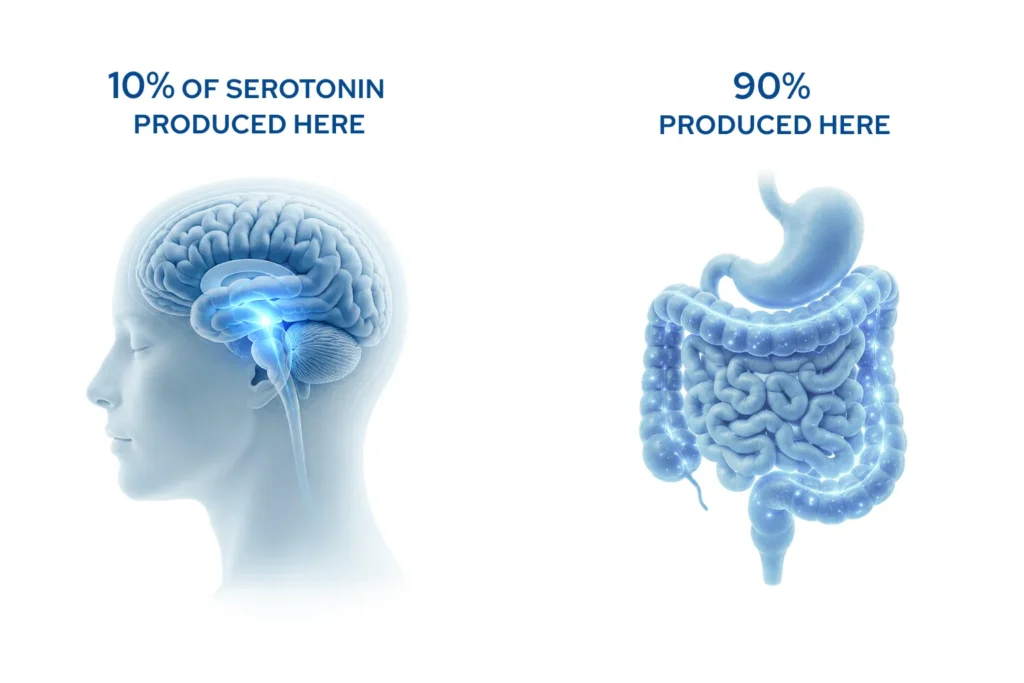
Most people have heard serotonin described as the “happy chemical.”
This doesn’t mean gut serotonin directly controls mood, but it highlights how neurologically active the digestive system is.
That’s the question worth considering for a moment.
Why This Fact Is Often Misunderstood
One important clarification before going further – because this is where a lot of wellness content gets it wrong.
This doesn’t mean serotonin simply travels from your gut into your brain. It doesn’t.
In fact, gut-produced serotonin mainly regulates digestion itself – gut motility, secretion, and sensory signalling within the intestinal wall. It cannot cross the blood-brain barrier.
So why does this statistic matter?
Because it tells us something important about how central the gut is to the body’s overall communication system.
The digestive system is one of the body’s largest neurochemical and signalling hubs. It is constantly exchanging information with the brain through immune pathways, hormonal signals, the microbiome, including the vagus nerve, one of the major communication pathways.
In other words, the statistic isn’t important because serotonin travels to the brain. It’s important because it reminds us how neurologically active the gut really is.
That nerve – the one carrying all of this gut-brain communication – turns out to be an important part of understanding why bloating and anxious thoughts so often travel together. And why addressing it may be the thing most therapies have been missing.
This is why researchers increasingly describe the gut and brain as part of an interconnected system.
And this is why, when that neural pathway breaks down, what shows up in the gut and in the mind are often reflections of the interconnected underlying disruption.
A large-scale genetic study from Cambridge and Oxford – analysing more than 50,000 people – found that irritable gut and anxious thought disorders share several biological pathways, including altered gut-brain communication, nervous system regulation, and immune signalling. Rather than one directly causing the other, the two often coexist because they influence each other.
Which means every person treating bloating and anxious thoughts as two separate problems may be overlooking shared mechanisms contributing to both symptoms, while missing the actual cause entirely.
And here is what makes this even harder to recognise.
When this gut-brain neural pathway breaks down, the mental symptoms are rarely just “feeling a bit anxious.” They tend to be specific. Persistent. And rarely connected to the gut by the person experiencing them:
- Racing thoughts that arrive at night, just as the body is trying to rest
- Panic that surfaces without cause - in a meeting, on a quiet morning, without warning
- A low hum of worry that never fully switches off, even on good days
- Low self-worth and self-doubt with no rational explanation
- Waking up already anxious before the day has even started
These are not character traits. They are not weaknesses. These symptoms may reflect overlapping nervous system processes.
“I’ve Tried Everything.” You Probably Have. Here’s What’s Missing.

The sufferers who come to me have almost always already done the following:
- Low-FODMAP diet - genuinely helps many people, but extremely difficult to sustain, and doesn't explain why the gut became reactive in the first place
- Elimination diets (gluten-free, dairy-free) - partial relief for some, but the exact foods cause problems again once reintroduced because nothing underlying has changed
- Probiotika - support microbiome diversity, but deliver inconsistent results when the gut-brain environment isn't regulated
- Digestive enzymes - reduce symptoms acutely, but don't restore the network between the gut and the brain
- Peppermint oil/antispasmodics - manage cramping in the short term, no lasting change
- Breathing exercises/meditation - genuinely valuable, but require quiet time and a baseline calm that most people with gut-brain dysregulation simply don't have
These aren’t bad suggestions. Many of them are good suggestions.
The problem is they all do the common thing: they target where the symptoms appear, not the system generating them.
The low-FODMAP diet works on the food. Probiotics work on the bacteria. Meditation works on the conscious mind.
None of them primarily targets the network channel between the gut and the brain.
And here is the quieter problem – the one I rarely see discussed:
People treat their bloating and anxious thoughts with completely different approaches, from different practitioners, and never suspect that they share common mechanisms.
One person I treated had been doing this for four years. An elimination protocol for the gut. CBT and supplements for anxious thoughts. Two practitioners. No one had ever connected the two.
Both approaches gave partial relief. Neither lasted. Because she was treating branches – not the shared pathway.
The Question That Led Me to the Answer
By this point in my practice, I had stopped asking: “Which food is causing this?”
Instead, I had started asking: “What system could influence both digestion and anxious thoughts at the exact time?”
That question kept bringing me back to the same place.
Den vagusnerv.
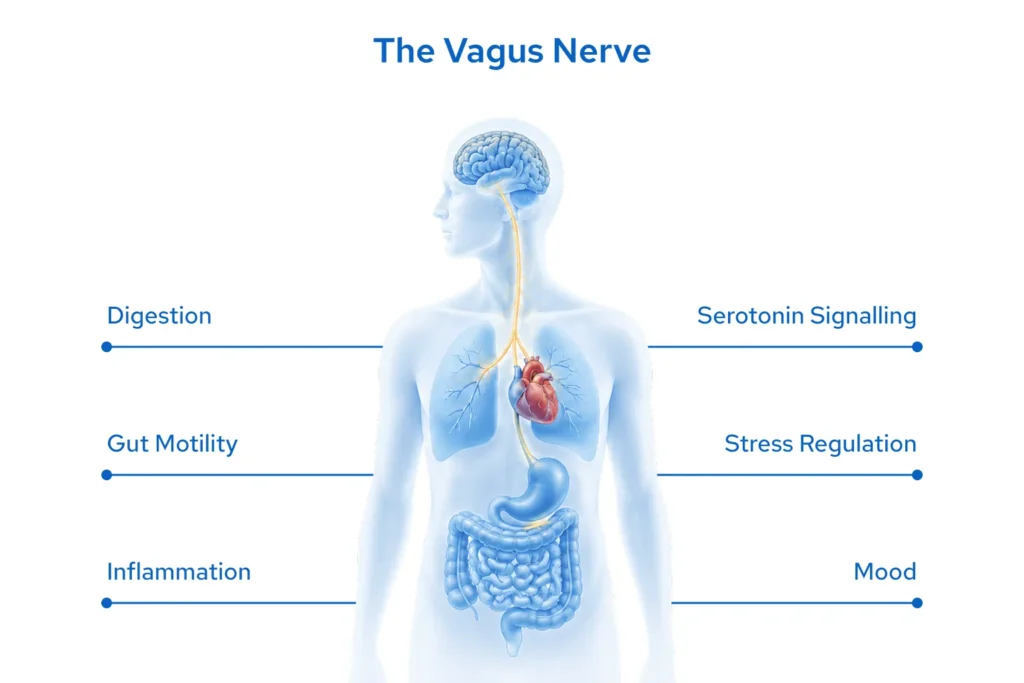
It is the longest nerve in the body. The vagus nerve is one of the primary communication pathways linking the gut and the brain, alongside hormonal, immune, and microbial signalling.
Think of it as the body’s own regulator – the system that helps coordinate communication between the gut and brain.
Your nervous system operates in two modes. The first is sympatisk – fight-or-flight. Heart rate up. Digestion slows. Stress hormones circulating. The second is parasympatisk – rest and digest. Gut active. Regulated. Recovering.
In chronic gut-brain dysregulation, the system gets stuck. The gut stops digesting properly. Communication between the gut and brain is altered. And the anxious thoughts, the racing mind, the low mood – they keep running because the system designed to quieten them isn’t functioning.
Reduced vagal activity has been associated with digestive symptoms, altered stress responses, and sleep disturbances in some people, although these symptoms can also have many other contributing causes.
Different symptoms may share overlapping physiological mechanisms.
Which brought me to the only question that remained: Is there a direct way to reach it?
What I Found – And Why I Was Sceptical
I came across research on vagus nerve stimulation several years into my practice. My immediate reaction was scepticism.
The only established method at the time was surgical – a device implanted in the chest, wired to the vagus nerve in the neck and used for therapy-resistant depression. Completely impractical for a person dealing with an irritable gut and persistent worry.
Then I found something I hadn’t expected.
Researchers had identified a branch of the vagus nerve that runs just beneath the skin – on the outer ear, at a small piece of cartilage called the tragus, at the entrance to the ear canal.
This is the best-established non-invasive access point for reaching the vagus nerve without surgery.
Scientists developed a technique to gently stimulate it with low-level electrical signals: transcutaneous auricular vagus nerve stimulation (taVNS).
I went through the research carefully. Peer-reviewed publications. Placebo-controlled researches. Studies from Harvard, UCL, and King’s College London.
A 2024 systematic review in the journal PAIN confirmed measurable reductions in gut symptoms across multiple health problems. Several studies on gut issues reported improvements in gut motility, microbiome composition, anxious thoughts scores, and sleep quality with a single intervention targeting the vagus nerve.
Rather than targeting individual symptoms, this approach aims to influence autonomic regulation.
I went from sceptical to genuinely convinced. The mechanism offered a possible explanation for many of the patterns I had been observing in practice, although gut-brain disorders remain complex and involve multiple biological systems.
But there was still one problem.
The research was solid. The proposed mechanism was biologically plausible. What I needed was a device that could bring this into a sufferer’s actual daily life – without a therapeutic visit, a prescription, or the kind of perfect state that people with dysregulated nervous systems rarely have.
I wasn’t looking for another supplement.
I wasn’t looking for another breathing app.
I wasn’t looking for another wellness trend.
I was looking for something that actually matched the biology I’d been reading about for years.
Vad forskningen visar
+80% | GI symptom improvement (10-day scientific study) |
−78% | Inflammatory markers IL-6 (3-month study) |
+61% | Vagus nerve activity (within 5 minutes) |
−35% | Ångestliga tankar (10-day study, sustained one month post-therapy) |
−45% | Depressive states / low mood (10-day study) |
−48% | Trötthet |
+30% | Sleep quality |
60+ completed scientific studies. Zero serious adverse events reported.
What struck me wasn’t any single number. It was the pattern.
Some studies have reported improvements across gut symptoms, inflammation markers, mood, anxious thoughts, tiredness, and sleep. While these systems are interconnected through the gut-brain axis, current evidence does not show that they all arise from a single underlying cause.
The 15-Minute Method I Now Recommend

That’s when I found Nurosym.
The research behind it
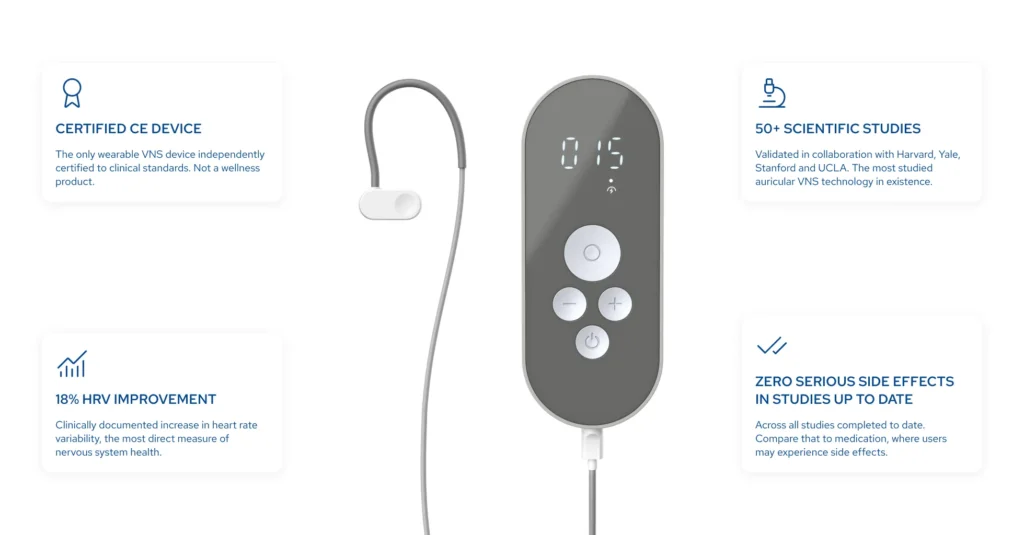
Developed by Parasym – a UK-based company with 10+ years of R&D and 10M+ invested in scientific studies – Nurosym is a CE-marked taVNS device and the most scientifically studied wearable vagal stimulation system in the world. Developed in collaboration with 150+ internationally recognised institutions, including Harvard, UCL, King’s College London, UCLA, and Mayo Clinic. Recommended by 1,000+ healthcare professionals. Over 5 million sessions completed.
Hur det fungerar
It uses proprietary AVNT™ technology – Auricular Vagal Neuromodulation Therapy – delivering a precisely calibrated electrical signal through the tragus of the left ear, directly stimulating the auricular branch of the vagus nerve.
In practical terms, it clips gently onto your ear, the way you’d put on a wireless earbud.
Unlike dietary approaches, it isn’t trying to change the food. Unlike digestive supplements, it isn’t trying to change the contents of the gut. Unlike mindfulness exercises, it isn’t asking you to consciously slow your mind.
Instead, it aims to support the autonomic signalling linking the gut and the brain through the nerve that connects them.
How you use it
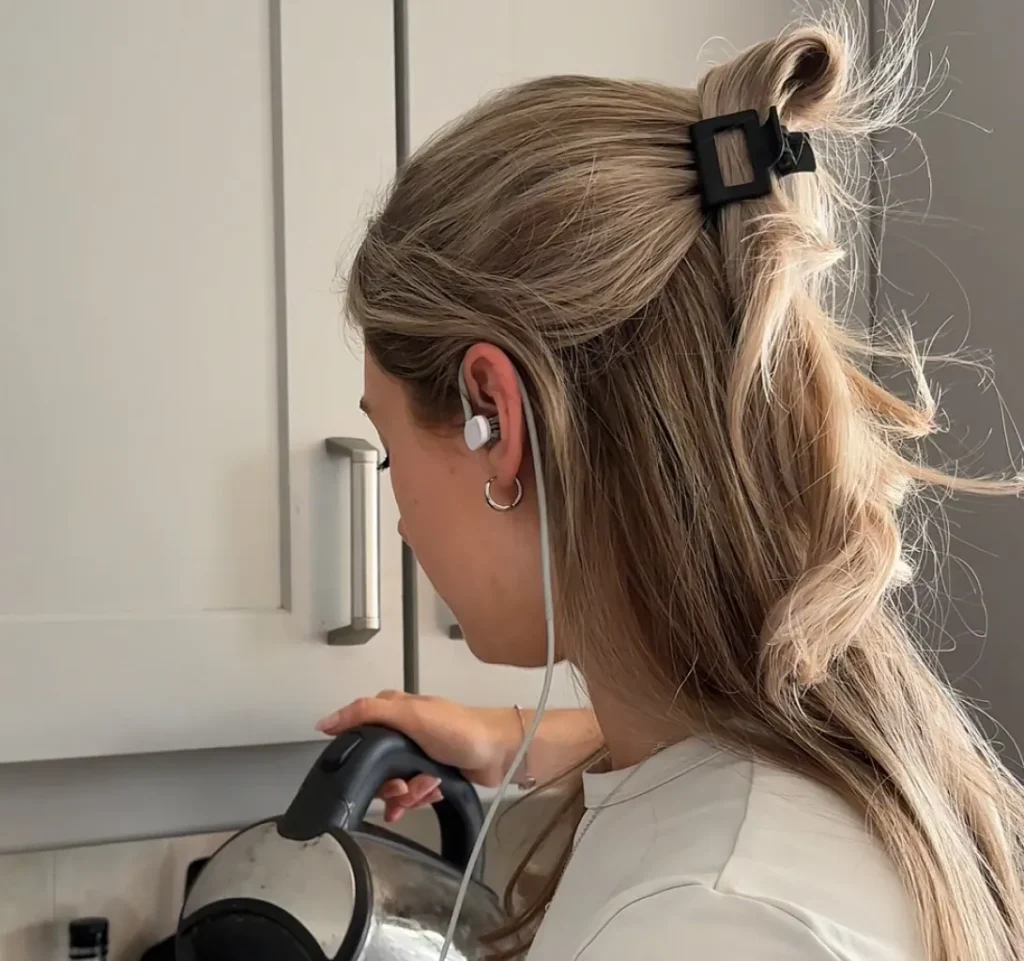
You use it for 15 minutes. While eating breakfast. At your desk. In the evening. Before sleep.
No appointment. No quiet room. No elimination protocol to follow first.
- For the person who eats carefully and still bloats after every meal
- For the person whose panic arrives without a reason, they can name
- For the person treating their gut and their anxious thoughts separately - and getting only partial results from both
- For the person whose tests show nothing, but whose body clearly knows something is wrong
The environment it requires is the environment that an ordinary day already provides.
What People Actually Notice
The changes tend to arrive quietly, almost without announcement.
“The bloating after meals – it’s just gone. One week it was there, and then it wasn’t.”
“I’ve been tested for all sorts of things – elimination diets, colonic irrigation, hydrotherapy. Finally saw a specialist who linked it to the vagus nerve. I no longer feel the bloating, the gas, or the nausea I used to have.”
“I noticed my stomach was calmer. Then I noticed I was calmer.”
“The racing thoughts at night just stopped. I hadn’t realised how constant they were until they weren’t there anymore.”
These experiences are consistent with improvements some users report, although individual responses vary. Small. Incremental. Real.
Why the Gut Is Rarely the Only Thing That Changes
One more thing worth understanding – because I see it consistently, and the science supports it.
The same nerve suppression that disrupts gut function also disrupts sleep, drives tiredness, and keeps anxious thoughts running in the background.
These are not separate problems that happen to coexist. They are one dysregulated system, expressing itself in multiple directions at once.
People who come to me for persistent bloating start mentioning – almost as an afterthought – that they’re sleeping better. That the background worry has dropped. That their energy is more consistent. Those meals feel like meals again, rather than something to be managed and feared.
Not because any device treats all of these things separately.
Because they may share common underlying mechanisms when that root begins to regulate, multiple symptoms may improve.
Is This the Right Next Step for You?
If this pattern is familiar – bloating that keeps returning, anxious thoughts that won’t fully quiet, approaches that help partially but never completely – this is worth exploring.
Nurosym works alongside everything else you’re already doing, not instead of it. In my practice, I consider vagus nerve support to be one component of a broader management approach that may also include dietary strategies, sleep optimisation, stress management, exercise, and microbiome-directed therapies. It is intended to complement, not replace, these established approaches.
A 30-day money-back guarantee means no financial risk. Either it makes a meaningful difference – or you return it.
Nurosym may be worth discussing with your healthcare professional if:
- Bloating or digestive discomfort persists despite dietary changes and probiotics
- Anxious thoughts, a racing mind, panic, or a low mood run alongside gut symptoms
- Sleep is shallow, restless, or leaves you waking already tense
- Symptoms consistently worsen during stressful or demanding periods
- You've had partial relief from gut and anxious thoughts approaches - but neither has lasted
- You've always sensed the two were connected, but nobody has confirmed it
Do not use Nurosym if you have an implanted cardiac device such as a pacemaker, if you are pregnant, if you have had a serious cardiac event in the last five years, or if you are under 18. Always consult your healthcare professional if you have an existing health problem.
If there’s one thing I hope you take away from this article, it’s this:
Your gut and your anxious thoughts may not be asking for two different therapies.
They may simply be reflecting the similar conversation happening inside your nervous system.
Once I started looking at my cases that way, many things that previously seemed unrelated began to make a great deal more sense.
Detta blogginlägg syftar till att vara informativt och bör inte ersätta professionell hälsorådgivning. Rådgör alltid med en vårdpersonal för personlig rådgivning.
Referenser
- Yano JM, et al. Indigenous bacteria from the gut microbiota regulate host serotonin biosynthesis. Cell. 2015;161(2):264–276. https://doi.org/10.1016/j.cell.2015.02.047
- Gershon MD, Tack J. The serotonin signaling system: from basic understanding to drug development for functional GI disorders. Gastroenterology. 2007;132(1):397–414. https://doi.org/10.1053/j.gastro.2006.11.002
- Mawe GM, Hoffman JM. Serotonin signalling in the gut – functions, dysfunctions and therapeutic targets. Nature Reviews Gastroenterology & Hepatology. 2013;10(8):473–486. https://doi.org/10.1038/nrgastro.2013.105
- Eijsbouts C, et al. Genome-wide analysis of 53,400 people with irritable bowel syndrome highlights shared genetic pathways with mood and anxiety disorders. Nature Genetics. 2021;53:1543–1552. https://doi.org/10.1038/s41588-021-00950-8
- Costa V, et al. Transcutaneous vagus nerve stimulation effects on chronic pain: systematic review and meta-analysis. PAIN Reports. 2024;9(5):e1171. https://doi.org/10.1097/PR9.0000000000001171
- Zhang J, et al. The role of transcutaneous auricular vagus nerve stimulation in chronic pain: from neurobiological mechanisms to clinical applications. Gränser inom smärtforskning. 2026. https://doi.org/10.3389/fpain.2026.1733445
- Redgrave J, et al. Safety and tolerability of transcutaneous vagus nerve stimulation in humans; systematic review. Hjärnstimulering. 2018;11(6):1225–1238. https://doi.org/10.1016/j.brs.2018.08.010
Dela via:



 Swedish
  English
  German
  French
  Spanish