
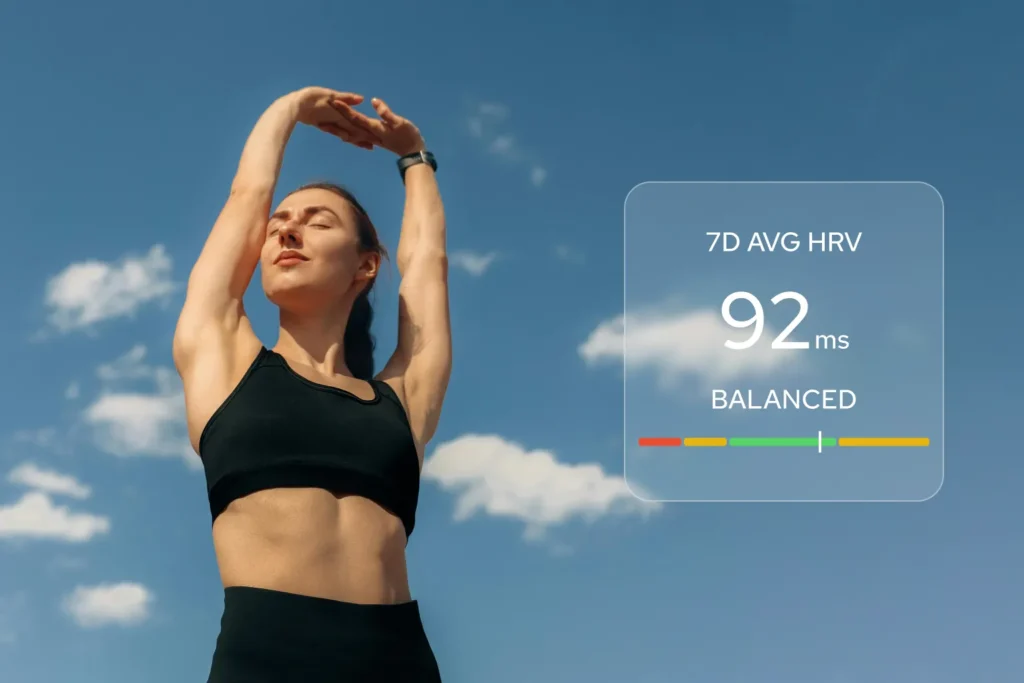
When You Have Done Everything to Support Recovery, But Your Nervous System Still Will Not Settle Down
You’ve done it all.
You track your HRV every morning; you take rest days when the data says to; you do the breathwork; you take the cold shower and use magnesium before bed; asleep by 10 pm, with the room dark and your phone in another room.
And yet…
- Your HRV stays suppressed
- You wake up feeling like your sleep was not fully restorative
- Your resting heart rate has barely dropped
You feel alert in a low-grade, uncomfortable way, even on days when nothing demands anything of you.
If this pattern is familiar, you are not alone: most people assume that low HRV simply means they need more rest, fewer training sessions, or better sleep hygiene.
But here is what working in intensive care has taught me: resting more does not automatically restore the regulatory system that generates recovery in the first place.
What I See Every Day: In the ICU and in the Gym
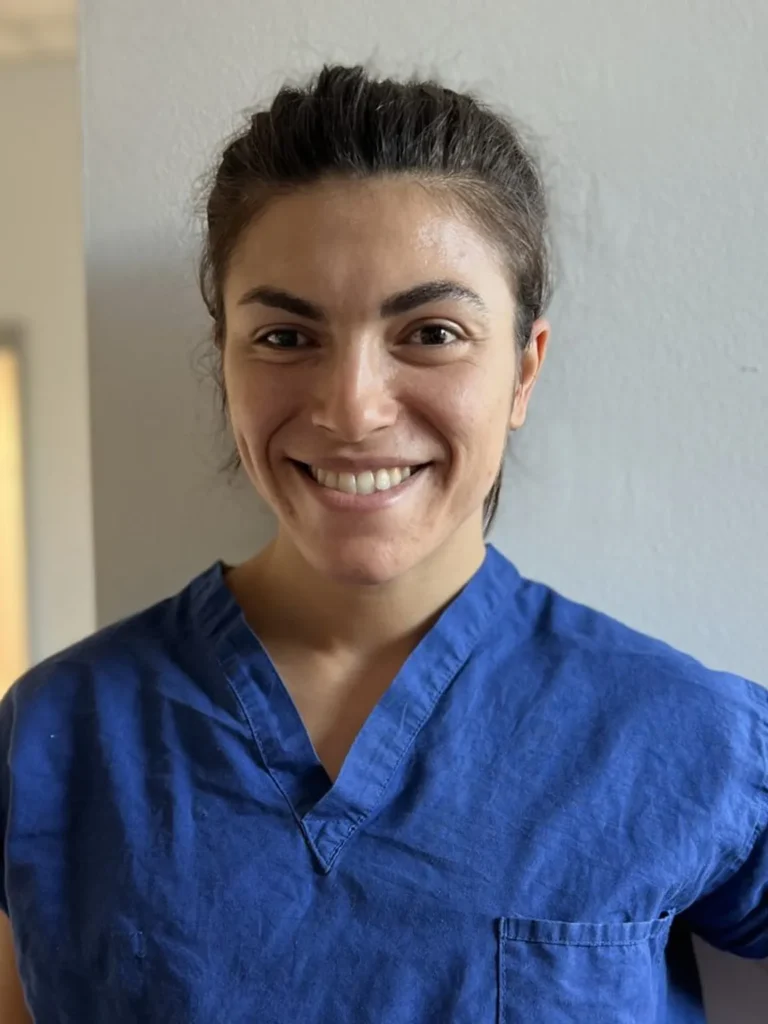
I am an ICU staff nurse specialising in cardiothoracic care in London.
My role is intense and the environment is intense. It is not like a normal job. When most people go to work, they go in, deal with whatever happens that day, and come home. My reality is life and death, literally.
It is seeing families’ lives fall apart in front of you, telling people that there is nothing more we can do, and these are the last moments of someone’s life.
Or, on the flip side, nursing someone who is going to recover, but who is critically unwell right now.
Outside the hospital, I am a CrossFit athlete and coach. I am currently preparing for an elite competition in May and the semifinals of the CrossFit Games in Madrid at the end of that month. Training at this level requires the same nervous system that I rely on at work to switch off completely between sessions.
That is the part most people underestimate.
What that combination has shown me is something the recovery conversation usually misses. The stress of a difficult shift does not stay at work. Sometimes I wake up the next morning feeling heavy, with anxious thoughts running through my head, puffy, tired.
I cannot always trace it to anything specific.
It is the body holding onto something the mind has already moved past.
Many people treat HRV as a number to manage. Instead, it may be more useful to view it as a signal of underlying physiological processes.
When You Are Doing Everything Right, But Still Running on Empty
Some of the people I speak with have genuinely committed to their recovery.
They:
- Take structured rest days in line with their HRV data
- Prioritise sleep consistently and track sleep quality
- Practice breathwork or meditation as part of a daily routine
- Reduce caffeine, manage alcohol, and eat well
- Limit high-intensity sessions when their metrics indicate they should
Yet their HRV remains chronically suppressed.
They feel flat rather than recovered on rest days.
They cannot seem to reach the performance levels they know they are capable of.
There is a persistent sense of performing below baseline, and it does not shift regardless of what they do or do not do.
This may not necessarily be a discipline or sleep hygiene issue.
It is a nervous system that has lost some of its capacity to regulate itself effectively, and no amount of rest will address that directly if the underlying regulatory mechanism is the issue.
HRV vs Vagal Tone: The Difference That Changes the Picture
HRV is what you measure: the variation in time between heartbeats, reflecting how adaptively your autonomic nervous system responds from moment to moment.
Vagal tone is what drives it: the underlying activity of the vagus nerve and the parasympathetic system it regulates, which determines how efficiently your body can shift between states of activation and recovery.
You can improve your HRV on any given day by getting more rest.
But you cannot increase your underlying vagal tone simply by taking more rest days, just as you cannot build strength by avoiding the gym.
Vagal tone is a capacity that needs to be actively supported and, in people whose nervous system has been under sustained load, potentially directly stimulated. When that capacity is genuinely impaired, the autonomic system loses some of its ability to switch efficiently between sympathetic activation and parasympathetic recovery.
HRV stays suppressed, your sleep quality suffers, and your inflammatory markers can rise.
The body stays in a state of readiness; it cannot seem to step back from it.
This is what I mean when I say low HRV is not always a training-load problem. For some people, it is a vagal tone problem. And those require different approaches.
The Nervous System’s Role in HRV and Recovery
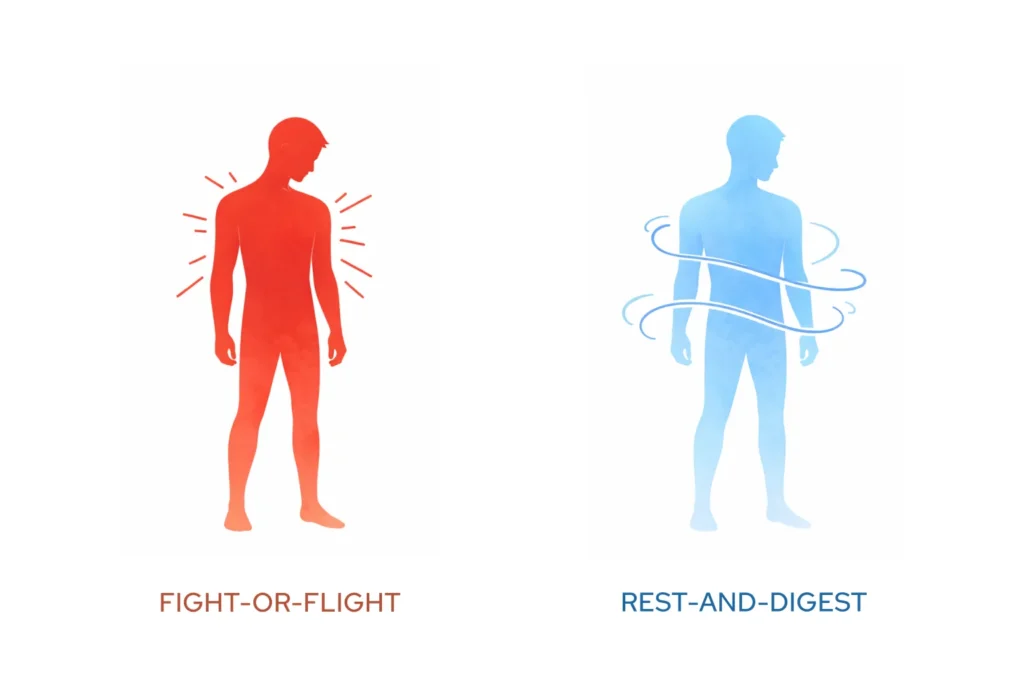
The autonomic nervous system has two primary operating modes:
- Sympathetic ("fight or flight"): prepares the body for activity, raises heart rate, mobilises energy, reduces the variation between heartbeats, and keeps physiological systems primed for response
- Parasympathetic ("rest and digest"): primarily driven by the vagus nerve, slows the heart, widens HRV, supports cellular repair, reduces inflammatory activity, and enables genuine recovery
In a well-functioning autonomic system, the balance between these two modes shifts fluidly in response to demand.
After exertion or stress, the parasympathetic system typically reasserts itself, HRV rises, recovery proceeds, and the body is ready to perform again.
But sustained load, whether from training, shift work, psychological stress, illness, or accumulated life demands, can impair that capacity to switch.
The sympathetic system remains dominant longer than it should, and HRV remains narrow. As a result, the body’s recovery does not fully occur, regardless of how many hours are spent resting.
This is particularly relevant in populations under chronic occupational or physiological stress.
I have seen it in the patients I nurse through illness, where the autonomic system is under acute, visible load.
I have seen it in myself, in the periods when shift work, training and the cumulative weight of difficult days kept me operating in a state I could not step back from.
There was a period when I could feel it constantly. If I were a button, you could hear static from me, all the time. That is not sustainable. At some point the body asks the question for you.
The Vagus Nerve: Your Recovery Regulator
The vagus nerve is the primary pathway of the parasympathetic nervous system, originating in the brainstem and extending through the neck, chest, and abdomen, where it helps regulate heart rate, breathing rhythm, inflammatory signalling, and the body’s fundamental capacity to shift from a state of activation into genuine recovery.
Heart rate variability, a key metric that athletes and clinicians rely on to assess recovery, is essentially a measure of vagal tone.
When vagal tone is adequate, HRV is higher and more variable, the heart rate drops efficiently after exertion, the body transitions smoothly from sympathetic activation to parasympathetic recovery, sleep is deeper and more restorative, and inflammatory activity is better regulated.
When vagal tone is reduced, HRV is correspondingly suppressed, and the physiological signs of recovery (improved HRV, reduced resting heart rate, lower inflammatory markers) do not emerge at the rate the person expects, given the rest they are taking.
In intensive care, we see the consequences of severely impaired vagal activity in ill clients: dysregulated cardiac rhythms, heightened inflammatory cascades, and impaired stress response recovery.
The mechanism is the same at a less acute level in people experiencing chronic autonomic dysregulation, operating across a longer timescale with more subtle but equally real effects on function, recovery, and wellbeing.
What the Research Says
The goal is to support the system that creates calm.
The science related to HRV and vagal tone is extensive:
- HRV as a marker of autonomic health: Research consistently shows that reduced HRV reflects impaired parasympathetic activity and is associated with heightened inflammation, increased stress reactivity, disrupted sleep architecture, and slower physiological recovery following physical or psychological demands.¹
- taVNS and HRV improvement: A living Bayesian meta-analysis found that transcutaneous auricular vagus nerve stimulation (taVNS) produces measurable improvements in vagally mediated HRV, suggesting a shift in autonomic balance rather than a superficial change.²
- Inflammatory regulation: taVNS has been shown to reduce inflammatory markers, including IL-6 and interferon-gamma, consistent with activation of the vagal cholinergic anti-inflammatory pathway, an important mechanism linking chronic stress, nervous system dysregulation, and impaired recovery.³
- Regulated pain modulation and stress resilience: Research has linked taVNS to improvements in the body's regulated pain modulation capacity, which reflects broader changes in central nervous system regulation and stress response efficiency.⁴
- Safety profile: Systematic reviews encompassing more than 50 completed scientific studies, including collaborations with Harvard, Yale, and Imperial College London.⁵
Where Nurosym Fits (At-Home Support)
In my work, I focus on the acute end of autonomic dysregulation.
But the same physiological principles apply across the spectrum.
For people who are not in crisis but whose HRV data consistently shows a suppressed autonomic state that rest and recovery practices alone cannot resolve, what is often missing is not more recovery activity. It is direct support for the vagal pathway that drives the recovery process itself.
That is where Nurosym is relevant.
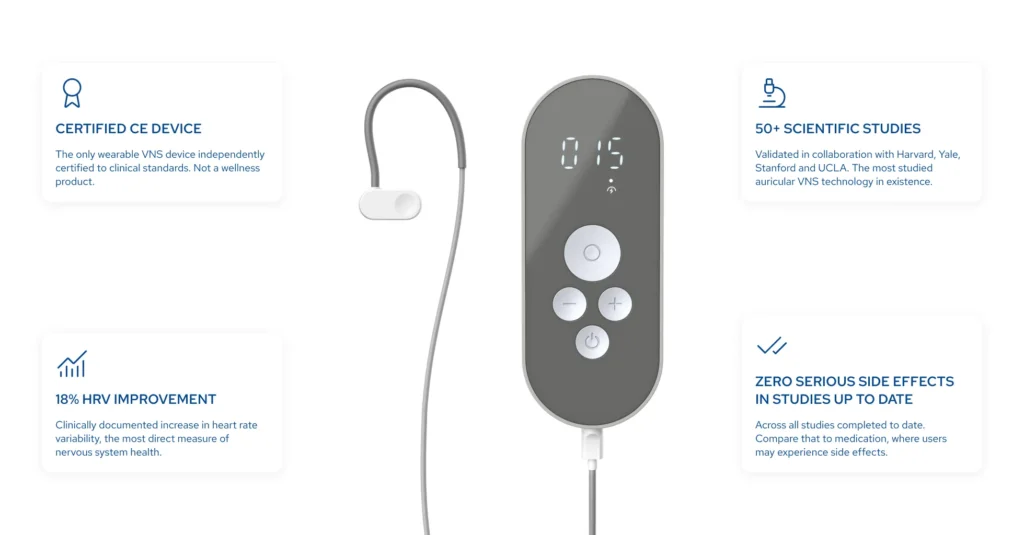
- What it is: A CE-marked transcutaneous auricular vagus nerve stimulation device that clips to the outer ear at the auricular branch of the vagus nerve, the only location on the body's surface where a cranial nerve branch is directly accessible without surgery.
- How it works: Delivers a calibrated, gentle electrical signal to stimulate vagal afferent pathways, supporting a shift in autonomic balance and measurable improvements in HRV over consistent use.
- Potential rationale for its use includes: For people whose HRV stays chronically suppressed despite doing the right things, it addresses the regulatory mechanism directly rather than creating situations under which that mechanism might improve. That distinction matters.
It is not a replacement for good recovery practices.
Breathwork, structured rest, sleep, and training load management all remain relevant. Nurosym works alongside those practices, addressing a different level of the same problem.
“At work, I use it on my 15-minute morning break. We call it the wobble room. Instead of having another coffee, which can trigger more IBS symptoms on a long day, I sit and use it for 15 minutes.”
– Olivia Tompkins, ICU Nurse & CrossFit Athlete
Real-World Profiles Where This Is Most Relevant
The Shift Worker Whose Nervous System Never Fully Clocks Off
Irregular hours, heightened alertness during shifts, and difficulty downregulating between shifts produce chronically suppressed HRV that standard recovery advice cannot fully address. The pattern is familiar from my own context.
The High-Output Athlete With Plateauing Recovery Metrics
Training load is appropriate, sleep is prioritised, rest days are observed, and yet HRV has not returned to the seasonal baseline for weeks. The regulatory capacity is the limiting factor, not the recovery behaviours.
The Professional Under Sustained Occupational Stress
Not acutely unwell, not overtrained, but carrying a sustained sympathetic load from work demands that keeps the autonomic system in a state of readiness it cannot step back from. HRV is the visible sign; vagal tone is the underlying variable.
The Person Whose HRV Data Shows Consistent Suppression After Illness
Post-viral or post-inflammatory presentations frequently involve autonomic dysregulation that lingers well beyond the resolution of the original illness. Direct vagal support may be a more targeted approach than general recovery practices in this context.
Who Might Benefit, and Who Should Not Use It
May benefit:
- People with chronically suppressed HRV despite appropriate training load and recovery practices
- Those experiencing poor sleep quality with low subjective restoration despite adequate sleep duration
- Individuals under sustained occupational or psychological stress with measurable autonomic dysregulation
- Athletes whose recovery metrics have plateaued despite no change in training volume
- People in post-illness recovery, where autonomic dysregulation appears to be a persisting factor
Avoid if:
- You have a pacemaker or an implantable cardiac device
- You are pregnant
- You have experienced a recent serious cardiac event
- You are under 18 years of age
Always seek medical advice before starting, particularly if you have a complex cardiac or autonomic history.
A Considered Way to Try It
- 30-Day Money-Back Guarantee: Nurosym includes a 30-day policy with a full refund if you do not notice a meaningful change in your HRV or recovery quality. That makes it practical to evaluate against your own data before committing.
- Research Rebate: At times, participants in Nurosym's ongoing research programme may receive a subsidy of up to 70 euros for sharing their experience.
When used for about 30 minutes a day, it fits into existing recovery time without restructuring the day.

Final Thoughts: You Cannot Out-Rest a Dysregulated Regulatory System
If your HRV data indicates something that your recovery practices are not resolving, the most useful question is not “What else should I add to my recovery routine?”
It is whether the regulatory system that drives recovery has sufficient capacity to respond to what you are already doing.
Rest creates an opportunity for recovery.
The vagus nerve and the parasympathetic system it governs determine whether that opportunity is taken.
When vagal tone is genuinely impaired, supporting it directly represents a different kind of intervention from anything in the standard recovery toolkit. For some people, it is the intervention that makes the rest of it work.
References
- Cooper, T. M., McKinley, P. S., Seeman, T. E., Choo, T. H., Lee, S., and Sloan, R. P. (2015). Heart rate variability predicts levels of inflammatory markers: Evidence for the vagal anti-inflammatory pathway. Brain, Behavior, and Immunity, 49, 94-100. https://doi.org/10.1016/j.bbi.2014.12.017
- Wolf, V., Kuhnel, A., Teckentrup, V., Koenig, J., and Kroemer, N. B. (2021). Does transcutaneous auricular vagus nerve stimulation affect vagally mediated heart rate variability? A living and interactive Bayesian meta-analysis. Psychophysiology, 58(11), e13933. https://doi.org/10.1111/psyp.13933
- Bremner, J. D., Gurel, N. Z., Jiao, Y., Wittbrodt, M. T., Levantsevych, O. M., Huang, M., Jung, H., Shandhi, M. H., Beckwith, J., Herring, I., Rapaport, M. H., Murrah, N., Driggers, E., Ko, Y. A., Alkhalaf, M. L., Soudan, M., Song, J., Ku, B. S., Shallenberger, L., and Pearce, B. D. (2020). Transcutaneous vagal nerve stimulation blocks stress-induced activation of interleukin-6 and interferon-gamma in posttraumatic stress disorder: A double-blind, randomized, sham-controlled trial. Brain, Behavior, and Immunity – Health, 9, 100138. https://doi.org/10.1016/j.bbih.2020.100138
- Pacheco-Barrios, K., Gianlorenco, A. C., Camargo, L., Andrade, M. F., Choi, H., Song, J. J., and Fregni, F. (2024). Transauricular vagus nerve stimulation enhances conditioned pain modulation in healthy subjects: A randomized controlled trial. Brain Stimulation, 17(2), 346-348. https://doi.org/10.1016/j.brs.2024.03.006
- Kim, A. Y., Marduy, A., de Melo, P. S., Gianlorenco, A. C., Kim, C. K., Choi, H., Song, J. J., and Fregni, F. (2022). Safety of transcutaneous auricular vagus nerve stimulation (taVNS): A systematic review and meta-analysis. Scientific Reports, 12, 22055. https://doi.org/10.1038/s41598-022-25864-1
- Redgrave, J., Day, D., Leung, H., Laud, P. J., Ali, A., Lindert, R., and Majid, A. (2018). Safety and tolerability of transcutaneous vagus nerve stimulation in humans: A systematic review. Brain Stimulation, 11(6), 1225-1238. https://doi.org/10.1016/j.brs.2018.08.010
- Chalmers, J. A., Quintana, D. S., Abbott, M. J. A., and Kemp, A. H. (2014). Anxiety disorders are associated with reduced heart rate variability: A meta-analysis. Frontiers in Psychiatry, 5, 80. https://doi.org/10.3389/fpsyt.2014.00080
- Forte, G., Favieri, F., Leemhuis, E., De Martino, M. L., Giannini, A. M., De Gennaro, L., Casagrande, M., and Pazzaglia, M. (2022). Ear your heart: transcutaneous auricular vagus nerve stimulation on heart rate variability in healthy young participants. PeerJ, 10, e14447. https://doi.org/10.7717/peerj.14447
This blog post aims to be informational and should not replace professional health advice. Always consult with a health professional for personalised advice.



 English
  German
  French
  Spanish
  Swedish