
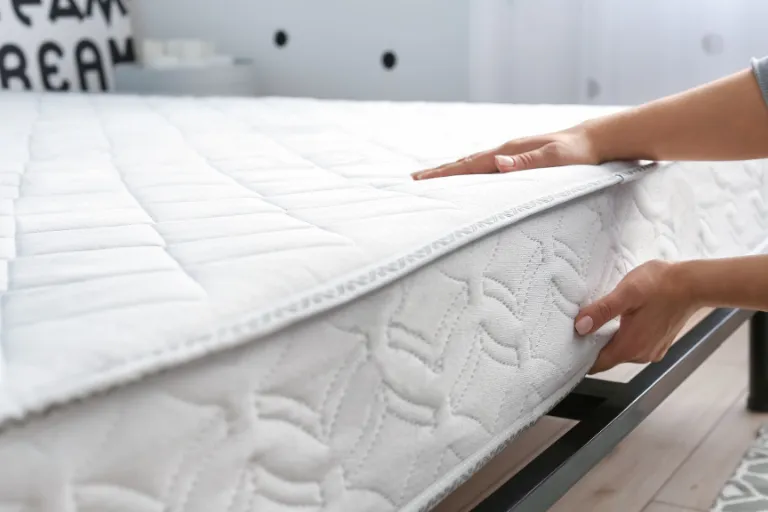
Key Points
- Back sleepers need a mattress that helps maintain the spine’s natural curve—neither too soft (allowing hips to drop) nor too firm (forcing unnatural arch) for optimal alignment.
- Medium-firm to firm mattresses often offer the best balance of contouring and support for back sleepers.
- Long-term spinal health depends not only on initial comfort but on durability, materials quality, and support structure that resist sagging.
- Features such as zoned support, lumbar reinforcement, and high-density materials can improve spinal support for back sleepers.
Why the Right Mattress Matters for Your Spine
If you sleep on your back, it may seem that any flat mattress would work. But the reality is more nuanced: your sleep surface must support your body to maintain spinal alignment throughout the night. Without it, even subtle misalignment can result in waking with lower-back stiffness, aching glutes, or discomfort around the hips.
While occasional discomfort may seem minor, persistent misalignment can affect sleep quality and contribute to ongoing spinal strain. Sleep research suggests that a mattress that allows the spine to relax neutrally leads to better rest and fewer morning aches.
The Unique Support Challenges of Back Sleepers
Lying on your back places specific demands on a mattress:
- The hips, shoulders, and heels carry a higher proportion of body weight. If the hips sink too far, the lumbar spine loses support and may arch upward (lordosis).
- If the mattress is overly firm, the shoulders may not sink enough, causing tension and pressure points.
- Over time, a mattress that lacks durability or proper core support can sag in the midsection, altering alignment and inviting low-back discomfort.
These factors mean back sleepers should prioritise lumbar support, weight distribution, and long-term alignment over surface softness alone.
The Science of Spinal Alignment in Back Sleep
Here’s what the research tells us about mattress design and spinal posture:
- A systematic review of 39 studies found that medium-firm mattresses promoted better comfort, sleep quality, and spinal (rachis) alignment.
- Another meta-analysis on mattress design found that mattress firmness plays a key role in spinal alignment and reported pain levels, though customisation matters.
- Practical guides note that back sleepers typically benefit most from medium-firm surfaces because they provide sufficient support without excessive rigidity.
In practical terms: the mattress should allow the pelvis to settle slightly while keeping the lumbar region supported, and maintain a gentle, natural curve rather than forcing the spine flat or exaggerated. Durability also matters, as sagging materials can compromise alignment over time.
What Back Sleepers Should Prioritise in a Mattress
Here are the key mattress characteristics to evaluate, especially if you sleep on your back:
1. Ideal Firmness: Medium-Firm to Firm
Research and scientific guidance indicate that a “medium-firm” level is often optimal for back sleepers. Too soft and the hips sink; too firm and the shoulders/hips don’t settle naturally. Lighter individuals often prefer medium-firm surfaces, while heavier individuals may require firmer or reinforced support to maintain alignment.
2. High-Quality Support Core
The mattress’s support layers determine how well it maintains alignment over time. Key support features include:
- Pocketed coil systems or strong hybrid cores for push-back support.
- High-density foams (generally, ≥ 1.8 lb/ft³) to resist deformation and sag.
- Zoned support systems—firmer under the lumbar region, softer under the shoulders/hips—to optimise body alignment.
3. Durable, Sag-Resistant Materials
Durability is especially important for back sleepers because sagging mid-sections lead to misalignment. Natural latex, high-density foams, and reinforced coil systems generally show better long-term durability than low-density foams.
4. Pressure Relief & Cooling for Comfort
While support is critical, comfort remains important. Back sleepers benefit when the mattress allows the shoulders and glutes to settle without excessive pressure. Cooling features (gel-infused foams, open-cell latex, breathable coils) improve sleep quality by reducing heat buildup.
5. Edge Support & Motion Isolation (If Needed)
If you share your bed, strong edge support keeps you from sliding near the edges; good motion isolation means your partner’s movement doesn’t disturb you. These are bonus features that enhance overall sleep quality.
Choosing the Right Mattress Type for Back Sleepers
Here’s how different mattress types perform for back sleepers:
Hybrid Mattresses
These combine coils with foam or latex layers and often strike an excellent balance of contouring and support. The coil base gives robust support, while the comfort foams allow proper hip and shoulder settlement.
Best for: Medium to heavier back sleepers who want responsive support and durability.
Latex Mattresses
Latex offers buoyant contouring without excessive sinkage, meaning the hips are supported and the lumbar spine stays aligned. Plus, latex tends to sleep cooler and is naturally durable.
Best for: Back sleepers seeking a lively feel, strong support, and long-term durability.
Memory Foam Mattresses
High-density memory foam can offer excellent contouring, but back sleepers must watch for too much sinkage—if the hips drop too far, alignment suffers.
Best for: Lightweight to average-weight back sleepers who prefer a “hug” feel and prioritise pressure relief.
Modern Innerspring Mattresses
Some modern innerspring mattresses with pocketed coils and adequate comfort layers can work well, but they need sufficient cushioning over the springs to avoid point pressure under the hips/shoulders.
Often suitable for: Those who prefer a firmer, traditional sleep surface.
Extra Features That Add Value for Back Sleepers
- Zoned support layers: firmer midsection (lumbar), softer shoulders/hips to encourage neutral alignment.
- Lumbar reinforcement: extra support beneath the lower back region helps maintain alignment.
- Reinforced edges: prevent sag near the bed’s perimeter.
- Cooling covers and open-coil layers: help reduce heat retention, which can disturb restful sleep.
These features contribute to more consistent sleep posture and spinal alignment over time.
Budget Tiers and Long-Term Value
Here’s how to think about mattress cost versus value for back sleepers:
- Budget Tier (~$300–$800): Entry-level foams or simple hybrids. May provide short-term comfort but often lack long-life durability or advanced support cores.
- Mid-Range (~$800–$1,500): Higher-density foams, quality coil systems, better materials—all strong value for back sleepers.
- Premium Tier ($1,500+): Advanced support design (zoned coils, natural latex, reinforced cores), longer warranties/studies, and stronger durability—often offering greater durability and long-term support.
For back sleepers, investing in durable support may reduce discomfort and extend mattress lifespan.
What to Do Next
- Lie down on the mattress in your typical sleep position (back) for at least 10 minutes in the store—or use trial nights at home if buying online.
- Assess whether your hips seem level and your lower back feels supported (not overly arched).
- Check manufacturer specs: foam densities, coil gauge, warranty length, and trial period.
- Prioritise durability and support structure—especially if you weigh more than average.
By taking these steps, you’re prioritising alignment, support, and sleep quality.
Conclusion
Sleeping on your back can support spinal health, provided the mattress maintains proper alignment night after night. The key is choosing a mattress with the right firmness, high-quality support core, durability, and features that preserve neutral alignment. With the right surface beneath you, you can wake up fresher, move more freely, and avoid the subtle spinal wear that accumulates over time. A mattress that loses support can compromise alignment, making durability an essential consideration.
Medical Disclaimer:
This blog post aims to be informational and should not replace professional health advice. Always consult with a health professional for personalised advice.
Subscribe for Free for more insightful health articles tailored to your needs.
Sources
- Caggiari G, Talesa GR, Toro G, Jannelli E, Monteleone G, Puddu L. What type of mattress should be chosen to avoid back pain and improve sleep quality? Review of the literature. Journal of Orthopaedics and Traumatology. 2021 Dec;22(1).
- Bolton R, Hulshof H, Daanen HAM, van Dieën JH. Effects of mattress support on sleeping position and low-back pain. Sleep Science and Practice. 2022 May 10;6(1).
- Tian S, Yao C, Wang Y, Cao X, Sun Y, Wang L, et al. The individualized optimal pillow height and neck support design for side sleepers. Medical & Biological Engineering & Computing. 2024 Oct 16;
- Breus M, Hooper SL, Lynch T, Barragan M, Hausenblas HA. Effectiveness of a grid mattress on adults’ sleep quality and health: A quasi‐experimental intervention study. Health science reports. 2024 Apr 1;7(4).



 English
  German
  French
  Spanish
  Swedish
  Italian
A clear and informative read. Small habits like proper mattresses and sleeping positions truly make a difference
Very insightful. I appreciate the focus on simple, natural habits to support my sleep