
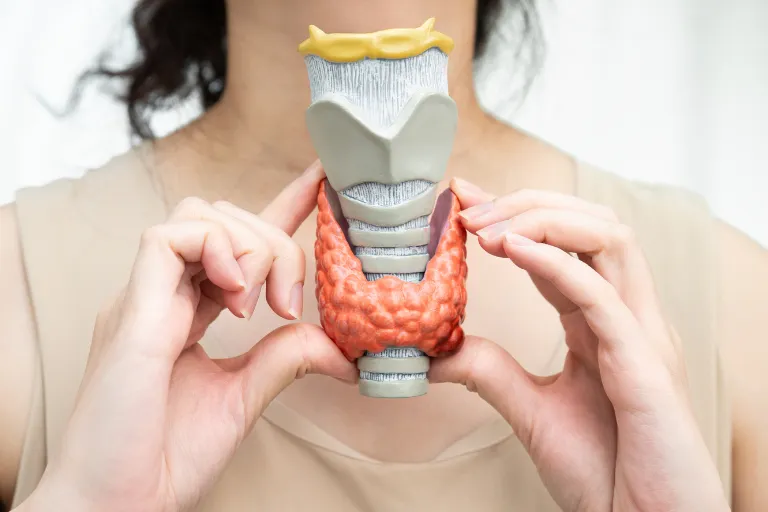
Are you dealing with tiredness all the time for no clear reason, shedding more hair than usual, getting dry skin or putting on extra weight? Your thyroid might be sending you a clue – that it is running low or underactive. An underactive thyroid means your thyroid is not producing enough hormones the body needs – and your body starts signalling this through many different symptoms. 1)
This article breaks down what an underactive thyroid means, the signs and symptoms you should not ignore and when to consider seeking professional advice.
What the Thyroid Is and Why it Matters ?
Thyroid is a tiny butterfly shaped gland found in the front of your neck. 1) Though small, it has a huge role in keeping you physically and psychologically healthy and balanced. By continuously releasing hormones (T3 and T4) into the blood, it influences almost every organ system in your body – including the heart, brain, lungs, nervous system, skeletal system, bones and digestion. 3) Thyroid hormones control your metabolism, energy level, heart rate, body temperature, growth and overall development.
So any imbalance in the hormone level (overactive or underactive thyroid) can affect many of the body functions and cause various symptoms.
How Your Body Keeps Thyroid Hormones Balanced
- T4 (Thyroxine / Tetraiodothyronine)
- T3 (Triiodothyronine) – are the two key hormones produced by thyroid gland, both of which are made using iodine. 1)
The hypothalamus (in the brain), pituitary (at the base of the brain) and thyroid (in the neck) – work closely to keep these hormones balanced. Hypothalamus is the starting point. It releases the TRH (Thyrotropin-releasing hormone), which signals the pituitary to release TSH (thyroid stimulating hormone). TSH then stimulates the thyroid, to release the hormones T3 and T4 into blood. 2)
This system works through a negative feedback loop to maintain healthy levels of thyroid hormones in the body. When the circulating levels of T3 and T4 are high, the release of TSH is inhibited whereas low levels of T3 and T4 increase the release of TSH signaling the thyroid to release more hormones to maintain balance.
What an Underactive Thyroid Means for Your Body
An underactive thyroid means the thyroid is not producing enough hormones the body needs – slowing down all of the cells in your body. Your metabolism becomes slower, heart rate slows down and the body functions become sluggish.
It occurs mostly in adults and is more common in women than in men. Around 5 out of 100 individuals aged 12 years and above in the US have an underactive thyroid.
Two Types of Underactive Thyroid
An underactive thyroid can be primary or secondary (central)
- Primary is the common form, in which the thyroid gland itself is unable to produce enough thyroid hormones.
- Secondary or Central is rare. In this, the thyroid is functioning normally, but the hypothalamus and pituitary gland do not properly signal thyroid to release thyroid hormones.
Symptoms to Watch For
An underactive thyroid signals the body through various symptoms but it doesn’t show up the same in every person. Some people have no symptoms at all and identify it during routine blood tests. Many of the symptoms are common to other health issues and can cause confusion.
The typical symptoms of underactive thyroid are
- feeling tired always
- unusual weight gain
- dry skin
- dry, thinning hair
- constipation
- muscle cramps
- difficulty in tolerating cold
- sleep disturbances
- feeling sad or depressive
- change in voice
- heavy or irregular menstrual cycle
- Galactorrhea / milky nipple discharge 2)
What Causes a Slow Thyroid?
Globally, Iodine deficiency is the common cause for underactive thyroid. 2) Iodine is needed for the production of thyroid hormones. Including iodine rich foods such as seafood, milk, dairy products and eggs in your diet can help you to get enough iodine. 3).
In the US, the leading cause of underactive thyroid is autoimmune thyroid diseases – mostly Hashimoto’s thyroiditis or chronic inflammation of the thyroid gland. It is the most common cause of underactive thyroid in iodine sufficient areas. The thyroid can get inflamed due to infection also. 2)
Underactive thyroid can also be caused by
- Surgery of thyroid
- Radiotherapy of head and neck
Diagnosing Underactive thyroid
The symptoms of an underactive thyroid are common to many other health issues and hence it should be discussed with a health professional regardless.
Your health professional may
- perform physical examination of the thyroid
- ask for your signs and symptoms
- check your family history of thyroid problems and
- use blood test 2)
Blood tests
- Usually starts with simple blood tests – mainly TSH and Free T4 serum level.
These determine whether the underactive thyroid is primary (arise from the thyroid gland) or secondary/central (related to pituitary or hypothalamus).
– In primary underactive thyroid: TSH is high and T4 is low.
– In subclinical form: TSH is elevated but T4 remains within normal limits.
– In central: Diagnosis is based on low serum T4 level.
- Test for antithyroid antibodies help to assess autoimmune causes for underactive thyroid. 4)
Screening recommendations
The American Thyroid Association recommends screening for everyone, once every five years, starting from the age of 35.
The risk of developing an underactive thyroid is higher, if you are
- Women older than 60 years
- Pregnant women
- User with a history of radiation therapy of head and neck
- Family history of thyroid disorders
- Have autoimmune symptom or Type 1 Blood Sugar regulation problem 2)
Managing Underactive Thyroid
If left neglected, an underactive thyroid can risk your health and life. The good news is – it can be easily managed. It is primarily managed with medicine to replace the thyroid hormone which your body is unable to produce. This is done with a daily dose of synthetic form of T4 (levothyroxine) in pill form.
Effective therapy helps in improving the associated signs and symptoms, restores the balance of hormones and supports overall well being of the user. 2)
Don’t ignore the symptoms – speak to a health professional and consider getting your thyroid levels checked.
Medical Disclaimer: This article has been written by a licensed medical professional and is intended for general informational purposes only. It does not substitute for personalised medical advice, diagnosis, or treatment. Readers should always seek the guidance of a qualified healthcare provider with any questions regarding a medical symptom or health objectives. Never ignore or delay seeking medical advice based on information presented here.
Subscribe for Free for more insightful health articles tailored to your needs.
Sources
- In brief: How does the thyroid gland work? (2024). In InformedHealth.org [Internet]. Institute for Quality and Efficiency in Health Care (IQWiG). https://www.ncbi.nlm.nih.gov/books/NBK279388/
- Patil, N., Rehman, A., Anastasopoulou, C., & Jialal, I. (2025). Hypothyroidism. In StatPearls.StatPearlsPublishing. http://www.ncbi.nlm.nih.gov/books/NBK519536/
- Overview: Underactive thyroid (Hypothyroidism). (2024). In InformedHealth.org [Internet]. Institute for Quality and Efficiency in Health Care (IQWiG). https://www.ncbi.nlm.nih.gov/books/NBK279601/
- Shahid, M. A., Ashraf, M. A., & Sharma, S. (2025). Physiology, thyroid hormone. InStatPearls. StatPearlsPublishing. http://www.ncbi.nlm.nih.gov/books/NBK500006/



 English
  German
  French
  Spanish
  Swedish