
Vagus nerve stimulation (VNS) has been used for years in the management of treatment-resistant depressive states. Researchers are now studying whether non-invasive forms may also support gut-brain disorders such as irritable gut.
The idea is simple: a gentle, non-invasive signal to one of the primary communication pathways between your gut and your brain.
A neuroscientist explains why an out-of-control gut is really a breakdown in that conversation, and why early studies are now testing this nerve in people with irritable gut.

You have probably been told your gut looks fine.
The tests come back normal, and somewhere in there is the quiet suggestion that it is all in your head.
Current research suggests otherwise.
Irritable gut is real.
In many people, the problem isn’t structural damage to the gut; it is in the communication.
Irritable gut is now classified as a disorder of gut-brain interaction: a breakdown in the constant conversation between your gut and your brain.
One of the most important communication pathways is the vagus nerve, the main cable between your head and your digestive system.
Your gut, its muscles, and even the trillions of microbes inside you may send signals that travel through it, while the brain sends signals back in return.
When that line becomes disrupted and the signals cross, the gut function may become dysregulated.
This breakdown can contribute in several ways:
- The signals between the gut and the brain get scrambled, so normal digestion is misread as pain.
- Your gut's pain sensitivity increases, so ordinary gas and stretching start to hurt.
- The muscle rhythm that moves things along becomes dysregulated, so you swing between constipation and urgency.
- A low-grade inflammation simmers, so the gut stays irritated and on edge.
- The gut microbial composition changes, so the signals it sends become noisy.
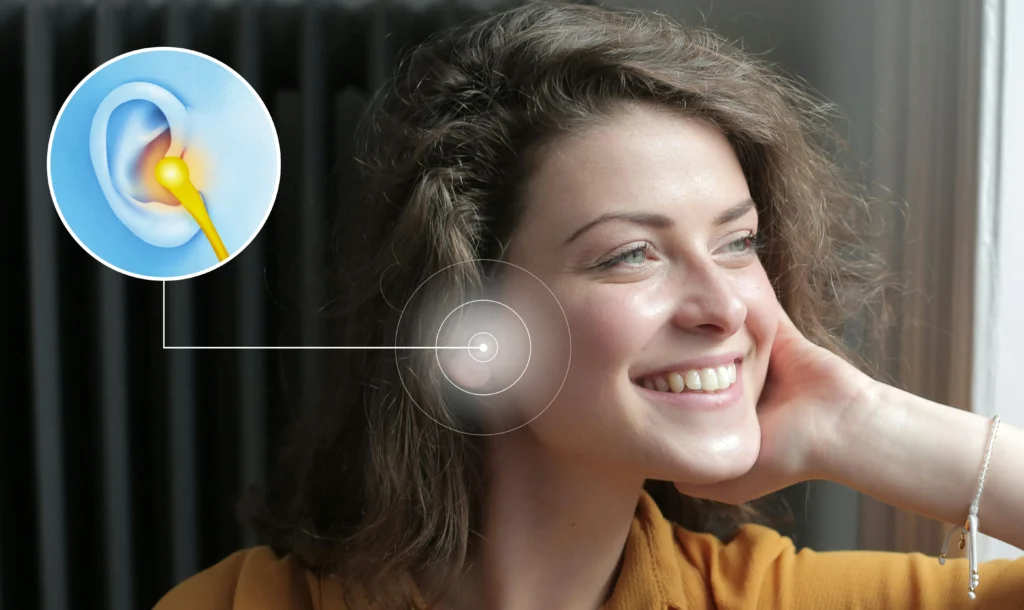

May help support gut-brain communication so your gut stops misfiring
What’s going wrong: the messages between your gut and brain have become scrambled.

Nothing shows up on a scan, yet your gut clearly isn’t behaving.
That gap is the whole clue.
Irritable gut is now understood as a problem in signalling between the gut and the brain, rather than damage to the gut itself. When the vagus, the main line between them, is not carrying clean signals, normal events get misread: a normal amount of gas registers as pain, routine digestion triggers cramping or urgency.
The hardware is fine, but the messaging is not.
Stimulating the vagus aims to improve signalling on that line, so the gut and brain can communicate more effectively.
As the conversation settles, the gut may become less reactive.

Turns down an oversensitive gut so normal digestion stops hurting
What’s going wrong: your gut’s pain pathways are turned up far too high.
For many people with an irritable gut, the problem is not that more is happening in the gut.
It is that the gut feels everything too intensely.
This is called visceral hypersensitivity, one of the best-documented features of irritable gut. The gut’s nerves and the brain regions that read them have become hypersensitive, so that ordinary stretching and gas, which most people never notice, register as genuine pain.
The vagus contributes to communication between the gut and brain.
By supporting the vagal side of that system, stimulation may help turn the volume back down so that normal digestion is no longer read as a threat.
The everyday sensations of a working gut no longer hurt the way they used to.

May help support normal gut motility, so you’re not stuck between constipation and urgency
What’s going wrong: the muscle contractions that move things along have lost their timing.
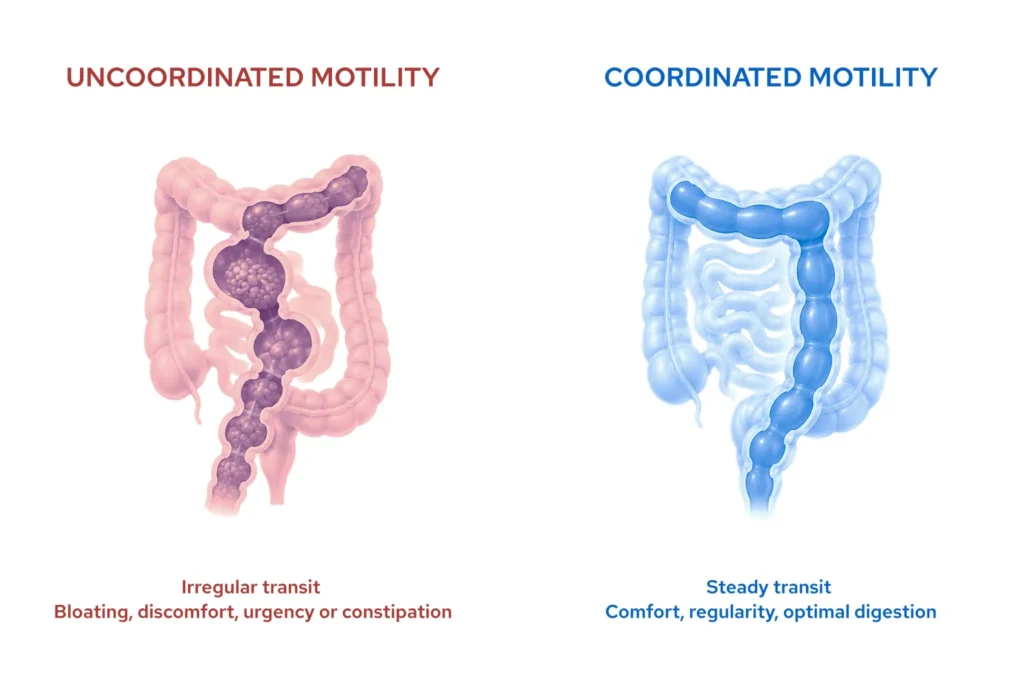
Either nothing moves for days, or everything moves at once with no warning. That whiplash is a timing problem.
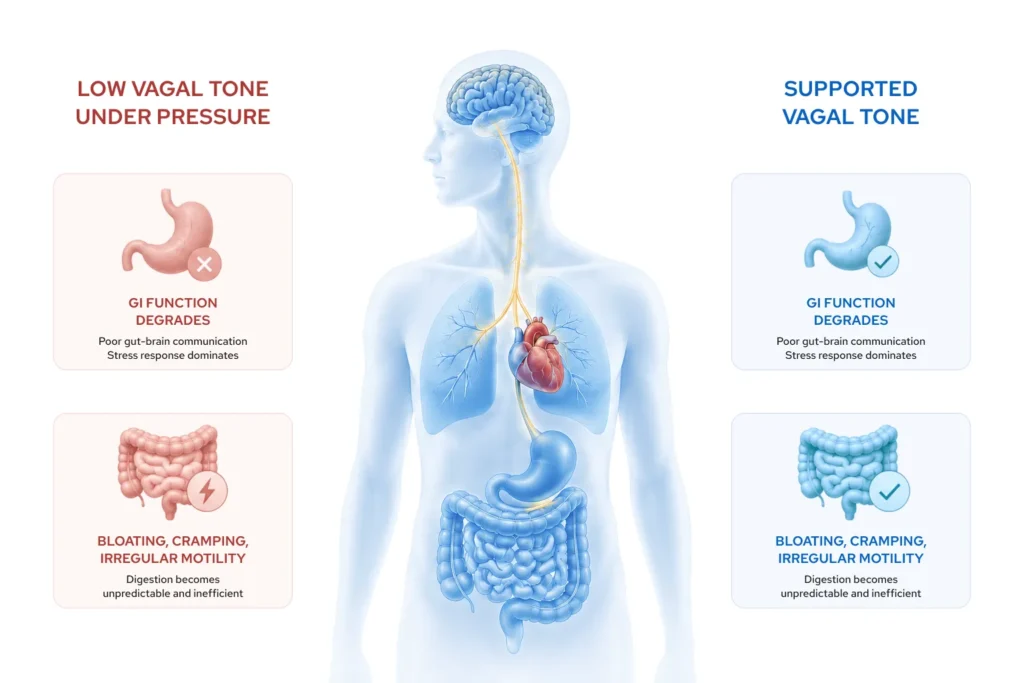
Your gut moves food along with a coordinated wave of muscle contractions, and that rhythm is part of the “rest and digest” work that parasympathetic activity supports. When the system is stuck in stress and vagal tone is low, the coordination becomes disrupted: Transit may speed up, stall, or alternate between the two.
That is the constipation-and-urgency swing so many people with irritable gut know well.
Supporting vagal tone supports the steady, coordinated rhythm that moves things along at the right pace.
Your gut starts to find a regular rhythm again, instead of lurching between extremes.

May help support gut inflammatory balance
What’s going wrong: a low-grade irritation has thrown your gut environment, and its bacteria, out of balance.

An irritated, inflamed gut is not a comfortable home for the trillions of microbes that are supposed to keep it running.
One of the vagus nerve’s quieter jobs is to act as a brake on inflammation.
When vagal tone is low, that brake weakens, a low-grade irritation can simmer, and the gut environment shifts in ways that unsettle the microbiome. Because those same microbial metabolites influence gut-brain signalling, including pathways involving the vagus nerve.
By supporting the natural brake on inflammation and helping calm the gut environment, stimulation may provide a struggling microbiome with the environment it needs to rebalance.
It does not install good bacteria for you, but it can help make the gut a place they want to live.
As the irritation settles, the gut becomes a steadier place, and the bacteria that keep it healthy get room to recover.

Helps your microbiome recover so it can do its job again
What’s going wrong: stress and gut symptoms have locked into a vicious circle.

Inside your gut live trillions of microbes, and they are not just passengers.
They help break down your food, help keep inflammation in check, and produce metabolites that influence brain function.
Some of these signals are transmitted via pathways involving the vagus nerve.
When the gut environment is disrupted, the mix shifts, the helpful microbes lose ground, and the messages they send turn noisy.
Because those messages reach your brain through the vagus, a struggling microbiome keeps the whole gut-brain system on edge.
Supporting the vagus and settling the gut may help create a state that supports microbial balance.
It does not install good bacteria for you, but it helps make the gut a place where they can recover.
As the balance returns, the microbes that keep your gut running get room to do their job again.
One communication pathway connects them all
Notice what all five have in common.
The scrambled signals, the oversensitivity, the lost rhythm, the unsettled microbiome, the stress spiral: not five separate problems, but five things that go wrong when one major communication pathway between gut and brain is struggling, and five things that may improve when it works again.

“That is what I want people to understand,” says the neuroscientist. “An out-of-control gut is usually not a broken gut. It is a gut that has lost touch with the brain. Support the connection, and a surprising amount can settle on its own.”
Working on that line directly is exactly why vagus nerve stimulation has moved out of the clinic and into something you can do at home.
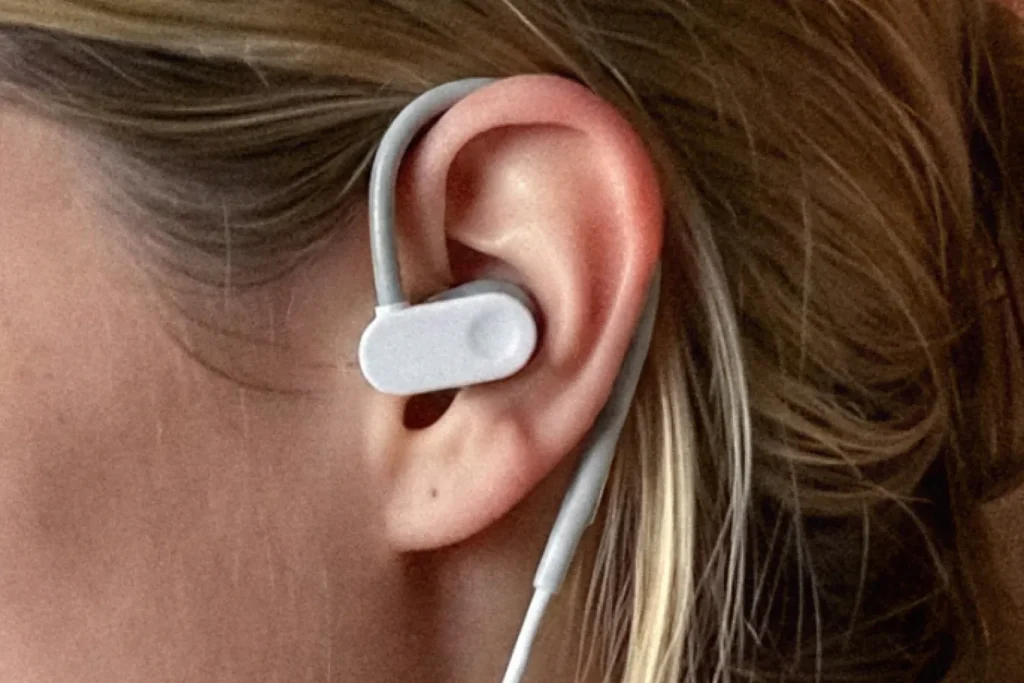
The vagus is accessible, of all places, at your outer ear, so a gentle signal applied right there can stimulate that branch without anything invasive at all.
One of the devices built around this is Nurosym™, a CE-certified, non-invasive vagus nerve stimulator that clips to the ear and delivers this kind of gentle stimulation in short daily sessions. It is not a cure for irritable gut, and anyone who promises a device alone will fix your gut while you ignore everything else is overselling it.
But if it makes sense to you that your gut and brain have lost the thread, and you want to work on that connection directly, that’s where I’d point you to start reading.
If you’d like to see how it works in more detail, the Nurosym™ page is here.
This blog post aims to be informational and should not replace professional health advice. Always consult with a health professional for personalised advice.
References
- Bonaz, B., Sinniger, V., & Pellissier, S. (2018). Vagus Nerve Stimulation at the Interface of Brain–Gut Interactions. Cold Spring Harbor Perspectives in Medicine, 9(8), a034199. https://pmc.ncbi.nlm.nih.gov/articles/PMC6671930/
- Faraji, N., Payami, B., Ebadpour, N., & Gorji, A. (2024). Vagus nerve stimulation and gut microbiota interactions: A novel therapeutic avenue for neuropsychiatric disorders. Neuroscience & Biobehavioral Reviews, 169, 105990. https://www.sciencedirect.com/science/article/pii/S0149763424004597
- Quan, Y., & Zhou, T. (2026). Efficacy and mechanisms of vagus nerve stimulation in irritable bowel syndrome: a comprehensive literature review. Frontiers in Immunology, 17. https://www.frontiersin.org/journals/immunology/articles/10.3389/fimmu.2026.1769070/full
- Veldman, F., Hawinkels, K., & Keszthelyi, D. (2025). Efficacy of vagus nerve stimulation in gastrointestinal disorders: a systematic review. Gastroenterology Report, 13. https://academic.oup.com/gastro/article/doi/10.1093/gastro/goaf009/7979382
Share via:



 English
  German
  French
  Spanish
  Swedish