

Cuando tu instinto se siente molesto sin importar lo que comas, y los síntomas aparecen incluso cuando nada parece "malo", puede dejarte atascado y buscando respuestas.
Al principio, parece que el problema es la comida.
So you start trying to “fix” your digestion:
- skipping breakfast to feel “lighter”
- fasting longer to “reset” your gut
- cutting out gluten, dairy, sugar, or carbs
- reading every ingredient label before eating
And sometimes, things improve for a while.
Then the bloating comes back.
A meal that felt completely fine last week suddenly leaves you uncomfortable for hours.
Even simple foods start feeling “too heavy” for no obvious reason.
Si esto te suena familiar, no estás solo.
For years, digestive symptoms like bloating, irritable gut-like discomfort, reflux, cramping, and food sensitivities have been treated mainly as food problems.
And food absolutely can matter.
But here’s the surprising part: food alone is rarely the whole issue.
Because many people notice something strange:
Their symptoms often flare up most during stressful periods – even when their diet stays exactly the same.
So what’s actually going on?
What I Started Noticing After Years of Working With Gut Issues

For years, I’ve worked in functional medicine DNA naturopathy with people struggling with bloating, irritable gut-like symptoms, food intolerances, tiredness, poor sleep, nervous system overload, and chronic digestive issues that often keep returning despite therapy.
I work with everyone from office-based professionals living under constant stress to active people trying to optimise their health, recovery, and energy – yet still feeling controlled by their digestion.
My work combines gut health support, nervous system regulation, functional diagnostics, nutrition, and root-cause medicine.
And over time, one pattern kept showing up:
People cleaned up their diet, yet symptoms still kept returning.
Because the issue often wasn’t just the food itself.
It was how the nervous system was regulating the gut.
When You’re Doing Everything Right – But You Still Feel Bloated

Some people become extremely careful around food.
Ellos:
- avoid “trigger meals”
- skip meals because eating feels unpredictable
- go deep into keto, low-FODMAP, or elimination diets
- track ingredients, reactions, and “safe foods”
- plan their day around digestion
Some even stop eating before meetings, long drives, or social events because they’re worried about bloating, stomach noises, urgency, or suddenly feeling uncomfortable in public.
And yet, their gut still feels overly sensitive.
Foods that once felt “safe” suddenly start causing problems again.
A normal lunch leaves them heavy for hours.
Their stomach feels swollen even when they barely ate anything.
At a certain point, many stop feeling confused by the symptoms and start feeling controlled by them.
Over time, eating stops feeling natural and starts feeling stressful.
This isn’t a lack of willpower.
It isn’t “doing the diet wrong.”
In many cases, it’s a nervous system that has become stuck in a pattern of overreacting DNA overprotecting.
Food Triggers vs. Gut Reactivity – The Difference That Changes Everything

Food triggers are what people notice.
Gut reactivity is the state of the system responding to that food.
And over time, I started noticing something important:
One week, someone becomes convinced gluten is the issue.
Next, they cut out dairy.
Then sugar.
Then caffeine.
Some eventually end up eating smaller and smaller lists of “safe foods” because the gut feels unpredictable so often.
The same food could feel completely different depending on the state of the person eating it.
During stressful periods, poor sleep, burnout, or emotional overload, the gut often becomes far more reactive – even to foods that would normally feel completely fine.
Suddenly, the symptoms stopped feeling random.
Because the problem wasn’t always just the food itself.
It was the state of the nervous system responding to it.
The Nervous System’s Role in Gut Reactivity
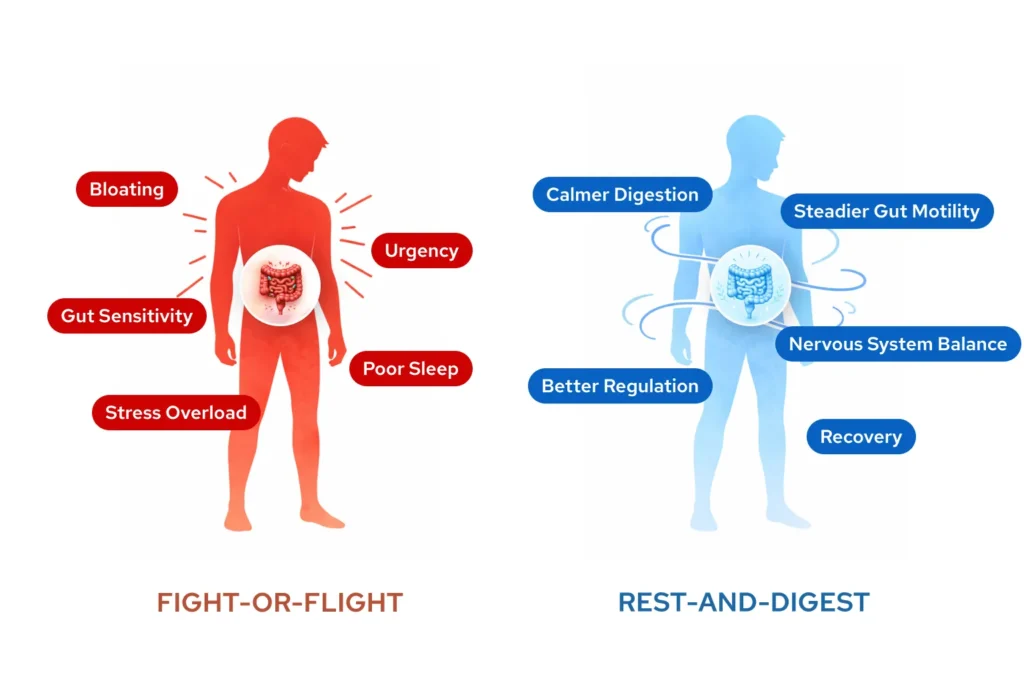
Two Nervous System States
The autonomic nervous system has two primary states:
- Comprensivo ("luchar o huir") - associated with stress, alertness, and survival
- Parasympathetic (“rest and digest”) - associated with recovery, regulation, and healthy digestion
En un sistema saludable, el cuerpo se mueve naturalmente entre los dos.
But many people today never fully come out of stress mode.
Not because of one dramatic event.
But because of constant pressure, poor recovery, mental overload, and the feeling of always needing to stay “on.”
For most people today, stress does not look dramatic.
Aspecto tiene:
- answering emails while eating
- sleeping poorly but pushing through anyway
- too much caffeine
- never fully relaxing
- always feeling slightly behind
And when the nervous system stays stuck in that state for too long, digestion often becomes one of the first things affected.²
The gut becomes more sensitive, more easily triggered, and far less predictable.
The gut often reacts to stress long before people realise how overloaded the body has actually become.³
If the nervous system helps decide whether the body stays in stress mode or shifts back into recovery, one pathway becomes especially important:
La nervio vago.
The Vagus Nerve: One of the Gut’s Main Communication Pathways
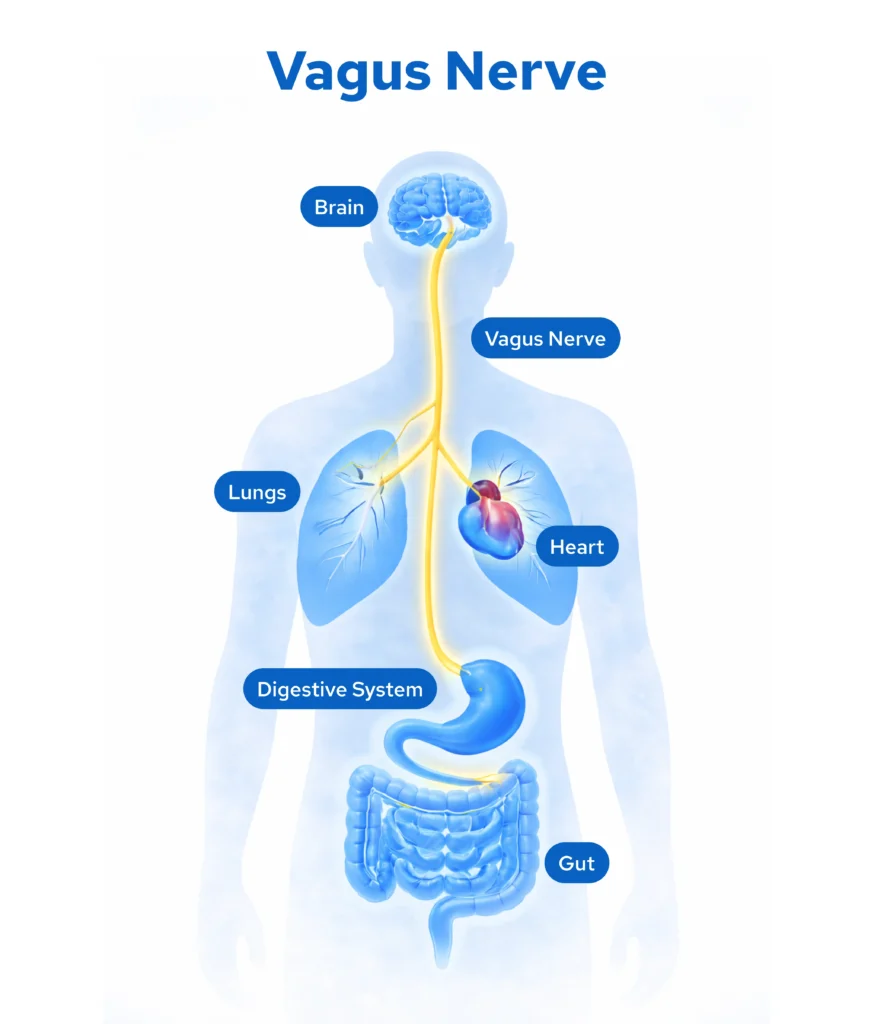
La nervio vago helps connect the brain with major organs throughout the body, including the digestive system.¹
It plays an important role in digestión, gut motility, recovery, and communication between the brain and gut.
Cuando vagal activity is strong, the body can shift more easily into a calmer “rest and digest” Estado.
Digestion tends to feel more stable, the gut becomes less reactive, and recovery often feels easier overall.
But when the nervous system stays stuck in stress mode for too long, the opposite often happens.
The body stays primed for stress.
The gut becomes more sensitive.
And even small triggers can create bigger flare-ups.
For many people, the issue is not simply digestion itself.
It is a body that never fully leaves survival mode.
So when I see digestive symptoms worsening during stress, burnout, poor sleep, or emotional overload, I don’t only think about food.
I think about regulation.
Because digestion is not just a food issue.
It is also closely connected to nervous system regulation and the gut-brain axis.⁶
Lo que dice la investigación
Many people try probiotics, elimination diets, digestive supplements, or cutting out more and more foods to calm symptoms.
And sometimes, these approaches help temporarily.
But for people whose symptoms seem closely linked to stress, poor sleep, overload, or burnout, the pattern often keeps coming back.
That’s what led me to look more closely at the connection between the nervous system and digestion.
One reason this connection matters is because chronic stress does not only affect mood or energy levels.
It also changes signalling inside the body.
When the nervous system stays stuck in survival mode, stress-related inflammatory signals can remain elevated, digestion becomes less efficient, and the gut often becomes more reactive to otherwise normal inputs.
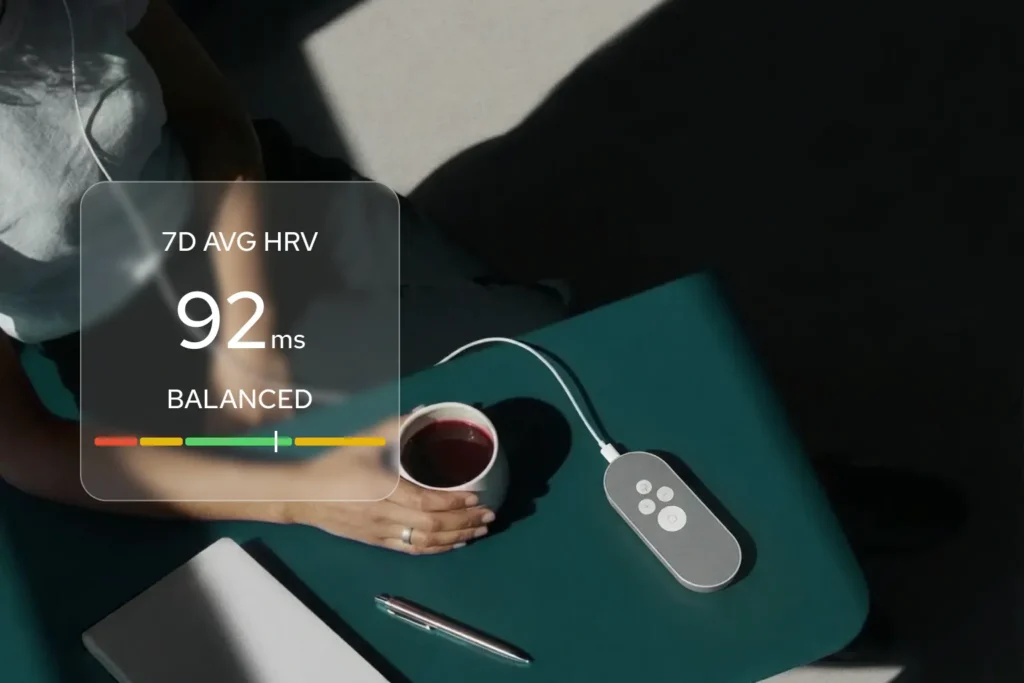
Research around vagus nerve stimulation has explored its effects on HRV (heart rate variability), inflammatory markers, stress regulation, and gut-brain communication – all systems closely connected to digestive regulation and recovery.
In recent years, I became particularly interested in taVNS – transcutaneous auricular vagus nerve stimulation – a gentle, non-invasive way of stimulating the vagus nerve through part of the outer ear⁴ to support the body’s “rest and digest” response.
For many years, vagus nerve stimulation was mainly performed through surgically implanted devices.
But newer developments made it possible to stimulate the vagus nerve externally, without surgery.
And among the devices I explored, Nurosym consistently stood out because of the amount of scientific research and development behind it – which mattered to me, because I wasn’t looking for another wellness trend or quick fix.
Dónde encaja Nurosym (apoyo en el hogar)
In my work, I support both digestion itself and the nervous system patterns often driving reactive gut symptoms underneath.
For some people – particularly those whose bloating, gut sensitivity, or irritable gut-like symptoms seem closely linked to stress, overload, poor sleep, or burnout – I suggest an at-home nervous system support tool.
Ahí es donde Nurosym entra en acción.
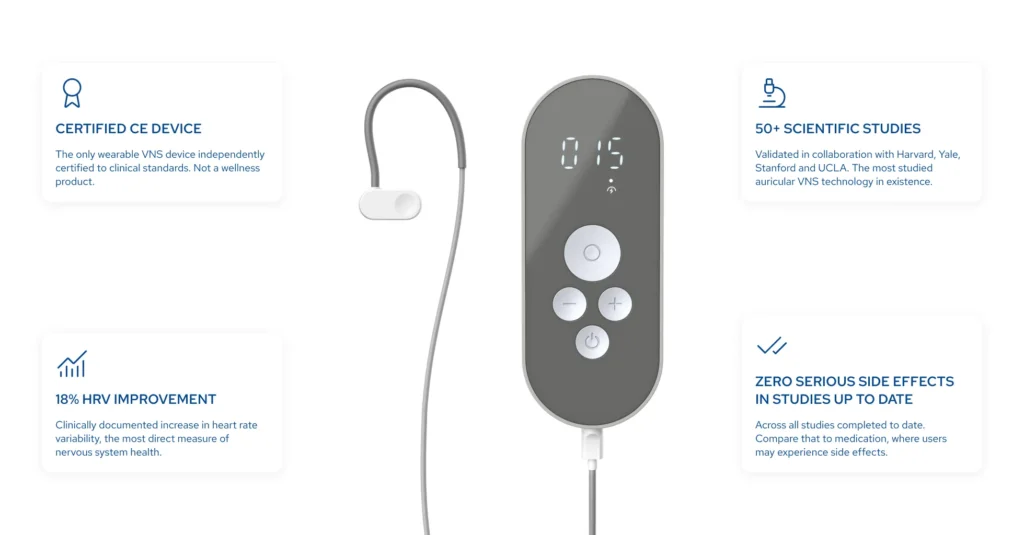
Nurosym is a CE-certified taVNS device designed to gently stimulate the vagus nerve through part of the outer ear using mild electrical stimulation intended to support parasympathetic (“rest and digest”) activity and nervous system regulation.
Compared to most of the devices I explored, Nurosym consistently stood out because of the amount of scientific research and development behind it, with over 60 scientific studies exploring areas such as HRV (heart rate variability), stress regulation, and vagus nerve activity⁵, including collaborations involving institutions such as Harvard, Yale, and Imperial College London.
As a practitioner, I’m naturally cautious with devices that claim to support complex symptoms like digestion, stress, or tiredness.
I wasn’t looking for another wellness trend or a quick fix.
It is not a replacement for nutrition, lifestyle work, testing, or medical care. But for the right person, it may help support a calmer nervous system – which for some people can also mean steadier digestion, better recovery, improved sleep, and less of that constant “wired” feeling running in the background.
What Some People Notice When Regulation Improves

In my work, people rarely describe the change as one dramatic overnight transformation.
People often describe subtle shifts like:
- “I could finally eat out without stressing the whole day about my stomach.”
- “My digestion felt calmer during stressful weeks instead of spiralling.”
- “I didn’t realise how tense my body constantly felt until it finally started relaxing.”
- “Even my sleep improved once my system started calming down.”
And interestingly, many people notice changes beyond digestion alone.
- Better sleep.
- Less tension.
- Feeling calmer in their body.
- Less of that constant “wired” feeling in the background.
Because when the nervous system becomes more regulated, the effects often extend far beyond the gut.
Real-World Patterns I Commonly See
The High-Stress Gut
Symptoms flare up most during periods of pressure, poor sleep, rushed meals, and constant mental overload – even when diet stays exactly the same.
El caso "lo he probado todo"
Some people spend months rotating through probiotics, elimination diets, fasting protocols, low-FODMAP plans, keto, gluten-free eating, supplements, and food-tracking apps.
The Burnout Gut
Bloating starts showing up alongside tiredness, brain fog, tension, poor recovery, and the feeling that the body never fully settles down.
The Unpredictable Gut
Foods tolerated one week suddenly trigger symptoms the next, leaving people constantly second-guessing what they can eat.
Quién podría beneficiarse - Y quién no debería usarlo
Podría beneficiar:
- People with stress-related digestive flare-ups
- Those with irritable gut-like symptoms linked to stress or poor recovery
- People whose gut symptoms worsen during burnout or overload
- Those who feel constantly “on” alongside digestive symptoms
Evitar si:
- You have a pacemaker or implanted cardiac device
- Usted está embarazada
- Ha tenido recientemente un episodio cardíaco grave
- You are under 18
Siempre siga el consejo médico antes de comenzar.
Una forma segura de intentarlo

- Garantía de devolución del dinero de 30 días - explore at home with no risk.
- Espacios de estudio limitados disponibles - some participants may receive a ~€70 subsidy in exchange for providing feedback.
In my work, I help people decide whether this type of nervous system support makes sense for their individual situation and how it fits into a broader root-cause approach.
Final Thoughts: Better Digestion Starts With a More Regulated Nervous System

If you’ve spent years trying to fix digestion only through food, it may be time to look deeper.
Food matters.
But in many cases, the state of the nervous system matters too.
That’s why some people continue struggling even after cleaning up their diet and trying all the “right” things.
Not because they lack discipline.
But because the system regulating digestion may need support too.
Because sometimes the body does not need more restriction.
It needs help shifting out of survival mode.
If your gut still feels reactive despite doing everything “right,” learning more about nervous system regulation and Nurosym may be the next step worth exploring.
Este artículo de blog tiene como objetivo ser informativo y no debe reemplazar el asesoramiento profesional en salud. Consulte siempre con un profesional de la salud para obtener asesoramiento personalizado.
Referencias
- Breit S, Kupferberg A, Rogler G, Hasler G.
Vagus Nerve as Modulator of the Brain–Gut Axis in Psychiatric and Inflammatory Disorders. Front Psychiatry. 2018.
https://doi.org/10.3389/fpsyt.2018.00044 - Bonaz B, Bazin T, Pellissier S.
The Vagus Nerve at the Interface of the Microbiota–Gut–Brain Axis. Front Neurosci. 2018.
https://doi.org/10.3389/fnins.2018.00049 - Konturek PC et al.
Stress and the Gut: Pathophysiology, Scientific Consequences, Diagnostic Approach and Therapy Options. J Physiol Pharmacol. 2011.
https://pubmed.ncbi.nlm.nih.gov/22314561/ - Yap JYY et al.
Critical Review of Transcutaneous Vagus Nerve Stimulation: Challenges for Translation to Scientific Practice. Front Neurosci. 2020.
https://doi.org/10.3389/fnins.2020.00284 - Clancy JA et al.
Non-invasive Vagus Nerve Stimulation in Healthy Humans Reduces Sympathetic Nerve Activity. Brain Stimul. 2014.
https://doi.org/10.1016/j.brs.2014.07.031 - Carabotti M et al.
The Gut-Brain Axis: Interactions Between Enteric Microbiota, Central and Enteric Nervous Systems. Ann Gastroenterol. 2015.
https://pmc.ncbi.nlm.nih.gov/articles/PMC4367209/
Compartir a través de:



 Spanish
  English
  German
  French
  Swedish