
HRV. Resistencia. Recuperación. Motivación. Los cuatro están conectados a un nervio del que la mayoría de los atletas nunca han oído hablar.
Los atletas de élite no solo entrenan más duro. Se recuperan de manera más inteligente. Y después de 15 años como osteópata -y años en las alfombras yo mismo- he llegado a creer que la recuperación es donde más atletas están dejando en la mesa.
Cada atleta serio con el que he trabajado ha dicho alguna versión de lo mismo.
"Estoy haciendo todo bien, entrenando bien y comiendo bien. Durmiendo lo suficiente. Y todavía no me recupero como antes."
Después de años trabajando con todo el mundo, desde trabajadores de escritorio con dolor crónico hasta competidores en BJJ y atletas del Ironman -y pasando por mi propia cuota de lesiones, sobreentrenamiento y estancamientos de recuperación-, comencé a notar algo que ningún protocolo de recuperación estaba abordando.
El problema no fue el programa de entrenamiento. No fue la nutrición. Ni siquiera el sueño.
Fue el sistema nervioso el que coordinó la recuperación después del entrenamiento.
Y para la mayoría de los atletas -recreativos, competitivos o de élite- ese sistema está funcionando silenciosamente por debajo de lo que debería. No por algo que estén haciendo mal. Por algo que nadie ha mencionado.
Quiero decir:
Lo que sigo viendo - en la alfombra y en la clínica
Los atletas que acuden a mí no están mal entrenados. No están poco motivados. No cometen errores obvios.
Ellos rastrean todo. HRV (variabilidad de la frecuencia cardíaca - una medida de la recuperación del sistema nervioso) en su WHOOP o Oura cada mañana. Macros registrados, blancos de proteínas alcanzados. Base de la Zona 2 construida. Baños de hielo después de sesiones duras. Han leído la investigación. Han hecho el trabajo.
Y sin embargo,
Llegué a entender este patrón no solo a través de la práctica sanitaria, sino a través de mi propia capacitación. El deporte ha sido parte de mi vida desde que tengo memoria. Triatlón a distancia olímpico. Entrenamiento con pesas. Y en los últimos años, el Jiu-Jitsu Brasileño - un deporte que me encanta, y un deporte que me ha puesto sobre el tatami con desgarros de la muñeca del rotator, una ruptura muscular, dolor y rigidez en el cuello, y más de unas pocas sesiones donde sabía que algo no estaba bien antes de poder nombrarlo.
Hago mi propio seguimiento de la HRV. Me he sentado con calificaciones crónicamente bajas después de períodos de sobrecarga y he observado que todas las demás métricas se ven bien en el papel. He sido el atleta que está haciendo todo bien y todavía no se recupera. Esa experiencia cambia las preguntas que haces.
He estado a ambos lados de esto. El atleta que insiste. Y el practicante que pregunta por qué el cuerpo no responde como debería.
Lo que oigo de mis clientes sigue el mismo patrón cada vez.
El atleta de BJJ entrena cuatro veces por semana, y su HRV ha estado en los 40’s bajos durante tres semanas seguidas. No están heridos. No están enfermos. Simplemente no se recuperan entre sesiones. Lo describió perfectamente:
"Me duele todo, pero en realidad nada está herido. Mis piernas se sienten pesadas. No sé qué me pasa."
El atleta de CrossFit que alcanzó una meseta hace seis meses y no ha atravesado. Ella está verde en su WHOOP la mayoría de las mañanas. Está haciendo todo lo que los entrenadores sugieren. Sus números de actuación se han estancado.
"Me siento en forma, pero plano. Como si el motor estuviera ahí, pero la energía no está pasando."
El corredor de resistencia está entrenando para su segundo maratón - más disciplinado que cualquiera con quien he trabajado, más consistente con los protocolos de recuperación que la mayoría de los profesionales. Todavía se despierta cansado y sigue descubriendo que sus carreras largas son más difíciles de lo que fueron al mismo ritmo el año pasado.
El soldado de fin – Trabajo a tiempo completo, dos hijos, entrenamiento cinco mañanas por semana antes de que el hogar se despierte. Ninguna definición de libro de texto lo entrena demasiado. Pero su cuerpo ha dejado de responder como cuando empezó.
"No quiero entrenar. Es la primera vez. Y no sé por qué."
Lo que a ninguno de ellos se les había dicho era esto:
La mayoría de los atletas asumen que les falta otra herramienta de recuperación: un mejor suplemento, un protocolo más inteligente y un día de descanso extra. En realidad, la pieza que falta es a menudo la capacidad del sistema nervioso para pasar del estrés a la reparación. Y ese interruptor está controlado por un nervio del que la mayoría de los atletas nunca han oído hablar.
No es tu programa. Es tu sistema nervioso.
Esto es algo que me tomó años de práctica -y años de entrenamiento- para entender completamente.
Tu sistema nervioso comienza el proceso de recuperación antes que tus músculos.
La señal para pasar del estrés simpático a la reparación parasimpática pasa por un nervio y se dispara en cuestión de segundos al terminar una sesión. Si esa señal se activa efectivamente puede influir en la eficiencia de la transición del cuerpo a la recuperación, en la rapidez con que el HRV vuelve al punto de referencia y en lo bien que el cuerpo se adapta antes de la próxima sesión de entrenamiento.
Cada sesión de entrenamiento desencadena una respuesta inflamatoria temporal que es parte de la adaptación normal. Y eso es exactamente lo que debería ser.
Cuando entrenas duro, tus músculos liberan IL-6 (interleucina-6 - una proteína que actúa como señal de entrenamiento y marcador de inflamación). A corto plazo, éste no es el enemigo. Indica al cuerpo que libere compuestos antiinflamatorios, impulsa la descomposición de la grasa y desencadena el proceso de reparación y adaptación. Sin esta señal, no hay crecimiento, ni ganancia de fuerza, ni mejora aeróbica.
El problema no es la inflamación. Pueden surgir problemas cuando la recuperación es incompleta o las señales inflamatorias permanecen elevadas durante más tiempo del esperado.
En un atleta bien recuperado, el IL-6 se eleva durante el entrenamiento y cae en cuestión de horas. TNF-α (factor de necrosis tumoral-alfa - otra citocina pro-inflamatoria) sigue el mismo patrón. El cuerpo hace su trabajo de reparación. HRV se recupera. El atleta se despierta a la mañana siguiente listo para ir.
En algunos atletas crónicamente poco recuperados, los marcadores inflamatorios como IL-6, TNF-α y CRP pueden permanecer elevados por más tiempo de lo esperado.
El dolor persistente puede reflejar tanto las demandas del entrenamiento como los procesos de recuperación que aún no se han resuelto por completo.
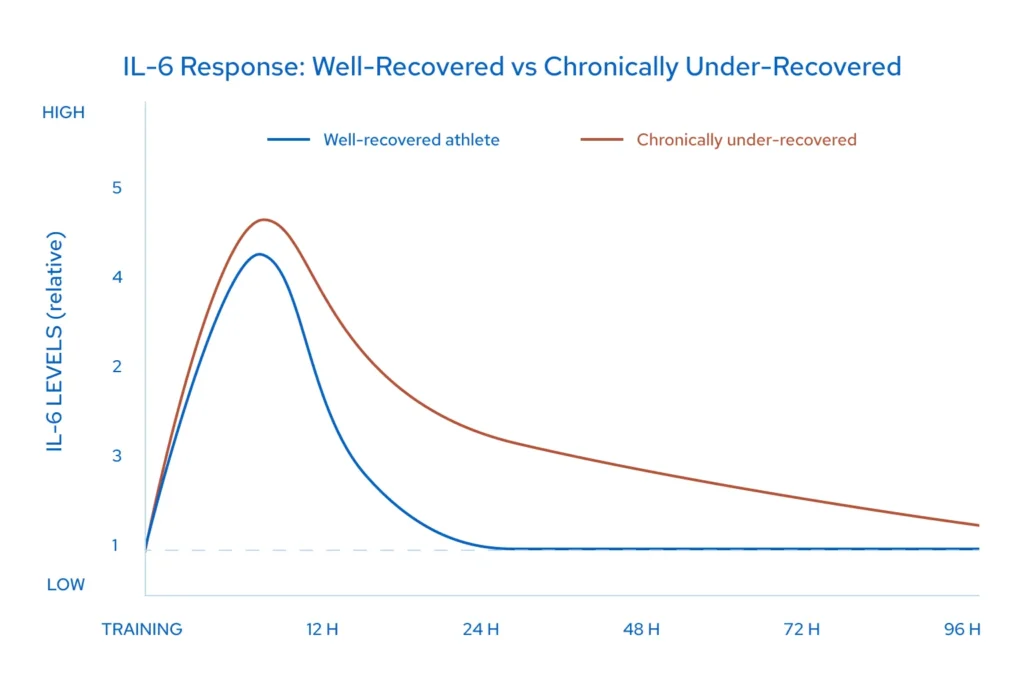
Por eso los atletas que hacen todo bien todavía se sienten como si estuvieran corriendo a través de la arena. El entrenamiento es bueno. La nutrición es buena. El sueño está bien.
La regulación de la recuperación parece estar deteriorada.
Y afecta más que el dolor. Los marcadores inflamatorios persistentemente elevados se han asociado con una función mitocondrial alterada y un rendimiento del ejercicio reducido. Por eso los atletas que no se recuperan bien no solo se sienten doloridos. Su capacidad de resistencia disminuye. Esto puede contribuir a una reducción de la capacidad de ejercicio y un mayor cansancio, no porque el estado físico haya disminuido, sino porque las células que producen energía están trabajando en un ambiente inflamatorio que limita su producción.
Lo que me dejó con una pregunta en la que no podía dejar de pensar:
¿Qué sistema se supone que está ejecutando esta autorización, y por qué ha dejado de funcionar?
Lo que tu HRV realmente te está diciendo
Antes de responder a esa pregunta, una palabra sobre HRV. Porque si lo estás rastreando, ya tienes los datos. Es solo que puede que no los estés leyendo correctamente.
La VFC es principalmente un marcador de la actividad del sistema nervioso autónomo, más que una medida directa de la aptitud.
Específicamente, mide cuán bien tu Sistema nervioso parasimpático (SNP - estado de "descansar, digerir y recuperarse") está funcionando en relación a tu sistema nervioso simpático (SNS - el estado de "lucha o huida").
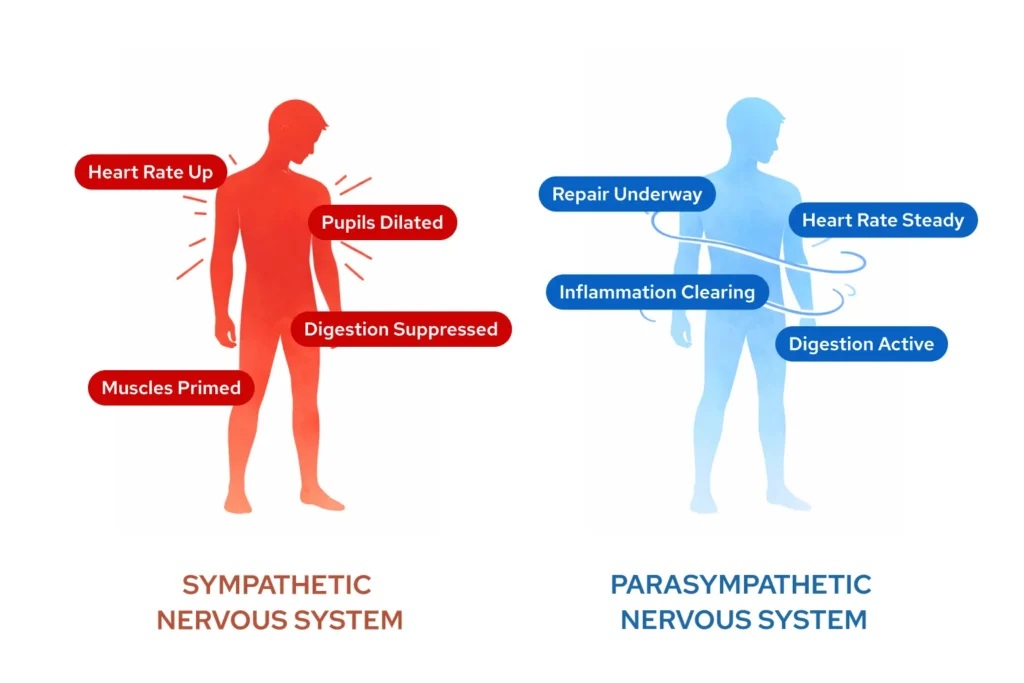
La métrica que más importa es RMSSD (raíz cuadrada media de las diferencias sucesivas - la medición HRV patrón oro, más sensible a la actividad parasimpática).
Cuando tu HRV baja después de una sesión dura y luego se recupera durante 24-48 horas, eso es un sistema nervioso saludable haciendo su trabajo. Entrena duro, recupera, adapta. El ciclo funciona.
Cuando tu HRV baja y se mantiene bajo - ese no es solo un mal día de recuperación. Ese es un sistema nervioso que ha perdido su capacidad de cambiar estados - y una señal directa de que tu capacidad de entrenamiento para la próxima sesión ya está comprometida.
Y aquí está la conexión que la mayoría de los atletas pierden:
El mismo estado del sistema nervioso que suprime la HRV también suprime la eliminación de la inflamación y limita la adaptación que se suponía que el entrenamiento iba a desencadenar.
La activación simpática crónica está asociada con una elevación prolongada del cortisol, lo que puede influir en la señalización inflamatoria. El IL-6 elevado provoca cansancio, dolor, alteración del estado de ánimo y una caída en la motivación. Un bajo HRV no es solo una advertencia para la recuperación. Un HRV persistentemente bajo puede indicar que el sistema nervioso autónomo no se ha recuperado completamente.
Tu puntuación WHOOP no mide lo cansadas que están tus piernas. Es medir si tu sistema nervioso ha pasado a un estado en el que la adaptación es posible.
"Lo he probado todo." Probablemente lo has hecho. Esto es lo que en realidad falta.
Cada método de recuperación que la mayoría de los atletas usan tiene un valor genuino. Yo mismo uso varios de ellos.
Pero esto es lo que observo en la práctica... y en mi propio entrenamiento.
- Baños de hielo/exposición al frío Realmente reduce el dolor agudo y apoya la activación parasimpática en el corto plazo. Pero requieren 10-15 minutos en agua a 10-15°C. Para la mayoría de las personas -después de una larga sesión de capacitación, un día completo de trabajo y compromisos familiares- encontrar esa ventana, y la fuerza de voluntad para usarla, es una barrera. Y no regulan directamente el tono vagal con el tiempo.
- Prendas de compresión - Reducir el DOMS (dolor muscular de inicio retardado, la rigidez que alcanza su punto máximo 24-48 horas después del entrenamiento) y apoyar la circulación. Bueno como parte de la imagen, pero no hay un efecto directo significativo en la vía de los citocinos inflamatorios.
- Proteína y creatina - esencial para la reparación muscular y la restauración del ATP. Ambos son cosas que recomiendo. Ni llega directamente al sistema nervioso ni al mecanismo de eliminación inflamatoria.
- Omega-3 y curcumina - efecto antiinflamatorio genuino, respaldado por la investigación. Pero periféricas: trabajan en la química de la inflamación, no en el sistema regulatorio que controla cuándo comienza y se detiene la inflamación.
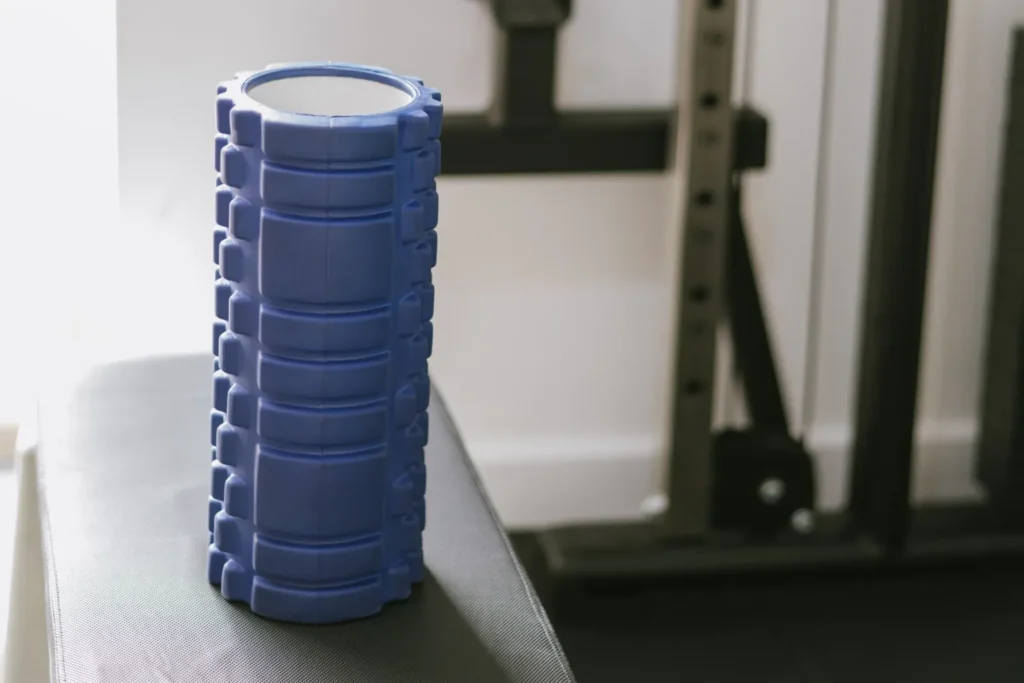
- Laminación de espuma/pistola de masaje - efecto local sobre la tensión muscular y el flujo sanguíneo. Valioso. Sin impacto sistémico en el tono vagal o la regulación de las citocinas.
- Magnesio - puede apoyar la calidad del sueño y la recuperación en algunas personas, aunque la evidencia de que mejora directamente el tono vagal sigue siendo limitada.
- Respiración y respiración en caja - activar directamente el nervio vago. Realmente efectivo. Pero requiere silencio, concentración y tiempo que tal vez no tengas entre una sesión de entrenamiento y el resto del día. Y para los atletas que ya están en un estado de hiperactividad, acostumbrarse a la respiración suele ser más difícil de lo que parece.
"Hago el baño de hielo. Tomo la creatina y el omega-3. Hago trabajo respiratorio antes de acostarme. Mi HRV todavía está bajo. Aún no me estoy recuperando. ¿Qué me estoy perdiendo?"
Estos no son enfoques erróneos. La mayoría de ellos están exactamente en lo cierto.
El problema es que todos ellos trabajan en partes individuales de la ecuación de recuperación -pero ninguno de ellos trabaja directamente en el interruptor del sistema nervioso que hace posible la recuperación en primer lugar.
El baño de hielo ayuda. Los suplementos ayudan. La respiración ayuda.
La reducción de la actividad vagal puede influir en la regulación y recuperación inflamatoria, aunque la recuperación también se ve afectada por la carga de entrenamiento, el sueño, la nutrición y la salud general.
Un atleta con el que trabajé tenía el protocolo de recuperación más completo que había visto. Baño de hielo después de cada sesión. Ocho horas de sueño, seguidas con Oura. Proteína dentro de los 30 minutos después del entrenamiento. Omega-3, magnesio y creatina. Masaje semanal. Su HRV había estado crónicamente bajo durante cuatro meses. Su rendimiento se había estancado. Su motivación estaba decayendo.
Él estaba tratando cada rama del árbol de recuperación. Nadie había mirado lo que estaba impulsando todo el asunto.
El nervio detrás de la respuesta a la recuperación
Para cuando había estado practicando lo suficiente como para ver este patrón de manera consistente, había dejado de preguntar: "¿Qué protocolo de recuperación le falta a este atleta?"
Y empezó a preguntar: "¿Qué sistema se supone que está haciendo pasar el cambio de simpático a parasimpático y por qué no funciona?"
Esa pregunta me llevaba de vuelta al mismo lugar.
Al nervio vago (vagus is Latin for “wandering” – it runs from the brainstem all the way through the chest and abdomen, connecting the brain directly to the heart, lungs, gut, and immune system).
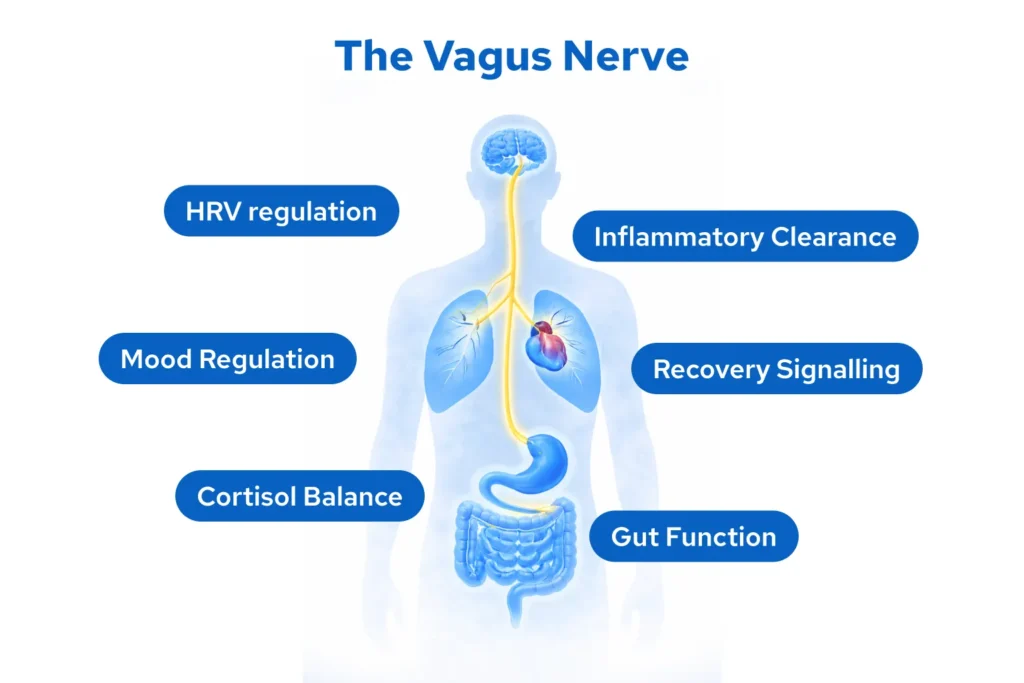
Es una de las vías principales involucradas en la comunicación entre los sistemas nervioso e inmunológico y puede ayudar a regular las respuestas inflamatorias.
Esta es la vía antiinflamatoria colinérgica (CAP - el mecanismo del nervio vago para enviar señales de acetilcolina a los macrófagos, instruyéndolos a dejar de producir IL-6 y TNF-α).
Cuando el tono es vagal (la medida de lo bien que funciona el nervio vago - se refleja directamente en su HRV) es saludable, la secuencia funciona según lo previsto. El entrenamiento crea una inflamación aguda. El nervio vago activa el CAP. Las citocinas están limpias. El HRV se recupera. El atleta se recupera y se adapta.
Cuando se suprime el tono vagal -por estrés acumulado en el entrenamiento, sueño deficiente, presión psicológica o sobrecarga crónica- la actividad de CAP puede reducirse.
Estos marcadores inflamatorios pueden permanecer elevados por más tiempo. El cuerpo permanece en modo de reparación pero no puede completar la reparación. El HRV se mantiene bajo. El atleta se siente en forma pero plano, pesado pero no herido, cansado pero incapaz de descansar.
Piense en el tono vagal como un regulador importante dentro del sistema de recuperación del cuerpo. Una buena función vagal puede apoyar la recuperación junto con la nutrición, el sueño y el entrenamiento.
Lo que me llevó a la única pregunta que quedaba: ¿Hay una manera directa de alcanzarlo?
Lo que encontré - Y por qué fui escéptico
Seré honesto - cuando me encontré por primera vez con la investigación sobre la estimulación del nervio vago (VNS), mi reacción inmediata fue el escepticismo.
Como osteópata, estoy entrenado para ser cauteloso con cualquier cosa que parezca un atajo. El enfoque terapéutico establecido era quirúrgico: un dispositivo implantado en el pecho, conectado directamente al nervio vago del cuello y utilizado para estados depresivos resistentes a la terapia. Completamente irrelevante para un atleta que intenta eliminar la inflamación post-entrenamiento.
Entonces encontré algo que no esperaba.
Los investigadores habían identificado una rama del nervio vago que discurre justo debajo de la superficie de la piel, en el oído externo, en un pequeño trozo de cartílago llamado trago, a la entrada del canal auditivo.
Resonancia magnética funcional (fMRI) Los estudios han demostrado la activación de las regiones cerebrales asociadas con las vías vagales.
El oído externo es actualmente el sitio de estimulación no invasiva más estudiado.
Los científicos desarrollaron una técnica que utiliza señales eléctricas de bajo nivel: Estimulación del nervio vagus auricular transcutáneo (taVNS - "transcutáneo" significa a través de la piel, "auricular" significa a través del oído).
Un estudio revisado por pares mostró que la actividad vagal aumentó en 61% en solo 5 minutos de estimulación. Marcadores inflamatorios IL-6 - la citochina principal detrás del dolor crónico post-entrenamiento - reducido por 78% en tres meses. TNF-a por −23%. HRV mejorado por +18%. El cansancio disminuyó −48%.
Los datos de IL-6 y TNF-α provienen de estudios en casos cardíacos, no en atletas. Pero el mecanismo es idéntico. Se cree que la vía antiinflamatoria colinérgica regula la señalización inflamatoria en diferentes contextos fisiológicos. Simplemente responde a la activación vagal.
La misma vía que conduce a la eliminación de la inflamación después del entrenamiento es la que estos estudios midieron.
Estaba buscando algo que llegara al sistema mismo. Y esta fue la primera cosa que encontré que llegó.
Pero todavía había un problema.
La investigación fue detallada. El mecanismo propuesto parecía biológicamente plausible. Lo que necesitaba era algo que los atletas realmente pudieran usar -en casa, después de una sesión, sin cita médica, sin el tipo de ventana de recuperación dedicada que tienen los atletas profesionales y la mayoría de las personas no.
Lo encontré. Y fue más sencillo de lo que esperaba.
Lo que muestra la investigación
Antes de recomendar esto a los atletas, quería asegurarme de que la evidencia coincidía con lo que había estado viendo.
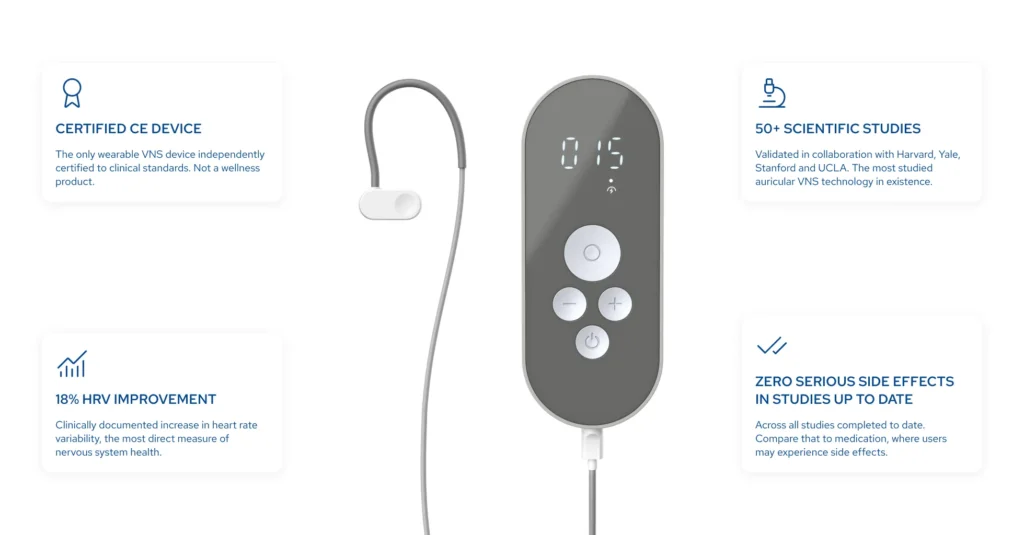
Resultado | Métrico |
−78% | Marcadores inflamatorios IL-6 (estudio de 3 meses) |
−23% | Marcadores inflamatorios de TNF-α |
+18% | HRV (Variabilidad del ritmo cardíaco) |
+61% | Actividad del nervio vago (dentro de los 5 minutos de uso) |
−48% | Cansancio |
−38% | Dolor generalizado |
−35% | Pensamientos de ansiedad |
−45% | Estados depresivos / estado de ánimo bajo |
Más de 60 estudios científicos completados. Ningún evento adverso grave notificado hasta la fecha.
Lo que me llamó la atención no fue un número único. Era el patrón - y cómo se correspondía con precisión a la cascada que había estado observando en atletas poco recuperados durante años.
Varios resultados relacionados con la recuperación, incluyendo HRV, cansancio y marcadores inflamatorios, han sido investigados en estudios publicados, aunque la evidencia varía según el resultado.
Disminución de la inflamación. Mejora del HRV. Alivio del cansancio. Reducción del dolor.
Y luego - los dos números en la parte inferior. Los que la mayoría de los atletas no esperan.
No esperaba que un solo dispositivo mostrara resultados en todos estos simultáneamente. Pero eso es exactamente lo que los datos mostraron. Y la razón tuvo todo el sentido una vez que entendí el mecanismo.
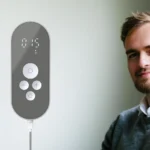
El dispositivo que produjo estos resultados se llama Nurosym.
El restablecimiento de recuperación de 15 minutos que ahora recomiendo

Nurosym es un dispositivo taVNS con marca CE desarrollado por Parasym, una empresa con sede en el Reino Unido que lleva más de 10 años realizando actividades de investigación e innovación y ha invertido más de 10 millones de libras esterlinas en investigación científica.
Respaldado por más de 60 estudios revisados por pares, incluyendo colaboraciones con instituciones como Harvard, UCL y King’s College London.
Recomendado por más de 1000 profesionales de la salud. Más de 5 millones de sesiones completadas.
Utiliza tecnología patentada Tecnología AVNTTM (Terapia de neuromodulación vagal auricular - una señal eléctrica calibrada con precisión que se transmite a través del tragus del oído izquierdo, estimulando directamente la rama auricular del nervio vago).
A efectos prácticos, se sujeta suavemente a la oreja con un pequeño cable: discreto, ligero y fácil de usar.
Cómo funciona
Nurosym no es un sustituto para los protocolos de recuperación que ya están funcionando para ti. El sueño sigue siendo importante. Las proteínas siguen siendo importantes. El baño de hielo todavía importa.
Lo que añade es la activación directa de la vía colinérgica antiinflamatoria -el mecanismo del nervio vago que determina con qué rapidez se aclaran las citocinas después del entrenamiento, qué tan rápido se recupera el HRV y qué tan completamente el cuerpo pasa del estrés simpático a la recuperación parasimpática.
A diferencia del trabajo de respiración, no requiere que estés en el espacio mental adecuado para trabajar. A diferencia de un baño de hielo, no requiere fuerza de voluntad que tal vez no tengas después de una sesión dura. A diferencia de los suplementos, no es ajustar la química en la periferia.
Está diseñado para estimular las vías vagales involucradas en la regulación de la recuperación. Puede complementar otras estrategias de recuperación basadas en evidencia.
Cómo se usa
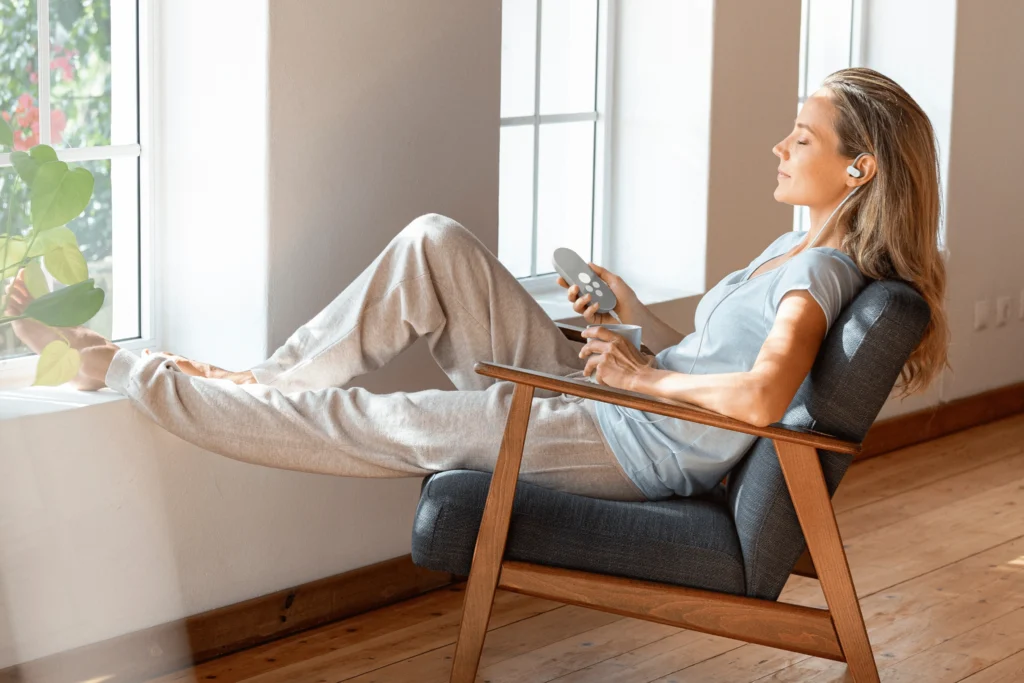
15 a 30 minutos. Después de una sesión de entrenamiento. En el camino a casa en el coche. Mientras comías tu comida de recuperación. Mientras te estirabas. Mientras mirabas algo. Sin hacer nada en absoluto.
No se requiere baño de hielo. No hay habitación silenciosa. No hay una ventana dedicada a la recuperación. No se requiere preparación mental. No se requiere fuerza de voluntad.
Te lo conectas a la oreja con un cable pequeño, discreto y ligero - y se puede usar mientras el resto del día continúa alrededor de él. En el trayecto. A la mesa de la cocina. En el sofá. Dondequiera que estén los próximos quince minutos.
Seré honesto - mi propia rutina vespertina no es perfecta. Soy un padre trabajador que lleva a cabo una práctica. Algunas noches, el baño de hielo no sucede. Se omite la respiración. El cronometraje de las proteínas no funciona.
Lo que uso consistentemente es Nurosym. No porque sea lo único que importa, sino porque es lo único que cabe en la noche que realmente tengo, no la noche que planeé.
Nurosym puede ser particularmente adecuado:
- El atleta cuyo HRV se mantiene crónicamente bajo a pesar de sus sólidos hábitos de recuperación
- El atleta que se siente en forma pero con buen rendimiento ha estabilizado sin una razón obvia
- El BJJ, el MMA o el contacto con un atleta deportivo que lidia con dolores acumulados que nunca se resuelven por completo
- El atleta de resistencia cuya resistencia ha dejado de mejorar a pesar del entrenamiento constante
- El atleta de CrossFit cuyos números se han estancado a pesar de hacer todo bien
- El guerrero del fin de semana cuyo cuerpo simplemente no se recupera entre sesiones como antes
- Cualquiera que haya dicho "no quiero entrenar" por primera vez - y sepa que eso no es lo suyo
El estado que requiere son los estados que ya proporciona el drive home.
Por qué la recuperación rara vez es lo único que cambia
Algo que veo consistentemente - y que los atletas rara vez esperan.
La misma supresión del tono vagal que ralentiza la eliminación de la inflamación y aumenta el HRV también provoca caídas del estado de ánimo, caídas de la motivación y una sensación mental plana que los atletas de alto nivel experimentan pero de la que rara vez hablan.
Los datos de la investigación cuentan la misma historia: 35% pensamientos ansiosos, 45% estados depresivos.
Estas no son coincidencias. Son el mismo sistema que se expresa en diferentes direcciones.
Los atletas que acuden a mí en relación con la recuperación y el rendimiento comienzan a mencionar -casi como un detalle- que se sienten más agudos mentalmente. La irritabilidad de fondo ha disminuido, por lo que quieren volver a entrenar de una manera que no habían hecho durante meses.
Esto tiene un sentido fisiológico.
El bajo VFC se ha asociado con el estrés fisiológico, aunque las relaciones con el cortisol y la testosterona varían entre estudios. El cortisol crónicamente elevado provoca trastornos del estado de ánimo, baja motivación y agotamiento cognitivo que hacen que entrenar parezca una obligación en lugar de un impulso.
Tanto los factores fisiológicos como psicológicos influyen en la motivación y el tono vagal está en el centro de ella.
Cuando el sistema de recuperación comienza a funcionar correctamente, se produce la frescura mental. No como un evento adverso, sino como parte de la misma cascada regulatoria.
¿Es esto correcto para ti?
Si algo de esto te resulta familiar -HRV que no volverá a subir, dolor que no se aclarará, rendimiento que se ha estancado, motivación que ha caído en silencio-, vale la pena explorarlo seriamente.
Una garantía de devolución del dinero de 30 días significa que no hay riesgo financiero. O hace una diferencia significativa para tu recuperación y HRV, o lo devuelves.
Nurosym puede valer la pena considerarlo si:
- Su HRV ha sido suprimida crónicamente a pesar de los buenos hábitos de sueño y recuperación.
- Te estás recuperando más lentamente entre sesiones que antes
- El dolor y el cansancio acumulados están afectando la calidad del entrenamiento
- Tu motivación para entrenar ha disminuido sin una razón obvia
- Quieres apoyar el reinicio del sistema nervioso que hace que todo lo demás funcione mejor
Nurosym no es adecuado para todos. Si usted tiene un dispositivo cardíaco implantado como un marcapasos, está embarazada, ha tenido un evento cardíaco grave en los últimos cinco años o es menor de 18 años, por favor no lo use. Como con cualquier intervención nueva, siempre vale la pena consultar primero con su profesional de salud si tiene síntomas médicos existentes.
Los atletas que mejoran más rápido no siempre son los que entrenan más duro. A menudo son los que se recuperan más rápido, cuyos sistemas nerviosos vuelven al punto de partida lo suficientemente rápido como para que la siguiente sesión sea importante.
Tu sistema nervioso tiene un interruptor que te mueve desde el estrés del entrenamiento hasta la recuperación que permite la adaptación. Y para muchos atletas -especialmente aquellos que entrenan duro mientras manejan una vida plena- ese cambio está yendo a peor de lo normal.
Apoyarlo directamente, en 15 minutos, puede ser el área ignorada en un protocolo que ya está haciendo casi todo bien -y la diferencia entre alcanzar tu techo de rendimiento y romperlo.
La recuperación no termina cuando haces ejercicio.
Si ya estás entrenando de manera inteligente, pero sigues luchando con una VFC baja, dolor persistente o recuperación lenta, puede valer la pena explorar cómo apoyar a tu sistema nervioso puede complementar tu rutina de recuperación existente.
Este artículo refleja mi evaluación profesional de la evidencia y mis 15 años de experiencia clínica como osteópata y especialista en rehabilitación funcional. Es posible que reciba un acuerdo de referencia por compras realizadas a través de los enlaces en este artículo. Solo recomiendo enfoques que he examinado cuidadosamente y me mantendría al tanto de mis propios clientes y en mi propia capacitación. Este no es un consejo médico - siempre consulte a un profesional de la salud calificado antes de comenzar cualquier nueva intervención. Las cifras reflejan el cambio relativo en los estudios revisados por pares en poblaciones de estudio específicas; los resultados individuales pueden variar.
- Ashley Ridout, osteópata, cinturón azul de BJJ, especialista en rehabilitación funcional y educadora sobre el dolor | Precision Wellbeing
Este artículo de blog tiene como objetivo ser informativo y no debe reemplazar el asesoramiento profesional en salud. Consulte siempre con un profesional de la salud para obtener asesoramiento personalizado.
Referencias
- Tracey KJ. The inflammatory reflex. Naturaleza. 2002;420:853–859. https://doi.org/10.1038/nature01321
- Stavrakis S, et al. Low-level vagus nerve stimulation suppresses post-operative atrial fibrillation and inflammation: A Randomized Study. JACC: Clinical Electrophysiology. 2020. https://pubmed.ncbi.nlm.nih.gov/29759717/
- Laborde S, et al. Vagal tank theory: the three Rs of cardiac vagal control functioning – Resting, Reactivity, and Recovery. Frontiers in Neuroscience. 2022. https://www.frontiersin.org/journals/neuroscience/articles/10.3389/fnins.2018.00458/full
- Redgrave J, et al. Safety and tolerability of transcutaneous vagus nerve stimulation in humans; a systematic review. Estimulación Cerebral. 2018;11(6):1225–1238. https://doi.org/10.1016/j.brs.2018.08.010

 Spanish
  English
  German
  French
  Swedish
  Italian