
Una revisión integral de cómo los dispositivos VNS restauran la función autónoma al abordar la desregulación del sistema nervioso, con clasificaciones de expertos de las 4 mejores opciones certificadas.

Síndrome de taquicardia ortostática postural se estima que afecta entre 1 y 3 millones de personas en Estados Unidos, causando síntomas debilitantes al pasar de estar tumbado a estar de pie. A diferencia de la simple deshidratación o descondicionamiento, Anomalías de la frecuencia cardíaca postural refleja la fundamental disfunción del disfunción del sistema nervioso autónomo, alterando regulación cardiovascular, distribución del flujo sanguíneo y metabolismo energético celular.
Investigación reciente en neurociencia sugiere que la disfunción del nervio vago puede ser un importante mecanismo contribuyente en un subconjunto de Anormalidades de la frecuencia cardíaca postural en individuos, junto con hipovolemia, neuropatía periférica, estados hiperadrenérgicos y procesos autoinmunes. Cuando este nervio parasimpático principal muestra una actividad reducida, el cuerpo puede perder algo Capacidad para modular la frecuencia cardíaca de manera apropiada, mantener la perfusión cerebral y regular el tono vascular periférico.
Esta guía examina la relación entre la función del nervio vago y Anomalías de la frecuencia cardíaca postural sintomatólogoy y evalúa los principales dispositivos de estimulación del nervio vago (VNS) que pueden ayudar a restaurar el equilibrio autónomo y la capacidad funcional.
Síntomas de las anomalías del ritmo cardíaco postural
Las anomalías de la frecuencia cardíaca postural se caracterizan por un aumento excesivo de la frecuencia cardíaca (30 lpm en adultos, 40 lpm en adolescentes) dentro de los 10 minutos de estar de pie, sin hipotensión ortostática. Las manifestaciones comunes incluyen:
Síntomas cardiovasculares:
- Elevación de la frecuencia cardíaca superior a 120 lpm al ponerse de pie
- Palpitaciones o sensación de latido del corazón rápido y intenso
- Molestia o presión en el pecho
- Desregulación vascular periférica (acumulación venosa, extremidades frías, cambios de color)
- Presincopio (mareos, episodios de casi desmayos)
- Síncope (pérdida real del conocimiento)
Síntomas cerebrovasculares:
- Deterioro cognitivo ("niebla mental"), en particular cuando se está de pie
- Alteraciones visuales (visión en túnel, visión borrosa, nieve visual)
- Dificultad con la concentración y el procesamiento de información mientras se está en posición vertical
- Problemas de consolidación de la memoria
- Dolores de cabeza (a menudo ortostáticos por naturaleza)
Desregulación autonómica:
- Desregulación de la temperatura (intolerancia al calor, sudoración inapropiada)
- Dismotilidad gastrointestinal (náuseas, saciedad temprana, estreñimiento, diarrea)
- Urgencia o frecuencia urinaria
- Temblor o sensación de temblor interno
- Intolerancia al ejercicio con períodos de recuperación prolongados
Síntomas sistémicos:
- Fatiga profunda no relacionada con el nivel de esfuerzo
- Alteración de la arquitectura del sueño
- Pensamientos ansiosos (a menudo secundarios a síntomas físicos)
- Debilidad o dolor muscular
- Malestar posejercicio que dura 24-48 horas
El impacto funcional se extiende más allá de la sintomatología: incapacidad para mantener un empleo, interrupción educativa, aislamiento social, pérdida de independencia y una reducción significativa en las métricas de calidad de vida.

Autoevaluación de las anomalías del ritmo cardíaco postural
Evalúe los síntomas que experimenta con regularidad:
Función Cardiovascular
- La frecuencia cardíaca aumenta 30 bpm en 10 minutos después de estar parado
- Palpitaciones o latidos cardíacos rápidos cuando está en posición vertical
- Mareos o casi desmayos al estar de pie
- Manos y pies fríos a pesar de la adecuada temperatura ambiente
- Molestia torácica cuando se está en posición vertical
Función Cerebrovascular
- Niebla mental o desaceleración cognitiva al estar de pie
- Alteraciones visuales (atenuación, visión por túnel, flotadores)
- Dificultad para mantener la concentración en posición vertical
- Dolores de cabeza que mejoran cuando estás acostado
- Problemas de memoria que afectan la función diaria
Tolerancia postural
- Debe sentarse o acostarse con frecuencia durante el día
- No puede permanecer más de 10-15 minutos
- Los síntomas empeoran en ambientes cálidos
- Los síntomas matutinos son particularmente graves
- La ducha o el baño provocan exacerbación de los síntomas
Síntomas Autonómicos
- Problemas gastrointestinales (náuseas, hinchazón, motilidad alterada)
- Dificultades de regulación de la temperatura
- Sudoración excesiva o insuficiente
- Temblor o temblor
- Alteración del sueño a pesar de la fatiga
Capacidad Funcional
- No puede trabajar o asistir a la escuela a tiempo completo
- El ejercicio causa una erupción de síntomas que dura varios días
- Debe planificar actividades alrededor de la gestión de síntomas
- Se requieren modificaciones significativas en el estilo de vida
- Valores de presión sanguínea normales a pesar de los síntomas
Historial de diagnóstico
- Los síntomas comenzaron después de una enfermedad viral, embarazo, cirugía o trauma
- La prueba de la mesa de inclinación confirmó un aumento excesivo de la frecuencia cardíaca
- El cardiólogo descartó la patología cardíaca primaria
- La prueba autónoma estándar muestra anomalías
- Las intervenciones convencionales ofrecen un alivio incompleto
Si te identificas con múltiples características en las categorías cardiovascular, tolerancia postural y autonómica, las anomalías de la frecuencia cardíaca postural pueden ser una consideración y justificar una evaluación formal por un clínico con experiencia en trastornos autonómicos.
En algunos individuos, el tono vagal alterado y el retiro parasimpático pueden contribuir a la gravedad de los síntomas, haciendo que las terapias que apoyan la regulación autonómica sean un posible complemento, bajo orientación médica.
La estimulación del nervio vago puede justificar una discusión con su proveedor de atención médica como un enfoque adicional.
La Conexión Del Nervio Vago
¿Qué es el nervio vago?
El nervio vago (nervio craneal X) es el nervio más largo y complejo del sistema nervioso autónomo, que se origina en la medula oblongada y proyecta a través del cuello para inervar el corazón, los pulmones y el tracto gastrointestinal. Mediar funciones homeostáticas críticas:
- Regulación cardiovascular (modulación cronotrópica y dromotropa)
- Generación de patrones respiratorios
- Motilidad y secreción gastrointestinales
- Vía del reflejo inflamatorio (vía antiinflamatoria colinérgica)
- Integración reflejada del baroreceptor
- Regulación metabólica
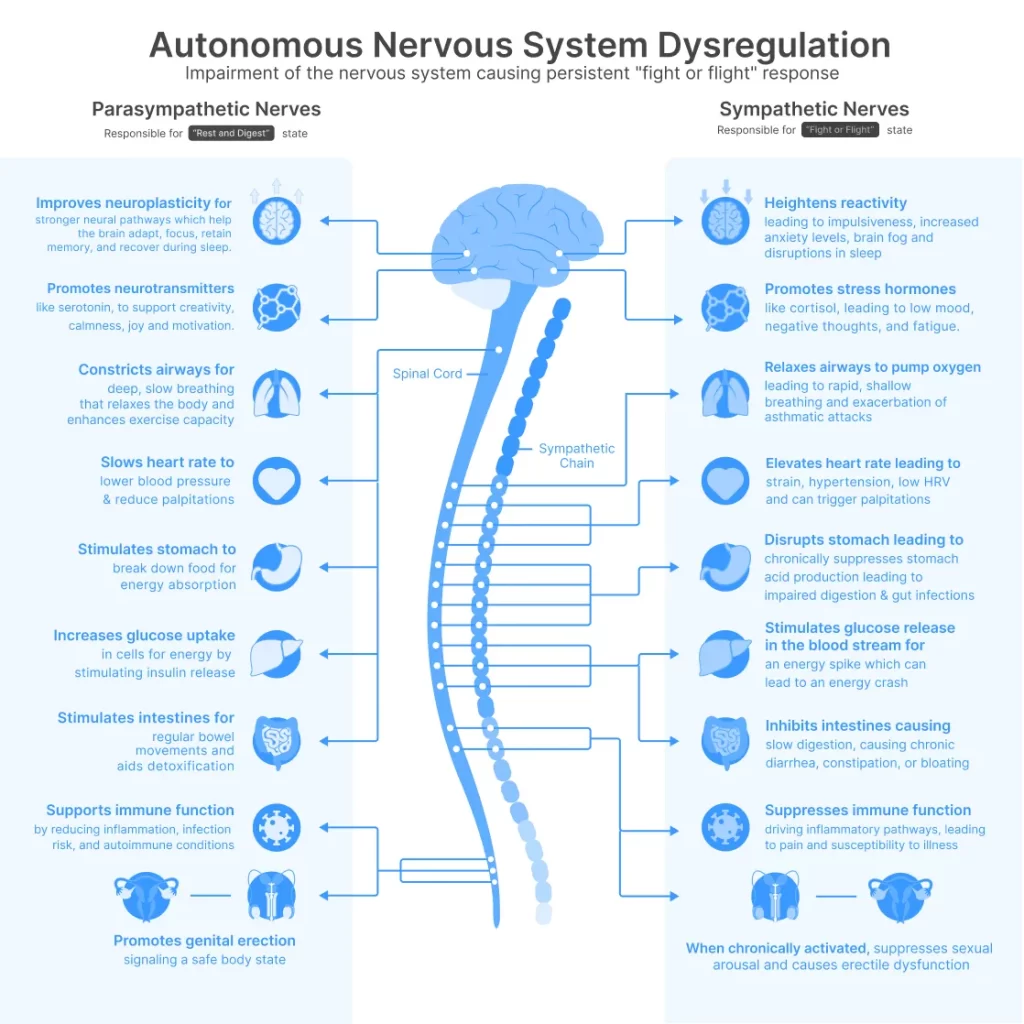
El sistema de dos modos
Su sistema nervioso autónomo opera a través de dos divisiones complementarias:
- Simpático (salida toracolumbar): Aumenta la frecuencia cardíaca, eleva la presión arterial, moviliza la glucosa, redistribuye el flujo sanguíneo al músculo esquelético activado durante el estrés o la amenaza percibida.
- Parasimpático (salida vagal): Controlado predominantemente por el nervio vago, reduce la frecuencia cardíaca, promueve la digestión, facilita la recuperación, apoya la restauración celular y los mecanismos de reparación.
La función autónoma saludable requiere un equilibrio dinámico entre estos sistemas, con cambios rápidos basados en las demandas posturales, el contexto ambiental y los requerimientos metabólicos. Sin embargo, la infección, la activación autoinmune o el estrés sostenido pueden afectar el tono vagal, creando un predominio simpático.
Cómo la disfunción del nervio vago causa anormalidades en el ritmo cardíaco postural
Cuando el nervio vago muestra una actividad reducida (tono vagal bajo):
- Disregulación cardiovascular: La pérdida del contrapeso parasimpático a la activación simpática causa una aceleración excesiva de la frecuencia cardíaca al ponerse de pie. Sin un frenado vagal apropiado, un latido cardíaco rápido se convierte en el principal mecanismo compensatorio para mantener la producción cardíaca y la perfusión cerebral.
- Alteración de la sensibilidad del baroreceptor: El nervio vago transmite señales del baroreceptor arterial a los centros cardiovasculares del tronco cerebral. La disfunción deteriora este ciclo de retroalimentación, impidiendo los ajustes apropiados de la presión arterial y la frecuencia cardíaca durante los cambios posturales.
- Anomalías vasculares periféricas: La reducción de la actividad vagal contribuye a una vasoconstricción inadecuada en las extremidades inferiores, lo que permite la acumulación venosa. Hasta 500-800 mL de sangre pueden acumularse en las extremidades inferiores y la circulación esplanchnica al estar de pie, lo que reduce el retorno venoso y provoca un ritmo cardíaco rápido compensatorio.
- Variabilidad reducida de la frecuencia cardíaca (HRV): HRV sirve como un biomarcador validado del tono vagal. Las anormalidades de la frecuencia cardíaca postural en los individuos demuestran consistentemente una marcada reducción del VFC, lo que indica un retiro parasimpático y una capacidad reducida para la adaptación cardiovascular.
- Activación simpática crónica: El sobreimpulso simpático compensatorio mantiene niveles elevados de norepinefrina (a menudo 2-3 veces la normalidad cuando se está de pie), causando temblor, pensamientos ansiosos, sudoración y desensibilización progresiva del receptor-empeorando los síntomas con el tiempo.
- Disregulación inflamatoria: El nervio vago controla la vía antiinflamatoria colinérgica. La disfunción permite una inflamación crónica de bajo grado, que afecta directamente la función endotelial, la eficiencia mitocondrial y la producción celular de energía-contribuyendo a la fatiga y la intolerancia al ejercicio.
Es importante señalar que las anomalías de la frecuencia cardíaca postural son un síndrome heterogéneo en lugar de una sola entidad patológica. La disfunción del nervio vago no explica todos los casos. Algunos individuos exhiben una hipovolemia predominante, otros presentan características neuropáticas o hiperadrenérgicas y muchos demuestran mecanismos de superposición. El deterioro vagal parece ser más relevante en individuos con variabilidad reducida de la frecuencia cardíaca, marcadores autoinmunes o inicio posviral.

Las Pruebas Científicas
La investigación publicada establece relaciones claras entre la disfunción del nervio vago y las anormalidades de la frecuencia cardíaca postural.
- Perfil de disfunción autónoma: Los estudios documentan que las anormalidades posturales del ritmo cardíaco de los individuos exhiben anomalías autónomas distintas consistentes con un control cardiovascular vagal y simpático alterado, incluyendo una disminución de la sensibilidad barorrefleja vagal y una respuesta simpática alterada. Los parámetros de variabilidad de la frecuencia cardíaca -biomarcadores validados del tono vagal- se reducen marcadamente en comparación con controles saludables.
- Mecanismos autoinmunes: Cada vez hay más pruebas que indican que las anomalías del ritmo cardíaco postural pueden representar un trastorno autoinmune. La investigación demuestra una mayor expresión de autoanticuerpos contra los receptores adrenérgicos y muscarínicos de acetilcolina en individuos con anormalidades del ritmo cardíaco postural. Los autoanticuerpos del receptor adrenérgico alfa-1 (α-1 AR) están significativamente elevados en la mayoría de los individuos con anomalías de la frecuencia cardíaca postural, con un subconjunto de individuos (aproximadamente 20-30% en algunas cohortes) que muestran anticuerpos elevados α 1-AR y α 2-AR. Estos autoanticuerpos de receptores adrenérgicos se correlacionan significativamente con la severidad de la intolerancia ortostática-una característica fundamental de las anormalidades del ritmo cardíaco postural.
- Pruebas científicas de la estimulación del nervio vago: Un ensayo científico aleatorizado, doble ciego y controlado con placebo realizado en el Centro de Ciencias de la Salud de la Universidad de Oklahoma (dirigido por el profesor asociado Stavros Stavrakis) demostró mejoras científicamente significativas en el ritmo cardíaco ortostático rápido asociado con la estimulación del nervio vago transcutáneo para las anomalías de la frecuencia cardíaca postural:
- Diseño de estudio: 26 participantes (activo n=12, placebo n=14) recibieron una hora de estimulación diaria durante 2 meses utilizando la tecnología de estimulación del nervio vago auricular
- Resultado primario: El ritmo cardíaco postural rápido se redujo significativamente en el grupo activo comparado con el placebo. El aumento postural de la frecuencia cardíaca fue de 18 10 lpm en el grupo de terapia comparado con 32 14 lpm en el placebo (p=0,016), lo que representa una diferencia científicamente significativa de 14 lpm.
- Hallazgos mecanísticos: Los autoanticuerpos antiautonómicos fueron significativamente más bajos en el grupo de terapia después de 2 meses en comparación con el placebo, proporcionando una visión mecanicista sobre las alteraciones fisiopatológicas del ritmo cardíaco postural.
- Perfil de seguridad: No se notificaron acontecimientos adversos relacionados con el dispositivo; todos los sujetos demostraron una excelente adherencia al protocolo
- Clasificación de las pruebas: Esto representa evidencia de nivel IB según las recomendaciones del Centro para la Medicina Basada en Evidencias, proporcionando un fuerte apoyo para la aplicación científica
- Conexión de las anomalías posturales posvirales del ritmo cardíaco: Los síndromes posvirales, incluidas las anomalías del ritmo cardíaco postural tras la infección por SARS-CoV-2, demuestran un marcado deterioro vagal y marcadores inflamatorios elevados que normalmente se regulan mediante vías antiinflamatorias vagales. Los estudios indican que una pequeña pero científicamente significativa proporción de personas que se recuperan de la infección por SARS-CoV-2 desarrollan anormalidades del ritmo cardíaco postural o anormalidades del ritmo cardíaco postural, como la disfunción autonómica, particularmente después de una enfermedad moderada a grave.
- La conclusión mecánica: Restaurar la función del nervio vago a través de estimulación dirigida aborda la fisiopatología autonómica e inmunológica subyacente de las anormalidades de la frecuencia cardíaca postural, incluyendo tanto el retiro parasimpático como la disfunción mediada por autoanticuerpos, en lugar de simplemente suprimir los síntomas.
Dispositivos VNS como solución: cómo funcionan
Revolución Tecnológica
Hasta hace poco, la estimulación del nervio vago requería procedimientos quirúrgicos invasivos: implantar electrodos directamente en el nervio mediante operaciones que conllevaban riesgos quirúrgicos, tiempo de recuperación y colocación permanente de dispositivos. Esta terapia confinada de VNS principalmente a la terapiaresistente casos de estados depresivos donde los beneficios justificaban la intervención quirúrgica.
El avance de hoy lo cambia todo.
La estimulación moderna del nervio vago transcutáneo (tVNS) entrega los mismos impulsos eléctricos terapéuticos al nervio vago, facilitando la adaptación neuroplástica y el restablecimiento del tono apropiado-pero completamente no invasivo a través de la piel. Sin cirugía. Sin implantación. Sin período de recuperación.
La estimulación moderna del nervio vago transcutáneo (tVNS) entrega los mismos impulsos eléctricos terapéuticos al nervio vago, facilitando la adaptación neuroplástica y el restablecimiento del tono apropiado-pero completamente no invasivo a través de la piel. Sin cirugía. Sin implantación. Sin período de recuperación.
- Cervicalmente (cuello): Atacar la rama cervical del nervio vago cerca de la arteria carótida, donde el nervio recorre superficialmente debajo de la piel
- Auricular (oreja): Apuntar a la rama auricular del nervio vago que innerva la concha tragus y cymba-el único lugar donde los nervios craneales llegan a la superficie del cuerpo
Esto representa un cambio fundamental: la terapia de estimulación del nervio vago, que antes estaba confinada en quirófanos, ahora está disponible para el uso diario en casa, con científicogrado de precisión y cero riesgo quirúrgico.
Mecanismo De Acción
Cuando los impulsos eléctricos calibrados con precisión llegan al nervio vago, inician una cascada de respuestas neurofisiológicas:
- Modulación de los neurotransmisores: La estimulación desencadena la liberación de acetilcolina en los terminales parasimpáticos, contrarrestando directamente el predominio simpático y activando las vías antiinflamatorias colinérgicas.
- Activación del núcleo del tronco cerebral: Proyecto de señales vagales relativas al tracto solitario del núcleo, que integra información reguladora autonómica y modula el control cardiovascular centros en la médula
- Reequilibrio autonómico: Los protocolos de estimulación consistentes facilitan un cambio del dominio simpático a la restauración parasimpática, mejorando la variabilidad de la frecuencia cardíaca y la sensibilidad al barorreflejo.
- Mejora de la neuroplasticidad: El VNS promueve la reorganización sináptica en las redes autónomas centrales, lo que potencialmente restaura la capacidad regulatoria cardiovascular normal.
- Supresión inflamatoria: La estimulación vagal activa la vía colinérgica antiinflamatoria, reduciendo la producción proinflamatoria de citoquinas (TNF-α, IL-1β, IL-6) que contribuye a la disfunción endotelial y la perpetuación de los síntomas
Parámetros Clínicos
Los protocolos VNS validados por la investigación suelen emplear:
- Duración de la sesión: 30-60 minutos al día (permitiendo efectos neurofisiológicos sostenidos)
- Intensidad: Individualizado hasta el umbral sensorial (estimulación perceptible pero cómoda)
- Coherencia: Aplicación diaria durante un mínimo de 8-12 semanas (los cambios neuroplásticos requieren una intervención sostenida)
Plazo Previsto
El VNS promueve la adaptación gradual del sistema nervioso en lugar de la supresión inmediata de los síntomas:
- Semanas 1-2: Mayor respuesta de relajación durante las sesiones de estimulación, mejoras modestas en la arquitectura del sueño, posible reducción leve de la frecuencia cardíaca en reposo
- Semanas 3 y 4: Mejoras notables en la tolerancia ortostática, reducción de la intensidad del latido cardíaco rápido, disminución de la frecuencia presíncopica, mejora de la función cognitiva cuando se está en posición vertical
- Mes 2-3: Estabilidad cardiovascular sostenida, aumento de la tolerancia a estar de pie, reducción de la gravedad de los síntomas, mejoras mensurables en el VFC, menor dependencia de las estrategias de gestión de síntomas
- Mes 3+: Restablecimiento del equilibrio autónomo, mejoras de la capacidad funcional, capacidad para reanudar actividades previamente limitadas, mejora de los indicadores de calidad de vida
Consideraciones De Seguridad
El VNS utilizando enfoques transcutáneos generalmente es bien tolerado en la investigación científica. Las posibles respuestas transitorias pueden incluir:
- Leve sensación de hormigueo en el sitio de la estimulación
- Tensión muscular temporal en la región del cuello (dispositivos cervicales)
- Breve mareo (que normalmente se resuelve con el ajuste del protocolo)
limitaciones importantes: No es adecuado para personas con marcapasos cardíacos, episodios cardíacos agudos recientes, embarazo o antecedentes de vagotomía. La consulta con el proveedor de atención médica es esencial antes de iniciar cualquier protocolo VNS.
Los 4 principales dispositivos VNS para las anomalías de la frecuencia cardíaca postural
#1: Nurosym
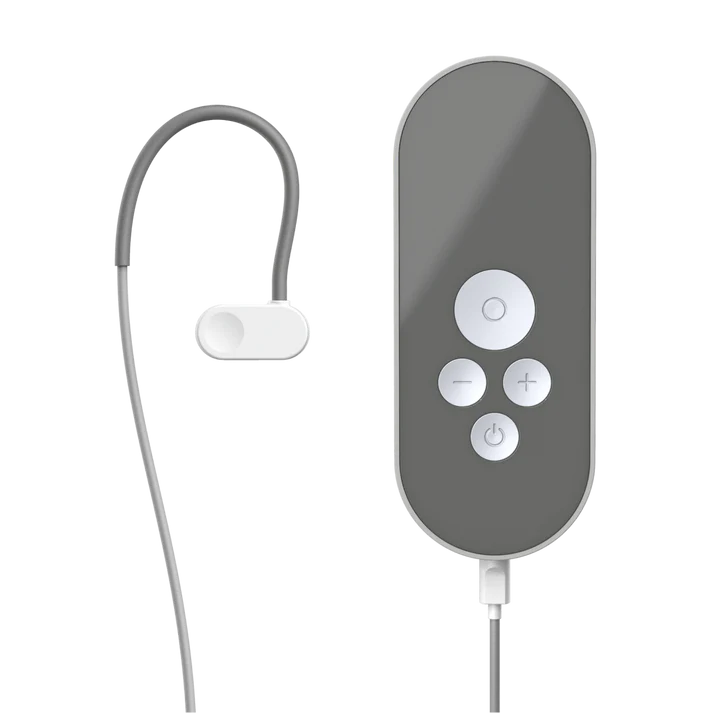
Precio: 700 EUR Varía según la región (hay disponible un subsidio de investigación de 40€)
Tipo: Auricular (usado en el oído)
Tecnología: AVNT™ por Parasym
Por qué #1:
- Más ampliamente validado: Apoyado por más de 50 publicaciones revisadas por pares de la Escuela de Medicina de Harvard, UCLA e instituciones de investigación líderes en todo el mundo.
- Eficacia demostrada para la disfunción autónoma: Estudios científicos documentan una mejora del 61% en el tono vagal (métricas de HRV), una reducción significativa en la sobreactivación simpática y una mejor regulación cardiovascular.
- Certificación independiente: Dispositivo portátil con marca CE que cumple rigurosos estándares de seguridad y rendimiento - verificado por terceros.
- Adopción científica: Utilizado por más de 1000 profesionales e investigadores sanitarios; integrado en protocolos institucionales; se completaron más de 4.000.000 de sesiones de estimulación supervisada.
- Parámetros basados en la evidencia: Protocolos de estimulación derivados de investigaciones revisadas por pares, no conjeturas propias.
- Soporte integral: Período de evaluación de 30 días, recursos de orientación científica, soporte técnico receptivo.
Ideal para: Personas que buscan el dispositivo más científicamente validado, particularmente aquellas con disfunción autonómica (anormalidades de la frecuencia cardíaca postural, disutonomía), síndromes post-virales o aquellos que priorizan la evidencia sobre las afirmaciones comerciales.
#2: Truvaga Plus
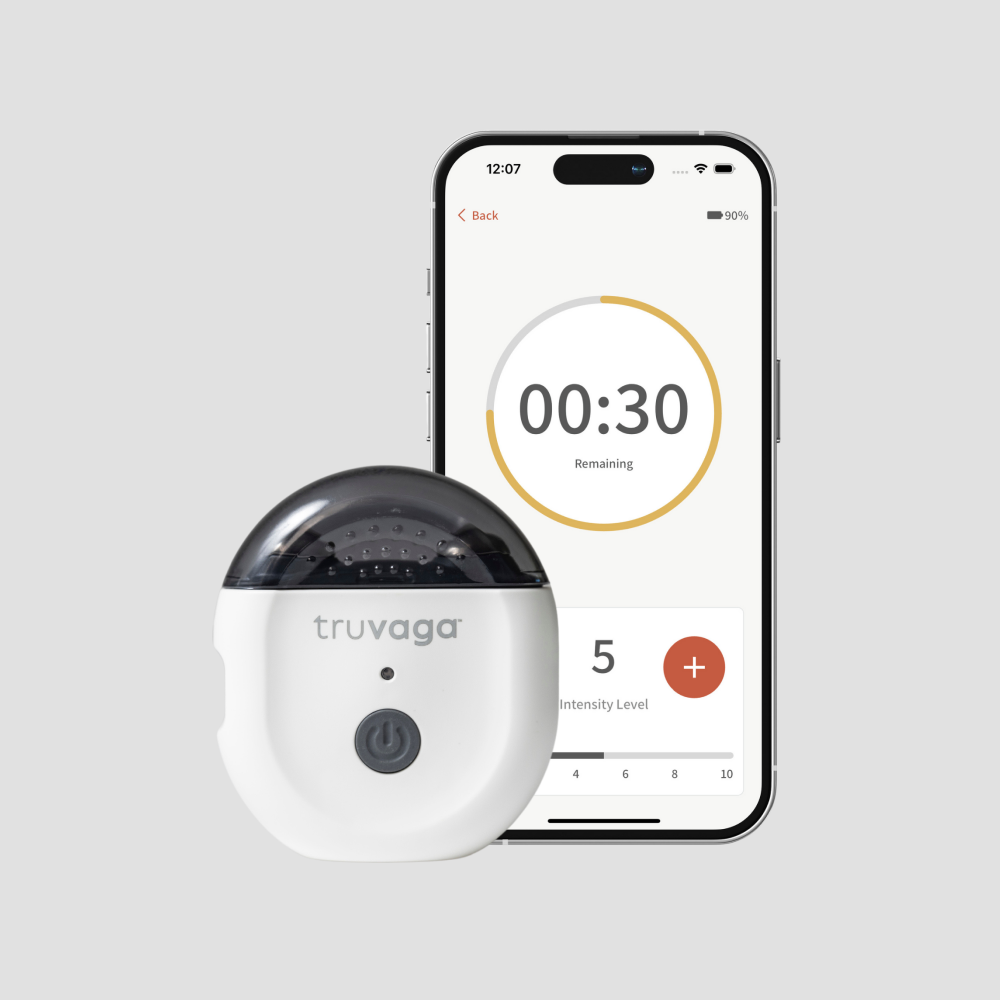
Precio: $544+ (dispositivo $499 + spray $45/año + posible suscripción) Tipo: Cervical (cuello portátil)
Nota técnica: Comparte tecnología central con gammaCore, un dispositivo aprobado por la FDA para migrañas/dolor de cabeza en racimo (no para anormalidades del ritmo cardíaco postural). Efectos parasimpáticos rápidos. Protocolo sencillo.
Consideraciones: Costos continuos para el espray conductivo más la posible suscripción a una aplicación: verifique los precios antes de comprar. Los efectos adversos comunes incluyen espasmos musculares, flacidez facial, tirón labial y dolor de cabeza. No es adecuado para usuarios con estados cardíacos, marcapasos o problemas cardíacos recientes. Se han reportado problemas de conectividad en la aplicación móvil.
Ideal para: Aquellos que prefieren la estimulación cervical con tecnología aprobada por la FDA (para migrañas, no para anormalidades de ritmo cardíaco postural) que pueden tolerar posibles efectos adversos del espasmo muscular facial.
#3: Pulsetto

Precio: $350-$371 (dispositivo $269 + gel $81-$102/año) Tipo: Cervical (collar manos libres)
Ventajas: diseño de wearable manos libres. Apto para HSA/FSA. Cobertura de garantía de 2 años.
Limitaciones Críticas: No hay estudios científicos revisados por pares que demuestren la eficacia para las anormalidades de la frecuencia cardíaca postural, solo comunicados de prensa de empresas y testimonios minoristas. Los problemas de ajuste frecuentes crean un contacto nervioso inadecuado, especialmente con cuellos más pequeños. Los usuarios informan consistentemente de una mejoría mínima o nula en los síntomas de las anormalidades del ritmo cardíaco postural en comparación con los dispositivos validados por la investigación.
No recomendado para las anomalías de la frecuencia cardíaca postural: La diferencia de precio entre 200 y 350 dólares parece atractiva hasta que se calcula el costo real: meses de discapacidad continua mientras se usa un dispositivo no probado. Los dispositivos de menor costo pueden parecer atractivos; sin embargo, la ausencia de validación científica significa que su efectividad para trastornos autónomos como las anormalidades del ritmo cardíaco postural sigue siendo incierta.
#4: Sentido
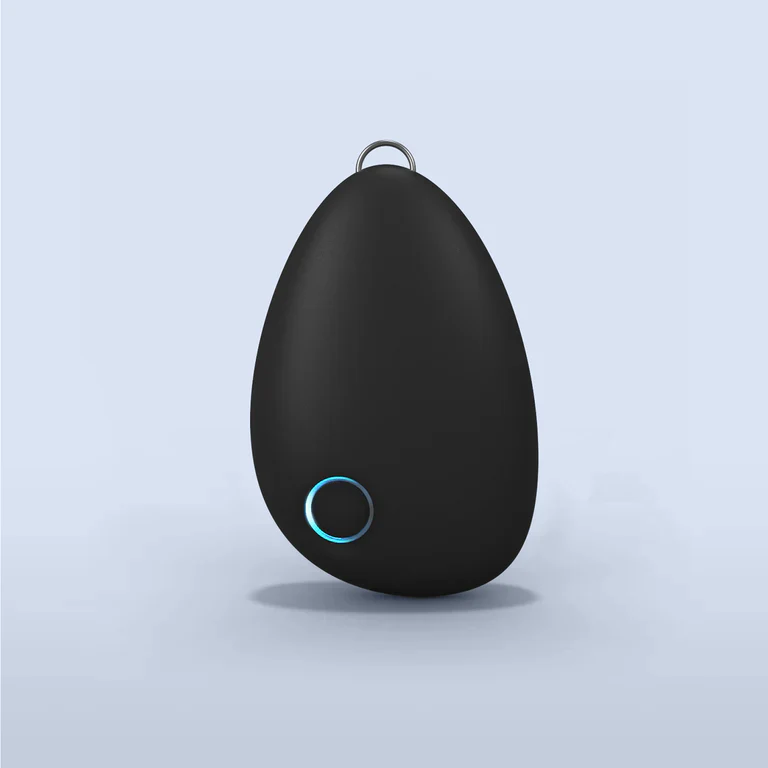
Precio: $299-$349 Tipo: Dispositivo vibrotáctil de uso torácico (no VNS verdadero)
Ventajas: Cómodo diseño de guijarros usado en el pecho. Interfaz de aplicación sencilla con paisajes sonoros. Precio más bajo. Se puede usar mientras realiza otras actividades con una correa para el cuello.
Distinción crítica: Sensate no estimula directamente el nervio vago a través de impulsos eléctricos como otros dispositivos en esta comparación. En su lugar, utiliza vibraciones infrasónicas y conducción ósea colocadas sobre el pecho-un enfoque indirecto dirigido a la reducción general del estrés en lugar de la activación específica del nervio vagal. Si bien la conducción ósea en el oído tiene algunas investigaciones que apoyan la estimulación vagal, la ubicación del tórax de Sensate carece de evidencia científica para el compromiso directo del nervio vago. El mecanismo es fundamentalmente diferente: los dispositivos VNS reales (como Nurosym, Truvaga y Pulsetto) entregan señales eléctricas calibradas directamente a las ramas del nervio vago accesibles; Sensate entrega vibraciones al esternón, con la esperanza de efectos posteriores.
Para las anormalidades del ritmo cardíaco postural de los individuos: Esto es muy importante. Las anormalidades de la frecuencia cardíaca postural requieren restauración de la función autonómica medible-mejora de la variabilidad de la frecuencia cardíaca, reducción de la ortostática taquicardia, mayor sensibilidad al barorreflejo. Los dispositivos de relajación general pueden ayudar con el estrés administración, pero no abordar la disfunción vagal subyacente y la desregulación autónoma de la conducción Anomalías de la frecuencia cardíaca postural síntomas. No científico estudios demostrar la eficacia de Sensate para Anomalías de la frecuencia cardíaca postural o trastornos autónomos, estudios financiados exclusivamente por la empresa que muestran una reducción general del estrés en voluntarios sanos.
Ideal para: Aquellos que buscan una herramienta general de relajación y manejo del estrés en lugar de una estimulación específica del nervio vago para la disfunción autonómica. No recomendado para personas priorizando basada en la evidencia Anomalías de la frecuencia cardíaca postural fisioterapia.
*Con un subsidio de investigación de 70 € para los participantes que cumplan los requisitos
**Requiere una gestión meticulosa de la intensidad y el cumplimiento del protocolo
Conclusión: Nurosym ofrece la validación científica más completa, eficacia comprobada para la disfunción autonómica, incluidas las anomalías de la frecuencia cardíaca postural, certificación regulatoria independiente y un equilibrio óptimo entre la base de investigación y la aplicación práctica para quienes priorizan la evidencia-basados en resultados.
Ponte en marcha
Anomalías de la frecuencia cardíaca postural relacionado con la disfunción del nervio vago representar a síntoma de enfoques terapéuticos emergentes y complementarios. Su sistema nervioso autónomo posee la capacidad de adaptación neuroplástica y restauración de la función reguladora.
Con el apoyo de más de 50 estudios científicos, certificación independiente del marcado CE y más de 4.000.000 de sesiones documentadas de estimulación, Nurosym ofrece un potencial científicamente validado para restaurar el equilibrio autónomo y la capacidad funcional.
Esta información se proporciona con fines educativos. Los dispositivos VNS no están destinados a diagnosticar, tratar, curar o prevenir ninguna enfermedad. Las personas con anomalías de la frecuencia cardíaca postural deben trabajar con proveedores de atención médica calificados para desarrollar estrategias integrales de manejo. Siempre consulte a su médico antes de comenzar cualquier nueva intervención.
Fuentes
- Stavrakis S, Chakraborty P, Farhat K, Whyte S, Morris L, Zain, et al. Noninvasive Vagus Nerve Stimulation in Postural Tachycardia Syndrome. JACC: Clinical Electrophysiology. 2023 Nov 1;
- Wang Z, Zhu T, Li X, Lai X, Chen M. Tragus Nerve Stimulation Attenuates Postural Orthostatic Tachycardia Syndrome in Post COVID‐19 Infection. Clinical Cardiology. 2025 Feb 27;48(3).
- Stavrakis S, Cai X, Morris L, Whyte S, Karfonta B, Matlock HG, et al. LB-456640-4 NONINVASIVE VAGUS NERVE STIMULATION IN POSTURAL TACHYCARDIA SYNDROME: A RANDOMIZED CLINICAL TRIAL. Heart Rhythm. 2023 Jul 1;20(7):1090–0.
- Shiffer D, Rigo S, Minonzio M, Yarsuvat DT, Tobaldini E, Furlan L, et al. Short and long term effects of a two-week transcutaneous vagus nerve stimulation in hyperadrenergic postural orthostatic tachycardia syndrome: a proof-of-concept trial. European Journal of Internal Medicine [Internet]. 2025 Sep 27;106529. Available from: https://www.sciencedirect.com/science/article/abs/pii/S0953620525004078



 Spanish
  English
  German
  French
  Swedish
I appreciate how Dr. Saloni didn’t oversimplify POTS and actually acknowledged different underlying mechanisms. The device comparison was helpful, but the science section stood out the most for me.
Dr. Saloni, I like that you included limitations and didn’t present VNS as a one-size-fits-all fix. That made the article feel more grounded and trustworthy.