
El nervio que controla la respuesta al dolor de tu cuerpo es accesible a través del oído. La mayoría de los practicantes nunca lo han mencionado - esto es lo que muestran más de 60 estudios científicos.
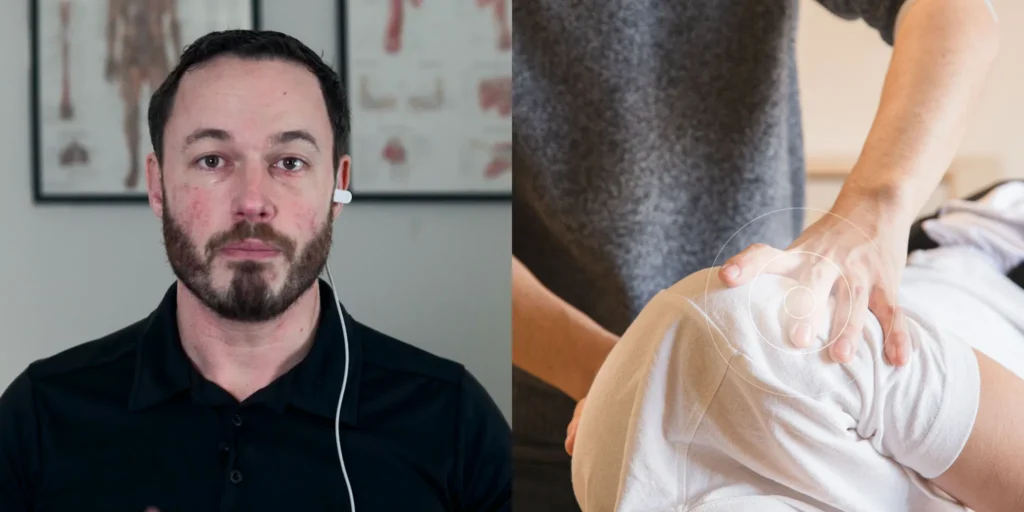
La mayoría de los pacientes con dolor crónico están tratando las zonas adecuadas. Simplemente no tienen el sistema que está creando el dolor en primer lugar.
Después de 15 años como osteópata -y mis propios años en el tatami lidiando con lesiones que no sanaban adecuadamente- puedo decirte exactamente cuál es ese sistema.
No está en tu espalda. No está en tu hombro. No está en tu cuello.
Es un nervio. Y te pasa por la oreja.
Lo que noté en la clínica - y luego en mi propio cuerpo

He sido osteópata durante más de 14 años, trabajando con todo el mundo, desde profesionales que trabajan en mesas hasta atletas de alto nivel: personas que se recuperan de reconstrucciones del LCA, hombros congelados, dolores de cabeza crónicos, lesiones por esfuerzo repetitivo y dolor espinal que había estado corriendo durante años.
Mi enfoque combina terapia manual, rehabilitación funcional, prescripción de ejercicio y educación en neurociencia del dolor. Cuando es apropiado, también recurro a la medicina funcional y las terapias complementarias. El objetivo es siempre el mismo: entender la causa raíz, no solo la ubicación del dolor.
Y en todos esos casos - miles de usuarios, cientos de presentaciones diferentes - un patrón seguía apareciendo que no podía explicar con el entrenamiento estándar.
La gente haría todo bien. Se trataría. Se sentiría mejor. Y entonces el dolor regresaría... en otro lugar.
El deporte también ha sido parte de mi vida desde que tengo memoria. Rugby. Natación. Triatlón - He completado la distancia olímpica, que te enseña muy rápidamente lo que tu cuerpo puede y no puede recuperar. Entrenamiento de pesas. Y en los últimos años, Jiu Jitsu brasileño.
El BJJ es un deporte que me encanta. También es un deporte que me ha dejado sobre el tatami con desgarros en las mangas del rotator, un músculo desgarrado, espinillas que no se quitaban y dolor articular que parecía moverse sin importar lo que hiciera. Me han atrapado en un kimura del que no pude escapar a tiempo. Me desperté a la mañana siguiente sin saber si mi cuello o mi hombro iban a ser el problema ese día.
Y cuando comencé a seguir mi propio HRV durante el entrenamiento y la recuperación, algo inesperado sucedió: los datos mostraron lo que mi cuerpo ya sabía, incluso antes de que yo lo sintiera conscientemente.
Los días en que mi dolor era más intenso rara vez eran los días en que había entrenado más duro. Eran los días en que mi sistema nervioso estaba más desregulado - y mi HRV lo mostró antes de que yo siquiera lo sintiera.
Empecé a ver exactamente el mismo patrón en mis usuarios.
Una gerente de proyecto a los 40 años. El dolor lumbar se trató cuatro veces durante dos años. Cada vez, en menos de un mes, el dolor había cambiado. Cadera. Hombro. Base del cráneo.
Se sentó frente a mí y dijo: "Siento que estoy jugando a golpear a un topo con mi propio cuerpo."
Nadie le había dado nunca una explicación de por qué seguía sucediendo. Esa frase me quedó en la cabeza - porque ella tenía toda la razón.
Por qué el cambio del dolor no es aleatorio - y por qué la mayoría de las terapias no lo paran
Aquí está la suposición de que la mayoría de las terapias -y honestamente, la mayoría de los practicantes- comienzan con:
Dolor en la espalda? Problema de espalda. ¿Dolor en el cuello? Problema de cuello.
Es lógico. Para una lesión nueva, a menudo es correcto.
Pero para el dolor que sigue regresando -un dolor que nunca se resuelve del todo, sin importar cuántos puntos tratemos-, esa suposición desaparece.
Aquí explicamos por que.
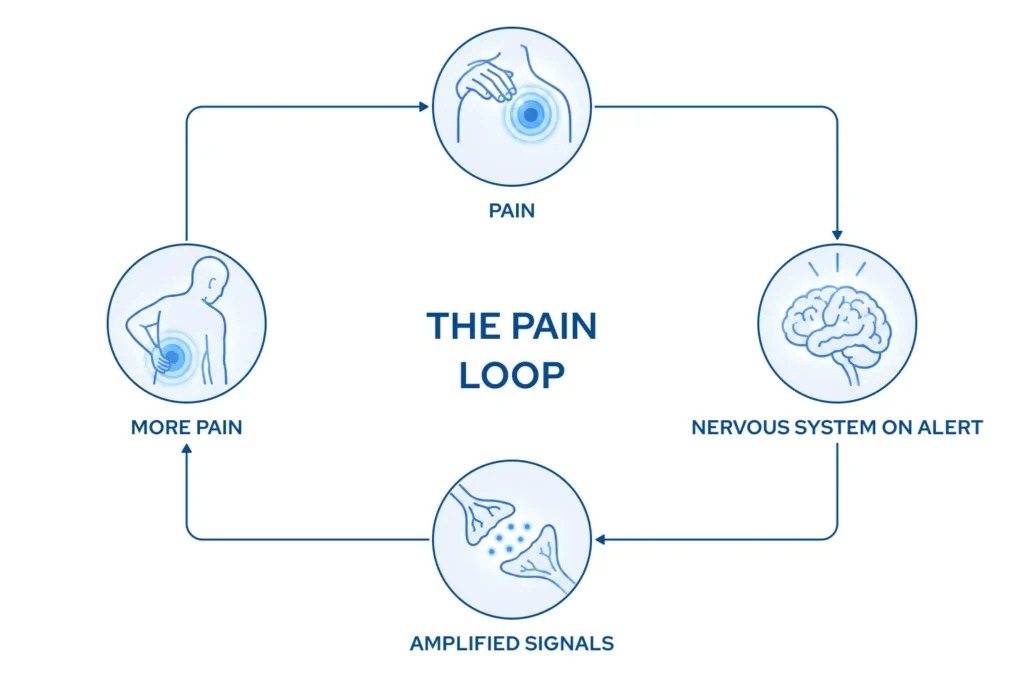
Cuando el dolor persiste más allá del tiempo de curación normal, algo se altera de manera mensurable en el sistema nervioso central. Los investigadores lo llaman sensibilización central - pero yo lo pienso más simplemente como El bucle del dolor.
El Pain Loop funciona así:
El dolor activa el sistema nervioso. El sistema nervioso permanece en alerta alta. La alerta alta amplifica más señales de dolor. Lo que mantiene el sistema nervioso activado. Lo que amplifica más señales.
Redondo y redondo. Mucho después de que la lesión original se haya curado.
Piensa en ello como una alarma de seguridad doméstica con un sensor defectuoso.
Reparas el sensor en la ventana. Dos semanas después, la alarma vuelve a sonar - disparada por la puerta. Lo arreglas. Luego el pasillo.
La alarma nunca fue culpa de la ventana. O de la puerta. O del pasillo.
La alarma misma se había calibrado mal.
Esta es también la razón por la que tantos usuarios vienen a mí con resonancias magnéticas que no muestran nada serio. No hay daños importantes en el disco. No hay explicación estructural para el dolor continuo.
El problema no está en la estructura. Está en el sistema procesando las señales.
"Lo he probado todo." Probablemente ya lo has hecho. Aquí está por qué no es suficiente.
Antes de seguir adelante, quiero decir algo importante:
Las terapias que la mayoría de la gente intenta para el dolor crónico no son erróneas.
El masaje funciona en tejidos reales. La fisioterapia mejora los patrones de movimiento reales. La quiropráctica aborda las restricciones articulares reales. El enrollamiento y estiramiento con espuma reducen de manera genuina la tensión muscular local. Una pistola de masaje puede proporcionar un alivio temporal real.
Estos no son placebos. El esfuerzo es real. El alivio es real.
Pero todos ellos hacen lo mismo: apuntan a donde aparece el dolor.
Ninguno de ellos llega al propio Pain Loop, el sistema que genera la señal en primer lugar.
Y hay un segundo problema del que nadie habla:
La mayoría de los enfoques para el manejo del dolor requieren condiciones que la vida real rara vez proporciona.
- Fisio necesita citas - dos veces por semana, al otro lado de la ciudad, en medio de un día laboral
- Masaje necesita una hora ininterrumpida que rara vez tienes libre
- Aplicaciones de respiración necesita diez minutos de silencio - pregunte a cualquier padre de niños pequeños con qué frecuencia esto realmente sucede
- Rodillo de espuma necesita espacio y energía al final de un día ya agotador
- Quiropráctica necesita semanas de asistencia constante antes de que se detengan los ajustes
La gente que viene a mí no está fallando en esto.
Un gerente de proyecto que pasa ocho horas seguidas en reuniones, desplomándose en el sofá a las 7:00 p.m., no es perezoso. Una madre de dos hijos que no ha dormido más de cinco horas consecutivas en más de un año no se está descuidando a sí misma. Un hijo que ha estado cuidando a su anciano padre durante los últimos dieciocho meses -cuyo dolor de espalda se convirtió silenciosamente en dolor de hombro, que se convirtió en dolores de cabeza tensionales que no puede sacudir- no está haciendo nada malo.
Están haciendo todo lo que tienen a su disposición, dentro de una vida que no deja mucho espacio para las rutinas de recuperación.
Y debajo de todo eso, el Pain Loop sigue funcionando. Esperando. Amplificando. Moviendo la señal a algún lugar nuevo.
El nervio oculto detrás del bucle del dolor
Fue entonces cuando comencé a mirar más profundamente. Y una parte del sistema nervioso seguía apareciendo - en estudio tras estudio, síntoma tras síntoma.
Pero primero - un breve contexto que dé sentido a todo lo demás.
Tu sistema nervioso tiene dos modos.
La primera es simpático - tu estado de lucha o huida. Ritmo cardíaco elevado, músculos tensos, cuerpo alerta. Diseñado para la supervivencia a corto plazo.
El segundo es parasimpático - tu estado de reposo y recuperación. El ritmo cardíaco disminuyó, la digestión se activó, la inflamación se reguló, las señales de dolor se calmaron.
El problema con el dolor crónico es que el sistema nervioso se queda atascado en modo simpático. El Pain Loop lo mantiene ahí. Y cuanto más tiempo se queda allí, más sensible al dolor se vuelve.
El cambio entre estos dos estados es controlado principalmente por un nervio.
La nervio vago.
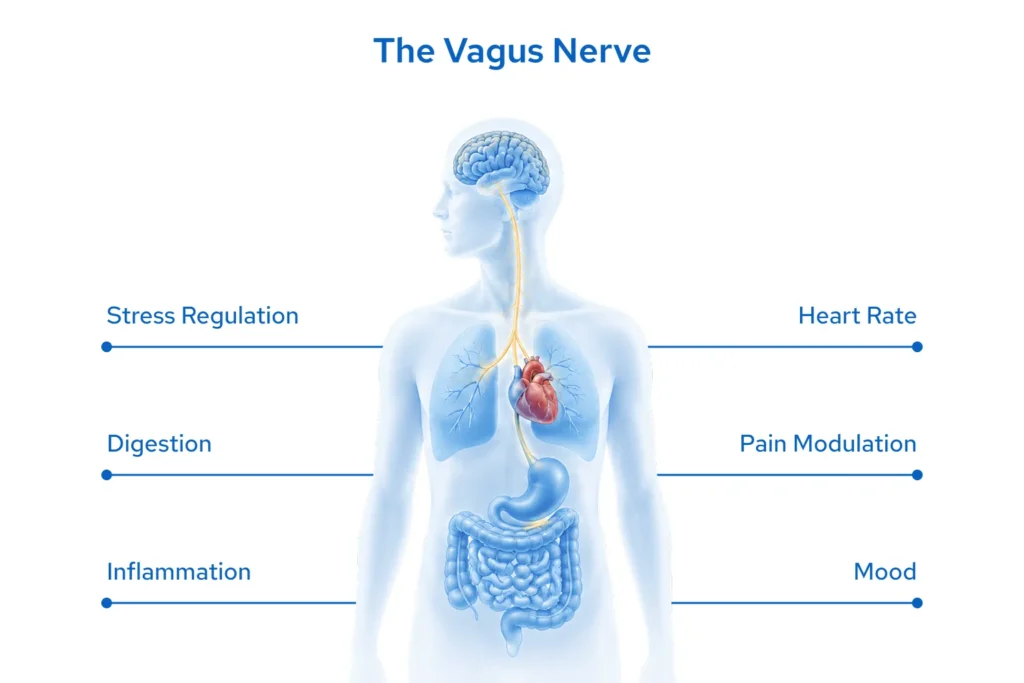
Es el nervio más largo del cuerpo: sale del tronco encefálico y pasa por el pecho y el abdomen, conectado al corazón, los pulmones, el intestino y el sistema inmunológico.
Piensa en ello como el interruptor de tu cuerpo para el Pain Loop.
Cuando el tono vagal está sano, el sistema nervioso se mueve de forma fluida: alerta cuando es necesario, recuperándose cuando no. Las señales de dolor se modulan antes de amplificarse. La inflamación se mantiene regulada. El sistema se reinicia de forma natural.
Cuando el nervio vago está suprimido - por estrés crónico, dolor persistente o sobrecarga acumulada - el interruptor de apagado deja de funcionar. El bucle de dolor no tiene nada que lo interrumpa. Y el dial de volumen se atasca al máximo.
Este es el mecanismo detrás del dolor que se mueve de un punto a otro. Al despertar, ya estás tenso antes de que comience el día. Detrás del cansancio que una noche completa de sueño no arregla. Detrás de los pensamientos ansiosos de bajo nivel que se han convertido en ruido de fondo.
Un sistema. Muchas expresiones diferentes.
Lo que me llevó a la única pregunta que importaba:
¿Hay una manera directa de llegar al nervio vago y reiniciarlo?
Lo que encontré - y por qué al principio me mostré escéptico
Me encontré con investigaciones sobre la estimulación del nervio vago (VNS) hace varios años.
Mi primera reacción fue el escepticismo inmediato.
En ese momento, el único método establecido era quirúrgico. Un dispositivo implantado en el tórax, con un alambre enroscado hasta el nervio vago en el cuello. Utilizado en hospitales para la terapia - estados depresivos resistentes. Genuinamente efectivo en esos contextos.
Pero no es algo que pudiera ofrecer a un usuario que acudiera a mí con un problema de retroceso. No es realista. No es práctico.
Entonces me encontré con algo que realmente no esperaba.
Los investigadores habían identificado una rama específica del nervio vago que se encuentra justo debajo de la piel -justo en la oreja externa, en el trago: el pequeño trozo de cartílago en la entrada del canal auditivo.
Este es el único lugar en todo el cuerpo donde se puede llegar al nervio vago sin cirugía.
Los científicos habían desarrollado una técnica no invasiva para estimularla mediante señales eléctricas suaves transmitidas a través de la piel. El método se llama estimulación del nervio vago auricular transcutáneo - o taVNS.
Revisé la investigación cuidadosamente. Publicaciones revisadas por pares, no materiales de la empresa. Estudios controlados con placebo. Estudios realizados en colaboración con Harvard, UCL y King’s College London.
Una revisión sistemática de 2024 publicada en la revista DOLOR confirmó reducciones mensurables del dolor crónico en múltiples síntomas. Una revisión de 2026 en Investigación de las fronteras del dolor identificó el mecanismo preciso: taVNS activa las vías de control del dolor descendente del cerebro -las mismas vías suprimidas por The Pain Loop- e interrumpe directamente el ciclo de amplificación.
No en el lugar donde aparece el dolor. En el sistema manteniéndolo.
Pasé de escéptico a genuinamente interesado.
Pero todavía había un problema.
La investigación fue sólida. El mecanismo tenía todo el sentido. Lo que aún no sabía era si existía un dispositivo que pudiera llevar esto a la vida diaria de un usuario -sin necesidad de una visita a la clínica, una receta o síntomas que la mayoría de las personas simplemente no tienen.
Lo que muestra la investigación
−38% | Dolor generalizado (estudio científico de 4 semanas) |
−78% | Marcadores inflamatorios IL-6 (estudio de 3 meses) |
+61% | Actividad del nervio vago (dentro de los 5 minutos de uso) |
+18% | HRV - Variabilidad de la frecuencia cardíaca (marcador clave de recuperación para atletas) |
−35% | Pensamientos de ansiedad |
−48% | Cansancio |
+30% | Calidad del sueño |
Más de 60 estudios científicos completados. Hasta la fecha, no se han reportado eventos adversos graves.
Lo que me llamó la atención no fue un solo número, sino el patrón.
El dolor se calma. La inflamación disminuye. El sueño se profundiza. El cansancio aumenta. El HRV mejora. Los pensamientos ansiosos disminuyen.
Múltiples sistemas - simultáneamente - a través de una intervención.
No es de extrañar, cuando uno entiende por qué. Todos comparten la misma raíz: el bucle del dolor, impulsado por un nervio vago suprimido. Resolver esto y varias sucursales responden.
El reinicio de 15 minutos - Lo que ahora recomiendo junto con cada plan de terapia
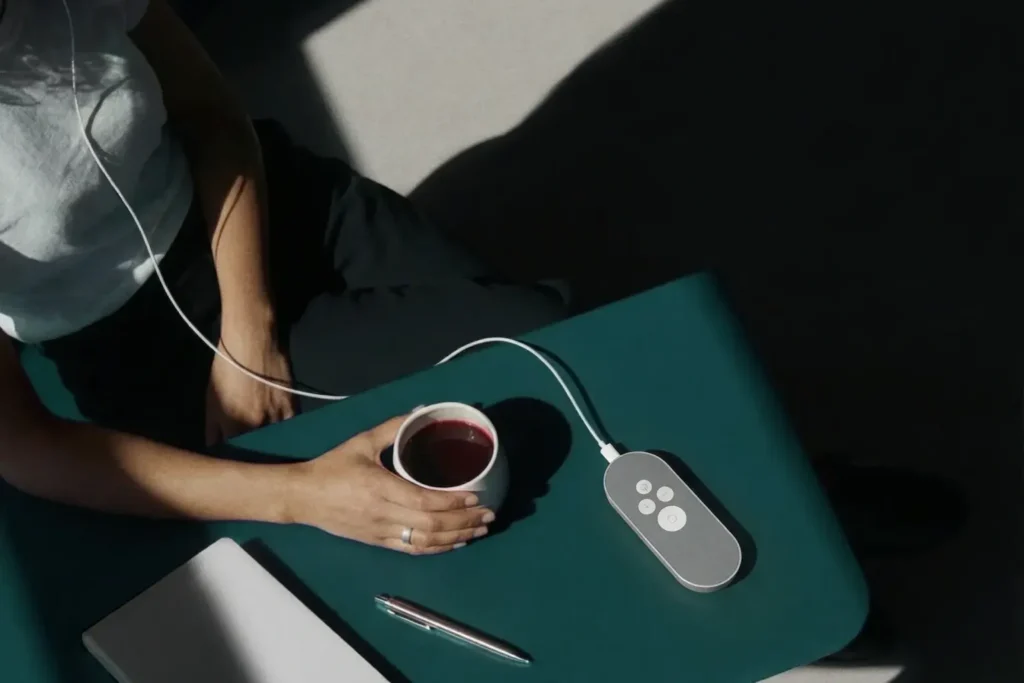
Y entonces lo encontré.
Nurosym.
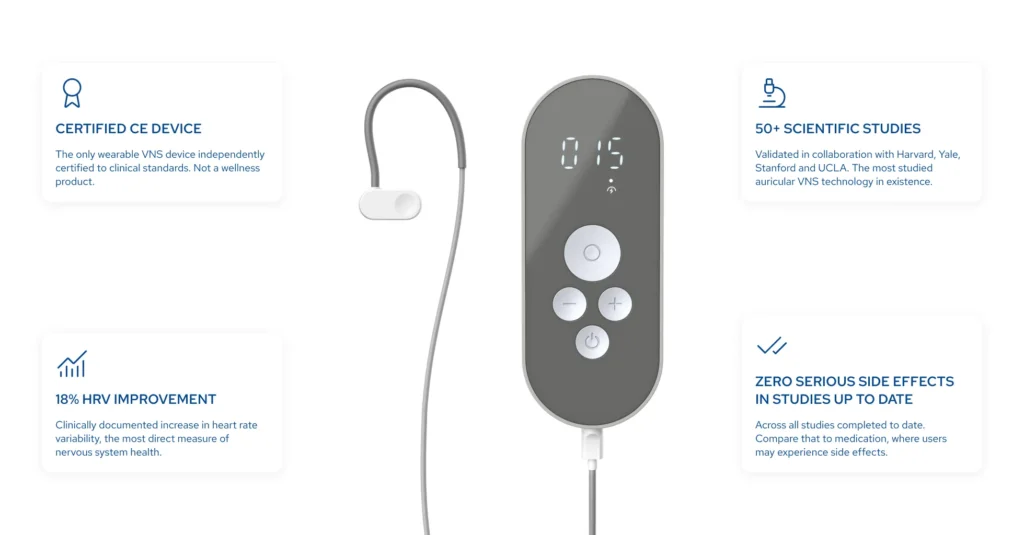
Desarrollado por Parasym - una empresa con sede en el Reino Unido con más de 10 años de I+D y 10 millones de inversiones en estudios científicos - Nurosym es un dispositivo taVNS con marca CE y el sistema de estimulación vagal portátil más estudiado científicamente en el mundo. Desarrollado en colaboración con más de 150 instituciones reconocidas internacionalmente, incluyendo Harvard, UCLA, UCL, King’s College London y Mayo Clinic. Recomendado por más de 1000 profesionales de la salud en todo el mundo. Más de 5 millones de sesiones completadas.
Utiliza su tecnología patentada AVNTTM -Terapia de Neuromodulación Auricular Vagal- que proporciona una señal eléctrica calibrada con precisión a través del tragus del oído izquierdo, estimulando directamente la rama auricular del nervio vago.
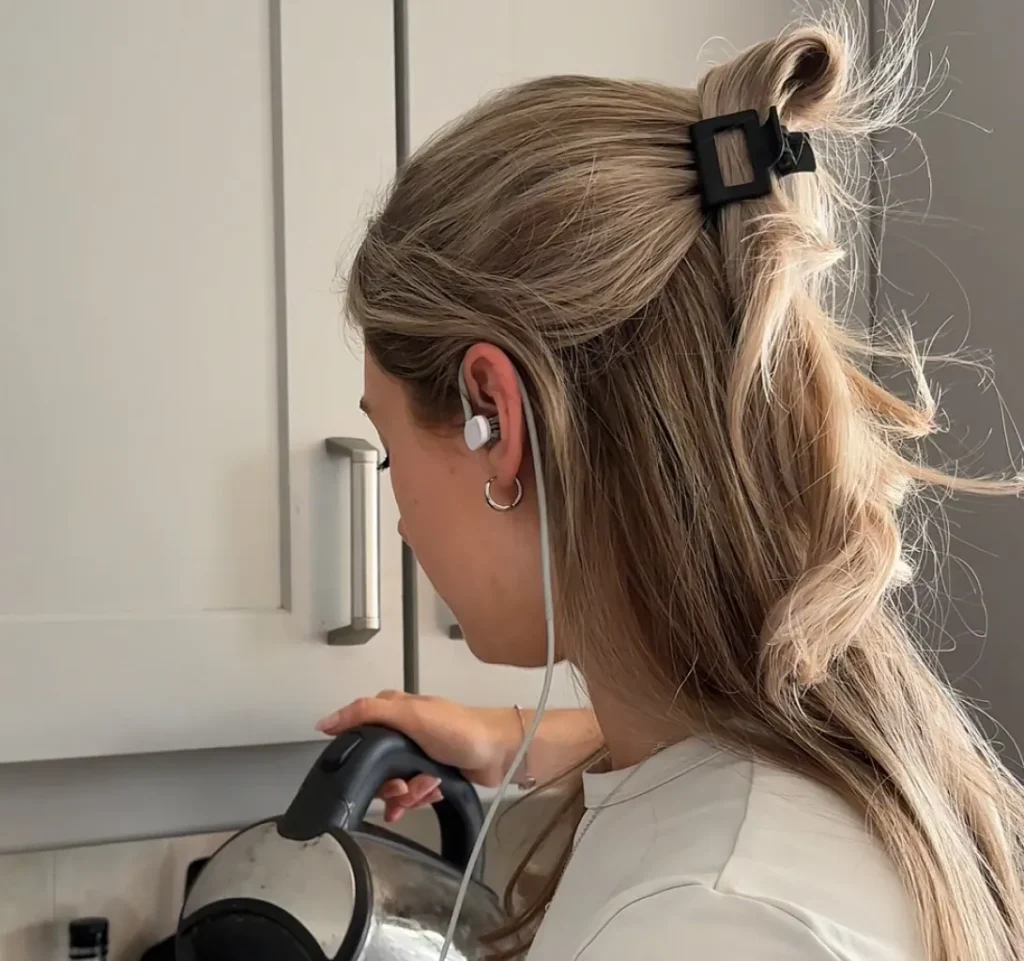
En términos prácticos: se engancha suavemente a tu oído, de la misma manera que te pondrías un auricular inalámbrico.
Y esto es lo que lo hace diferente de todo lo demás:
No bloquea el dolor como lo hace un antiinflamatorio.
No libera un músculo específico como lo hace el masaje.
Interrumpe el bucle del dolor en su origen, enviando al sistema nervioso una señal directa para salir del estado de dolor amplificado y regresar a la recuperación.
Y la parte que más importa en lo práctico:
Lo usas durante 15 minutos. Mientras almuerzas. Mientras estás sentado en tu escritorio. Mientras miras algo por la noche. Mientras te acuestas en la cama antes de dormir.
Sin cita. Sin habitación silenciosa. Sin hora extra tallada de un día que ya no tiene ninguna.
- Para el trabajador de escritorio quien no puede salir de la oficina para un masaje
- Para el padre quien no puede terminar un ejercicio de respiración sin ser interrumpido
- Para el cuidador quien no tiene nada más que darle a otra rutina que demanda algo primero
- Para el Practicante o atleta de BJJ cuyo HRV la mañana después del entrenamiento cuenta una historia diferente
No requiere nada más de lo que un día ordinario ya proporciona.
Esto es lo que estaba buscando. Algo que funcione con la vida real, no una vida idealizada.
Lo que los usuarios realmente notan
Los cambios que la gente describe rara vez son dramáticos al principio. Tienden a llegar silenciosamente.
"Dormí toda la noche."
"La tensión en mis hombros era simplemente... menos."
"Un día olvidé usarlo y el dolor de espalda volvió inmediatamente. Al día siguiente lo usé de nuevo y se redujo enormemente."
"No me di cuenta de lo preparado que había estado... hasta que dejé de estar preparado."
Estas son las señales de un sistema nervioso que comienza a salir del Ciclo del Dolor. Pequeño. Incremental. Real.
Por qué el dolor rara vez es lo único que cambia
Una cosa más que vale la pena entender:
El sistema nervioso que ha estado amplificando tu dolor es el mismo que interrumpe tu sueño.
El mismo cansancio de conducir que el descanso no arregla. El mismo que te mantiene alerta a las 3 de la mañana cuando estás agotado. El mismo que está detrás de los pensamientos ansiosos de bajo nivel que se han vuelto tan familiares que has dejado de notarlo.
Estos no son problemas separados que coexisten.
Todas son expresiones del mismo Pain Loop - un sistema nervioso desregulado atrapado en el overdrive simpático.
Cuando el nervio vago empieza a funcionar mejor, los efectos no quedan confinados a un solo síntoma. Los usuarios que acuden a mí para cambiar el dolor de espalda comienzan a mencionar -casi como una reflexión posterior- que están durmiendo mejor. Que la tensión de fondo ha bajado. Que las cosas que solían volcar no están cayendo de la misma manera. Que su energía es más consistente a lo largo del día.
No porque algún dispositivo trate todos estos individualmente.
Porque todos comparten la misma raíz. Y cuando esa raíz empieza a regular, varias ramas se asientan.
¿Es este el siguiente paso adecuado para ti?
Si este patrón es familiar -dolor que se mueve, alivio que no se sostiene, terapias que ayudan pero nunca terminan del todo el trabajo- vale la pena explorarlo seriamente.
Nurosym trabaja junto con el cuidado práctico, no en su lugar. En mi práctica, lo recomiendo para los usuarios cuyo sistema nervioso necesita apoyo entre sesiones - especialmente cuando el estrés es alto, el sueño se interrumpe y el dolor sigue encontrando un nuevo lugar para establecerse.
Una garantía de devolución del dinero de 30 días significa que no hay riesgo financiero al intentarlo. O hace una diferencia significativa, o la devuelves.
Nurosym puede ayudar si usted experimenta:
- Dolor crónico que cambia de lugar
- Tensión muscular persistente que regresa después de la terapia
- Cansancio o falta de sueño junto con el dolor
- Dolor que empeora durante periodos estresantes o exigentes
- Una sensación de que nunca te recuperarás completamente, sin importar lo que intentes
No utilice Nurosym si Usted tiene un dispositivo cardíaco implantado, como un marcapasos, si está embarazada, si ha tenido un evento cardíaco grave en los últimos cinco años o si es menor de 18 años. Siempre consulte a su profesional de la salud si tiene un síntoma médico existente.
Si pudiera decirle a cada usuario de dolor crónico una cosa, es esto: el lugar donde duele rara vez es donde está el problema. Y una vez que se aborda la fuente real - todo lo demás se vuelve más fácil de manejar.
Este artículo refleja mi evaluación profesional de la evidencia y 15 años de experiencia científica en el tratamiento del dolor crónico. Es posible que reciba un acuerdo de referencia por compras realizadas a través de los enlaces en este artículo. Solo recomiendo enfoques que he examinado cuidadosamente y me quedaría atrás con mis propios usuarios. Este no es un consejo médico - siempre consulte a un profesional de la salud calificado antes de comenzar cualquier nueva intervención. Las cifras reflejan el cambio relativo en los estudios revisados por pares; los resultados individuales pueden variar.
- Ashley Ridout, Osteópata | Precision Wellbeing, Londres
Este artículo de blog tiene como objetivo ser informativo y no debe reemplazar el asesoramiento profesional en salud. Consulte siempre con un profesional de la salud para obtener asesoramiento personalizado.
Referencias
- Volcheck MM, Graham SM, Fleming KC, Mohabbat AB, Luedtke CA. Central sensitization, chronic pain, and other symptoms: Better understanding, better management. Cleveland Clinic Journal of Medicine. 2023;90(4):245–254. https://doi.org/10.3949/ccjm.90a.22019
- Costa V, et al. Transcutaneous vagus nerve stimulation effects on chronic pain: systematic review and meta-analysis. PAIN Reports. 2024;9(5):e1171. https://doi.org/10.1097/PR9.0000000000001171
- Zhang J, et al. The role of transcutaneous auricular vagus nerve stimulation in chronic pain: from neurobiological mechanisms to clinical applications. Frontiers in Pain Research. 2026. https://doi.org/10.3389/fpain.2026.1733445
- Zheng S, et al. Transcutaneous auricular vagus nerve stimulation enhanced emotional inhibitory control via increasing intrinsic prefrontal couplings. International Journal of Clinical and Health Psychology. 2024;24(2):100462. https://doi.org/10.1016/j.ijchp.2024.100462
- Tarn J, et al. The effects of noninvasive vagus nerve stimulation on tiredness in participants with primary Sjögren’s syndrome. Neuromodulation. 2023;26(3):681–689. https://doi.org/10.1016/j.neurom.2022.08.461
- Dolcini J, et al. Effects of taVNS on sleep quality: RCT. Peer-reviewed clinical data, Parasym Ltd. 2025.
- Pacheco-Barrios K, et al. Transauricular vagus nerve stimulation enhances conditioned pain modulation in healthy subjects. Brain Stimulation. 2024;17(2):346–348. https://doi.org/10.1016/j.brs.2024.03.006
- Redgrave J, et al. Safety and tolerability of transcutaneous vagus nerve stimulation in humans: a systematic review. Brain Stimulation. 2018;11(6):1225–1238. https://doi.org/10.1016/j.brs.2018.08.010


 Spanish
  English
  German
  French
  Swedish
  Italian