
Lo que 10 años de casos me enseñaron sobre la gente que no puede apagarse
Has probado todo.
Tu diario todas las noches. Caminas - una hora a un buen ritmo, solo para salir de la cabeza. Tú haces la respiración, el anclaje, la aplicación de mindfulness que todos recomiendan.
Algunos de ustedes han ido más allá. Terapia. Duchas frías. Cortar la cafeína. Hablar de ello hasta que no quede nada por decir.
Y por un tiempo, algo de eso funciona. Te sientes más tranquilo. Te alejas.
Entonces llega la mañana.
Incluso antes de que hayas abierto los ojos, está de vuelta. Con toda la fuerza. Exactamente donde se quedó:
- El pecho apretado que estaba allí cuando te quedaste dormido
- El bajo zumbido del temor que no puedes nombrar
- La mente ya corre, escanea, compone la primera preocupación del día
- La mandíbula se apretó durante la noche sin que te dieras cuenta
Como si la noche nunca hubiera pasado.
Tu vida se ve bien en el papel. Eres capaz. Funcionas. Nadie que te mire desde afuera lo vería.
Pero desde dentro, te sientes como un pasajero en tus propios pensamientos. Observándolos girar. Incapaz de detenerlos.
Si algo de eso te resulta familiar, no estás solo. Y lo que es más importante: no se trata sólo de cómo eres.
Tu vida se ve bien. Tu sistema nervioso no ha entendido el mensaje.
"La gente con la que trabajo no se está desmoronando. Lo están manteniendo todo unido. Ese es precisamente el problema."
Lo que veo en mi práctica (más de 10 años, miles de casos)
He sido hipnoterapeuta cognitivo durante más de diez años, trabajando con personas que se recuperan del agotamiento, la presión laboral prolongada, las ansias de salud y los problemas de relación. A lo largo de los años, también he trabajado con personas que luchaban contra ataques de pánico que parecían surgir de la nada, problemas de sueño persistentes, síntomas del intestino irritable sin un desencadenante obvio, pensamientos ansiosos por la salud, fobias y patrones de pensamiento ansiosos que los habían seguido durante años.
Las personas que vienen a verme no se están desmoronando visiblemente. Parecen, desde afuera, como si lo tuvieran todo junto.
Un profesional sénior que se desempeña brillantemente en el trabajo pero miente despierto ensayando conversaciones que nunca sucederán. Un padre que mantiene unida a la familia todo el día y siente los pensamientos ansiosos descender en cuanto la casa se tranquiliza. Alguien que ha pasado por un período verdaderamente difícil, ha seguido adelante y encuentra los pensamientos ansiosos todavía corriendo como si nada hubiera cambiado.
Todas vidas muy diferentes. Todas llevando lo mismo.
A lo largo de todo esto, sigue apareciendo un patrón.
Estas no son personas cuyas vidas están en crisis.
Su cuerpo sigue ejecutando un programa que alguna vez tuvo sentido.
Nadie le dijo que las cosas habían cambiado.
Lo has intentado todo - pero los pensamientos ansiosos siguen regresando

Esto es lo que la gente con la que trabajo normalmente ya ha probado:
- Técnicas de escribir un diario, caminar y poner los pies en la tierra
- Aplicaciones de meditación guiada y atención plena
- Respiración - respiración de caja, 4-7-8, el suspiro fisiológico
- Reducir la cafeína, ajustar las rutinas de sueño
- Hablar de ello con amigos
La mayor parte ayuda. En el momento.
Pero a la mañana siguiente, ha vuelto. El ciclo de preocupaciones se reanuda exactamente donde lo dejó.
La hora de acostarse, que debería sentirse como un descanso, empieza a parecer una presión: estar tumbado esperando por el sueño que no vendrá, verificando si ya te estás quedando dormido, preocupándose por lo cansado que estarás mañana.
Algunas personas descubren que no pueden quedarse dormidas sin la televisión encendida - no por hábito, sino porque el ruido le da a la mente algo que seguir, y el silencio no le deja otra opción que volver al bucle.
Otros me dicen que siguen revisando sus teléfonos una última vez, releyendo mensajes que ya han leído, repasando conversaciones que ya han terminado o ensayando mentalmente conversaciones que aún no han ocurrido.
Aquí está la razón honesta - y no tiene nada que ver con el esfuerzo o la fuerza de voluntad. Cada uno de esos enfoques funciona a nivel de los pensamientos. Calman la alarma en el momento. Pero el sistema subyacente sigue activándola.
Y cada uno de ellos pide algo que un sistema nervioso agotado ya se ha quedado sin: una mente tranquila, capacidad diaria constante, la capacidad de estar completamente presente.
Cuando tu sistema ya está funcionando a plena capacidad, esos son precisamente los recursos que ya no tienes.
Has estado manejando los síntomas. No has llegado al sistema que los produce.
Pensamientos ansiosos vs. Un sistema nervioso atascado en modo de alerta - La diferencia que cambia todo
Aquí está lo que la mayoría de los consejos sobre pensamientos ansiosos reciben al revés.
La gente asume que sus pensamientos son lo que activa el cuerpo. Lo que veo consistentemente en la práctica es todo lo contrario.
El cuerpo se vuelve alerta primero. Los pensamientos ansiosos llegan después, llenando un espacio que ya estaba abierto.
Piensa en la última vez que te despertaste, ya tenso. Antes de que revisaras tu teléfono. Antes de que el día te diera una sola razón para preocuparte. Algo en el cuerpo ya estaba preparado -y la mente se apresuró a explicar por qué.
Puede que reconozcas algunos de estos:
- La mandíbula que se ha cerrado desde que te despertaste - y solo lo notas ahora, leyendo esto
- El fusible corto que llega sin previo aviso - atacando a alguien que amas y sin saber del todo por qué
- Yacer despierto repasando conversaciones que ya han terminado - o ensayar las que tal vez nunca sucedan
- Despertar a las 3 de la mañana, cuerpo cansado - pero la mente está completamente despierta, como si el sueño nunca hubiera ocurrido
- La sensación de esperar que algo salga mal - incluso cuando nada está mal
Estos no son pensamientos. Son un cuerpo en estado de alerta. Así es como se ve la desregulación del sistema nervioso en la vida cotidiana: no un colapso, ni una crisis, sólo un sistema que ha perdido silenciosamente su capacidad de apagarse.
Los pensamientos ansiosos son la alarma. El sistema nervioso es lo que sigue activándolo.
Por qué tu sistema nervioso permanece en alerta máxima incluso cuando la vida está bien
Son las 21:00 de un martes. Cerraste tu portátil hace una hora. La casa está tranquila.
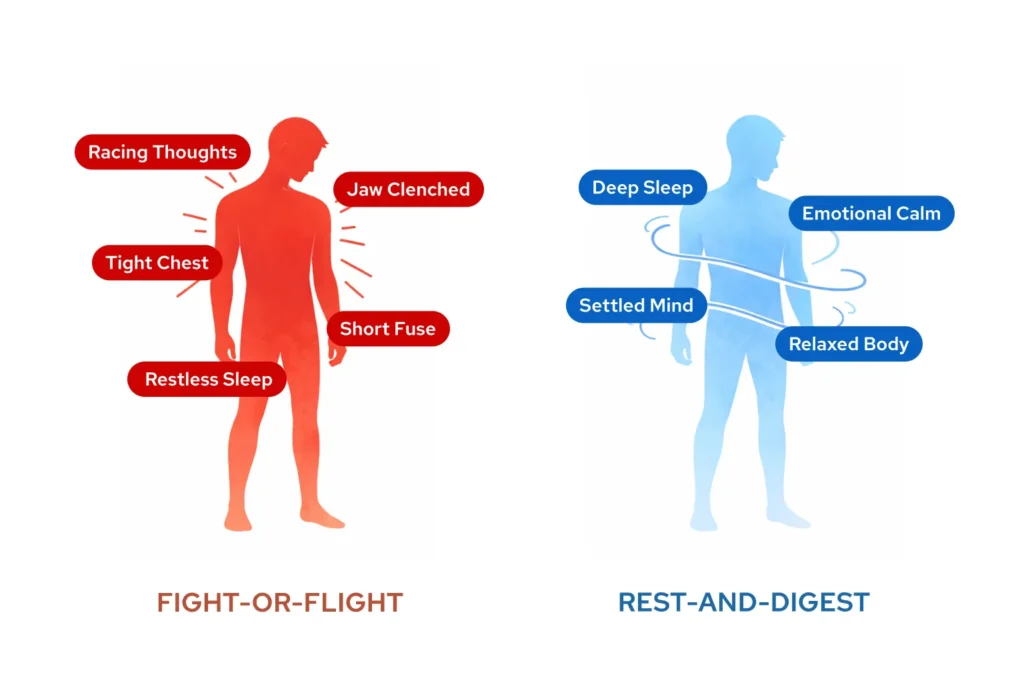
Y sin embargo, tu mente todavía está en la oficina. Tus hombros están cerca de tus orejas. Tu mandíbula está firme. El día está técnicamente terminado - pero tu cuerpo no ha recibido el mensaje.
Tu sistema nervioso autónomo tiene dos modos primarios.
Simpático - alerta, activada, escaneando en busca de amenaza.
Parasimpático - tranquilo, restaurador, recuperándose.
En un sistema saludable, uno se mueve entre los dos naturalmente. Pero el sistema nervioso no distingue entre una amenaza física y una psicológica sostenida.
Reuniones consecutivas. Una bandeja de entrada completa. El peso de ser responsable de todo y de todos. Años de ser el capaz que no muestra la tensión.
Para el sistema nervioso, todo esto se registra como una demanda continua. Algo a lo que estar preparado.
Y si eso continúa el tiempo suficiente, el cuerpo deja de tratar la alerta como una respuesta. Comienza a tratarla como un punto de referencia.
Esto es crónico desregulación del sistema nervioso - no un solo evento, sino una adaptación lenta, el aprendizaje corporal que alerta es el entorno más seguro para permanecer dentro.
El mismo patrón aparece en vidas muy diferentes. No se limita a los trabajos de oficina de alta presión. Aparece en atletas cuya recuperación se ha estancado a pesar de hacer todo bien. En padres que corren con el sueño interrumpido.
En personas que manejan dolor crónico o problemas digestivos persistentes junto con los pensamientos ansiosos. En cualquiera que haya pasado demasiado tiempo bajo presión sostenida sin suficiente recuperación genuina. Las circunstancias varían. La fisiología es la misma.
El sistema nervioso ha aprendido a perdurar. Esa es la raíz del problema.
El nervio vago: el interruptor de calma de tu cuerpo
Hay una vía más central que cualquier otra para la capacidad del cuerpo de hacer ese cambio.
Al nervio vago.
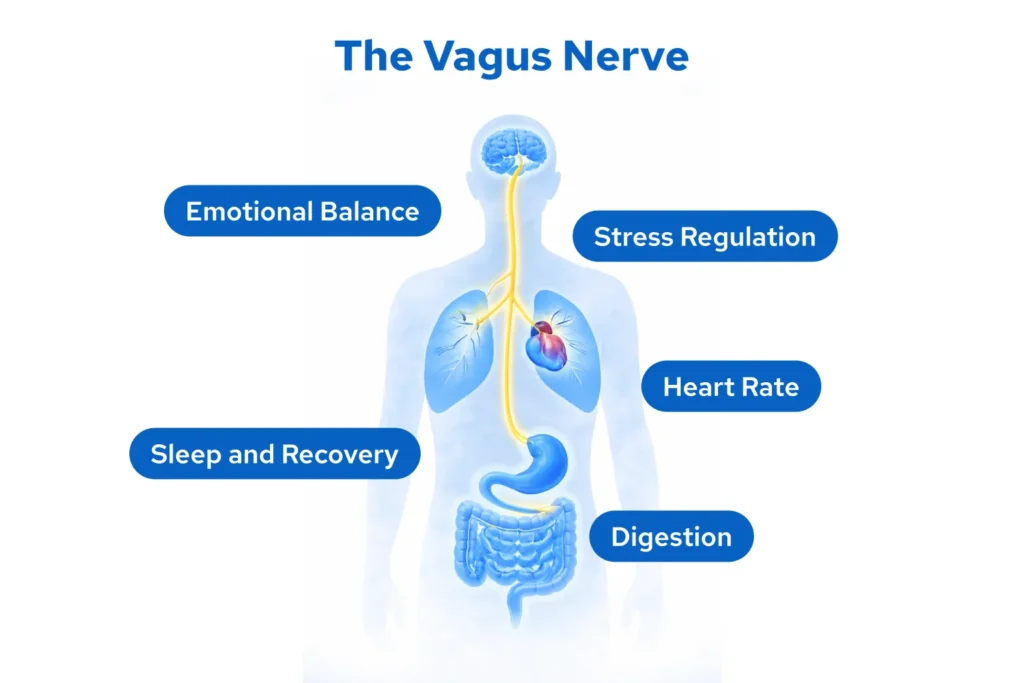
Discurre desde el tronco encefálico a través del corazón, los pulmones y el sistema digestivo. Es la línea de comunicación principal del cuerpo para un mensaje específico: la amenaza ha pasado. Ahora es seguro soltarla.
Cuando el tono vagal es fuerte, el cuerpo puede avanzar hacia la recuperación fácilmente. Cuando se reduce -cosa que suele ocurrir después de una presión prolongada- esa señal se vuelve más difícil de enviar y más difícil de recibir.
Una forma en que los investigadores miden esto es a través de la HRV - variabilidad de la frecuencia cardíaca. La HRV rastrea la variación en el tiempo entre los latidos del corazón.
Un HRV más alto indica que el sistema nervioso puede oscilar entre estados de alerta y recuperación.
Un HRV más bajo sugiere que está atascado en una sola marcha.
Muchas personas con pensamientos ansiosos persistentes, mal sueño o cansancio crónico muestran una reducción de la VFC. - una señal fisiológica de que el interruptor de calma está teniendo dificultades para activarse.
Esta es la razón por la cual las personas con desregulación crónica del sistema nervioso describen no solo pensamientos ansiosos, sino un grupo entero que llega a ser conjunto:
Mental y emocional:
- Pánico que llega en situaciones ordinarias - una cola de supermercado, una reunión, una autopista - sin ninguna razón lógica
- Momentos en los que te congelas a mitad de la oración o te encuentras incapaz de responder como normalmente lo harías
- Hora de dormir, me siento como si fuera algo que tengo que superar en lugar de esperar con ansias
Físico:
- El sueño que tarda más en llegar cada noche, o eso se interrumpe a la misma hora cada mañana
- El cansancio que no se resuelve con el sueño
- Molestia digestiva o dificultad para concentrarse que parece no estar relacionada - pero está impulsado por el mismo sistema
Es el mismo sistema subyacente. Síntomas diferentes. Una raíz.
Lo que me hizo tomarme esto en serio

Muchas prácticas a las que la gente acude -trabajo respiratorio, exposición al frío, yoga, zumbido- comparten algo en común. La investigación sugiere que parte de la razón por la que ayudan es porque estimulan el nervio vago.
Pero todos ellos requieren espacio mental, consistencia diaria y una base de calma. Para alguien cuyo sistema ya está funcionando a plena capacidad, esos son exactamente los recursos que se han agotado.
Esa es una de las razones por las que me interesé en los enfoques que no dependen de la motivación, la disciplina o encontrar más tiempo en un día ya ocupado. Algo simple. Algo práctico. Algo que pueda encajar en la vida real en lugar de convertirse en otra tarea en una lista interminable.
Porque cuando alguien ya está abrumado, la respuesta rara vez es añadir más esfuerzo. A menudo, se trata de encontrar un soporte que sea rápido, accesible y lo suficientemente fácil como para ser utilizado consistentemente.
Durante mucho tiempo, la estimulación directa del nervio vago requirió un dispositivo implantado quirúrgicamente -claramente no es algo que la mayoría de las personas consideraría para una ronda de preocupación que sigue regresando cada mañana.
Eso cambió en la última década. Los investigadores descubrieron que las ramas del nervio vago se extienden cerca de la superficie en un punto específico de la oreja externa, haciendo posible por primera vez una estimulación no invasiva.
Suaves pulsos eléctricos aplicados a la piel del oído, alcanzando el nervio vago sin cirugía ni ningún procedimiento científico. Este enfoque se llama taVNS: estimulación del nervio vago auricular transcutáneo.
Seré honesto. Cuando me topé con esto por primera vez, estaba escéptico. Necesitaba ver la investigación antes de poder tomarla en serio.
Lo que me atrajo inicialmente fue un programa de televisión con alguien que lo utilizó como parte de su investigación sobre la salud y la longevidad.
El dispositivo se llamaba Nurosym.
Desde allí, revisé la investigación disponible en el sitio web de Nurosym y lo que encontré fue lo suficientemente convincente como para tomarlo en serio.
La evidencia detrás de ello
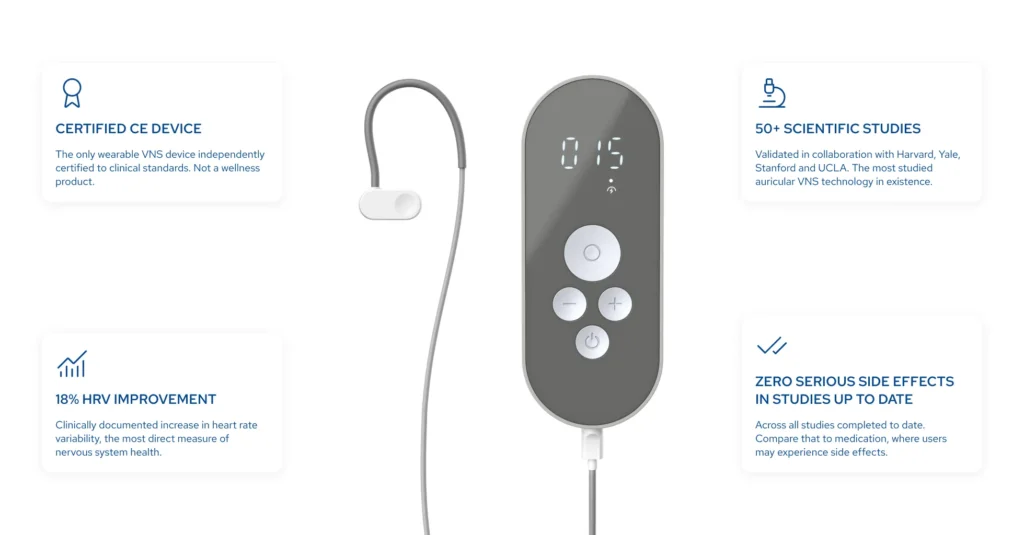
La investigación publicada ha mostrado:
- -35% de reducción en los pensamientos ansiosos - que refleja un cambio mensurable en el estado subyacente del sistema nervioso, no solo la gestión de síntomas a nivel superficial
- +18% de aumento en la HRV - un marcador fisiológico directo de lo bien que el sistema nervioso puede pasar al modo de recuperación. En un estudio científico, una sola sesión alteró favorablemente todos los parámetros de HRV en comparación con el placebo
- -45% reduction in low mood and depressive states, con mejoras observadas dentro de cinco días
- +30% de mejora en la calidad del sueño a lo largo de cuatro semanas - incluyendo menos despertares nocturnos y mejor funcionamiento durante el día
Resultados de estudios revisados por pares en poblaciones de estudio específicas. Los resultados individuales pueden variar.
Nurosym ha sido probado en más de 60 estudios científicos independientes, incluyendo colaboraciones con el King’s College de Londres, la UCL y el Imperial College de Londres.
Dónde encaja Nurosym (apoyo en el hogar)
En mi trabajo, a menudo pienso en la mente subconsciente como una computadora que ejecuta un software antiguo.
En mi trabajo, a menudo pienso que cuando un cliente está atrapado en un patrón de pensamientos ansiosos, sentimientos difíciles o comportamientos poco útiles, suele ser porque el subconsciente está ejecutando un programa que tenía sentido en algún momento... pero que no se ha actualizado desde entonces. Mi trabajo principal es actualizar ese software. la mente subconsciente como una computadora que ejecuta un software antiguo.
Pero junto con los patrones subconscientes, muchas de las personas con las que trabajo también tienen un sistema nervioso desregulado -un cuerpo que ha estado atrapado en modo de alerta durante tanto tiempo que ya no sabe cómo salir de él por sí mismo. Son dos capas diferentes del mismo problema, y a menudo necesitan ser abordadas juntas.
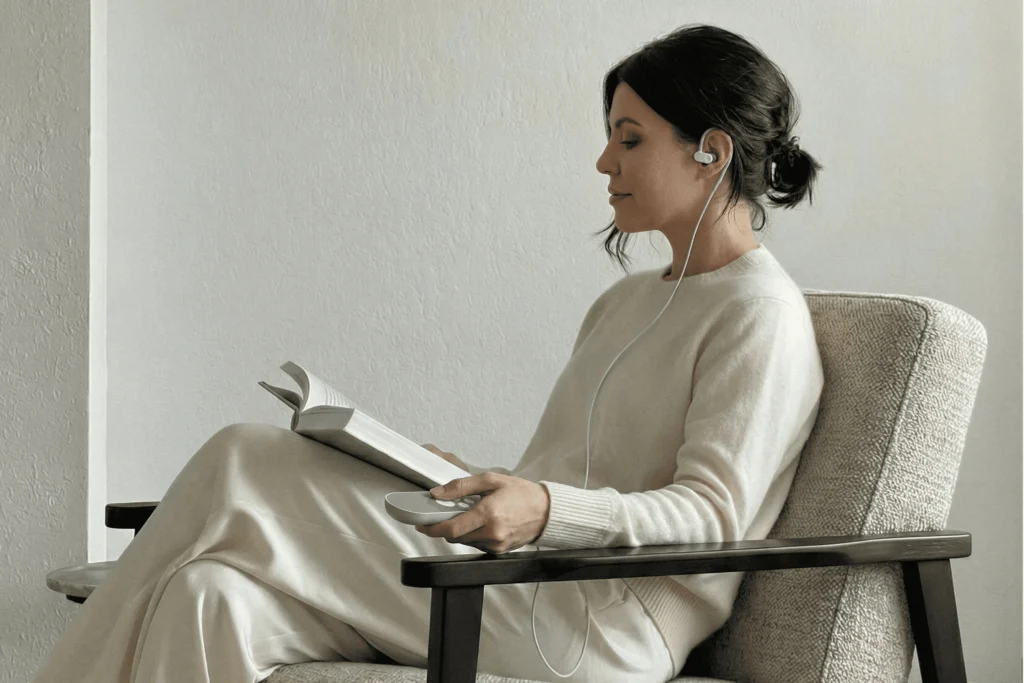
Para la capa del sistema nervioso, puedo sugerir Nurosym - una herramienta de apoyo para usar en casa junto con nuestras sesiones.
Definición: Un dispositivo taVNS con marca CE desarrollado por Parasym, con más de diez años de investigación y más de 10 millones de libras invertidas en evidencia científica.
Así funciona: Los impulsos eléctricos suaves apuntan a la rama auricular del nervio vago, apoyando el cambio del cuerpo desde la activación simpática hacia la recuperación parasimpática.
Por qué encaja en la vida real: Te lo pegas a la oreja y lo usas durante unos 30 minutos mientras haces algo completamente diferente: lees, almuerzas en tu escritorio, cocinas la cena o te relajas por la noche.
No requiere esfuerzo mental, un ambiente especial o alguna técnica para aprender.
No pide nada a un sistema que ya está agotado.
Escucho una versión de lo mismo a menudo de personas que eventualmente lo intentan: años despertándose con ese zumbido bajo de pavor, suponiendo que era simplemente su naturaleza. Rara vez lo es. Casi siempre se trata de un sistema nervioso que aún no ha recibido la señal de que es seguro retirarse.
Quién podría beneficiarse y quién no debería utilizarlo
Puede beneficiar:
- Personas que experimentan pensamientos ansiosos persistentes o un ciclo de preocupación que regresa a pesar de otros enfoques
- Aquellos que se sienten exhaustos pero no pueden apagarse por completo
- Personas con signos físicos persistentes de desregulación del sistema nervioso: tensión en la mandíbula, dolor torácico, trastornos del sueño, ritmo cardíaco acelerado
- Aquellos cuyo sueño dejó de ser reparador sin una razón obvia
- Personas cuyos síntomas continúan a pesar de que el período estresante que los desencadenó ya pasó
No lo use si:
- Tener un marcapasos o dispositivo cardíaco implantable
- Está embarazada
- Ha tenido un episodio cardíaco grave reciente
- Tener menos de 18 años
Siempre consulte a un profesional de la salud calificado antes de comenzar.
Una forma segura de intentarlo
- Garantía de devolución del dinero en 30 días - explorar en casa sin riesgo financiero
- Plazas de investigación subvencionadas limitadas - algunos participantes pueden recibir hasta 70 € de descuento a cambio de compartir su experiencia
No se requiere receta médica.
Pensamientos finales: tratar al sistema, no a los pensamientos
Una cosa que a menudo recuerdo a los clientes es que la forma en que te sientes hoy no necesariamente refleja quién eres. A menudo es un reflejo del estado en el que su sistema nervioso se ha visto obligado a operar durante demasiado tiempo.
La mayoría de las personas con las que me siento no están rotas. No son personas naturalmente ansiosas que simplemente tienen que aprender a vivir con ello.
Son personas cuyo sistema nervioso aprendió -razonablemente, sensiblemente- a estar alerta durante un período que lo requería. Y simplemente no ha recibido aún una señal lo suficientemente clara de que es seguro retirarse.
El círculo de preocupación no es tu personalidad.
El pecho apretado no es tu línea de base. Olvidar cómo se siente la calma no es lo mismo que estar tranquilo sin ella.
A veces, la pieza que falta no es más esfuerzo o mejores hábitos. Simplemente está ayudando al sistema nervioso a recibir la señal que ha estado esperando.
Si algo de esto resuena y quieres entender lo que realmente está impulsando tus pensamientos ansiosos, este es un buen lugar para empezar.
Este artículo de blog tiene como objetivo ser informativo y no debe reemplazar el asesoramiento profesional en salud. Consulte siempre con un profesional de la salud para obtener asesoramiento personalizado.
Referencias
- Thayer JF, Lane RD. Claude Bernard and the heart-brain connection: further elaboration of a model of neurovisceral integration. Neuroscience and Biobehavioural Reviews. 2009. https://pubmed.ncbi.nlm.nih.gov/18771686/
- Breit S, Kupferberg A, Rogler G, Hasler G. Vagus nerve as modulator of the brain-gut axis in psychiatric and inflammatory disorders. Frontiers in Psychiatry. 2018. https://www.frontiersin.org/articles/10.3389/fpsyt.2018.00044/full
- Farmer AD, et al. International consensus based review and recommendations for minimum reporting standards in research on transcutaneous vagus nerve stimulation. Frontiers in Human Neuroscience. 2021. https://www.frontiersin.org/articles/10.3389/fnhum.2020.568051/full
- Zheng S, et al. taVNS reduces anxious thoughts scores in a controlled study population. Brain Stimulation. 2024.
- Forte G, et al. Ear your heart: transcutaneous auricular vagus nerve stimulation on heart rate variability in healthy young participants. PeerJ. 2022. https://pmc.ncbi.nlm.nih.gov/articles/PMC9686410/
- Dolcini J, et al. Effects of transcutaneous auricular vagus nerve stimulation on mood and depressive states: Randomised controlled study. 2025.
- Dolcini J, et al. Effects of transcutaneous auricular vagus nerve stimulation on sleep quality: Randomised controlled study. 2025.
- Nurosym Scientific Research Overview. https://nurosym.com/pages/science



 Spanish
  English
  German
  French
  Swedish
  Italian