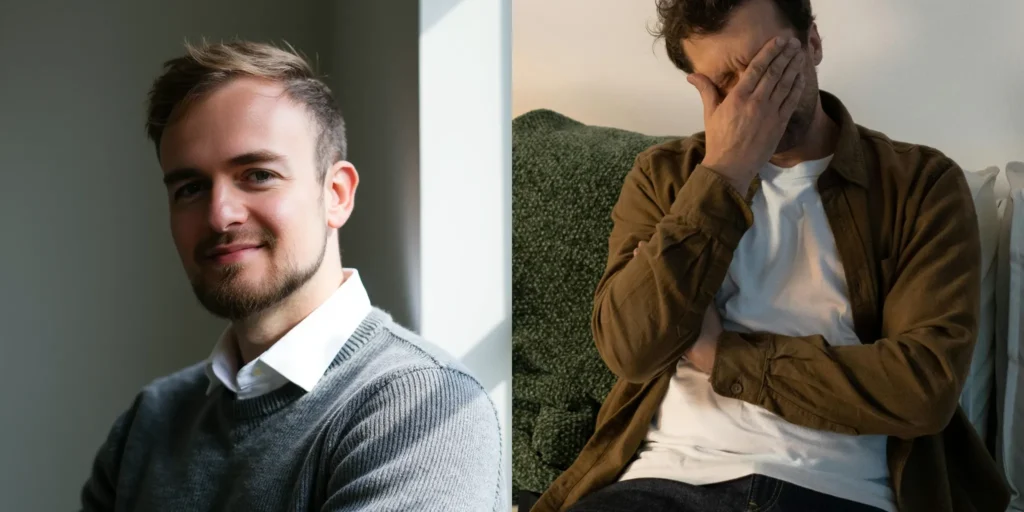
Cansancio constante, niebla mental que no se levanta y la sensación de que el descanso nunca te restaura completamente - a la mayoría de las personas se les dice que duerman más. A pocos les dicen por qué dormir ya no es reparador.
Dormiste siete horas anoche. Tal vez ocho.
No estás haciendo nada obviamente mal. Y sin embargo - te despiertas sintiendo como si la noche nunca hubiera pasado.
La alarma suena y tu primer pensamiento no es el día que viene. Es cuánto tiempo pasará hasta que puedas recostarte de nuevo.
A las 10 de la mañana, la niebla se ha asentado y no se levanta. Para las 14:00, estás buscando el tercer café... no porque lo quieras, sino porque lo necesitas sólo para funcionar. El efecto apenas dura más. Ahora simplemente se disipa. Te has dado cuenta de que estabas mirando bebidas energéticas en la caja.
Por la tarde, el plan que hiciste hace dos semanas parece imposible. Lo cancelas. Otra vez.
La membresía del gimnasio sigue activa. Lo mantienes porque cada pocas semanas realmente quieres empezar de nuevo - mañana, el próximo lunes, después de este proyecto. La energía nunca está del todo ahí cuando llega el mañana.
En primavera, era el cansancio estacional. En verano, el calor. En otoño, hay un cambio de luz. En invierno, hace frío. Ha pasado otro año, y la explicación sigue cambiando -pero la sensación de estar agotado sigue siendo la misma.
En algún momento, decidiste que lo que necesitabas eran unas vacaciones adecuadas. Una semana en un lugar cálido. Descanso de verdad. Y tal vez lo entendiste - y por un día o dos, ayudó. Pero para cuando estabas en casa desempacando, la pesadez ya había regresado. Los resultados de tus análisis de sangre estuvieron dentro del rango normal. Frustrante a su manera - porque nada está técnicamente mal, y sin embargo todo se siente más difícil de lo que debería. Has probado el hierro, la vitamina D, el magnesio y la ashwagandha. Algunos te ayudaron brevemente. Ninguno te proporcionó un beneficio duradero.
Y debajo de todo eso -más silencioso que el propio agotamiento- está la sensación de que no estás apareciendo del modo como solías hacerlo. No para la gente que te rodea. No para ti mismo.
Si esto suena familiar, quiero decir algo que la mayoría de los expertos en salud nunca te dicen:
El problema probablemente no es cuánto duermes. El problema es que tu cuerpo ya no puede recuperarse de verdad.
Dormir más no lo arreglará. Tampoco lo hará otro suplemento, una mejor rutina antes de acostarse o una semana en la playa. Porque el problema no es qué va a entrar en el tanque, sino que el sistema de recuperación ya no funciona eficientemente.
"He trabajado con cientos de personas agotadas, ennegrecidas y exhaustas. Casi ninguna de ellas tenía problemas para dormir."

Soy un naturópata y médico funcional. Antes de eso, fui una enfermera entrenada que trabajó en entornos sanitarios durante años.
El patrón que seguí viendo -en el hospital y más tarde en mi propia práctica- era el mismo: la gente no tenía poco descanso. Sus horas de sueño estaban ahí. Sus análisis de sangre eran en gran medida normales. Y sin embargo, claramente algo no estaba funcionando.
Lo que faltaba no era dormir. Era una recuperación. Las dos cosas no son la misma cosa.
Un caso -una gestora de proyectos a principios de los cuarenta- se produjo después de dos años de lo que ella describió como un agotamiento de antecedentes que nunca se resolvió.
Dormir de siete a ocho horas. Reducir el consumo de alcohol. Probé magnesio, vitaminas B y una infusión de hierro. Se tomó dos semanas libres del trabajo y volvió sintiéndose igual, como si el resto nunca hubiera sucedido. Había dejado casi por completo de hacer planes sociales, no porque quisiera hacerlo, sino porque la energía nunca estuvo ahí. Me dijo que sentía como si estuviera observando su propia vida desde una ligera distancia.
Ella no es inusual. Escucho versiones de esta historia regularmente.
Los detalles difieren. Debajo de ellos, una cosa sigue apareciendo:
Su sistema nervioso no está cambiando a modo de recuperación. No completamente. No cuando debería.
La fisiología que apoya la recuperación -reparación celular, regulación hormonal y mantenimiento inmunológico- parece estar funcionando de manera menos eficiente. No por pereza. No por malos hábitos. Por algo que la mayoría de las conversaciones de cansancio nunca alcanzan.
Entonces, ¿qué está sucediendo en realidad? ¿Y por qué el consejo estándar sigue fallando?
Tu cuerpo no está fallando en dormir. Está fallando en recuperarse.
La mayoría de los consejos para el cansancio apuntan a problemas de sueño: hora de dormir antes. Sin pantallas. Magnesio. Ashwagandha. Un colchón mejor.
Estas no son sugerencias equivocadas. Pero están trabajando en el contenedor, no en el sistema que se supone que debe hacer la restauración.
Tu sistema nervioso autónomo equilibra continuamente la actividad simpática y parasimpática. Aunque ambos sistemas están activos en diferentes grados, uno a menudo predomina dependiendo de las circunstancias.
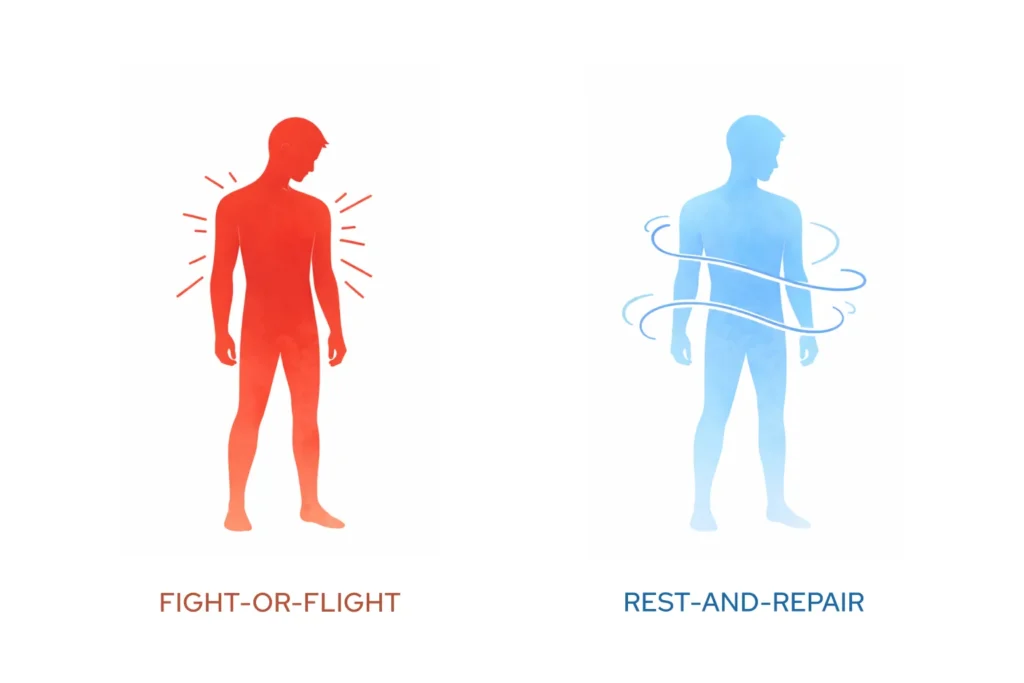
La primera es lucha o huida - el estado comprensivo. El cuerpo se moviliza. La frecuencia cardíaca aumenta. El cortisol se activa. La digestión se ralentiza. La reparación de los tejidos se desprioriza temporalmente. Todos los recursos disponibles se destinan a la supervivencia inmediata.
El segundo es descanso y reparación - el estado parasimpático. El cuerpo se recupera. La frecuencia cardíaca disminuye. El cortisol cae. Se forma una arquitectura de sueño profundo. El sistema inmunológico hace su mantenimiento. Aumentan los procesos de reparación y mantenimiento.
Un sistema nervioso sano se mueve naturalmente entre estos cuando realmente lo necesita - descanso y reparación como la opción por defecto.
El problema es lo que la presión moderna sostenida hace a ese equilibrio.
La bandeja de entrada nunca se vacía. Las demandas no tienen bordes limpios. El cuerpo registra presión baja casi continuamente y, con el tiempo, se adapta. Comienza a considerar la alerta leve como su estado normal.
Cuando eso sucede, algo importante se rompe: incluso durante el sueño, el sistema nervioso no se desplaza completamente hacia el descanso y la reparación.
La arquitectura del sueño cambia. El tiempo pasado en un sueño de onda lenta puede disminuir. El cortisol, que debería estar bajo por la noche, se mantiene elevado. La regulación inmune y la reparación de los tejidos que dependen del sueño profundo se comprimen o se omiten por completo.
Duermes. Las horas están ahí. Pero te despiertas sintiendo que el sueño no hizo nada.
Muchas personas que usan un Whoop, Oura Ring o Apple Watch notan exactamente este patrón en sus datos. Siete u ocho horas registradas. Pero la puntuación de recuperación es del 30% o 40%. El sueño profundo, una etapa asociada con muchos procesos fisiológicos restauradores, se comprime a 20 o 30 minutos durante toda la noche. La VHR tendió a disminuir durante semanas. El ritmo cardíaco en reposo se elevó a las 2 de la mañana, cuando debería haber llegado a su punto más bajo.
Los datos a menudo reflejan cómo la persona ya se siente: las horas pasan, pero la recuperación no está sucediendo.
Ese es el ciclo. Y la higiene del sueño no lo rompe, porque el problema no es el ambiente de sueño. Es que el cambio a la recuperación ha dejado de funcionar.
Esta es la parte que a la mayoría de las personas les parece sorprendente - y frustrante
La mayoría de las personas que enfrentan este tipo de agotamiento ya han probado mucho.
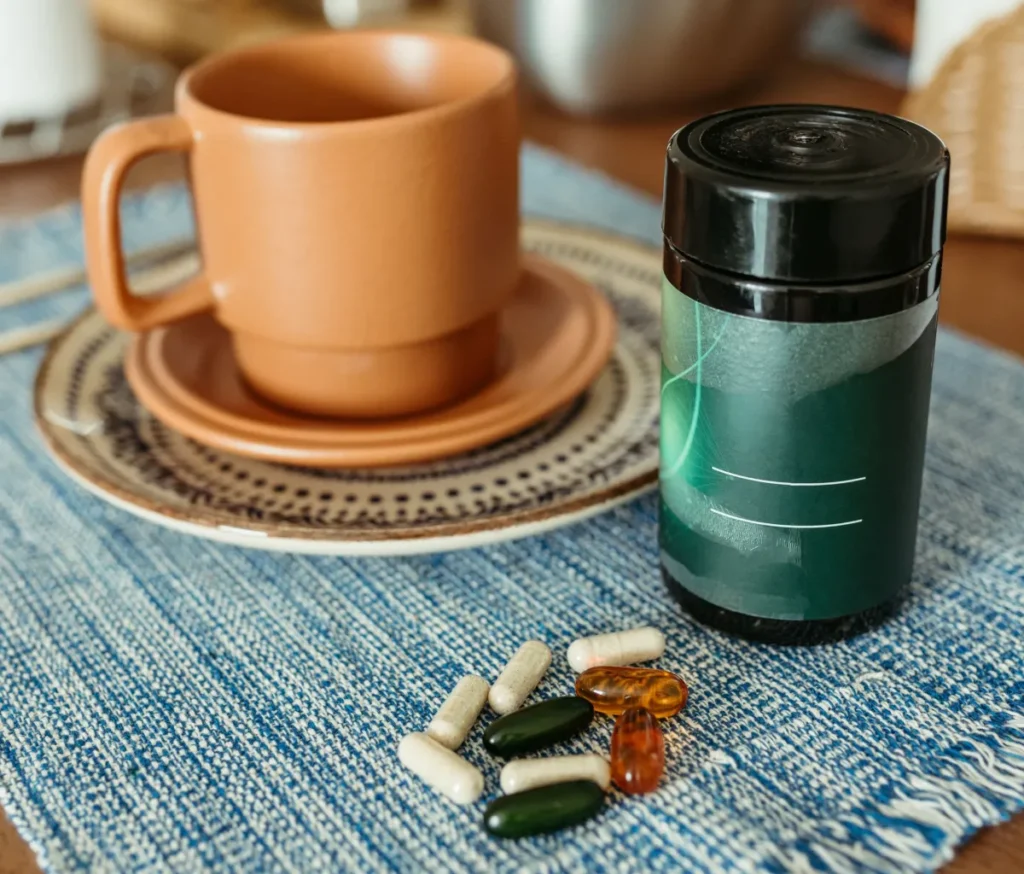
De día: un segundo matcha antes de las 9 de la mañana, una bebida energética a primera hora de la tarde, cordyceps o melena de león, alguien recomendó, un spray de B12, raíz de maca, algo de la tienda de alimentos saludables que prometía energía sostenida sin el accidente.
El fin de semana: un día de spa, una clase de yoga, respiración Kapalbhati para agitar la niebla, una sauna infrarroja.
Algunas de estas cosas ayudan. Temporalmente. Luego vuelve la pesadez.
La razón honesta por la que la mayoría de estos enfoques no funcionan es que no lo hacen. Es que todos ellos requieren algo que una persona con agotamiento crónico no tiene de manera confiable: tiempo, dinero, un momento de tranquilidad y la energía mental para hacerlos.
La sauna requiere conducir a algún lugar. La práctica de la respiración requiere una habitación tranquila y concentración. Las vacaciones requieren planificación - y si estás sin nada, incluso reservar un viaje puede sentirse como una cosa más para organizar. Los suplementos requieren recordar. La clase de yoga requiere presentarse.
Cuando el cansancio es el problema, cada cosa adicional se siente como un peso extra.
Y ese camino de recuperación tiene un nombre.
El nervio vago: por qué tu cuerpo dejó de saber cómo descansar
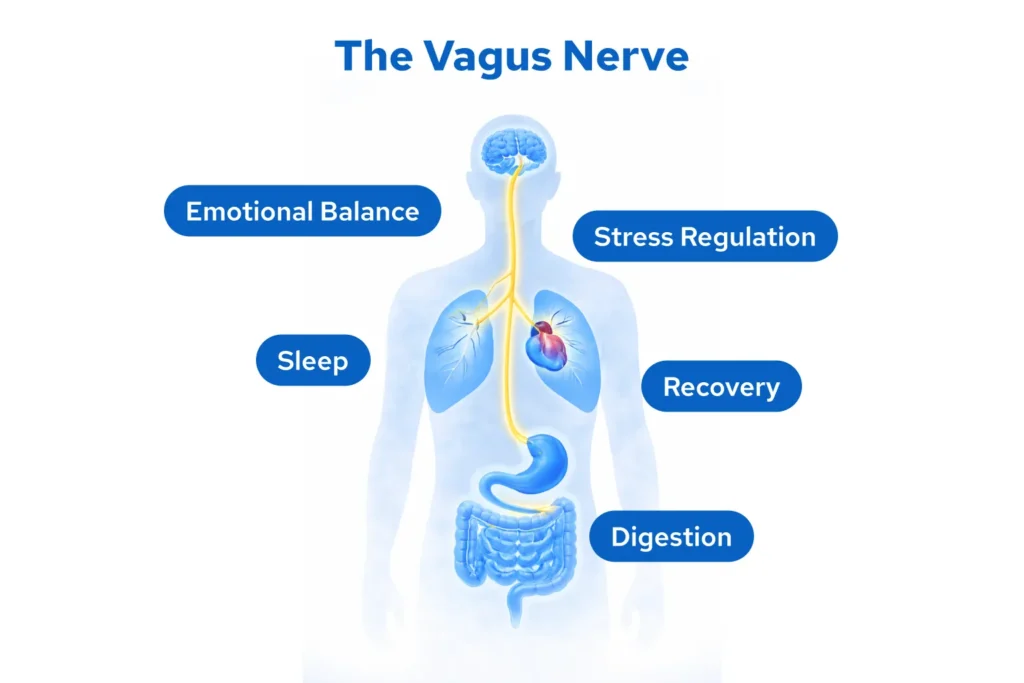
Se llama nervio vago. Y es una de las estructuras clave que conecta casi todo lo descrito anteriormente.
Al salir de tu tronco encefálico y atravesar el corazón, los pulmones y el tracto digestivo, actúa como la principal vía de comunicación del cuerpo para un mensaje específico: la amenaza ha pasado - ahora es seguro recuperarse.1
Cuando el tono vagal es fuerte, el cuerpo realmente se convierte en un estado de reposo y reparación. El sueño alcanza etapas profundamente restauradoras. Las caídas de cortisol. Aumentan los procesos de reparación.
Cuando el tono vagal es bajo -que puede disminuir después de un estrés prolongado, una enfermedad viral o simplemente años de presión acumulada- el interruptor de recuperación se vuelve poco fiable. El cuerpo pasa por los movimientos de reposo. Pero la reparación profunda no ocurre.
**HRV - Variabilidad de la frecuencia cardíaca - es ampliamente utilizado como un marcador no invasivo de la función autonómica y está influenciado por la actividad vagal. **2 Es simplemente la variación natural entre los latidos del corazón individuales. Un sistema nervioso saludable produce ritmos variables y flexibles. Una desregulación produce rigidez. Muchos de mis clientes que usan rastreadores de ejercicio notan puntuaciones HRV crónicamente bajas. Esto no es coincidencia. Es el sistema nervioso el que informa que su función de recuperación está deteriorada.
Pero hay un mecanismo más del que la mayoría de las personas -incluidos muchos profesionales- no son conscientes. Y esto explica algo que ha confundido genuinamente a muchos de mis clientes:
¿Por qué se sienten cansados incluso cuando técnicamente ya han descansado?
La respuesta tiene que ver con lo que sucede dentro de las células.
Cuando el sistema nervioso se queda en la lucha o huye, el sistema inmunológico produce niveles elevados de citoquinas proinflamatorias -mensajeros químicos que fueron diseñados para emergencias de corto plazo. Cuando permanecen elevados durante meses o años, sucede algo inesperado: comienzan a interferir con la capacidad de las células para producir energía.
Piense en ello como un corte de energía que nunca se resuelve por completo. Las luces vuelven a encenderse, pero la red está funcionando con una capacidad reducida. Tus células están generando menos energía de la que deberían, sin importar cuánto duermas. Esta es la razón por la que el agotamiento persiste incluso después de una noche completa de descanso. El problema no es la cantidad de sueño. Es que el propio sistema de producción de energía ha sido silenciosamente suprimido, y dormir por sí solo no puede solucionar eso.
Es por eso que el cansancio sigue regresando. No porque no duermas lo suficiente, sino porque tus células no se recuperan ni siquiera cuando lo haces.
Estudios realizados por investigadores afiliados a instituciones como Harvard, Yale y UCL han informado de asociaciones entre inflamación sistémica elevada, supresión de la producción de energía celular, alteración de la arquitectura del sueño y cansancio persistente que no se resuelve con descanso solamente.3
Lo que hace que esto sea relevante más allá del cansancio es el alcance del propio nervio vago: la misma vía que regula la respuesta al estrés, gobierna la motilidad intestinal y la digestión, modula el estado de ánimo e influye en la arquitectura del sueño. Es por eso que las personas con tono vagal desregulado rara vez experimentan cansancio en aislamiento. También perciben pensamientos ansiosos que no se calman, molestias digestivas que empeoran bajo presión, un estado de ánimo que parece estático o frágil y un sueño que nunca es verdaderamente reparador. Estos síntomas pueden compartir vías fisiológicas subyacentes comunes. Son expresiones diferentes del mismo desequilibrio subyacente.
Esto planteó una pregunta obvia: si el nervio vago es el interruptor, ¿hay alguna manera de alcanzarlo directamente -sin cirugía, sin receta, sin necesidad de alcanzar primero un estado de calma al que el cuerpo no pueda acceder de manera confiable?
Lo que encontré después de buscar algo que realmente llega a la raíz
Comencé a hacer una pregunta diferente a mis casos. No lo que estaban haciendo mal, sino qué mecanismo biológico estaba en realidad bloqueando la recuperación misma. Esa búsqueda me llevó a un lugar donde la mayoría de los expertos en salud nunca buscan.
Resulta que la respuesta había estado desarrollándose silenciosamente en la investigación científica durante años. Los dispositivos quirúrgicos de estimulación del nervio vago (VNS) existen desde hace décadas -eficaces en ciertos problemas de salud, pero no algo que la mayoría de las personas consideraría para el apoyo diario a la recuperación.
**Lo que había cambiado fue el descubrimiento de que una rama específica del nervio vago -la rama auricular- corre cerca de la superficie del oído externo. Ese hecho anatómico hizo posible la estimulación no invasiva por primera vez. **
Este método se llama taVNS - estimulación del nervio vago auricular transcutáneo. En lugar de implantar quirúrgicamente un dispositivo cerca del nervio, un pequeño auricular entrega pulsos eléctricos calibrados con precisión directamente a la rama auricular a través de la piel. La señal viaja hasta el tronco encefálico, apuntando a vías neuronales similares sin necesidad de una implantación quirúrgica, ni riesgo o costo.
Otros dispositivos que reclaman estimulación vagal -estimuladores del cuello, aparatos de vibración, dispositivos basados en TENS- apuntan a diferentes sitios con perfiles de evidencia sustancialmente más débiles.
Estaba interesado. También fui cauteloso.
El espacio de bienestar está lleno de dispositivos que dicen estimular el sistema nervioso, pero con poca evidencia sólida para respaldarlos. Estaba buscando una investigación revisada por pares, controlada con placebo, no marketing al consumidor. Pasé tiempo revisando la literatura científica antes de estar dispuesto a recomendar cualquier cosa.
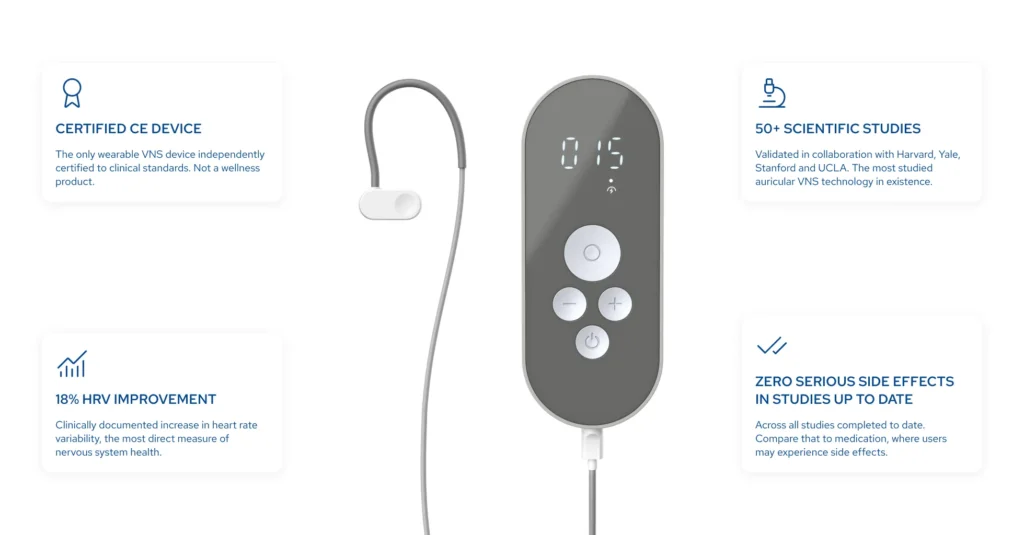
Lo que encontré fue más sustancial de lo que esperaba. Entre los dispositivos taVNS en el mercado, uno seguía apareciendo en contextos de investigación más que simplemente en la publicidad. No sólo uno o dos estudios, sino más de 60 completaron estudios científicos en colaboración con instituciones como la UCL, el King’s College de Londres, la UCLA, grupos de investigación afiliados a Harvard y el NHS. Es, por un margen significativo, uno de los dispositivos portátiles taVNS más ampliamente estudiados.
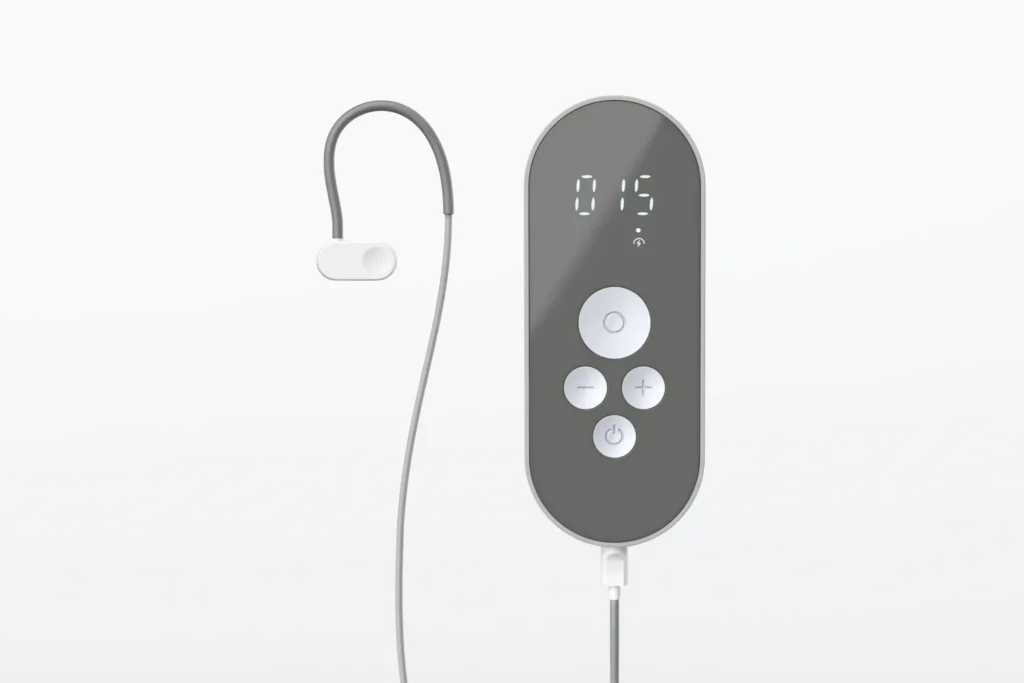
Ese dispositivo se llama Nurosym.
La certificación CE indica que el dispositivo cumple con los requisitos reglamentarios europeos aplicables en materia de seguridad y rendimiento. Ese es un umbral significativo que la mayoría de los dispositivos para el bienestar que afirman tener estimulación vagal no han superado.
Así son los 30 minutos
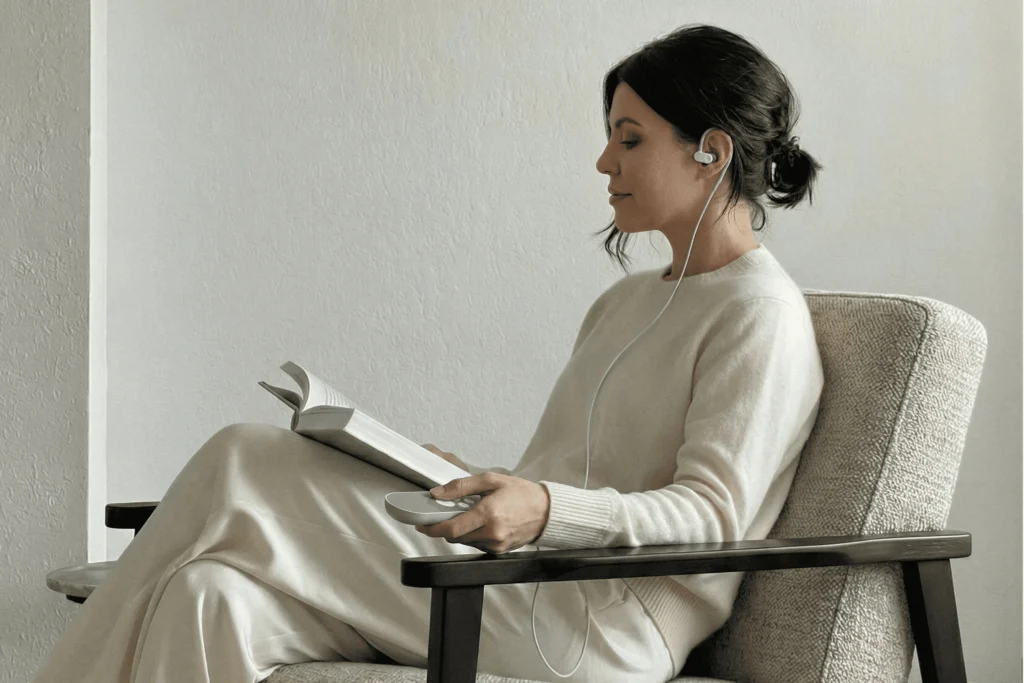
Un pequeño dispositivo que se usa en el oído, como un auricular. Entrega un pulso eléctrico calibrado con precisión a la rama auricular del nervio vago. Una sesión: 30 minutos.
Puedes usarlo durante tu pausa para el almuerzo en la oficina. No se requiere un cuarto tranquilo. No hay técnica que aprender. No hay tiempo extra extraído de un día ya agotado.
Puedes hacerlo mientras lees, trabajas en un escritorio, cocinas la cena o te relajas por la noche.
El pulso viaja directamente al tronco encefálico, diseñado para estimular las vías vagales involucradas en la actividad parasimpática que ha estado suprimiendo un estrés sostenido.
No sedación. No relajación en el sentido general. Una señal fisiológica directa al sistema nervioso de que es seguro pasar al modo de reparación.
Lo que muestra la investigación
- Una reducción del 48% en los puntajes de cansancio, con los participantes reportando mejoras sostenidas incluso una semana después de interrumpir la terapia.
- Una mejora del 31% en la calidad del sueño - midiendo la latencia del sueño, la duración, la eficiencia y la función diurna.
- Una reducción del 78% en IL-6 - supresión directa de las citocinas que pueden afectar la función mitocondrial.
- Un aumento del 61% en la actividad de los nervios vagos dentro de cinco minutos de uso: medible, no teórico.
Lo que encuentro científicamente significativo es el resultado de las citocinas en particular porque aborda directamente el mecanismo energético celular -no como un acontecimiento adverso, sino como una vía primaria.
Algunos participantes en estudios publicados también han informado de mejoras más allá del cansancio: en los pensamientos ansiosos, la profundidad del sueño, el confort digestivo y el estado de ánimo. Cuando el sistema regulatorio subyacente vuelve a funcionar, los efectos tienden a ser amplios.
"Después de años de estar atascado en la lucha o la huida, Nurosym ha sido esencial para restaurar mi sistema a la normalidad." – Deborah Knopf, Trustpilot
"Después de dos años de graves problemas para dormir, duermo más profundamente y por más tiempo que nunca. Además, me siento más descansado durante el día." – Kenny Van Bladel, Trustpilot
"El cansancio disminuyó y la niebla mental desapareció casi por completo." – Cornelia Krause, Trustpilot
A quién afecta este patrón
Veo esto de manera más consistente en personas con trabajos basados en escritorios o mentalmente exigentes, profesionales cuyo sistema nervioso debe estar alerta desde la primera notificación por la mañana hasta el último mensaje por la noche, sin un límite claro donde la presión realmente se detenga.
Pero el mismo patrón autonómico aparece en vidas muy diferentes.
Trabajadores por turnos cuyos ciclos de sueño-vigilia están continuamente interrumpidos. Personas en roles de cuidado -para niños, padres que envejecen, pacientes- que dan resultados sostenidos sin una recuperación adecuada incorporada. Las personas que pasaron por un período prolongado de alto estrés nunca volvieron a la línea base después.
También lo veo regularmente en los atletas: personas que entrenan de manera consistente, monitorean sus métricas de recuperación y aún no pueden entender por qué su energía y HRV no están donde deberían estar. El estado físico y el entrenamiento no protegen contra la desregulación autónoma cuando la carga mental y profesional es alta.
Y cada vez más en personas mayores de 45 años, donde los cambios fisiológicos relacionados con la edad pueden reducir los amortiguadores de resiliencia del cuerpo que anteriormente dependían.
El hilo conductor no es el estilo de vida o la ocupación. Es un sistema nervioso que ha estado en activación sostenida durante más tiempo del que estaba diseñado para sostenerse, sin suficiente recuperación genuina entre medias.
Una nota práctica antes de decidir
Nurosym no es un sustituto del sueño, la nutrición o el tratamiento de la causa subyacente de la desregulación.
Para las personas con un cansancio post-viral significativo, una alteración hormonal o un deterioro mitocondrial más profundo, el trabajo subyacente es importante y lo abordamos directamente en la práctica en YourBestHealth.
Lo que ofrece Nurosym es algo que los otros enfoques tienen dificultades para ofrecer de manera fiable: se puede incorporar a las actividades diarias con un esfuerzo mínimo. No se requiere enfoque. No hay ajustes perfectos. No hay hora extra tallada en un día ya agotado. Lo usas mientras vives tu vida - y está diseñado para proporcionar una estimulación dirigida de la rama auricular del nervio vago, al nivel fisiológico donde realmente se encuentra el problema.
También vale la pena aclarar por qué la elección del dispositivo es importante aquí. No todos los dispositivos que afirman la estimulación del nervio vago son equivalentes. La rama auricular es el punto de acceso externo al nervio vago mejor estudiado, un hallazgo validado por investigaciones revisadas por pares para llegar al tronco encefálico. Los dispositivos que estimulan el cuello, o que utilizan vibraciones en lugar de pulsos eléctricos calibrados, tienen perfiles de evidencia sustancialmente diferentes. Los parámetros específicos de la forma de onda de Nurosym han sido investigados a través de más de 60 estudios científicos publicados y en curso. Este nivel de investigación proporciona más evidencia que la disponible para muchos dispositivos de consumo comparables.
Nurosym ofrece una garantía de devolución del dinero de 30 días - si lo usas consistentemente durante 30 días y no notas ninguna mejora en cómo te sientes o en tus métricas de recuperación, lo devuelves. Eso elimina el riesgo financiero de saber si su sistema responde.
Si el cansancio sigue regresando sin importar lo que intentes -si el descanso no se restablece y el sueño no se refresca-, la pregunta que vale la pena hacerse no es "¿Estoy durmiendo lo suficiente?"
Es: ¿Es mi cuerpo realmente capaz de recuperarse?
Adopta un enfoque diferente para el cansancio persistente.
En lugar de añadir otro suplemento o buscar otro aumento temporal de energía, considere si apoyar a su sistema nervioso podría ayudar a abordar un factor subyacente de mala recuperación.
Ver cómo se está estudiando la estimulación del nervio vago para la calidad del sueño, la resiliencia y los síntomas relacionados con el cansancio.
Este artículo de blog tiene como objetivo ser informativo y no debe reemplazar el asesoramiento profesional en salud. Consulte siempre con un profesional de la salud para obtener asesoramiento personalizado.
Referencias
¹ Yaribeygi, H., et al. (2017). The impact of stress on body function: A review. EXCLI Journal. https://pmc.ncbi.nlm.nih.gov/articles/PMC5579396/
² Wolf, V., et al. (2021). Does transcutaneous auricular vagus nerve stimulation affect vagally mediated heart rate variability? A living and interactive Bayesian meta-analysis. Psychophysiology. https://doi.org/10.1111/psyp.13933
³ Breit, S., et al. (2018). Vagus nerve as modulator of the brain–gut axis in psychiatric and inflammatory disorders. Frontiers in Psychiatry. https://doi.org/10.3389/fpsyt.2018.00044
⁴ Bonaz, B., et al. (2018). The vagus nerve at the interface of the microbiota–gut–brain axis. Frontiers in Neuroscience. https://doi.org/10.3389/fnins.2018.00049
⁵ Yap, J.Y.Y., et al. (2020). Critical review of transcutaneous vagus nerve stimulation: Challenges for Translation to Clinical Practice. Frontiers in Neuroscience. https://doi.org/10.3389/fnins.2020.00284
⁶ Kim, A. Y., et al. (2022). Safety of transcutaneous auricular vagus nerve stimulation (taVNS): A systematic review and meta-analysis. Scientific Reports. https://doi.org/10.1038/s41598-022-25864-1
⁷ Parasym Ltd. (2024). Is Nurosym a certified device?. https://help.nurosym.com/en/articles/11659060-is-nurosym-a-certified-device
⁸ Clancy, J.A., et al. (2014). Non-invasive vagus nerve stimulation in healthy humans reduces sympathetic nerve activity. Brain Stimulation. https://doi.org/10.1016/j.brs.2014.07.031



 Spanish
  English
  German
  French
  Swedish