
Four options, ranked on evidence rather than marketing. What separates them, and what the price tags don’t tell you.
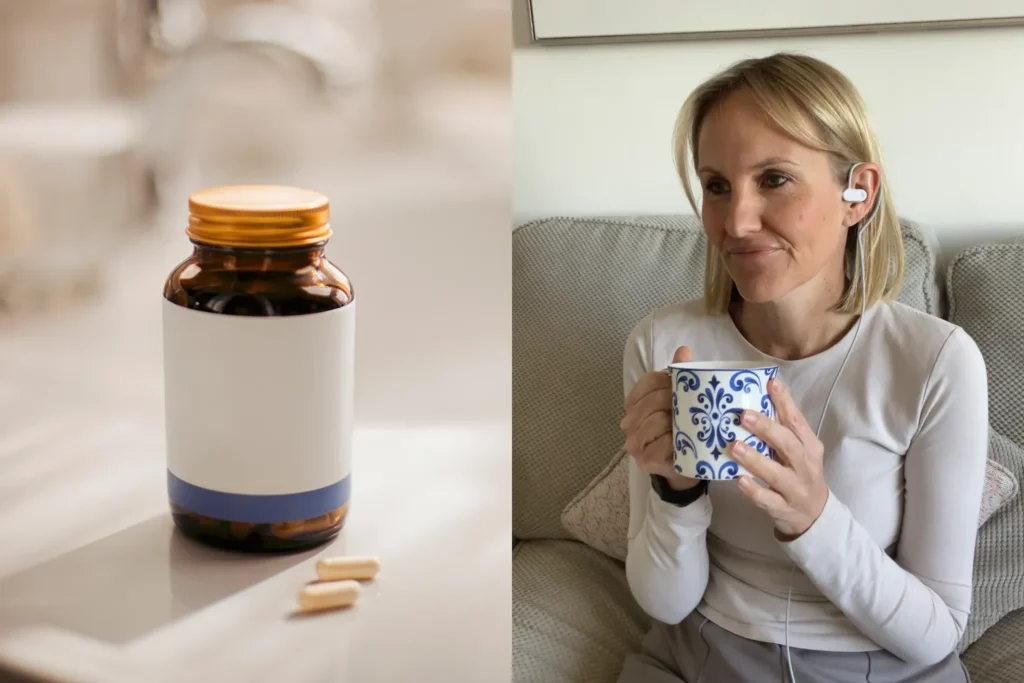
You’ve already worked out this isn’t a thinking problem.
Breathing helps for ten minutes, magnesium every night for a year, two meditation apps, both abandoned by March, therapy.
Then you found the research on vagal tone, and it explained more about your body than any of it had.
So now you’re wondering whether a device is just the next thing on the list.
Here’s what separates it.
Why the Vagus Nerve?
Anxious thoughts have a measurable physical driver, and it’s the vagus nerve.
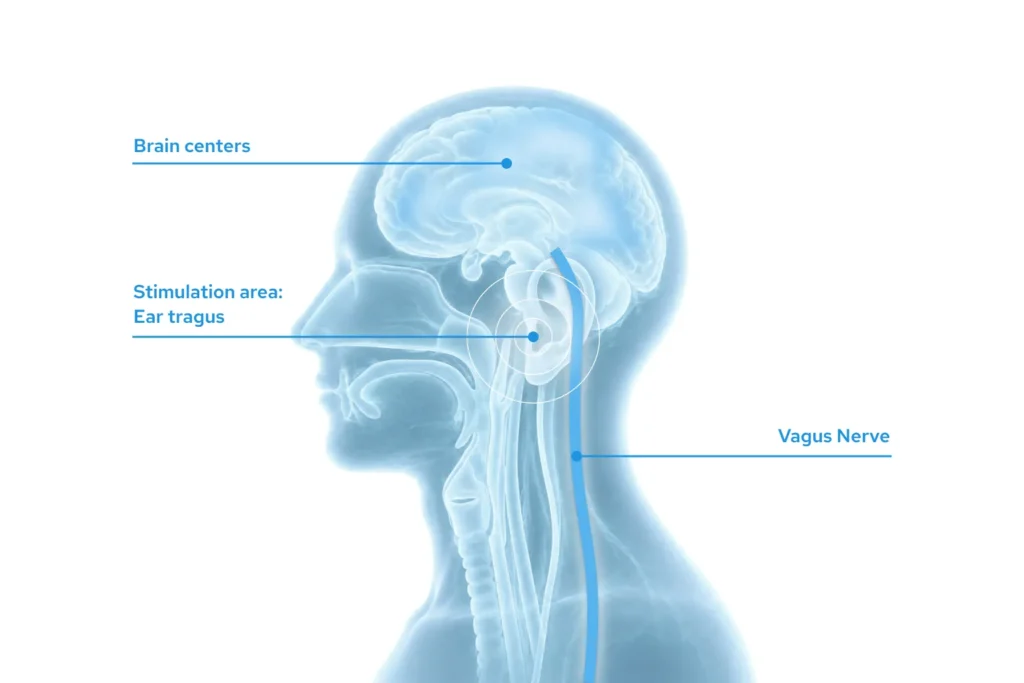
It runs from your brainstem, through your neck, down to your heart and gut.
When the signal is strong, your body downshifts on its own.
When it’s weak, you stay in low-grade fight-or-flight:
- Heart rate stays up and takes longer to come back down
- Muscles hold tension you only notice when someone mentions it
- Digestion slows, which is why gut symptoms and worry travel together
- Sleep loses its restorative stages even when the hours look fine
Here’s the part that matters:
Your brain doesn’t decide you’re safe by thinking; it reads the body.
Slow heart rate, deep breathing, loose muscles, normal digestion… Those four signals travel up the vagus nerve and tell the brain it’s safe.
When the vagal tone is low, the brain gets the opposite report and calls it a threat.
Your anxious thoughts are partly your brain explaining why your body feels like this.
Which is why reasoning with them only ever gets you so far.
What Actually Separates These Four Options
Three things, and none of them is price.
Evidence base.
Only one of the four options here has ever been measured on the nerve itself.
The rest are measured on how people say they feel, which is worth something, but it isn’t the same claim.
Where it acts. Everything else on this list works on the inputs around the nervous system. Direct stimulation acts on the pathway. That’s why it keeps working once the input-side gains run out.
Ongoing cost. Two of these you pay for every month, forever.
The Four Options: An Honest Ranking
#1 Nurosym
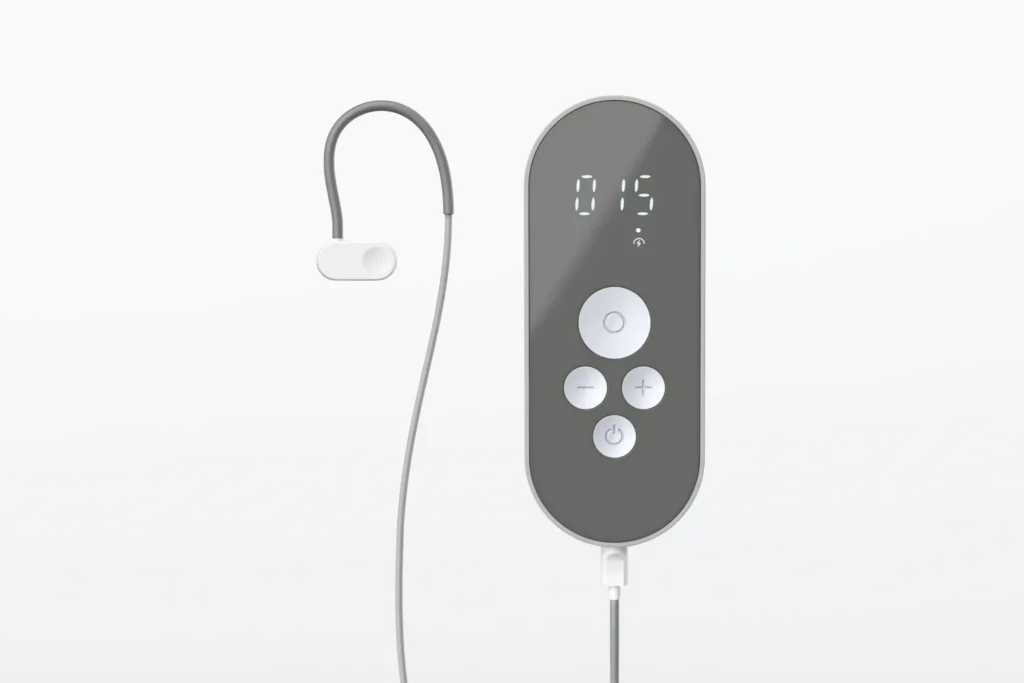
€700 one-time (research subsidy available) · Auricular · AVNT™ by Parasym
Nurosym has 60+ completed scientific studies supporting its mechanism.
- Studies using AVNT™ technology document a 61% improvement in vagal tone metrics
- Acts on the nerve directly rather than on the conditions around it
- Works while you do something else, so it doesn't compete with your attention
- Zero serious adverse events reported in studies to date
- CE-marked, verified by independent third-party assessment
- Over 4,000,000 supervised stimulation sessions completed; used by 1,000+ health professionals
- No consumables. Buy it once
- 30-day evaluation period
Best for: anyone who has done the breathing, the supplements and the apps, and still can’t get their body to stand down.
#2 Breathwork
Free · Self-administered · Acute effect
This one genuinely works, and it works on the same nerve. Slow breathing at around six breaths a minute produces a measurable vagal response. Long exhales, physiological sighs, box breathing: the mechanism is real, and it’s the reason these techniques survive.
Breathwork works, right up until the moment you need it most.
- It requires deliberate, sustained attention from a brain that is already hijacked
- The effect is acute. It pulls you out of a bad ten minutes and changes nothing about the next one
- Shifting your baseline demands a level of daily consistency almost nobody sustains for years
- It's free, which means there is no reason not to keep doing it alongside anything else
#3 Magnesium and Calming Supplements
€180–360/year, indefinitely · Oral · Systemic
Magnesium glycinate, L-theanine, ashwagandha, the whole shelf.
Magnesium corrects a deficiency, and most people taking it don’t have one.
- If you're genuinely deficient, correcting it helps, and that's a real thing worth ruling out
- If you aren't, the evidence for supplementation moving anxious thoughts is thin
- Nothing in the category acts on vagal signalling
- You pay again every month for as long as you take it, which over three years exceeds the one-time cost of the device

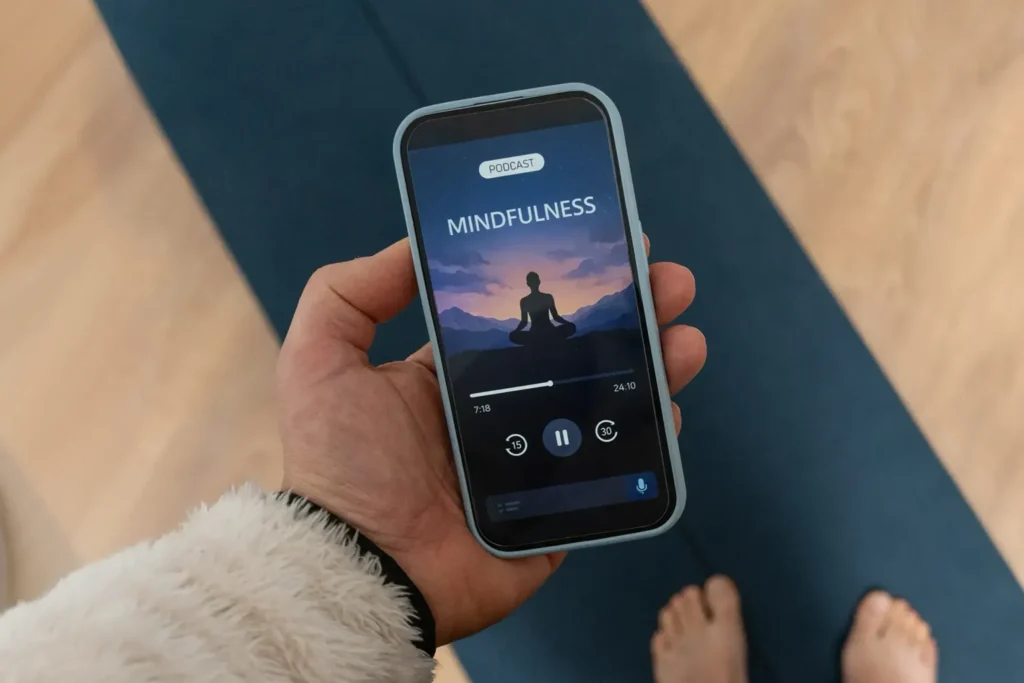
#4 Meditation Apps
€50–70/year · Subscription · Cognitive
Headspace, Calm, and the rest. There’s real evidence behind mindfulness for anxious thoughts, and it isn’t in dispute.
But it’s a top-down tool. It trains your relationship to your thoughts rather than changing the physical signal producing them.
Best for: running alongside something else. Not a way to change the underlying signal.
The Verdict
Breathwork and mindfulness both have meta-analyses behind them.
Neither one works when your attention is the thing that’s gone.
Nurosym is the one that acts on the pathway without requiring you to be calm enough to use it. It’s also €700, and the evidence base for anxiety specifically is smaller than for either breathwork or mindfulness.
Three years of supplements and a meditation subscription runs past €900, and at the end of it you own nothing and your baseline hasn’t moved.
A nervous system that learned to stay alert can learn safety again.
A nervous system that learned to stay alert can learn safety again.
Disclaimer: This article has been written by a licensed medical professional and is intended for general informational purposes only. It does not substitute for personalised medical advice, diagnosis, or therapy. Always seek the guidance of a qualified health professional with any questions regarding a medical symptom or health objective.
Sources
- Thayer JF, Åhs F, Fredrikson M, Sollers JJ, Wager TD. A meta-analysis of heart rate variability and neuroimaging studies. Neuroscience & Biobehavioural Reviews. 2012;36(2):747-756. https://doi.org/10.1016/j.neubiorev.2011.11.009
- Laborde S, Allen MS, Borges U, et al. Effects of voluntary slow breathing on heart rate and heart rate variability: A systematic review and a meta-analysis. Neuroscience & Biobehavioural Reviews. 2022;138:104711.
- Boyle NB, Lawton C, Dye L. The Effects of Magnesium Supplementation on Subjective Anxiety and Stress: A Systematic Review. Nutrients. 2017;9(5):429. https://doi.org/10.3390/nu9050429
- Goyal M, Singh S, Sibinga EMS, et al. Meditation Programs for Psychological Stress and Well-being: A Systematic Review and Meta-analysis. JAMA Internal Medicine. 2014;174(3):357-368.
- Borges U, Laborde S, Raab M. Influence of transcutaneous vagus nerve stimulation on cardiac vagal activity: A randomized controlled study. PLOS ONE. 2019;14(10):e0223848.
- Bremner JD, Gurel NZ, Wittbrodt MT, et al. Application of Noninvasive Vagal Nerve Stimulation to Stress-Related Psychiatric Disorders. Journal of Personalized Medicine. 2020;10(3):119.
- Kaniusas E, Kampusch S, Tittgemeyer M, et al. Current Directions in the Auricular Vagus Nerve Stimulation I: A Physiological Perspective. Frontiers in Neuroscience. 2019;13:854.


 English
  German
  French
  Spanish
  Swedish