
The Missing Piece for Stress, Racing Thoughts and Gut Problems
A client sat across from me not long ago. Stomach that reacted to everything – bloating after every meal, acid reflux with no clear trigger. Alongside that: racing thoughts that wouldn’t stop at night, a low hum of tension that never released, and an exhaustion that sleep didn’t fix.
She looked at me and said: “I feel like my body is running a programme I can’t turn off.”
I’ve heard that sentence more times than I can count.
When I first came across Nurosym by Parasym, I was sceptical. My standard is simple: show me the peer-reviewed data, or I’m not recommending it.
The research stopped me in my tracks.
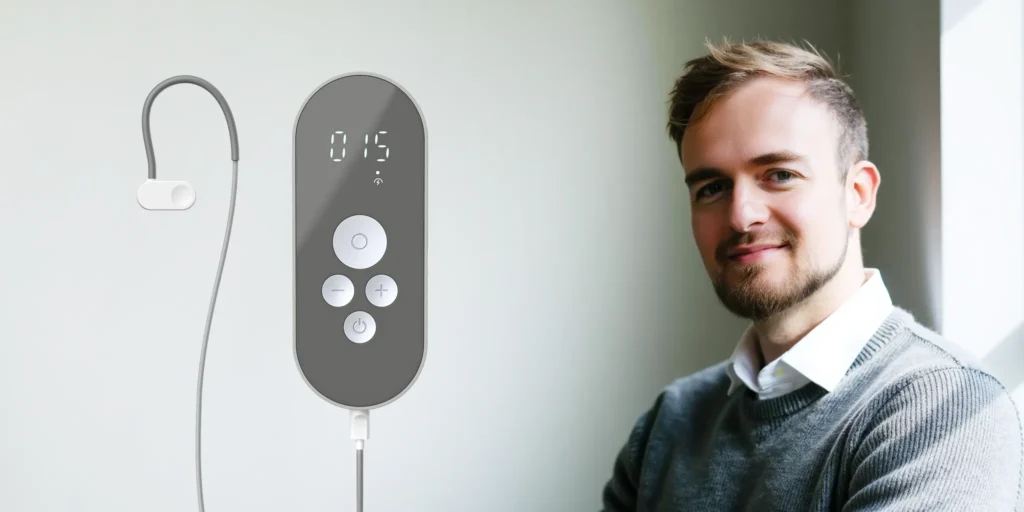
Nurosym is a small wearable device that clips onto the left ear and sends calibrated electrical signals to the vagus nerve – the body’s primary pathway for shifting out of stress and into recovery. No drugs. No prescription. Just a gentle tingling in the ear for 15 to 30 minutes a day.
Here’s what I wish I’d understood sooner.


The Gut and the Racing Mind Are Usually the Same Problem
The vagus nerve runs from the brainstem through the heart, lungs, and gut. When it’s functioning well, the body shifts out of alert mode on its own. Digestion works. The mind quiets. Sleep restores.
When vagal tone is impaired – after prolonged stress, chronic tension, or illness – the nervous system gets stuck.
Racing thoughts, disrupted sleep, gut problems, persistent tiredness. Multiple symptoms, one root.
Most of my clients had been treating these as separate problems. In many cases, they’re one.

I Went Straight to the Research. What I Found Surprised Me.
Before recommending anything to clients, I go to the primary literature. Not company websites. The actual peer-reviewed publications.
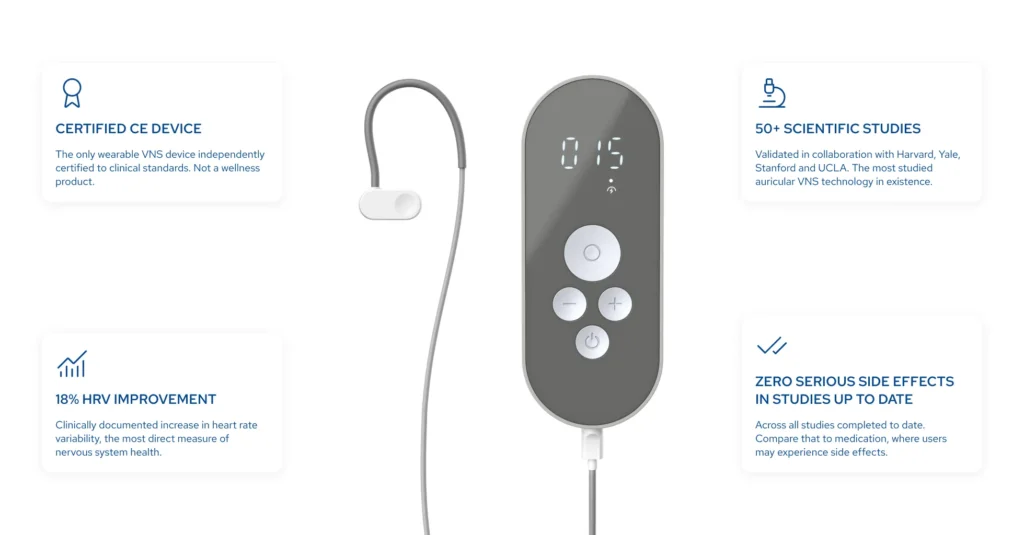
Nurosym is backed by 60+ completed independent scientific studies, conducted with Harvard, UCLA, Yale, UCL, King’s College London, the Mayo Clinic, and over 150 research institutions. Placebo-controlled designs. Replicated across multiple groups. €10M+ invested in scientific research over more than a decade.
No other wearable VNS device comes close. That’s not marketing. It’s a factual gap.

It Reaches the Vagus Nerve Where Nothing Else Can
The ear tragus – that small cartilage flap at the entrance to the ear canal – is the only point on the body where the vagus nerve reaches the skin surface. Before Nurosym, most of my clients had never heard of their tragus. Now they all know exactly where it is.
Nurosym targets precisely this location. The signal travels directly to the brainstem without passing through layers of muscle and tissue. That’s why the ear matters – and why neck-based devices work less reliably.

My Clients with Irritable Gut Noticed It First
I work with gut issues daily – leaky gut, SIBO, food intolerances, irritable gut, bloating that no elimination diet had fully resolved. The gut-brain connection is central to my practice.
What I didn’t fully appreciate before Nurosym was how directly vagal tone governs digestive function. When the vagus nerve is impaired, the gut stops receiving clear signals – and the result is exactly what my clients describe: unpredictable digestion, bloating, reflux, discomfort after meals that seems to have no pattern.
Studies show 80% improvement in gastrointestinal symptoms and 78% reduction in inflammatory markers in studied populations. Individual results may vary.
The client from the opening? Her digestion improved before her sleep did. She hadn’t expected that. Neither had I – until I understood the mechanism.

It Doesn’t Ask Anything From a System That’s Already Exhausted
Breathwork requires focus. Meditation requires a quiet mind – which is precisely what’s gone. Journaling requires energy that’s already depleted.
Nurosym doesn’t ask for any of it. Sessions run 15 to 30 minutes, worn on the ear. No gel, no app, no subscription. Clients use it while reading, having dinner, or lying in bed. You put it on. It does its job. You take it off.
I’ve seen genuinely effective interventions abandoned because the daily friction was too high. Nurosym is the first device I’ve recommended where consistency hasn’t been the obstacle.

The Numbers Across Multiple Systems Are Hard to Ignore
From peer-reviewed studies in specific study populations. Figures reflect relative change compared to placebo or baseline. Individual results may vary.
- -35% reduction in anxious thoughts
- -48% reduction in tiredness
- +30% improvement in sleep quality
- +18% improvement in HRV
- -78% reduction in inflammatory markers (IL-6)
- +80% improvement in GI symptoms
What strikes me scientifically is the breadth. Multiple systems improving simultaneously through a single intervention. That’s what happens when you address the regulatory mechanism – not each symptom individually.

I’ve Seen It Work for Very Different People
The obvious candidates are clients who are chronically overloaded – the kind of person who can’t remember the last time they felt genuinely calm.
An executive who told me his recovery scores hadn’t moved in six months despite doing everything right. An athlete who was always one session away from burnout. The mechanism was the same for all of them.
Same device. Same mechanism. Very different starting points – and consistent results across all of them.

Setup Is Easier Than I Expected – and That Matters More Than You’d Think
- Apply a small amount of moisture to the left ear tragus
- Clip the device on, cable behind the ear
- Turn it on and gradually increase intensity until there's a gentle tingling - mild, not uncomfortable
Most clients have it running within 60 seconds.

Results Follow a Predictable Pattern
Most clients notice a subtle settling in the first week. By week two to three, that shift carries into the rest of the day.
Studies show measurable improvements in anxious thoughts and tiredness within 5 to 14 days. Sleep deepens by week three to four. The baseline – not just the surface – shifts over six weeks to three months of consistent daily use.

The Price Felt High. Then I Did the Maths.
At €700, Nurosym is a considered purchase. I won’t pretend otherwise.
But most clients who end up with it have already spent considerably more – supplements, therapy, sleep aids, wellness apps, elimination diet consultations – without shifting the underlying pattern. A one-time device with no subscription, no refills, no gel, and no ongoing cost often works out as better value than the stack it replaces.
A €70 research rebate is currently available, bringing the effective cost to ~€630. The 30-day money-back guarantee removes the financial risk. If there’s no shift in the first month, return it.
Final Thoughts
If you’d told me five years ago that a small ear-worn device would become a regular part of how I support clients with gut problems, racing thoughts, and stress – I’d have been dismissive.
The research moved me first. What I’ve observed in clients has kept me there.
The most consistent thing I hear after a few weeks: “I stopped waking up already braced.” Sometimes: “My stomach finally feels like it’s working with me, not against me.”
That’s not a small thing. That’s the nervous system – and the gut that reports to it – remembering what regulated feels like.
I just wish I’d found it sooner. And recommended it sooner.
References
- Zheng S, et al. Transcutaneous auricular vagus nerve stimulation reduces anxious thoughts. Brain Stimulation. 2024.
- Geng D, et al. The effect of taVNS on HRV in healthy young people. PLOS ONE. 2022. https://pubmed.ncbi.nlm.nih.gov/35143576/
- Dolcini J, et al. Effects of taVNS on sleep quality: RCT. 2025.
- Tarn J, et al. The Effects of Noninvasive VNS on Tiredness. Neuromodulation. 2022. https://pubmed.ncbi.nlm.nih.gov/37032583/
- Bremner JD, et al. Application of Noninvasive VNS to Stress-Related Psychiatric Disorders. Journal of Personalized Medicine. 2020. https://www.ncbi.nlm.nih.gov/pmc/articles/PMC7563188/
- Breit S, et al. Vagus Nerve as Modulator of the Brain-Gut Axis. Frontiers in Psychiatry. 2018. https://doi.org/10.3389/fpsyt.2018.00044
- Kaniusas E, et al. Current Directions in Auricular VNS: A Physiological Perspective. Frontiers in Neuroscience. 2019. https://doi.org/10.3389/fnins.2019.00854
This article reflects my professional evaluation of the evidence and scientific experience. I may receive a referral arrangement from purchases made through links in this article. I only recommend products I’ve examined in detail and would stand behind scientifically. This is not medical advice – always consult a qualified health professional before starting any new intervention. Individual results may vary.



 English
  German
  French
  Spanish
  Swedish
  Italian