✓ Paid partnership
Why more sleep, weekends off and “doing everything right” can still leave you running on empty, and what your nervous system may have to do with it.
Some of the most burned-out people I see are also the ones who look the least burned out.
They sleep eight hours. Take weekends off. Eat well. Some have tried therapy, meditation, breathwork, supplements and stricter sleep routines. Many have even been to their GP, had blood work done and been told everything looks normal.
Yet I keep hearing versions of the same question:
“I’m doing everything right. Why do I still feel exhausted?”
These aren’t necessarily people who have stopped functioning. They’re going to work. Hitting deadlines. Picking up the kids. Answering messages. Making dinner. From the outside, they’re coping.
Coping and recovering are not the same thing.
That distinction points to what I think is one of the most overlooked pieces of managing burnout.
Burnout Doesn’t Always Look Like Someone Falling Apart
I’m a Functional Medicine Practitioner specialising in gut health, stress, sleep and longevity at Star Freud Wellness Clinic in London. With more than a decade in practice and around 15,000 clients globally, I’ve seen this pattern take many forms.
Sometimes burnout is obvious. Other times, it’s the person who still remembers the birthday. Still joins the 9am meeting. Still gets through the school run. They look capable. However, they just don’t feel like themselves any more.
I hear words like: “I just don’t care about things the way I used to.” “Wired but tired.” “I’m exhausted even after sleeping.” “I can’t properly switch off.” “I’m functioning, but that’s about it.” “I feel guilty because technically everything is fine.”
That last one matters. Because when you’ve already tried to rest, sleep better and “take care of yourself”, continuing to feel depleted can start to feel like a personal failure.
It isn’t a rare conversation either. Deloitte reported that 63% of UK working adults surveyed in 2023 had experienced at least one characteristic of burnout, compared with 51% in 2021.¹
The First Sign Usually Isn’t Tiredness
Tiredness is what people notice. In my experience, it often isn’t where burnout starts.
The World Health Organization describes burnout as an occupational phenomenon, not a medical condition, with three parts: feeling drained or exhausted, feeling mentally distant from or cynical about your work, and feeling less effective at it.² Exhaustion is one of the three, not the whole picture.
What I often see first is a drop in motivation. It tends to start in people who care a lot and work hard. Something disappoints them, and their drive falls. Because they’re driven, they respond by working harder to make up for it.
That’s the trap. Working harder doesn’t bring motivation back. Effort and motivation stop moving together. People pull back from friends, sport and hobbies to make more time for work. Frustration and cynicism grow. Only later does the deep tiredness arrive, along with trouble concentrating and remembering.
There’s no single agreed definition, and every person is different, so this is what I see in practice, not a rulebook. However, it may help explain why someone can feel “not even that tired” and still be burning out, and why extra sleep doesn’t always reach it.
It also changes what recovery means. In my experience, advanced burnout isn’t undone by a two-week holiday. It can take months, and in some cases I’ve seen, even years, to work through.
That leaves two groups of people. Some are noticing the early signs: motivation slipping, working harder to compensate. Others have been running on empty for a long time. I think the nervous-system side is worth understanding for both, as one layer of support, not a shortcut for either.
Which brings me to the question I think is more useful.
Resting vs. Recovering: The Difference That Often Gets Overlooked
Rest matters. Sleep matters. Taking time away from work matters.
Resting and recovering, however, aren’t necessarily the same physiological process.
You can close the laptop. Cancel the meeting. Spend Sunday on the sofa. Sleep eight hours. You’ve removed some of the demand. That doesn’t necessarily tell us everything about how effectively your body is shifting from a state of alertness towards recovery.
That’s why, with people who describe this pattern, I don’t only think about: “Are you resting enough?”
I also think about: “What is helping your body shift into recovery when you finally do rest?”
That is the piece I believe gets overlooked in many conversations about burnout. It leads us somewhere many people don’t think to look: the autonomic nervous system.
Why Managing Burnout Can Start Feeling Like Another Job
Here’s the irony. When someone is already overwhelmed, we often give them more things to do.
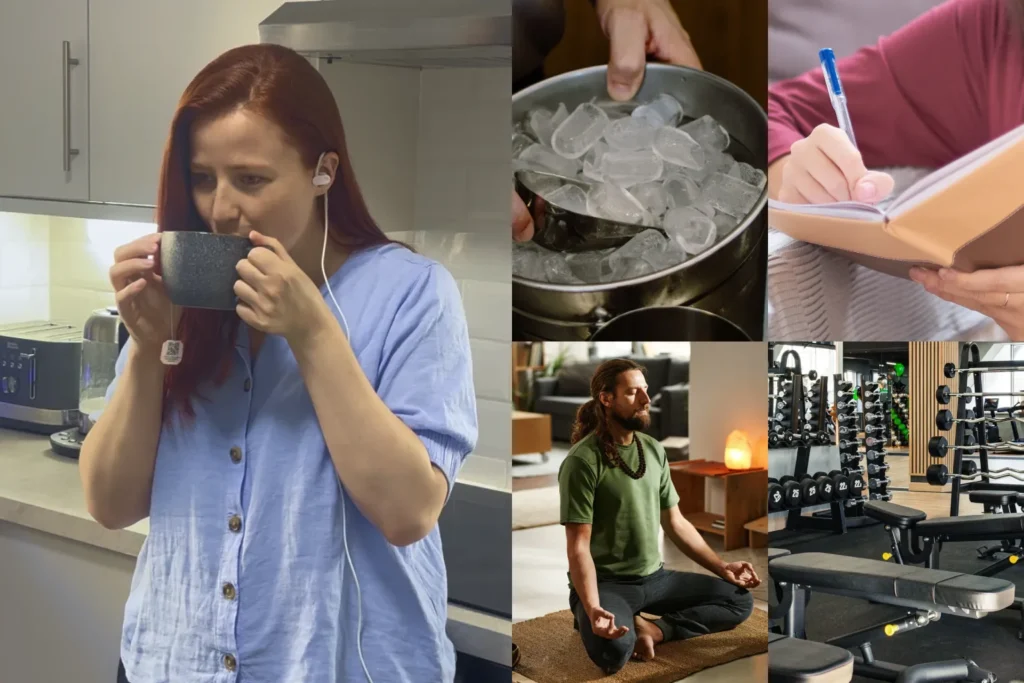
Meditate. Journal. Exercise. Stretch. Practise breathwork. Take a cold shower. Improve your sleep routine. Download another mindfulness app.
I want to be clear: these methods can absolutely be useful. Meditation and breathing exercises can support relaxation and autonomic regulation. Therapy can help us change how we respond to stress and address what is creating it. Movement, sleep, nutrition and genuine time away from pressure are foundational. I use and recommend many of these approaches myself.
The problem is often not whether they can work. It’s whether an exhausted person can do them consistently.
Meditation usually asks you to create some space and direct your attention. Breathwork is easier when you’re not sitting in the middle of an open-plan office. Cold exposure requires preparation and motivation. Exercise and stretching need time. Therapy requires appointments and active participation.
None of that makes these approaches bad. It simply means that recovery can accidentally become another item on an already impossible to-do list.
I see the same pattern in what helps. Adding activities you don’t enjoy only lengthens the list. What tends to work better is choosing things that give something back, such as a sport you like or a project you care about, and celebrating small milestones along the way instead of waiting for the finish line.
I’ve also seen what happens next. You miss two days. Then four. Then the routine disappears. Now the thing that was supposed to reduce stress has given you one more reason to think: “I’m not doing this properly either.”
That made one practical question particularly interesting to me: could we support the physiological side of recovery without turning it into another task someone has to perform perfectly?
The Nervous System Part of Burnout Most People Never Think About
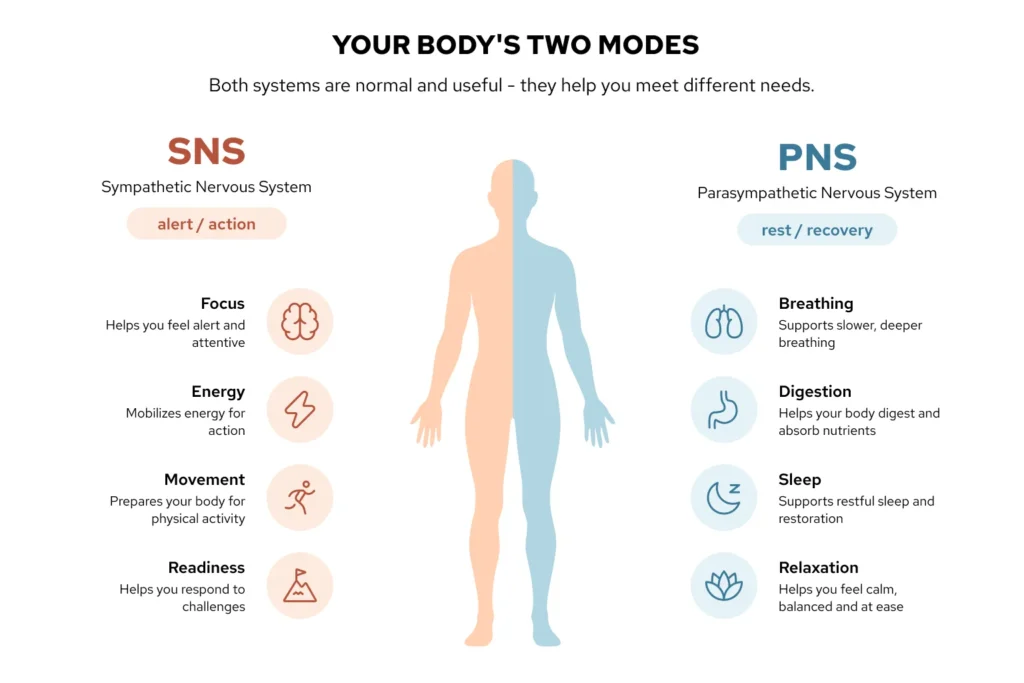
Your autonomic nervous system (ANS) manages many processes that happen without conscious effort. Two of its main branches are:
Sympathetic nervous system (SNS), involved in alertness and mobilisation during stress.
Parasympathetic nervous system (PNS), involved in rest, digestion and recovery.
Neither is the enemy. You need both. The goal isn’t to eliminate stress or stay “parasympathetic” all day. It’s flexibility: being able to respond when life demands it and shift back towards recovery when the demand passes.
One pathway I pay particular attention to in that process is the vagus nerve.
Why the Vagus Nerve Became Part of the Conversation
The vagus nerve, cranial nerve X, is the longest cranial nerve, travelling from the brainstem and communicating with areas throughout the neck, chest and abdomen. It plays an important role in parasympathetic regulation.
It is also one of the main communication routes between the gut and the brain, and most of its fibres carry information from the body up to the brain rather than the other way round. That’s one reason it has always mattered in my gut-health work: digestion, stress and recovery are more connected than many people realise.
Research has also linked measures associated with vagal and autonomic activity to stress regulation and recovery.³
The vagus nerve itself wasn’t some new discovery for me. What caught my attention was a much more practical development.
Traditionally, VNS (Vagus Nerve Stimulation) was associated with surgically implanted devices. Researchers later developed non-invasive approaches that target auricular branches of the vagus nerve accessible through the outer ear. This is known as taVNS (Transcutaneous Auricular Vagus Nerve Stimulation).
That raised exactly the question I’d been interested in: could you engage a pathway involved in autonomic regulation without asking someone to meditate harder, breathe perfectly or find another free hour in their day?
That’s when I started looking more closely at one particular approach.
The 30-Minute Routine I Tried Before Recommending It
I’m naturally sceptical of wellness devices. There are too many products promising to “reset” this, “hack” that or transform your health overnight.
What interested me was the combination of four things: a specific physiological target, a non-invasive approach, a growing body of research behind it, and a routine simple enough to fit into normal life.
Before recommending it to clients, I tried it myself, initially around sleep disruption and digestive discomfort. I found the sessions deeply relaxing, and the experience consistent enough that I began recommending it selectively where supporting autonomic regulation made sense as part of a broader approach.
The device is called Nurosym.
What Nurosym Actually Does
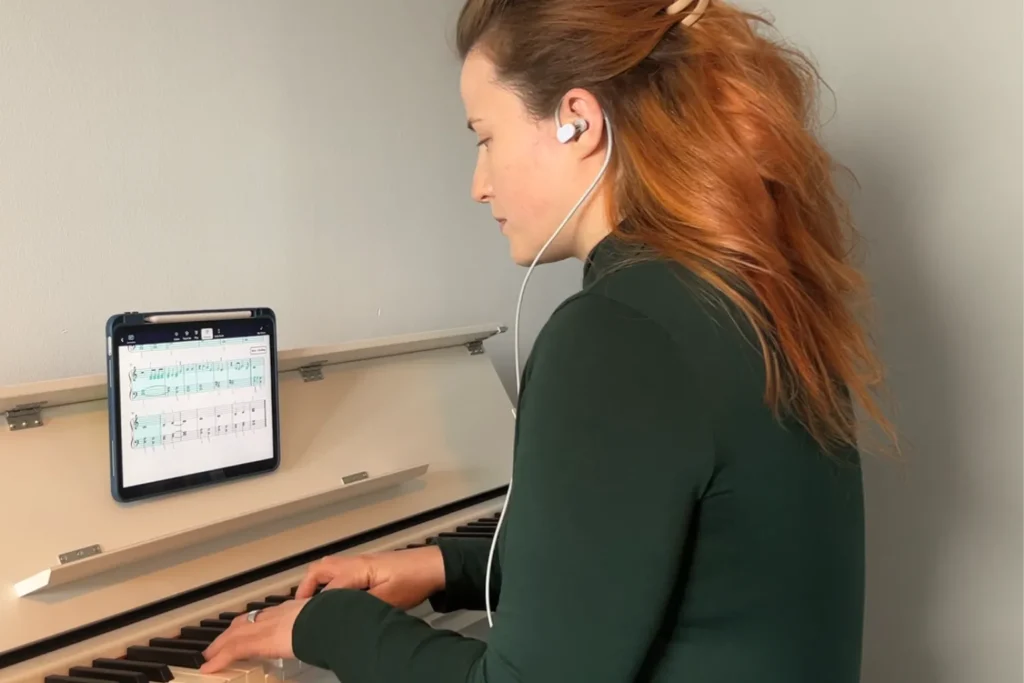
Nurosym is a CE-marked non-invasive neuromodulation wearable device developed by Parasym. It belongs to the category of taVNS devices and targets an auricular branch of the vagus nerve through the tragus of the left ear. It uses Parasym’s proprietary AVNT™ (Auricular Vagal Neuromodulation Technology).
That distinction matters because this isn’t simply another relaxation app or behavioural exercise. It’s a wearable neuromodulation approach designed to interact with a specific neural pathway.
This was another reason I paid attention: Nurosym isn’t built around a single wellness claim. It has been investigated across 60+ scientific studies and involves 150+ research partners.
That’s a very different proposition from “I saw a vagus nerve gadget on social media.”
What the Research Says About Tiredness, HRV and Sleep
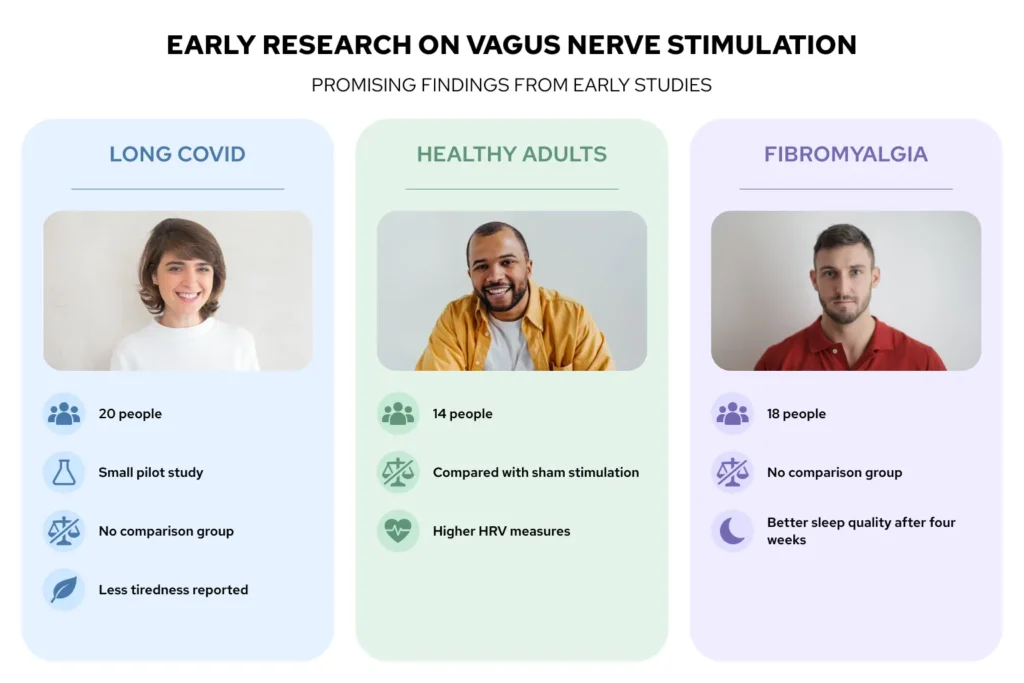
The research is broader than burnout itself, so this distinction is important: I wouldn’t take a result from one study population and promise the same outcome to every burned-out person. However, several areas are relevant to the pattern I see in practice.
Research on ear-based vagus nerve stimulation (taVNS), including Parasym’s AVNT™ technology which Nurosym uses, is still early but growing. In a lab study of 14 healthy young adults, a short stimulation session increased measures of heart rate variability compared with a sham (placebo) stimulation.⁴ HRV describes variation in the time between heartbeats and is commonly used as one marker of autonomic regulation. In two small pilot studies without a comparison group, people with postviral fatigue reported less tiredness after a short course of stimulation⁵, and people with widespread pain using AVNT™ reported better sleep quality after four weeks.⁶ Without a comparison group, we can’t yet tell how much of that change came from the device itself, and larger controlled trials are still needed.
That nuance is important to me. Promising research should make us interested, not careless.
Why I Don’t See Nurosym as a Replacement for the Basics
Nurosym doesn’t make an unsustainable job sustainable. It doesn’t replace sleep. It doesn’t replace therapy. It doesn’t replace movement, good nutrition, boundaries or changing the parts of your life that are genuinely driving constant stress.
I wouldn’t trust a device that claimed it did.
I see it differently: as a support tool that can sit alongside those things. The real advantage isn’t that it asks you to abandon what already works. It’s that it doesn’t necessarily require you to carve another wellness appointment into your day.
The Part That Makes It Easier to Stay Consistent
This is where Nurosym became particularly relevant to the people I work with.
You clip the wired earpiece onto the tragus of your left ear, switch the device on and adjust the intensity until you feel a light, comfortable tingling sensation. That’s essentially the setup.
No phone app. No gel. No quiet room. No technique to master. You don’t necessarily have to stop your day to use it.
You can wear it while eating lunch, reading, working at your desk, preparing food, folding laundry, doing the dishes, watching television, meditating, or simply sitting down.
Sessions typically run 15 to 60 minutes, with 30 to 60 minutes recommended for daily use. That is why I think of it as a 30-minute routine rather than another 30-minute task. The time doesn’t necessarily have to be added to your day. It can sit inside the time you’re already using.
When someone is already exhausted, that difference matters.
What it involves | Nurosym Routine | Other Active Practices |
Works as a complementary support | Yes | Yes |
Time | Integrates into daily activities | Often needs dedicated time |
Quiet environment required | No | Certain practices |
Technique required | No | Usually |
App required | No | Sometimes |
Phone pairing required | No | Sometimes |
Frequency | Daily (30–60 min sessions) | Varies |
How I Think About It in Practice
I wasn’t looking for an overnight personality transformation. That’s not how I think about recovery.
What interested me was a routine that fits around real life, instead of becoming another task on an exhausted person’s list. What matters to me isn’t turning someone into a different person. It’s making supportive habits easier to build into daily life.
Could This Apply to You?
Whether you’re noticing the first signs or have been running on empty for a long time, you may recognise this pattern if:
- Things you used to care about matter less, and you're working harder to make up for it
- You take time off but don't return feeling properly rested
- You're still performing at work, but everything takes more effort
- Your tests have come back normal while you still know something feels off
- You've tried meditation, breathwork, supplements or stricter routines but struggle to stay consistent
- You've pulled back from friends, sport or hobbies to make more time for work
- You feel "wired but tired": exhausted, but still unable to properly switch off
- You're tired of recovery itself feeling like another project to manage
None of those signs means that the vagus nerve is “the cause” of your burnout. However, they can be a reason to look at recovery more broadly than simply asking whether you’re getting enough rest.
If you haven’t already, speak to your GP to rule out other causes of ongoing tiredness, and if low mood or hopelessness is part of the picture, please seek mental health support.
A Low-Friction Way to Explore Nervous System Support
If you’re interested in adding a nervous-system support tool to what you’re already doing, either at the first signs or alongside professional support if you’re already deep in it, Nurosym has a few practical advantages:
Pros:
- CE-marked non-invasive neuromodulation wearable
- 60+ scientific studies
- 150+ research partners
- Recommended by 1,000+ healthcare professionals (Nurosym data)
- No prescription required
- No mobile app or conductive gel
- Sessions from 15–60 minutes
- Can be used during many ordinary daily activities
- 30-day money-back guarantee
Things to consider:
- Cost: Nurosym is an investment, so it's worth weighing against your budget (the 30-day money-back guarantee can help here)
- Results aren't immediate, and some people may need several weeks of regular use
- Individual responses vary, and it may not work for everyone
- The evidence is promising, but much of it comes from small studies in specific groups, not from large trials in people with burnout
- Not suitable for everyone (see the safety information below)
Advanced burnout can take months, sometimes years, to work through, so I’d never present anything as a shortcut. I would think of Nurosym as one possible layer of support, not a substitute for addressing sleep, workload, relationships, nutrition, mental health or whatever else may be contributing to the bigger picture.
Who should not use Nurosym: do not use it if you are pregnant, have had surgery to cut the vagus nerve, have been diagnosed with a severe low resting heart rate, or have a permanent metallic or electronic device, or jewellery, close to the tragus. If you have severe coronary disease or have had a heart attack in the last five years, speak to a healthcare professional first. Children should only use it with a parent or guardian supervising sessions. I’d also ask you to speak to your GP first if you have a pacemaker or any other implanted device. This isn’t the full list, so please see the Nurosym FAQ and always consult a qualified healthcare professional before starting.
Sometimes It’s Rest. Sometimes It’s Something Else
After years of working with stress, gut issues and the knock-on effects of demanding modern lives, one distinction keeps coming back: sometimes the answer genuinely is more sleep, therapy, or changing the job, relationship or schedule that’s keeping you under constant pressure.
Sometimes it’s worth looking at the physiological systems involved in how your body moves between stress and recovery. Not because you need another thing to do, but because the best support for an exhausted person may be something that doesn’t make recovery feel like more work.
For me, that’s why Nurosym earned a place in the conversation.
EXCLUSIVE OFFER FOR OUR READERS: Get 5% Off Nurosym From Our Editorial Team!
References
- Deloitte UK. Mental health and employers: The case for employers to invest in supporting working parents and a mentally healthy workplace. May 2024. https://blogs.deloitte.co.uk/health/2024/05/mental-health-and-employers-the-business-case-to-support-employees-and-in-particular-working-parents.html
- World Health Organization. Burn-out an “occupational phenomenon”: International Classification of Diseases. 28 May 2019. https://www.who.int/news/item/28-05-2019-burn-out-an-occupational-phenomenon-international-classification-of-diseases
- Thayer JF, et al. A meta-analysis of heart rate variability and neuroimaging studies: implications for heart rate variability as a marker of stress and health. Neuroscience and Biobehavioral Reviews. 2012. https://doi.org/10.1016/j.neubiorev.2011.11.009
- Geng D, Liu X, Wang Y, Wang J. The effect of transcutaneous auricular vagus nerve stimulation on HRV in healthy young people. PLoS ONE. 2022;17(2):e0263833. https://doi.org/10.1371/journal.pone.0263833
- Verbanck P, Clarinval AM, Burton F, Corazza F, Nagant C, Cheron G. Transcutaneous auricular vagus nerve stimulation (tVNS) can reverse the manifestations of the Long-COVID syndrome: a pilot study. Advances in Neurology and Neuroscience Research. 2021;2:100011. https://doi.org/10.51956/ANNR.100011
- Dolcini G, Favretti M, Franculli D, et al. Vagal nerve stimulation and fibromyalgia: an additional therapeutic option. Clinical and Experimental Rheumatology. 2025;43(6):1095-1104. PMID: 40576705. https://doi.org/10.55563/clinexprheumatol/johqvo
This article reflects my professional evaluation of the evidence and my experience in practice. It is published in partnership with Nurosym. I may receive compensation from purchases made through links in this article. This is not medical advice. Always consult a qualified health professional before starting any new intervention. Individual results may vary.

 English
 German
 French
 Spanish
 Swedish
 Italian