
I want to start with something a little uncomfortable to admit.
I’m an osteopath. Fifteen-plus years in practice, thousands of clients treated, everything from ACL reconstructions to persistent pain that’s been running for years. I’m also a BJJ Blue Belt, training several times a week. And I’m a dad, which means most evenings, whatever’s going on in my own body gets parked behind bedtime, dishes and whatever’s left of the day.
All three of those things are relevant to what follows.
I’ve written before about a pattern I call The Pain Loop, pain that settles somewhere, eases, then reappears somewhere else entirely. I explain it to clientss most weeks. What I hadn’t fully admitted was that I’d been living inside my own version of it for months.
That’s what led me to try Nurosym for 30 days, tracking what actually changed, not what I expected to change.
Here’s what happened.
Where I Was Before I Started: Pain That Wouldn’t Stay in One Place
I’ve trained Brazilian Jiu Jitsu for several years, alongside triathlon, weight training and years of rugby before that. It’s given me a first-hand understanding of injury no textbook fully covers, and a fairly long list of my own things to recover from.
Over the past year specifically: a rotator cuff strain that never quite resolved. A torn muscle that healed, then a different joint started aching. Shin splints that settled, then resurfaced the moment training intensity went back up.
None of it was severe. That was almost the problem. Nothing bad enough to stop and properly address. Just persistent enough that I was always managing something, and the location kept changing.
I remember one week clearly. Shoulder pain that had been nagging for a fortnight finally settled. Four days later, my lower back flared up out of nowhere, on a week I hadn’t done anything unusual.
That’s the exact pattern I describe to clientss as The Pain Loop. I’d written the explanation. I’d just never fully turned it on myself.
As a dad, what actually bothered me most wasn’t the training impact. It was noticing I was slower getting down onto the floor to play with my daughter than I wanted to be, and slower getting back up.
There was a second layer to this too, separate from the pain itself. Clinic, training and being properly present as a parent in the evenings is, most weeks, three jobs stacked on top of each other. Carrying that without much of a genuine off switch had started to show up as its own kind of tiredness, different from training fatigue, more of a background hum I’d stopped noticing.
What I’d Already Tried for the Pain and Recovery
I wasn’t approaching this casually. I already had a reasonable protocol, because I recommend most of it to clients.
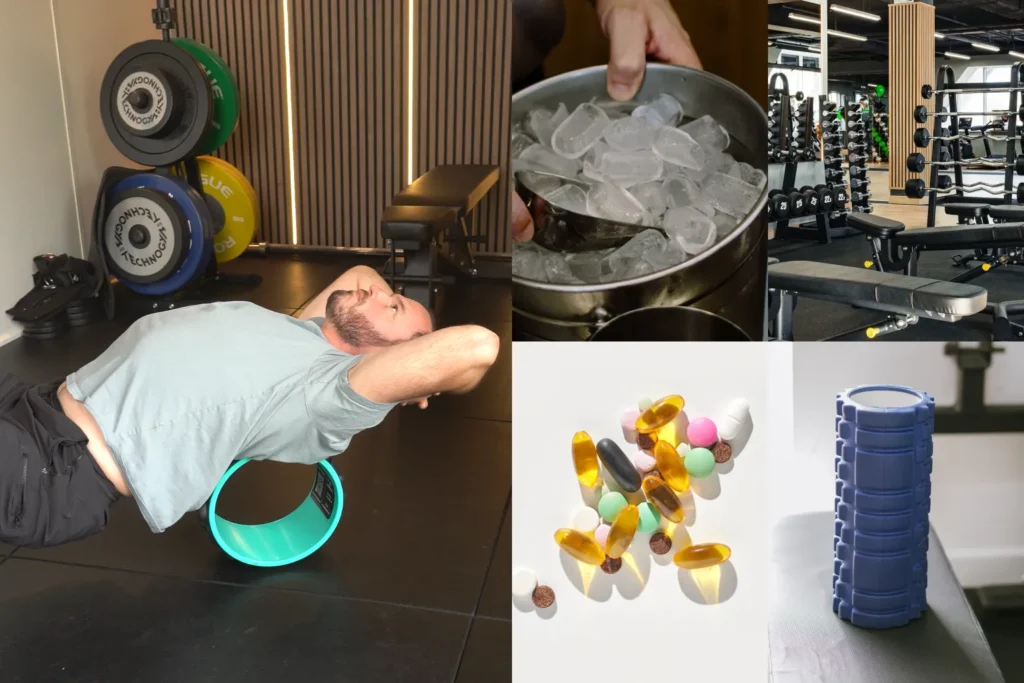
Ice baths after harder sessions. Genuinely useful for acute soreness. But they need ten to fifteen minutes in cold water, a window that doesn’t always exist on an evening that’s already parenting and dishes.
Physio and manual therapy on myself, where I could manage it. Effective for the joint in front of me. Less effective at explaining why the pain kept relocating rather than resolving.
Foam rolling and the massage gun. Real, local relief. Doesn’t touch whatever was driving the pattern underneath.
Rest days. The obvious answer, and the least practical one, given a clinic that runs on a schedule and a training habit I wasn’t willing to give up.
Each of these had genuine value. None of them addressed the pattern underneath.
Here’s the mechanism, briefly, and I want to be precise about what’s established versus what’s a working theory. When pain persists beyond normal healing time, changes in central pain processing can make the nervous system more responsive to incoming signals, a process researchers call central sensitisation.¹I think of it, in shorthand, as The Pain Loop. Autonomic regulation, how well the nervous system shifts between alert and recovery states, may be one part of that picture. It’s why the vagus nerve became particularly interesting to me.
Everything I’d tried treated the location. None of it was aimed at that underlying picture.
Why I Was Skeptical, And What Changed That
I’ll be honest about my starting position on this. As an osteopath, I’m trained to be wary of anything that sounds like a shortcut.
My first real exposure to vagus nerve stimulation was surgical, an implanted device used for treatment-resistant depressive states. Interesting mechanism. Completely irrelevant to an osteopath dealing with a shifting shoulder problem.
What changed my mind was going through the research properly, not the marketing around it.
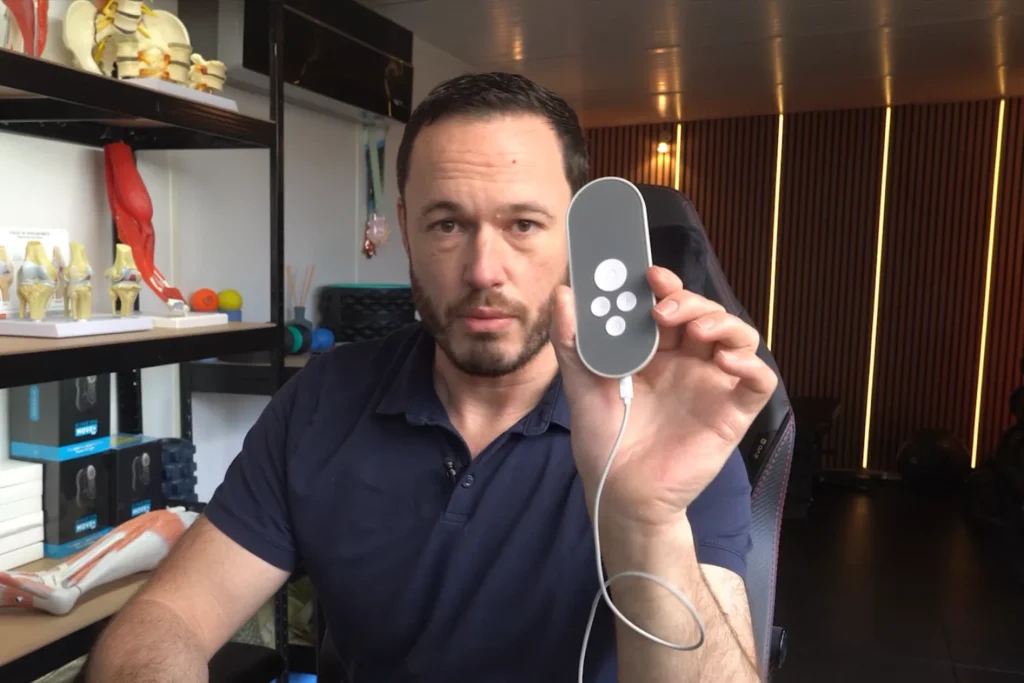
Nurosym is a taVNS (Transcutaneous Auricular Vagus Nerve Stimulation) device, using AVNT™ (Auricular Vagal Neuromodulation Technology) to deliver a calibrated signal through the tragus, the small piece of cartilage at the entrance to the ear canal, directly to the auricular branch of the vagus nerve. It’s the only place that nerve reaches the surface of the body without surgery.
Peer-reviewed studies. Placebo-controlled. Conducted with institutions I recognize, including UCL and King’s College London.A 2024 systematic review found evidence of reductions in persistent pain², while separate research suggests taVNS may influence descending pain modulation⁵, one of the pathways involved in how persistent pain signals are regulated.
I went into the 30 days the way I’d want a client approaching a new rehab tool: genuinely curious, not expecting a single dramatic session to fix a pattern that had been building for a year.
Days 1 to 4: First Impressions
The device is smaller than I expected, clips to the outer ear, wired to a small control unit. No app, no gel, no real setup beyond finding a comfortable intensity.
First session, a light tingling on the tragus, noticeable but not unpleasant. I spent most of that session working out the settings rather than paying attention to anything else.
Days one and two, nothing I’d call a shift. I used it during my morning coffee, and kept my expectations low. I know how nervous system regulation actually works, gradually, through repetition, not through one good session.
By day four, I’d more or less stopped noticing the sensation itself. It had quietly become part of the coffee, not a separate task competing with it.
Days 8 to 14: The First Real Shift in Pain and Muscle Recovery
Around day ten, the shoulder that had been nagging on and off for weeks stopped nagging. Not dramatically better, just quiet. I noticed it because I went to check it, out of habit, and there was nothing there to check.
Then on day twelve, something more specific. I finished a harder training session and did my usual mental scan for what was about to flare up next.
Nothing did.
That’s a small thing. It’s also exactly the kind of detail that’s too minor to talk yourself into believing, which is why it stuck with me.
The pain hadn’t relocated anywhere. It had just settled, the way an acute injury is supposed to settle, rather than migrating the way it had been doing for months.
Something else shifted in that same window, away from training entirely. Evenings with my daughter, bath, book, bed, started feeling less like the last task of a long day. There’d been a low-grade impatience creeping in by 7pm most nights that I hadn’t really noticed until it eased off.
Days 15 to 30: A Bad Week, Family Stress, and What Held
I want to be honest about week three, because it wasn’t smooth.
My daughter caught something at school, sleep dropped to five broken hours a night for four straight days, and I trained twice anyway, which in hindsight wasn’t the smartest call.
By the old pattern, that combination would usually surface something new within days, a joint, a strain, some fresh location for the Loop to settle into.
It didn’t fully hold. I felt worn down, and I’m not going to pretend otherwise. But nothing new flared. The general soreness I’d expect from a rough week showed up and cleared within days, in the place it started, rather than relocating and lingering the way it usually did.
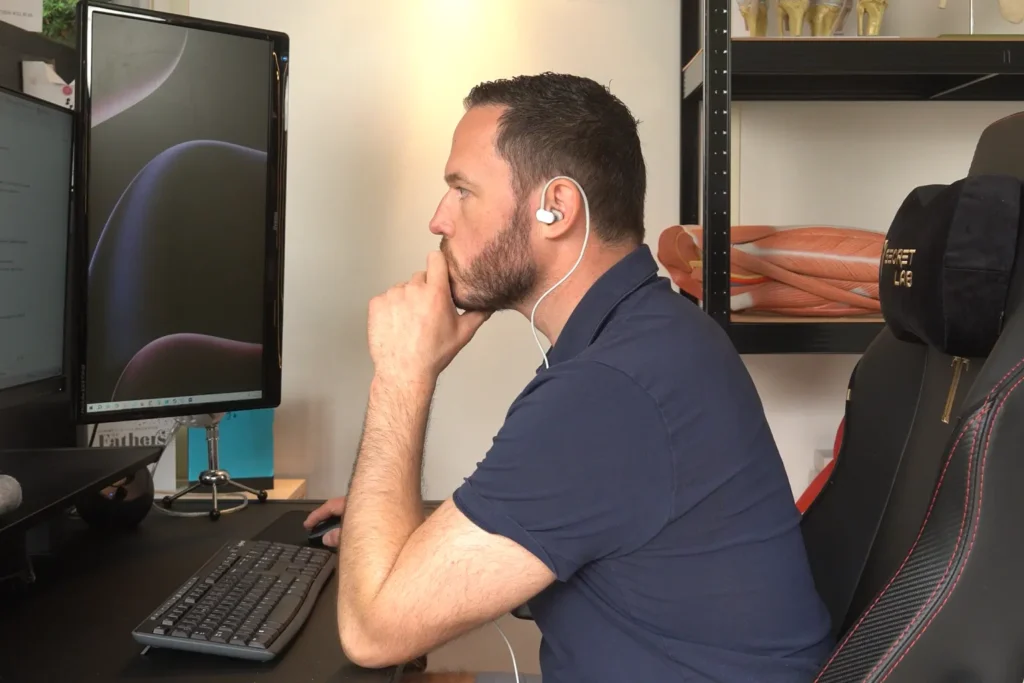
By day 25, I’d added a second short session most evenings, fifteen minutes after training or while going through the day’s notes. It stopped being an addition to the day and became a fixture inside it.
Day 30: What Changed, And What Didn’t
What didn’t change: it isn’t a substitute for training load management or proper rehab of an actual injury. On the week my daughter was ill and my sleep collapsed, I still felt worn down. This isn’t a way around a genuinely hard week.
What did change:
- The migrating pattern largely stopped. Pain that showed up stayed where it started and settled in days, rather than relocating
- The shoulder that had nagged on and off for months went quiet and hadn't returned by day 30
- Recovery after harder BJJ sessions was noticeably faster
- I stopped doing the mental scan for what was about to flare up next
- I was quicker getting down to the floor with my daughter, and quicker back up
- Evenings with my daughter had less of that 7pm edge
None of this was one dramatic session. It built, the way I’d expect anything working at the level of the nervous system to build.
The Bonus I Wasn’t Expecting: What My HRV Showed
I track my HRV (Heart Rate Variability, a measure of how well the autonomic nervous system is recovering) closely, and I hadn’t planned to make it part of this review. But the data lined up with what I was feeling closely enough that it’s worth including.
Before starting, my HRV had been sitting lower than my training and sleep should have produced, the kind of gap I usually flag in athletes as a sign the nervous system isn’t fully completing its recovery cycle, even when everything else on paper looks fine.
By the end of the 30 days, it had trended upward, including through the rough week my daughter was ill, recovering faster afterwards than my usual pattern. I can’t say Nurosym caused that change, or separate it cleanly from everything else happening that month: sleep, training load, the season. But the HRV trend moved in the same direction as what I was noticing subjectively, which made it worth tracking and worth including here.
How the Vagus Nerve and Inflammation Connect: The Short Version
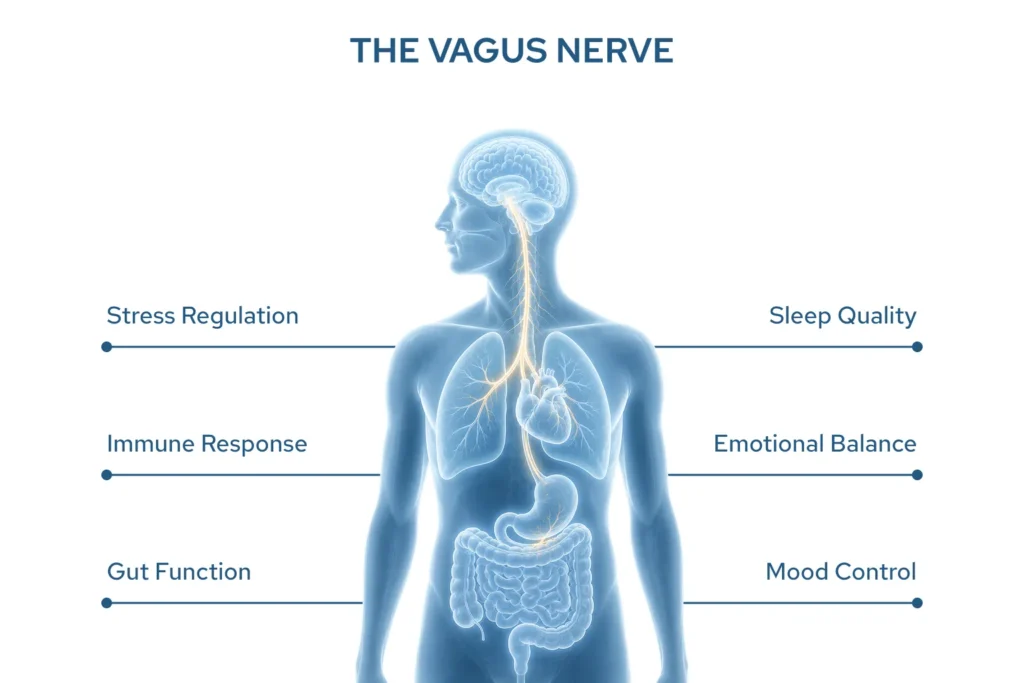
Your nervous system has two primary modes. The sympathetic nervous system (SNS) drives alertness and the body’s stress response. The parasympathetic nervous system (PNS) supports rest, recovery and processes involved in regulating pain.
The vagus nerve (cranial nerve X), the longest nerve in the body, running from the brainstem through the neck, chest and abdomen, is the primary carrier of parasympathetic signals. Vagal tone (how effectively this nerve is functioning) is thought to play a role in this shift between alert and recovery states, and researchers are actively investigating its relationship to descending pain modulation, the brain’s own system for regulating how strongly pain signals register.
There’s a second mechanism worth knowing. The vagus nerve also runs the cholinergic anti-inflammatory pathway, telling immune cells to moderate production of inflammatory markers like IL-6. Training creates a healthy spike in inflammation; recovery depends on that spike clearing efficiently. Reduced vagal activity has been associated with altered inflammatory regulation in some studies, which is one reason researchers are investigating the vagus nerve’s role in recovery and persistent pain more broadly.
taVNS reaches the vagus nerve through its auricular branch, the only place it surfaces at the outer ear without surgery. Nurosym delivers a calibrated electrical signal to this branch using proprietary AVNT™ (Auricular Vagal Neuromodulation Technology).
The broader taVNS field has been studied across 60+ peer-reviewed studies involving 150+ internationally recognized institutions, including UCL, UCLA and King’s College London.
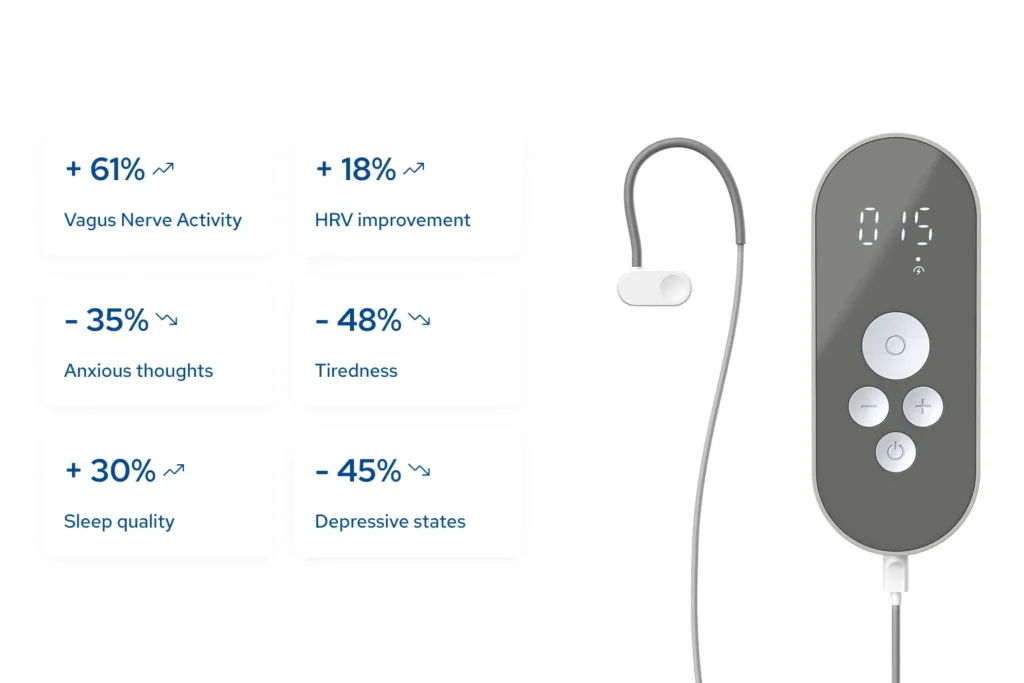
Results from peer-reviewed studies in specific study populations. Figures reflect relative change compared to placebo or baseline. Individual results may vary.
What Using It Actually Looks Like Day to Day
Cost: approximately €700. Guarantee: 30-day money-back, no questions asked. Setup: Clips to the outer ear. No app. No gel. No prescription. Wired, not wireless. Sessions: 15 to 30 minutes. I use it during morning coffee, after evening training, or while going through clinic notes. Battery: Over a month per charge.
You can use it while:
- Reviewing client notes or admin
- Ironing shirts for the week
- Washing up after dinner
- Reading with your daughter before bed
- Eating breakfast
- Sitting in the car as a passenger on the drive home from training
The whole appeal, practically, is that it doesn’t ask for a separate window. It sits inside a day that’s already full, not next to it.
Pros and Cons
✅ Pros:
- Safety data across 60+ published studies report no serious adverse events to date when used as directed.⁶
- Trusted by 1,000+ licensed healthcare professionals
- No app, no gel, no prescription
- Fits into an existing routine, no dedicated time required
- Adjustable intensity
- 30-day money-back guarantee
❌ Cons:
- Roughly €700 upfront
- Builds gradually, no instant changes
- Wired, not wireless
- Online purchase only
- Won't undo a genuinely rough week on its own
Who This Is For: Athletes, Parents and Anyone Whose Pain Keeps Relocating
Worth exploring if:
- Your pain moves, one joint settles and another flares, without an obvious new injury each time
- You've had specific areas treated individually, physio, massage, rest, with relief that never quite holds
- You train hard and recover more slowly than you used to, without a clear reason why
- Your HRV sits lower than your training and sleep would suggest
- You're stretched across work, training and family, with limited genuine downtime
- You want something that works inside your existing routine rather than asking you to build a new one
Skip it if you’re looking for instant changes, or a substitute for proper rehab of an acute injury. This works alongside those things, at the level underneath them, not instead of them.
Do not use if you have a pacemaker or implantable cardiac device, are pregnant, have had a recent serious cardiac event, or are under 18. Always consult a healthcare professional before starting.
My Honest Take
I went into this the way I’d want a client to go into any new intervention: cautiously, and paying attention to what actually happened rather than the story I wanted to tell myself.
What I found wasn’t a transformation. It was the pattern I’d been explaining to clients for years, finally interrupted in my own body. Pain that used to relocate started simply settling and clearing instead.
The clearest marker, for me, wasn’t the good weeks. It was the one bad week. A rough patch that would normally hand me a new injury to managedidn’t. That’s the kind of change that’s hard to fake yourself into believing, and hard to argue with once you’ve tracked it against a proper bad week.
I’ve spent years telling clients that the location of the pain is rarely where the problem actually is. Thirty days in, I finally applied that to myself, not just the people sitting across from me in clinic.
References:
- Volcheck MM, Graham SM, Fleming KC, Mohabbat AB, Luedtke CA. Central sensitization, persistent pain, and other symptoms: Better understanding, better management. Cleveland Clinic Journal of Medicine. 2023;90(4):245-254. https://doi.org/10.3949/ccjm.90a.22019
- Costa V, et al. Transcutaneous vagus nerve stimulation effects on persistent pain: systematic review and meta-analysis. PAIN Reports. 2024;9(5):e1171. https://doi.org/10.1097/PR9.0000000000001171
- Zhang J, et al. The role of transcutaneous auricular vagus nerve stimulation in persistent pain: from neurobiological mechanisms to clinical applications. Frontiers in Pain Research. 2026. https://doi.org/10.3389/fpain.2026.1733445
- Geng D, et al. The effect of taVNS on HRV in healthy young people. PLoS ONE. 2022. https://doi.org/10.1371/journal.pone.0263833
- Pacheco-Barrios K, et al. Transauricular vagus nerve stimulation enhances conditioned pain modulation in healthy subjects. Brain Stimulation. 2024;17(2):346-348. https://doi.org/10.1016/j.brs.2024.03.006
- Redgrave J, et al. Safety and tolerability of transcutaneous vagus nerve stimulation in humans: a systematic review. Brain Stimulation. 2018;11(6):1225-1238. https://doi.org/10.1016/j.brs.2018.08.010
- Dolcini J, et al. Effects of taVNS on sleep quality and widespread pain: Randomised controlled trial. Peer-reviewed clinical data, Parasym Ltd. 2025.
- Dasari TW, et al. Effects of transcutaneous vagus nerve stimulation on inflammatory markers. Peer-reviewed clinical data. 2023.
- Verbanck P, et al. Effects of taVNS on tiredness and fatigue scores. Peer-reviewed clinical data. 2021.
This article reflects my professional evaluation of the evidence and my own personal experience over 30 days. This article is published in partnership with Nurosym. I may receive compensation from purchases made through links in this article. I only recommend approaches I have examined carefully and would stand behind with my own clients. This is not medical advice, always consult a qualified healthcare professional before starting any new intervention. Individual results may vary.


 English
  German
  French
  Spanish
  Swedish